Demurrage vs detention becomes expensive when an importer tracks only the vessel arrival and misses the clocks that start after the container reaches destination.
If your container is already at the terminal, do not start by asking, “How much is demurrage per day?” Start with three questions:
Where is the container now? Which free-time clock has expired? What event will stop the charge?
In a common split system, demurrage usually concerns a carrier container that remains inside a terminal, port or depot beyond free time. Detention usually concerns carrier equipment that has left the terminal but has not been returned within the allowed equipment time. Storage generally relates to occupying space at a terminal, CFS, rail ramp, depot, yard or warehouse.
Those definitions are useful, but they are not one universal tariff. Carriers can use split or combined demurrage and detention, terminals may bill storage separately, and start/stop events vary by location and contract.
For an importer, the safest rule is simple:
Use the live booking, carrier tariff, terminal record and container timeline for the actual shipment—not a generic free-day number copied from a blog.
If you first need the wider ocean-freight picture, read our sea freight from China guide.
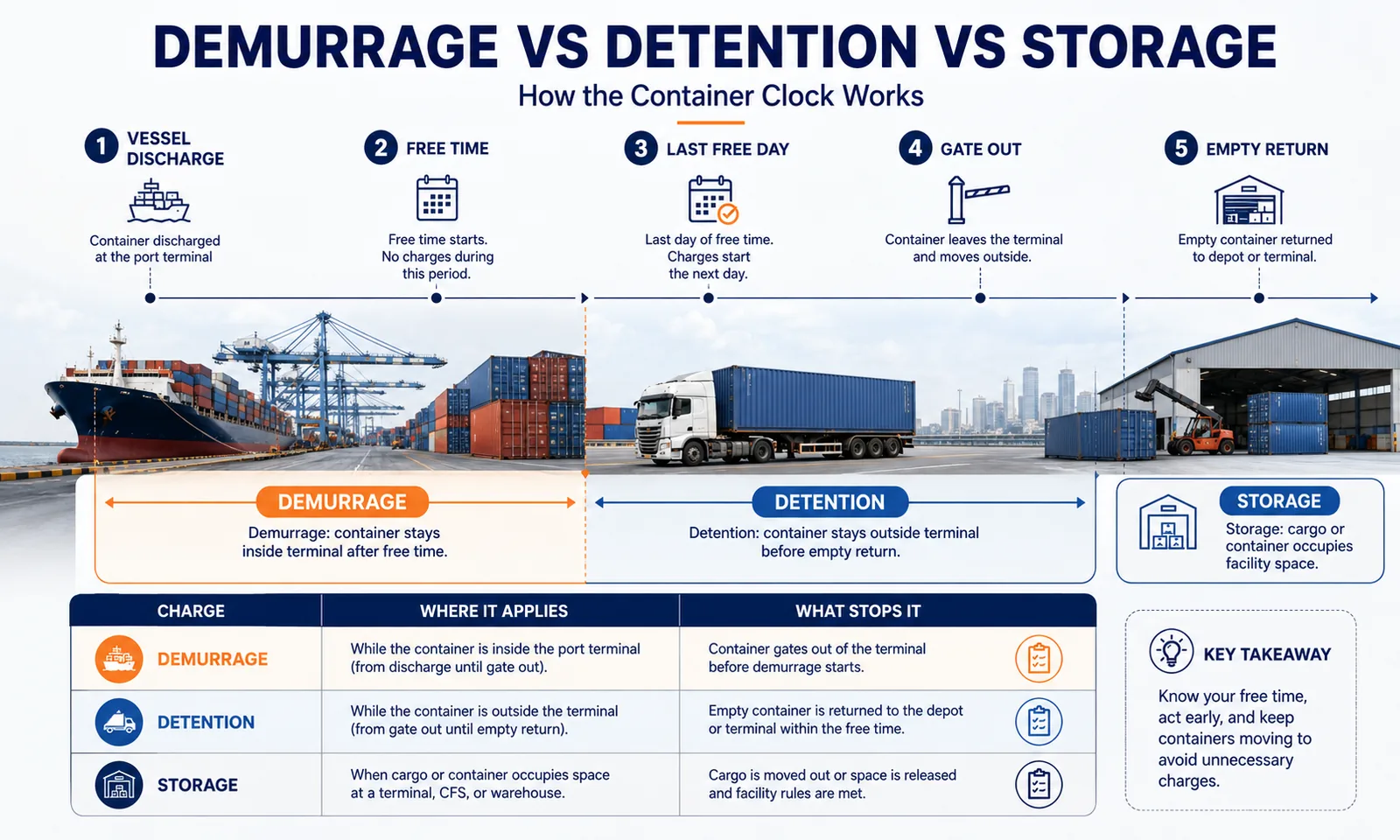
Demurrage vs Detention vs Storage: Quick Answer
| Charge | Where Does It Usually Apply? | What Usually Triggers It? | What Usually Stops It? |
|---|---|---|---|
| Demurrage | Full carrier container remains inside a terminal, port or depot | Applicable import free time expires before gate-out | Full container gates out, subject to the actual tariff |
| Detention | Carrier container remains outside the terminal | Equipment free time expires after pickup | Empty container returns to the approved location |
| Storage | Terminal, CFS, rail ramp, depot, yard or warehouse | Cargo or equipment occupies facility space beyond the allowed period | Cargo or container leaves the facility |
Important: This table shows a common split D&D model. Some carriers use combined D&D, while some terminals bill storage separately.
If Your Container Is at the Terminal, Check These 7 Things Now
When free time is close to expiring, an operational checklist is more useful than another definition.
- Cargo availability: Is the box actually available for pickup?
- Last Free Day: What LFD is shown in the carrier or terminal system?
- Customs release: Is the shipment clear, or is an exam/hold active?
- Carrier release: Are bill of lading and destination-charge issues complete?
- Pickup appointment: Can the trucker get a slot before LFD?
- Warehouse receiving: Can the consignee unload when the box arrives?
- Empty return: Where must the empty go, and when is it due?
Do not wait until LFD to discover the warehouse has no appointment or the empty-return depot changed.
If pickup before LFD looks impossible, ask the trucker whether a pre-pull is practical. Pre-pull creates extra drayage, chassis and yard costs, so it is not automatically cheaper. But in some cases it can prevent a larger terminal bill.
For destination unloading options, see our container devanning guide.
Free Time and Last Free Day: The Two Dates Importers Must Know
Free time is the period during which the applicable demurrage, detention or storage charge does not accrue.
It is not a universal number.
Free time can change according to:
- Shipping line and terminal
- Destination country
- Container and equipment type
- Import or export movement
- Merchant or carrier haulage
- Service contract
- Calendar-day or working-day rules
- Temporary operational disruptions
That is why “we normally get five days” is not enough for a real shipment.
What Is Last Free Day?
The Last Free Day (LFD) is the final day within the applicable free-time period before the next charge begins.
Vessel ETA and LFD are not the same thing.
Before pickup, the shipment may still need vessel discharge, terminal availability, customs release, carrier release, destination-charge payment and a truck appointment. A container can arrive on schedule while the usable pickup window becomes much shorter.
Split vs Combined Demurrage and Detention
Under a split system, one allowance applies inside the terminal and another can apply after gate-out.
Under combined D&D, the carrier may use one overall allowance covering equipment time inside and outside the terminal.
Before arranging delivery, ask:
Is this shipment split or combined, and what exact event starts and stops each clock?
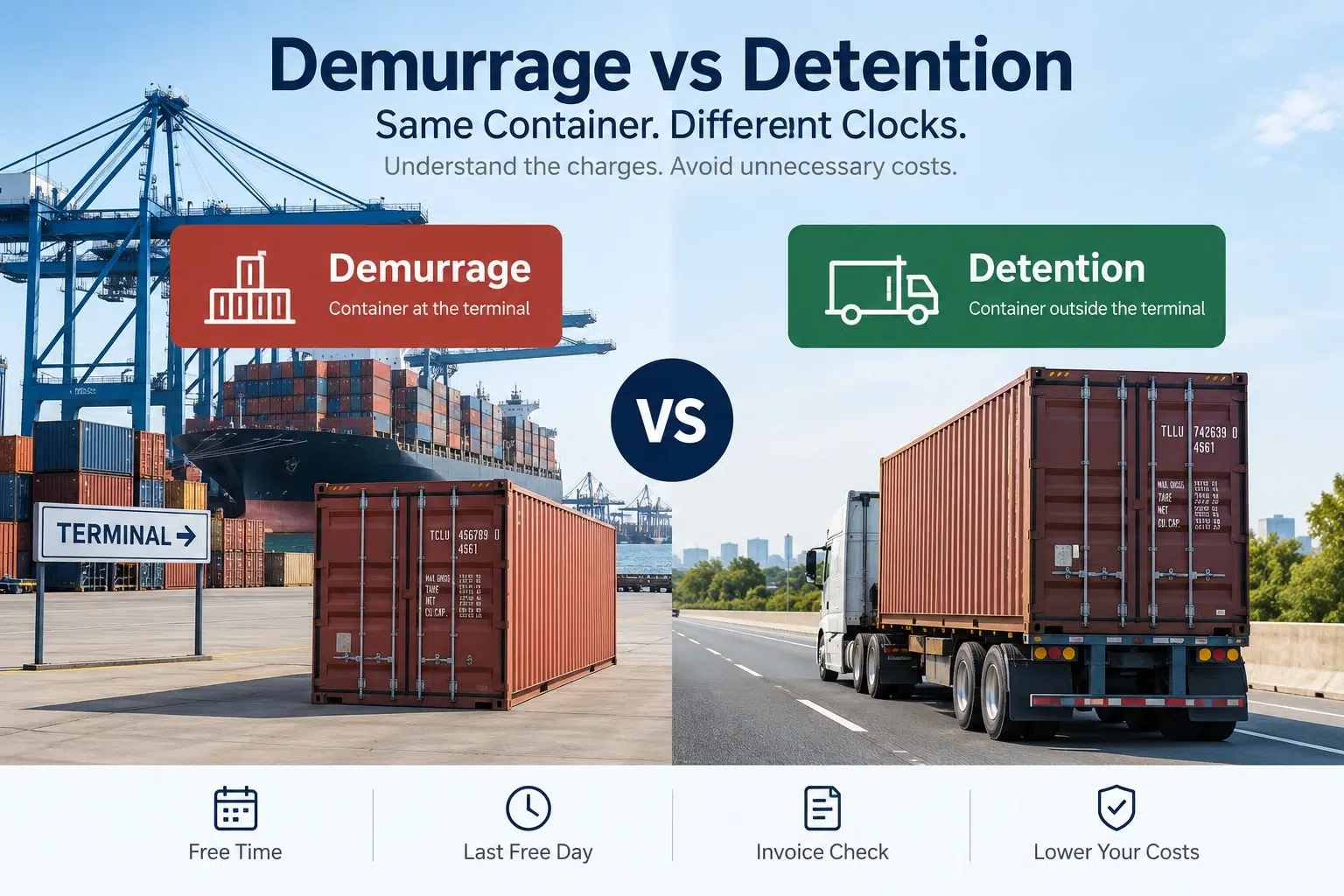
Demurrage, Detention and Storage in Real Operations
What Is Demurrage?
Demurrage generally concerns a full carrier container that stays inside a terminal, port or depot beyond the applicable free time.
Common causes include:
- Customs clearance or examination
- Incomplete bill of lading release
- Unpaid destination charges
- Missing permits or documents
- No terminal appointment
- Chassis or drayage shortages
- Warehouse receiving delays
- Weekends, holidays or port closures
A customs delay does not mean customs itself charged demurrage. Customs can create the delay while a commercial carrier or terminal clock continues.
What Is Detention?
Detention generally concerns carrier equipment that remains outside the terminal beyond the equipment free time.
The risk begins after pickup if the container is not unloaded and returned quickly enough.
Container Detention Charges: Common Causes
Container detention charges can arise when:
- The warehouse unloads too slowly.
- A live-unload appointment is delayed.
- A drop container sits too long.
- The empty-return depot changes.
- The nominated depot has no appointment.
- A weekend or holiday interrupts the return.
In a typical split model:
Inside terminal → demurrage risk
Outside terminal → detention risk
Is Detention the Same as Per Diem?
Not always.
In North American logistics, per diem is often used for daily equipment-use charges, but contracts and invoices may use the terms differently.
If an invoice says “per diem,” check the equipment, free-time period, chargeable dates and tariff instead of assuming it means exactly the same thing as detention.
What Is Port or CFS Storage?
Storage usually concerns the use of facility space after an allowed period.
It can apply at a terminal, CFS, rail ramp, depot, yard or warehouse.
Storage may be billed separately from demurrage, included within another local structure or appear as CFS/warehouse storage for LCL cargo.
One Container Timeline: Where the Charges Change
A simple import timeline explains more than a long list of definitions.
Stage 1 — Discharge and availability: The vessel arrives, the container is discharged and the terminal makes it available. Customs, commercial release and trucking should already be moving.
Stage 2 — LFD approaches: The container is available, but perhaps the trucker or warehouse cannot receive it. This is where small delays become expensive.
Stage 3 — Gate-out: The full container leaves the terminal. Under a common split structure, demurrage risk may end here.
Stage 4 — Delivery and unloading: The container reaches the consignee. Slow unloading can consume equipment free time.
Stage 5 — Empty return: The trucker returns the empty to the approved location. Under a typical split detention structure, this stops the detention clock.
This is why “the container left the port” does not mean the cost risk is over.
How Are Demurrage and Detention Charges Calculated?
There is no reliable global daily rate.
The actual amount comes from the carrier, terminal or contracted tariff.
A basic formula is:
Chargeable Days × Applicable Daily Tariff = D&D Charge
Rates can increase in tiers.
For example, if the actual shipment tariff says free time ends on Day 5 and the container gates out on Day 9, Days 6–9 may become four chargeable days. If the tariff has escalating tiers, each group of days must use the correct rate.
This is only a calculation example. It does not mean every shipment receives five free days.
Rates can differ by container size, dry/reefer equipment, special equipment, destination, number of chargeable days and service contract.
For a wider landed-cost view including drayage, chassis and pre-pull, see our container shipping cost from China to USA guide.
Does DDP Mean the Seller Must Pay Demurrage and Detention?
This is one of the most useful questions for importers because the invoice name can be misleading.
DDP describes responsibility between buyer and seller under the sales agreement. The carrier’s billing relationship is a separate operational question.
The party named on a D&D invoice and the party that ultimately bears the cost under the sales contract are not always the same question.
A real example appeared in a May 2026 r/CustomsBroker discussion. An importer said the purchase was DDP to its plant and the supplier arranged ocean and inland freight, yet the shipping line invoiced the consignee for demurrage and detention.
Source: Reddit — DDP Terms and Detention Fees.
This is an anecdotal importer discussion, not legal authority.
If this happens to you, check:
- The purchase contract and named DDP place
- The bill of lading and carrier relationship
- Who controlled pickup and empty return
- Who caused the delay
- What the freight quotation says about conditional costs
Do not assume that receiving the invoice automatically means you must ultimately absorb the cost. But do not ignore it either. If the amount is significant, ask the seller, forwarder, broker or legal adviser to review the contract structure.
Customs Exams: Ask for the Cost Basis, Not Just the Total
Customs examinations can consume free time and create several types of cost at once.
A useful question is:
What exactly was charged, by whom, for which dates and under which service or tariff?
In a February 2026 Reddit discussion, a first-time U.S. importer said a Los Angeles container was selected for customs examination and the forwarder billed exam-related charges plus demurrage. The importer’s biggest concern was not simply the amount; it was the lack of a clear breakdown.
Source: Reddit — Customs Exam Charges from Freight Forwarder.
That discussion does not prove the charges were right or wrong.
For your own shipment, ask for:
- Exam type and dates
- Container availability and hold/release dates
- Demurrage chargeable dates
- Carrier or terminal basis
- Drayage to/from an exam site
- Exam-site or bonded-facility storage
- Forwarder handling shown clearly where applicable
A transparent explanation helps the importer evaluate a legitimate charge and spot a possible mistake.
U.S. D&D Rules: What Changed in 2026?
For U.S. ocean shipments, the Federal Maritime Commission provides the most useful official framework.
The FMC defines detention as charges for extended use of intermodal equipment and demurrage as charges that accrue when a container exceeds free time on a marine terminal.
FMC data show that nine major ocean carriers collected roughly USD 15.4 billion in detention and demurrage between April 1, 2020 and March 31, 2025.
Official reference: Federal Maritime Commission — Detention and Demurrage.
Invoice Timing and Dispute Window
Under the FMC billing framework, vessel-operating common carriers and marine terminal operators generally must issue D&D invoices within 30 calendar days after charges were last incurred. NVOCC timing generally runs from the underlying D&D invoice it receives.
Billed parties also receive at least 30 calendar days to submit a timely mitigation, refund or waiver request.
Because court decisions have affected part of the rule dealing with who may be billed, check current FMC guidance if your dispute depends on invoice-party eligibility.
Official reference: FMC — Detention and Demurrage Billing Practices.
July 2026: Port Closure and Detention Fees
On July 8, 2026, the D.C. Circuit upheld an FMC decision involving detention charges assessed during a three-day port closure when the trucker had no practical ability to return the container and chassis.
The court supported the FMC’s view that D&D charges should promote freight fluidity rather than operate only as a penalty when earlier equipment return was not realistically possible.
Official reference: FMC — U.S. Court of Appeals Upholds Detention Decision, July 2026.
For an importer, the practical lesson is simple:
If you genuinely had no practical opportunity to pick up or return equipment, preserve the evidence.
That does not mean every closure or appointment problem creates an automatic waiver. It means the facts matter.
2026 Disruptions Show Why Free Time Must Be Checked Live
The Strait of Hormuz disruption produced another useful example.
During defined disruption periods in 2026, Maersk introduced temporary detention and free-time measures for specific cargo at locations including Salalah, Jeddah and Jebel Ali. Some affected scenarios received total free-time allowances extended to 15 days, while other shipments remained under standard or contracted terms or could purchase extensions.
Official reference: Maersk — Temporary Line Detention Solutions, June 2026.
These were temporary measures, not permanent global rules.
That is exactly why importers should check the current shipment rather than reuse a free-time number from a previous booking.
Do LCL Shipments Have Demurrage and Detention?
LCL follows a different destination process from FCL.
With FCL, one importer usually receives the full carrier container and is directly involved in gate-out and empty return.
With LCL sea freight, the destination CFS normally unloads the shared container and separates shipments. The individual consignee usually does not take the carrier’s complete container to its own warehouse.
As a result, LCL importers more often see:
- CFS or warehouse storage
- Deconsolidation
- Destination handling
- Documentation/release fees
- Late cargo pickup charges
- Final local delivery
Underlying container delay costs can still affect the consolidation, but the consignee’s invoice looks different from a normal FCL detention case.
For more detail, see our LCL sea freight from China guide.
How to Audit a Demurrage or Detention Invoice
Do not start with the total amount. Rebuild the timeline.
1. Confirm the Shipment
Check container number, B/L number, port/terminal, equipment type and direction.
2. Rebuild the Dates
Collect:
- Discharge and cargo availability
- Customs hold/release
- Carrier release
- Last Free Day
- Appointment attempts
- Gate-out
- Warehouse delivery
- Empty return
3. Check the Tariff
Confirm:
- Actual free-time allowance
- Calendar or working days
- Split or combined D&D
- Daily rate tiers
- Equipment type
- Separate storage
- Any negotiated service-contract terms
4. Save Evidence Before It Disappears
Save appointment screenshots, carrier emails, terminal messages and return records while the event is happening.
Maersk’s current U.S. dispute instructions are a good example. For certain pickup-appointment disputes, Maersk asks for time-stamped screenshots showing no appointments were available during the relevant period. For certain empty-return disputes, it also asks for time-stamped evidence and proof that an alternate return location was requested.
Official reference: Maersk — United States Import Demurrage and Detention.
The broader lesson applies even if your carrier is different:
Evidence saved at the time of the problem is much stronger than saying months later, “There were no appointments.”
How Can Importers Reduce Demurrage, Detention and Storage?
The best time to reduce D&D is before the clock becomes critical.
Before Vessel Arrival
- Send documents to the customs broker early.
- Confirm bill-of-lading release requirements.
- Track the live ETA and cargo availability.
- Check expected free time and LFD.
- Arrange trucking and chassis early.
- Reserve the receiving appointment.
Before Gate-Out
- Confirm customs and carrier release.
- Verify the terminal appointment.
- Confirm the warehouse can unload.
- Confirm the empty-return location and deadline.
After Gate-Out
- Unload promptly.
- Track the equipment deadline.
- Monitor depot changes.
- Keep gate-out and empty-return records.
How VoltFreight Helps Reduce Avoidable Container Delay Costs
Demurrage and detention are destination costs, but many preventable problems begin before the cargo leaves China.
For suitable ocean shipments, VoltFreight can coordinate:
- Supplier pickup and China warehouse receiving
- FCL/LCL route planning
- Export and shipping-document coordination
- Carrier or NVOCC communication
- Arrival tracking
- Customs-broker coordination under the agreed scope
- Destination release follow-up
- Port-to-door and warehouse delivery planning
- Container pickup scheduling
- Exception communication when timing changes
Our approach is straightforward:
If a cost can be prevented by better planning, we want to identify the risk before it becomes an invoice.
And if an unexpected charge appears, the customer should be able to understand why it happened, which dates were charged, who issued it and what evidence supports it.
We cannot guarantee that a container will never incur demurrage or detention. Customs exams, congestion, terminal closures and consignee delays can still happen.
But preventable surprises and unclear cost explanations should not be the normal way to manage a container shipment.
For broader service details, review our ocean freight services from China or contact VoltFreight with your shipment information.
FAQ About Demurrage vs Detention
What is the main difference between demurrage and detention?
In a common split structure, demurrage concerns a carrier container inside the terminal beyond free time. Detention concerns carrier equipment outside the terminal too long before empty return. The actual tariff controls the final calculation.
Is storage the same as demurrage?
Not always. Storage generally concerns occupying terminal, CFS, rail, depot or warehouse space. It may be billed separately or included within another local charge structure.
Who pays demurrage and detention?
Responsibility depends on the transport contract, sales term, carrier relationship, local rules and cause of delay. The party that receives the invoice is not always automatically the party that ultimately bears the cost under the sales agreement.
Does DDP include demurrage and detention?
Do not assume so. DDP allocates responsibilities between buyer and seller, but conditional costs should be addressed in the actual contract or quotation.
Does a customs delay stop demurrage?
Not automatically. A customs hold can prevent pickup while the commercial free-time clock continues. Whether a charge can be disputed depends on the facts, tariff and applicable rules.
When does detention end?
Under a common split model, detention generally ends when the empty carrier container is returned to an approved location under the carrier’s rules.
What does Last Free Day mean?
LFD is the final day within the applicable free-time period before the next relevant charge starts.
How many free days do containers normally have?
There is no universal number. Free time varies by carrier, terminal, equipment, contract, location and temporary operating conditions.
What is demurrage vs per diem?
Demurrage usually concerns container time inside a terminal. Per diem is often used for daily equipment-use charges outside the terminal, but terminology varies. Check the actual invoice and tariff.
Can I dispute demurrage if the terminal had no appointments?
Possibly, depending on the facts and applicable rules. Preserve time-stamped appointment screenshots, carrier messages and terminal records.
Can a freight forwarder guarantee no demurrage?
No responsible forwarder should guarantee that. Good planning can reduce avoidable D&D, but external events can still affect a shipment.
Conclusion: Follow the Container, Not Just the Vocabulary
The simplest way to understand demurrage vs detention is to follow the container.
Under a common split structure:
Demurrage concerns extra time while the full carrier container remains inside the terminal.
Detention concerns extra equipment time after gate-out and before empty return.
Storage concerns the use of terminal, CFS, rail, depot, yard or warehouse space.
For an importer, the most important dates are usually cargo availability, Last Free Day, customs release, gate-out and empty return.
If a charge appears, reconstruct those dates before arguing about the invoice.
If the shipment is still in transit, use those dates to prevent the charge before it starts.
Need help planning an FCL or LCL shipment from China? Send VoltFreight your supplier location, cargo details, container or CBM information, destination port and final delivery address through our contact page.
Important: This article provides general freight-planning information, not legal advice or a carrier tariff. Free time, demurrage, detention, storage, invoice requirements and dispute rights vary by carrier, terminal, country, contract and shipment. Always check the current terms for the actual container.