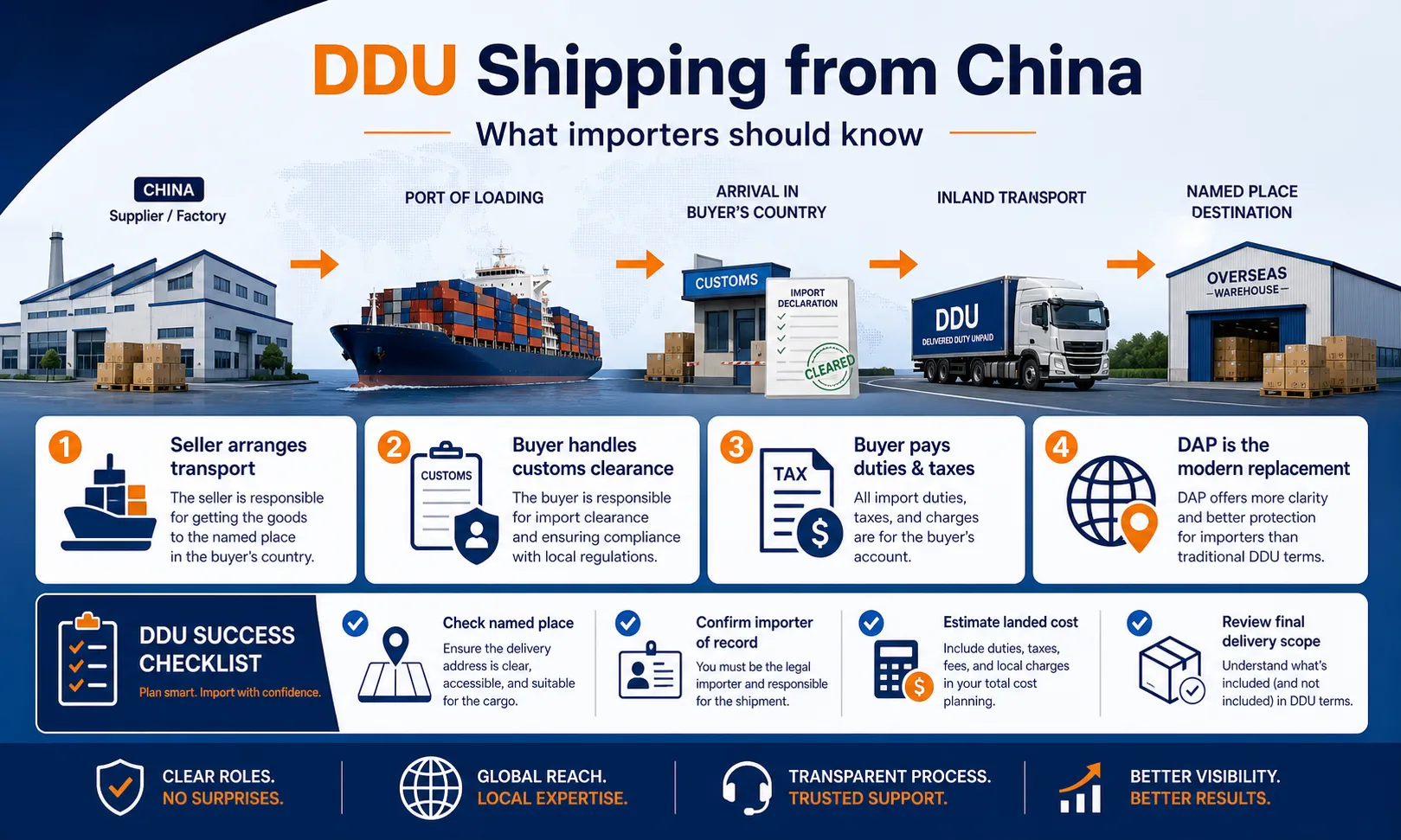
DDU shipping from China usually means the seller arranges transportation to a named destination, while the buyer handles import customs clearance and pays import duties, taxes and any excluded destination charges.
However, DDU is no longer a current Incoterms rule. In new contracts, DAP, Delivered at Place, is normally the closest replacement. If customs clearance, duties, taxes and final delivery are included under an agreed scope, the quote may be closer to DDP.
Before accepting a supplier’s “DDU” price, confirm the named place, transport method, customs responsibility, duties and taxes, unloading requirements and all possible destination charges.
This guide explains DDU shipping from China, how it compares with DAP, DPU and DDP, which costs are commonly excluded and what importers should confirm before booking.
Need help checking a supplier’s DDU, DAP or DDP quote? Send your supplier city, product name, carton quantity, carton dimensions, gross weight, total CBM, destination address and quoted shipping term. Contact VoltFreight to compare DAP, DDP, air freight, sea freight, customs clearance and door-to-door shipping options from China.
Quick Answer: What Does DDU Shipping from China Mean?
DDU means Delivered Duty Unpaid. In practical supplier and freight quotations, it usually means the seller arranges transportation to a named destination, while the buyer handles import customs clearance and pays import duties, import taxes and any destination charges not clearly included.
For a new contract, ask whether the supplier means DAP instead of DDU. If the buyer wants customs clearance, duties, taxes and final delivery included under a confirmed scope, DDP may be the better option to compare.
- Current status: DDU is an older term and is not a current Incoterms 2020 rule.
- Modern replacement: DAP is normally the closest replacement when the buyer handles import clearance and import charges.
- Duty responsibility: The buyer normally pays import duties, VAT, GST or other destination taxes.
- Customs responsibility: The buyer normally acts as, or appoints, the importer and customs broker.
- Main action: Confirm the named place and obtain a written list of all included and excluded charges.
Is DDU Still Valid, and Should You Use DAP Instead?
Why Suppliers Still Use DDU
Many Chinese suppliers still use DDU because it is familiar and widely understood in daily freight conversations. In practice, they may use it to mean “we can deliver the goods near your destination, but you still pay import duties and taxes.”
However, one supplier may use DDU to mean DAP, while another may use it for a custom door-to-door quote that excludes duty, VAT, GST, brokerage, storage, unloading or appointment fees. Therefore, buyers should not rely on the word DDU alone.
Why DDU Is No Longer a Current Incoterm
DDU may still appear in emails and quotations, but it is not a current Incoterms 2020 rule. For formal contracts, purchase orders and shipping agreements, importers should use current wording such as DAP, DPU, DDP, FCA, FOB or CIF when appropriate.
When to Use DAP Instead
For most DDU-style shipments, DAP is the closest modern replacement. Under DAP, the seller delivers the goods to the named place, ready for unloading, while the buyer normally handles import clearance, duties and taxes.
When a supplier says “DDU shipping from China,” ask whether the quote should be written as DAP under Incoterms 2020. Then define the named place clearly and list any excluded customs, storage, unloading, inspection, appointment or redelivery charges.
- Use DAP named place when the seller delivers to a named place but the buyer handles import clearance, duties and taxes.
- Use DPU named place when the seller must also unload the goods at the named place.
- Use DDP named place when duty-paid delivery is clearly agreed and legally workable.
DAP vs DPU: Does the Seller Need to Unload the Goods?
DAP and DPU both involve delivery to a named place, but the unloading responsibility is different.
Under DAP, the seller delivers the goods ready for unloading. The buyer normally handles unloading, import clearance, duties and taxes.
Under DPU, the seller delivers the goods unloaded at the named place. The buyer normally still handles import clearance and import charges unless the contract states otherwise.
This distinction matters for warehouses, job sites, trade shows, Amazon FBA facilities and business addresses. Before booking, confirm:
- Who unloads the vehicle or container
- Whether a liftgate, forklift or crane is required
- Whether appointment delivery is included
- Whether inside delivery or site handling is required
- Whether access restrictions or waiting-time charges apply
DDU vs DDP: Who Pays Import Duties and Taxes?
The biggest difference between DDU-style shipping and DDP shipping is who handles import duties and taxes. Under DDU or DAP, the buyer normally handles import clearance and pays import duties and taxes. Under DDP, the seller takes responsibility for duty-paid delivery under the agreed scope.
DDP may sound easier, but it also needs careful checking. A proper DDP quote should explain customs structure, declared value, HS code, duty/tax handling, product restrictions, excluded charges and final delivery rules. It should not be treated as a tax-free shortcut.
For urgent commercial cargo where the buyer prefers customs coordination, duty handling and final delivery under one reviewed service scope, see our air freight DDP from China service.
| Responsibility | DDU / DAP | DDP |
|---|---|---|
| Export clearance in China | Seller usually handles it | Seller usually handles it |
| International freight | Seller usually arranges freight to the named place | Seller usually arranges freight to the named place |
| Import customs clearance | Buyer usually handles it | Seller or seller’s agent usually handles it |
| Import duties and taxes | Buyer usually pays them | Seller usually pays them under the agreed DDP scope |
| Buyer convenience | Lower if the buyer has no customs setup | Higher if the quote is transparent and cargo is suitable |
| Risk of surprise charges | Higher if destination charges are not estimated | Lower only when all included and excluded charges are clearly listed |
What DDU Shipping Usually Includes and Excludes
A DDU-style quote may cover transportation to a named place, but it normally leaves import clearance, duties, taxes and some destination services outside the quoted price. The exact scope varies, so the seller or forwarder should confirm it in writing.
Services That May Be Included
- China supplier pickup when stated in the quote
- Export packaging and origin handling
- China export customs declaration
- Main carriage by air, sea, rail, truck or multimodal transport
- Transportation to the agreed port, terminal, warehouse or business address
- Shipment tracking and arrival information where available
Charges Commonly Excluded
- Import customs clearance and customs-broker fees
- Import duties, VAT, GST, sales tax or other destination taxes
- Destination terminal, CFS, storage or inspection charges unless listed
- Unloading, liftgate, forklift, crane or inside-delivery services
- Appointment, waiting-time, remote-area or redelivery charges
- Cargo insurance unless separately included
Confirm whether the delivery point is a port, terminal, curbside address, warehouse dock, Amazon facility or inside location. For a wider delivery-scope comparison, review our door-to-door shipping from China service.
Buyer and Seller Responsibilities Under DDU Shipping
Buyer Responsibilities
Under a typical DDU shipping from China arrangement, the buyer should prepare for import-side responsibilities. Many unexpected costs and delays happen because the buyer does not prepare customs clearance before the cargo arrives.
- Confirm who will act as the importer of record.
- Hire or appoint a customs broker if the shipment requires one.
- Prepare import documents, licenses, permits or compliance records if needed.
- Check the HS code, HTS code, TARIC code or local commodity code.
- Estimate import duties, VAT, GST, sales tax or other destination charges.
- Pay import duties, taxes, customs brokerage and destination-side fees.
- Handle customs holds, inspections or document questions.
- Confirm whether the quote covers unloading at the named place.
- Arrange any final-mile delivery that the seller’s quote excludes.
- Prepare warehouse, Amazon FBA, trade show or job site appointment details if required.
For importer preparation and document planning, review our customs clearance support.
Seller Responsibilities
The seller’s responsibilities depend on the quote and contract wording. In a typical DDU-style shipment, the seller arranges export-side work and transportation to the named destination, but the seller does not pay import duties or taxes in the buyer’s country.
- Prepare export packaging suitable for international shipping.
- Arrange pickup or inland transportation in China if the quote includes it.
- Handle export customs clearance in China if included in the agreed scope.
- Arrange the main carriage by air, sea, rail, truck or multimodal transport.
- Provide commercial invoice, packing list, bill of lading, air waybill or other transport documents.
- Deliver the goods according to the agreed named place and delivery scope.
- Inform the buyer which destination charges are excluded.
- Provide shipment tracking and arrival notice where available.
How to Compare DDU, DAP and DDP by Total Landed Cost
A DDU or DAP quote may look cheaper because it excludes import charges. A DDP quote may look higher because more charges are included upfront. Therefore, buyers should compare the complete landed cost instead of only the first freight number.
Total landed cost is especially important for container shipments, Amazon FBA delivery, e-commerce inventory, high-value goods, regulated products and shipments that require customs brokerage or delivery appointments.
Simple Landed Cost Formula
Total landed cost = product cost + China pickup + export handling + international freight + destination charges + customs brokerage + import duty + import taxes + storage or inspection risk + final delivery + cargo insurance if needed.
Before comparing two quotations, confirm the same:
- China pickup point and supplier Incoterm
- Transport method and named destination
- Customs-broker and importer responsibility
- Duty and tax treatment
- Destination handling, storage and inspection exclusions
- Final delivery, unloading and appointment scope
Destination Customs Checks Before Accepting a DDU Quote
DDU shipping from China is used for many destinations, but import rules differ by country and region. Before accepting a quote, confirm the importer setup, customs classification, duty and tax payment, and product compliance requirements for the destination market.
- United States: Check the importer of record, HTS code, duty estimate, customs bond and possible Section 301 or anti-dumping exposure.
- European Union: Check the EORI number, VAT setup, TARIC code, importer record and any CE, WEEE, EPR or product-compliance obligations that apply.
- United Kingdom: Check the GB EORI, VAT treatment, commodity code, importer setup and applicable UKCA or CE requirements.
- Canada: Confirm the importer setup, customs broker, HS code, GST/HST, duty estimate and compliance documents.
- Australia: Confirm importer details, GST, import declaration requirements and any biosecurity or quarantine checks.
- Middle East: Check the importer license, customs broker, HS code, duty or VAT treatment and any required legalized or product-specific documents.
The buyer should complete these checks before the shipment leaves China. Otherwise, customs holds, storage, return or redelivery costs may exceed the apparent saving in the original freight quote.
When DDU or DAP Works—and When It Becomes Risky
When DDU or DAP Can Work Well
DDU or DAP shipping can work well when the buyer has import experience and wants control over customs clearance. It can also suit buyers who already work with a trusted customs broker or need to manage import compliance directly.
- Experienced importers that understand customs clearance and duty estimates
- Buyers with their own customs broker and importer record
- Businesses that want direct control over HS codes, permits and compliance
- Companies with internal customs, tax or logistics teams
- Shipments where the named place and excluded destination charges are clearly defined
When Buyers Should Avoid It
DDU shipping from China creates risk when the buyer does not understand import clearance, duty rates, product restrictions or final delivery requirements. A low DDU quote can become expensive if the buyer does not prepare for customs and destination charges.
- You do not have an importer of record.
- You do not have a customs broker.
- You do not know the HS code, HTS code, TARIC code or duty rate.
- The product may require import licenses, compliance documents or special permits.
- The supplier cannot explain what the DDU quote includes.
- The quote does not clearly name the delivery place.
- The shipment requires Amazon FBA, trade show, job site, liftgate or appointment-based delivery.
- The buyer cannot pay import duties and taxes quickly after arrival.
- The destination warehouse cannot unload the goods.
- The seller does not explain destination storage, inspection or redelivery charges.
Red Flags in a Supplier Quote
A DDU quote does not automatically create a problem. Unclear scope creates the real risk. If your supplier or forwarder cannot explain charges and responsibilities clearly, you may face extra costs after the cargo arrives.
- The quote only says “DDU price” but does not show the named place of delivery.
- The supplier cannot explain whether DDU means DAP or a custom door-to-door service.
- The quote does not mention import duties, VAT/GST, brokerage or storage charges.
- The buyer has no importer record or customs broker ready before the shipment leaves China.
- The product may require import permits, certificates, compliance checks or special documentation.
- The shipment needs Amazon FBA, trade show, job site, liftgate or appointment-based delivery, but the quote does not mention those services.
- The seller promises “all included” but refuses to list included and excluded charges.
- The quote uses a vague destination such as “your city” instead of a named place or address.
- The seller cannot explain what happens if customs asks for documents or inspection.
DDU vs EXW, FOB and CIF Shipping from China
DDU is not the only term importers see when buying from Chinese suppliers. EXW, FOB and CIF are also common. Each term creates a different responsibility structure, so buyers should not compare price alone.
| Term | Basic Meaning | Main Buyer Risk | When It May Fit |
|---|---|---|---|
| EXW | Seller makes goods available at factory or warehouse | Buyer handles pickup, export, freight, import and delivery | Experienced buyers with a strong forwarder in China |
| FOB | Seller delivers goods on board at the origin port | Buyer controls ocean freight and destination costs | Sea freight buyers who want control after loading |
| CIF | Seller pays cost, insurance and freight to destination port | Risk transfer can happen earlier than buyers expect | Port-to-port ocean shipments where buyer can handle destination side |
| DAP / DDU-style | Seller arranges delivery to named place, buyer handles import charges | Buyer still pays duties, taxes and often brokerage | Buyers with broker and importer setup ready |
| DDP | Seller/provider arranges duty-paid delivery under agreed scope | Must confirm legal customs structure and product eligibility | Buyers wanting a more coordinated landed-delivery option |
CIF warning
CIF is only for sea and inland waterway transport. The seller pays freight and insurance to the destination port, but risk usually transfers when goods are loaded on board the vessel at the origin port. Therefore, importers should not assume CIF and DDU/DAP have the same risk transfer point or delivery scope.
DDU Quote Checklist and Supplier Email Template
Information to Confirm Before Requesting a Quote
To get an accurate shipping quote, do not only ask for “DDU price.” Send your freight forwarder or supplier enough information to define the route, cargo, customs responsibility and final delivery scope.
- Supplier city and pickup address in China
- Destination country, city, ZIP/postal code and delivery address type
- Named place of delivery
- Product name, product photos and HS code if available
- Carton quantity, carton dimensions, gross weight and total CBM
- Whether goods are stackable or palletized
- Preferred shipping method: air, sea, rail, truck, LCL, FCL or multimodal
- Whether you want DAP/DDU-style shipping or DDP duty-paid shipping
- Whether the buyer has an importer of record
- Whether the buyer has a customs broker
- Whether duties and taxes have been estimated
- Whether the cargo needs licenses, compliance documents or product certificates
- Whether delivery requires appointment, liftgate, pallet delivery, Amazon FBA delivery, trade show delivery or warehouse receiving coordination
- Whether cargo includes batteries, liquids, powders, chemicals, magnets, branded goods, cosmetics, medical items or regulated products
Email Template: What to Ask the Supplier
Use this email template when a Chinese supplier sends a vague DDU quote. It helps you confirm whether the quote is really DAP, DDP or a custom delivery arrangement.
Hello,
Thank you for the quotation. Before we confirm the shipment, please clarify the delivery term and included charges.
1. When you say “DDU,” do you mean DAP under Incoterms 2020, or do you mean another door-to-door arrangement?
2. What is the exact named place of delivery? Please confirm the full destination address or delivery point covered by the quote.
3. Does the quote include China pickup, export customs clearance and international freight?
4. Does the quote include import customs clearance, customs brokerage, import duty, VAT/GST or other destination taxes?
5. Who will act as importer of record at destination?
6. Does the quote include final delivery, unloading, liftgate service, appointment booking, warehouse delivery or Amazon FBA delivery if required?
7. Are there any possible extra charges for inspection, storage, redelivery, remote area delivery, oversized cargo or customs document issues?
Please list all included and excluded charges clearly before we confirm the booking.
Best regards,
How VoltFreight Helps Compare DDU, DAP and DDP Shipping
VoltFreight helps importers compare DDU-style quotes, DAP shipping, DDP door-to-door delivery, air freight, sea freight, rail freight, customs clearance and final delivery from China. If your supplier uses outdated or unclear trade terms, we can help clarify what the quote includes and what it excludes.
Our goal is not simply to quote the lowest freight number. Instead, we help buyers compare total landed cost, shipping risk, customs responsibility and delivery scope before cargo leaves China.
- China supplier pickup coordination
- Air freight, sea freight, rail freight, LCL, FCL and multimodal shipping
- DDP shipping options when buyers want duty-paid delivery
- DAP/DDU-style shipping review when buyers manage import customs themselves
- Customs clearance support and document review
- Final delivery to warehouses, businesses, Amazon FBA and commercial addresses
- Quote comparison to help importers understand total landed cost
- Risk review for batteries, liquids, branded goods, cosmetics and regulated products
FAQ About DDU Shipping from China
What does DDU shipping mean?
DDU means Delivered Duty Unpaid. It usually means the seller arranges delivery to a named destination, while the buyer handles import customs clearance and pays import duties and taxes.
Is DDU still a valid Incoterm?
DDU is not a current Incoterms 2020 rule. For a new contract, ask whether the shipment should use DAP, DPU, DDP or another current Incoterms rule.
What is the difference between DDU and DAP?
DDU is an older term, while DAP is a current Incoterms rule. In practical shipping conversations, both may describe delivery to a named place with the buyer handling import clearance and import charges, but DAP provides clearer wording for a modern contract.
Who pays customs duties under DDU?
The buyer normally pays import customs duties, taxes, customs-broker charges and other excluded destination costs. The seller normally handles export-side responsibilities and transport to the agreed named place.
Is DDU better than DDP?
DDU or DAP can work well for experienced importers with their own broker and importer setup. DDP may be more convenient when the buyer wants a coordinated landed-delivery scope, but the customs structure, product eligibility and included charges must still be clear.
Final Thoughts
DDU shipping from China can be useful, but the term itself is outdated and often unclear. The real issue is not whether a supplier writes “DDU” in an email. The real issue is whether the buyer understands customs clearance, duties, taxes, delivery scope and destination-side costs before the shipment leaves China.
For experienced importers with a broker, importer record and duty estimate, DAP or DDU-style shipping can work well. For new importers, e-commerce sellers or buyers who want a clearer landed price, DDP may be easier to compare. In either case, the quote should clearly list what is included and what is excluded.
If you need help comparing DDU, DAP and DDP shipping from China, contact VoltFreight with your cargo details and supplier quote. Our team can help you review the shipping term, customs responsibility, freight method and final delivery plan.
Information Sources
- ICC: Incoterms 2020
- Trade.gov: Know Your Incoterms
- ICC Academy: Incoterms 2020 DAP or DDP
- ICC Academy: Incoterms 2020 DPU or DAP
- Trade Finance Global: DDU Incoterm Delivery Duty Unpaid
- UK Business: Choosing the right Incoterms for your goods
Important note: This guide is for logistics planning only. Incoterms, DDU-style quotes, DAP, DPU, DDP, customs clearance, importer responsibility, duty, VAT, GST, sales tax, product compliance, delivery scope and final charges depend on the sales contract, cargo type, destination country, customs decision and current regulations. Always confirm final responsibilities with your supplier, freight forwarder, customs broker, tax advisor and legal/compliance specialist before booking a shipment.