Quick answer: To negotiate lower China-to-USA shipping rates, compare itemized quotes for the same cargo and service scope, then show your freight forwarder a credible shipment history and volume forecast. Consistent volume usually creates the strongest leverage. If the base rate cannot move, negotiate rate validity, payment terms, consolidation, storage, labeling or booking support instead.
For importers shipping from China to the USA, better rates rarely come from a clever negotiating line. The goal is to establish what a comparable shipment should cost, show the forwarder why your account has continuing value, and negotiate an arrangement that lowers the expected cost without weakening the service you need.
Establish a China-to-USA Rate Benchmark Before You Negotiate
For a first-time importer, a freight quote can look like a black box. Yet the China-to-USA market is highly competitive, and pricing becomes easier to evaluate when every forwarder quotes the same cargo, route and service scope. Ocean carrier rates, port charges, fuel surcharges and customs-related charges follow recognizable market or published charge structures. They are not identical for every forwarder or every service. The forwarder’s buying rate, service scope and margin also affect the final price, and the business you bring to the table can influence that margin.
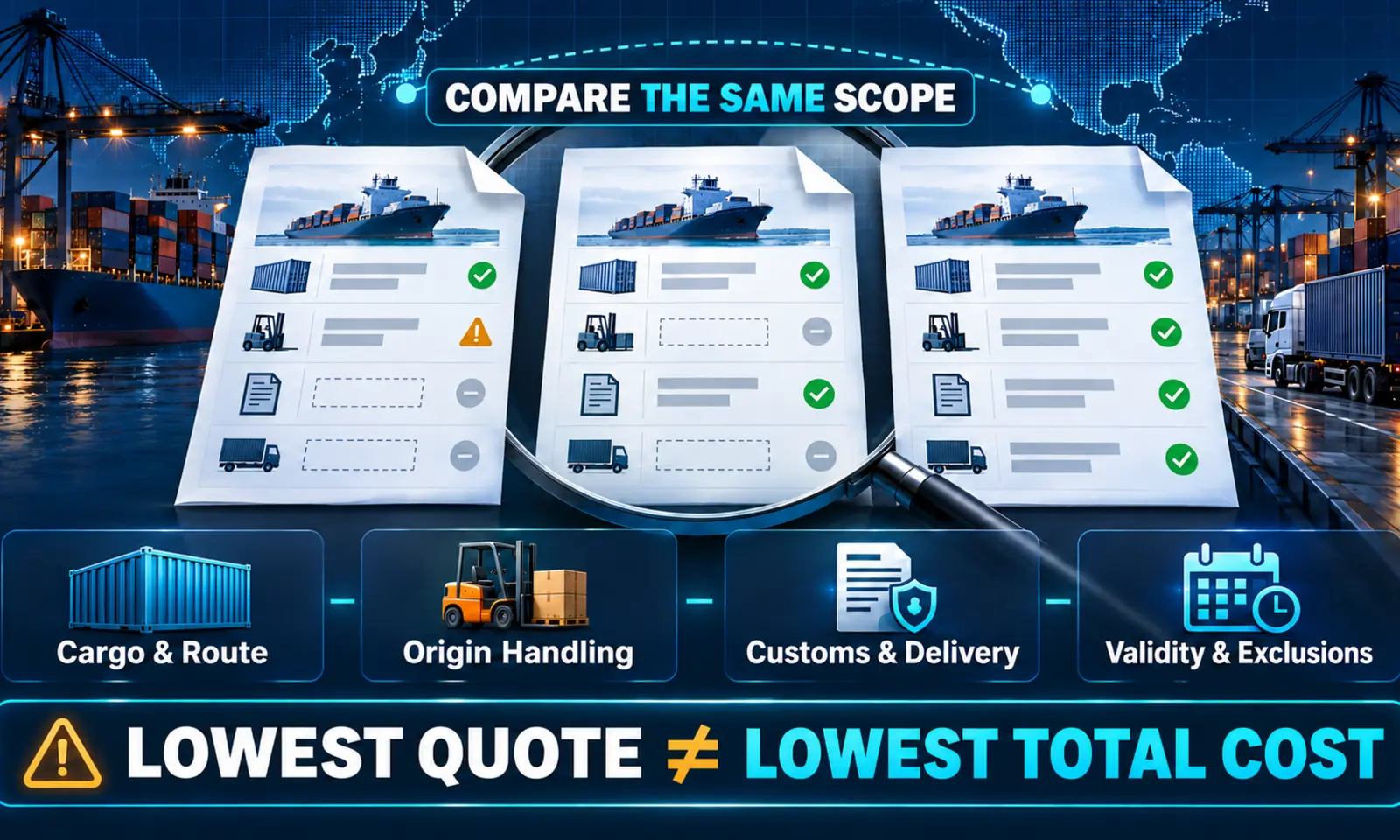
Before negotiating, ask three to five forwarders to quote the exact same shipment: the same Incoterms, origin and destination ports, container type, cargo description and delivery scope. Compare the validity period and what each price includes. For a straightforward, like-for-like move, you may find that several quotes fall within roughly 5 to 10 percent of one another. That is a useful observation, not a guaranteed market rule; a wider gap may reflect a different service or missing charges.
Once you have a fair baseline, you can tell whether a quote is genuinely competitive, whether you are paying more for a service you need, or whether a low headline rate is likely to grow after the shipment leaves China.
What should be the same in every quote?
| Compare | Ask each forwarder to confirm |
|---|---|
| Shipment and route | Cargo type, packed weight and volume, container size or LCL volume, origin, destination and ready date. |
| Service scope | Incoterms, supplier pickup, origin handling, port-to-port or door-to-door delivery and the final delivery address. |
| Customs and destination | Who arranges export and import clearance, whether ISF filing applies, and which destination charges are included. |
| Validity and exceptions | Rate expiry, possible fuel or peak-season adjustments, free time, and charges that depend on delays or special handling. |
Use Consistent Shipping Volume as Your Strongest Negotiating Lever
Shipping volume usually matters more than negotiating style. A company sending one LCL shipment each quarter may have little room to ask for a meaningful rate reduction, however well it presents its case. Compare that with an importer moving ten full containers a month from Shenzhen to Long Beach. Predictable, repeated bookings allow a forwarder to plan capacity and compete more seriously for the account.
From a forwarder’s perspective, ten containers every month for the next year are more valuable than ten unrelated, one-off shipments. That steady throughput makes it easier to discuss a sharper rate or better service terms. The key is to show a credible forecast: your usual route, container or shipment size, shipping frequency, seasonal peaks and likely volume over the coming months. An estimate backed by past shipments carries more weight than a promise of volume that has not yet materialized.
Volume will not make every cost negotiable. Carrier pricing, timing, cargo type and destination requirements still matter. But when you can demonstrate consistent freight, the space to negotiate generally opens up.
How Should You Ask Your Freight Forwarder for a Lower Rate?
Start with evidence rather than a general request for a cheaper price. Prepare your recent shipment history, the routes you use, average weight or container volume, shipment frequency, seasonal peaks and expected cargo-ready dates. If you are planning future growth, separate confirmed bookings from estimates so the forwarder can judge how much volume is dependable.
Next, define the quotation you want improved. Identify the same origin, U.S. destination, equipment or chargeable volume, Incoterm and delivery scope used in your benchmark quotes. Ask whether the forwarder can improve the rate for that specific shipment pattern or hold the rate for an agreed period. A defined request is easier to evaluate than asking, “Can you make it cheaper?”
Use a realistic commitment in return. You might offer a regular monthly booking forecast, earlier cargo-ready information, one primary route or an agreed volume range. Do not promise freight that you cannot deliver. If the forwarder bases a concession on expected volume and the bookings never appear, the arrangement may not continue.
Finally, ask for the revised rate, validity period, included charges, exclusions and any volume condition in writing. A verbal discount has limited value if the destination scope or conditional charges remain unclear.
A message you can send to your freight forwarder
We currently ship approximately [volume] from [China origin] to [U.S. destination] each month, and we expect this pattern to continue for the next [period]. We are reviewing our freight arrangement and would like to know whether you can improve the rate or offer a longer rate-validity period based on this volume. Please quote the same agreed service scope and confirm the origin, freight, destination and documentation charges included.
This message gives the forwarder enough commercial information to review the account without demanding an unsupported discount. Replace the brackets with real shipment data and attach a forecast when one is available.
Check Whether a Low China-to-USA Freight Quote Is Really All-In
A rate that sits far below every comparable quote deserves a closer look. A legitimate forwarder cannot sustainably price every shipment below its costs. If one offer is 20 or 30 percent lower than the others, ask exactly which services and charges it covers before treating it as a saving.
Destination charges may be excluded from the original figure and appear only after the container has sailed. Check for documentation and telex release fees, terminal handling charges, and ISF filing fees if they apply to your shipment. Ask about the free time at destination, too. Storage, demurrage and related charges can arise when a shipment is delayed; you need to know the rules and who will pay if that happens. Importers can also find that cargo will not be released until an unexpected destination bill is settled.
A lower base freight rate does not always produce a lower final shipping cost. A quotation may look cheaper because pickup, documentation, ISF filing, destination handling, customs coordination or final delivery sits outside the quoted amount. Before negotiating a discount, confirm the complete service scope and compare the expected China-to-USA shipping cost to the same U.S. destination.
Request an itemized, all-in quote for the agreed service scope. It should show what is included at origin and destination, who handles customs and final delivery, and which charges remain conditional or excluded. A forwarder cannot quote an unknown future delay as a fixed cost, but it can explain the applicable free time and potential charges in advance. Judge the total expected cost rather than the lowest number on the first line.
What Else Can You Negotiate Besides the Base Freight Rate?
Once you have established a reliable shipping pattern, negotiate more than the per-container rate. A lower headline price helps, but the services around each shipment and the timing of payment also affect your landed cost and cash flow. Depending on your route and volume, ask your forwarder about:
- A rate agreed for a defined period, such as three to six months. Confirm the shipment volume covered, the rate’s validity, and whether fuel or peak-season surcharges can still change. This can give you more protection against sudden market increases.
- Extended payment terms, such as net 30 or net 45. For an established account, these may be more useful than paying before cargo is released at destination.
- Free or reduced Los Angeles warehouse storage. Agree on the number of days after arrival and the rate that applies once that period ends.
- Free consolidation for goods from multiple Chinese suppliers. Define how many incoming deliveries and how much handling the arrangement includes.
- Free or discounted labeling, relabeling and basic inspection at the origin warehouse. Specify the tasks so both sides know what is covered.
- Priority booking during peak season. Ask how the forwarder will handle your bookings when vessel space is tight, while recognizing that space is still subject to availability.
- Dedicated account management. A consistent contact who knows your shipments can save time when you need a booking update or help with a problem.
Put agreed concessions in writing. That way, the value you negotiated is reflected in the day-to-day service, not just in a promising conversation.
Negotiate Payment Terms When the Freight Rate Cannot Move
Even a high-volume customer may reach a point where the forwarder has little room to reduce the base freight rate. This is especially likely when carrier rates are tight or fuel costs have risen. At that point, payment terms can be a more useful request than another small discount.
Many importers are asked to pay before cargo is released at destination, which can strain cash flow when several shipments arrive close together. If you have a clean payment record and steady volume, ask whether the forwarder can offer net 15, net 30 or net 45 terms. If no financing charge is added, that extra time can leave cash in your business for longer and may be worth more than a modest reduction in the shipping rate.
Credit terms are usually earned rather than granted on a first shipment. Forwarders are more likely to consider them for customers whose volumes and payment habits they already know. Any credit arrangement may also remain subject to account history, internal credit review and the agreed payment conditions. That is another practical advantage of a dependable, long-term shipping relationship.
Use a Long-Term Forwarder Relationship to Improve Pricing
Running a new tender every month may uncover a low spot rate, but it does not always produce the best overall shipping arrangement. Importers with regular volume often benefit from building a working relationship with one or two trusted forwarders. Once your forwarder understands your products, suppliers, busy season, destination warehouses and acceptable transit times, it can plan bookings and service around the way you actually ship.
This is the kind of working relationship VoltFreight aims to build with importers. Our Shenzhen team can coordinate supplier pickup, warehouse receiving and multi-supplier consolidation before the shipment moves by ocean or air. For eligible China-to-USA shipments, we can also arrange Amazon FBA preparation, the agreed customs-clearance scope and door-to-door delivery. When we know a customer’s recurring cargo and destination requirements, we can discuss a practical shipping plan instead of treating every booking as an unrelated, one-off quote.
A trusted forwarder may also be more willing to help when something small goes wrong: a missed cutoff, a customs issue that needs attention, or a brief need for warehouse space in Los Angeles. You should still agree on chargeable services in advance. But a partner that values the continuing account is more likely to work through a problem with you than to focus only on the margin from that one shipment.
Know When a Lower Freight Rate Could Compromise Service
There is a practical limit to any negotiation. Even with strong volume and a long relationship, a forwarder cannot keep lowering the price without affecting the resources available for service, compliance and reliable execution. You may win a lower quote on paper but lose the saving through delayed shipments, poor customs documentation or lower priority when capacity is scarce.
A worthwhile agreement gives you a better rate than a casual, one-off shipper could expect while leaving the forwarder enough room to deliver the service it has promised. When the arrangement works for both sides, it is easier to maintain consistent pricing and support over time. That consistency can be worth more than squeezing the last few dollars out of a single shipment.
Negotiating lower China-to-USA shipping rates with your freight forwarder starts with understanding what the market price covers. Compare like-for-like quotes, use consistent volume as your main bargaining tool, and check unusually low offers for charges that have been left out. If the base rate cannot move further, discuss payment terms and useful services such as consolidation, storage and labeling. A fair, long-term partnership can do more for your total landed cost than chasing the lowest headline rate every time.
Shipping regularly from China to the USA? Contact VoltFreight with your cargo description, supplier location, packed weight and volume, destination, and expected shipping frequency. Our Shenzhen team can review the route and service scope with you, then prepare a quote that makes the included charges and any exclusions clear.