Updated: August 2026.
U.S. importers using DDP shipping from China to the USA should verify their Importer of Record information before their next shipment departs. Beginning September 18, 2026, U.S. Customs and Border Protection may immediately void an Importer of Record number when the information on CBP Form 5106 is inaccurate or incomplete.
However, this change does not ban DDP shipping. Instead, it makes importer identity, customs documentation and declaration accuracy more important. Before accepting an all-inclusive DDP quotation, a U.S. buyer should know who will act as the Importer of Record, which customs broker will file the entry, how the provider calculated duties and whether the declared product information matches the actual cargo.
In short, this guide explains the September 18 enforcement date, CBP Form 5106, Importer of Record responsibilities, DDP warning signs and the documents that China-to-USA importers should check before booking.
What Changes on September 18, 2026?
On August 19, 2026, CBP published a notice about the accuracy of Importer of Record data. According to the notice, CBP will begin enhanced enforcement on September 18, 2026. CBP may void an IOR number immediately if the agency finds incomplete or inaccurate information on the corresponding Form 5106.
As a result, once CBP voids that number, the importer cannot use it to enter merchandise into the United States. Therefore, an outdated address, an incorrect company name or contact details that do not belong directly to the importer could interrupt future entries.
Moreover, the notice applies to new and existing Importers of Record. In addition, customs brokers that submit Form 5106 information for clients must hold a valid Power of Attorney executed directly with the IOR.
Accordingly, importers can review the official Federal Register notice on Importer of Record data accuracy. CBP also provides the current CBP Form 5106 and filing information.
What Is an Importer of Record?
In practice, the Importer of Record, commonly called the IOR, is the party identified to CBP for the customs entry. The IOR carries important responsibilities for the accuracy of the entry, including the product description, classification, customs value, country of origin and payment of applicable duties.
For example, a freight forwarder can coordinate transportation and work with a licensed customs broker. However, arranging the shipment does not automatically make the forwarder the legal Importer of Record. The customs structure must connect the entry to an eligible owner or purchaser and the broker acting for that party.
Meanwhile, the consignee, delivery warehouse and IOR may be different parties. For example, cargo can arrive at a third-party warehouse or an Amazon fulfillment center, but that delivery address does not automatically assume importer responsibility.
Therefore, buyers should never rely only on the words “DDP” or “all duties included.” They should confirm the actual IOR arrangement before the cargo leaves China.
What Is CBP Form 5106?
Specifically, CBP uses Form 5106, the Create or Update Importer Identity Form, to establish and maintain an importer’s identity information. The form connects an importer to a unique IOR number used for U.S. customs activity.
According to the 2026 CBP notice, important Form 5106 data includes:
- The importer’s legal name
- EIN, SSN or CBP-assigned importer number
- Mailing address
- Physical business address when different
- Telephone number
- Email address
- Relevant company, ownership or officer information when requested
CBP states that the contact information must belong directly to the IOR. Consequently, an importer should not use an unrelated warehouse address, temporary telephone number or another company’s email simply to complete the form.
Therefore, companies that have moved, changed legal names, replaced contact details or reorganized their business should review their records with their licensed customs broker. If information has changed, the importer should update Form 5106 before the new enforcement date or before the next customs entry.
Why China-to-USA DDP Importers Should Pay Attention
Overall, DDP can remain a practical option for suitable cargo. Under a properly structured DDP service, the seller or logistics provider coordinates export handling, international freight, import clearance, applicable duties and final delivery according to the written quotation.
However, DDP is a commercial delivery term. It does not override U.S. customs laws or determine whether a particular company qualifies to act as the IOR. As a result, the customs structure behind the quotation matters as much as the price.
Nevertheless, the risk becomes higher when a quotation is substantially lower than the duty amount and transportation cost would normally allow. Certainly, a low rate alone does not prove wrongdoing. However, the importer should investigate whether the quotation assumes an incorrect HTS code, an artificially low customs value, an unidentified third-party IOR or a duty exclusion that the seller has not disclosed.
The June 2026 Executive Order on Strengthening Customs Enforcement directs U.S. agencies to increase IOR vetting and focus enforcement on misclassification, undervaluation and illegal transshipment. Therefore, importers should treat declaration accuracy as a core booking requirement rather than an issue to review after arrival.
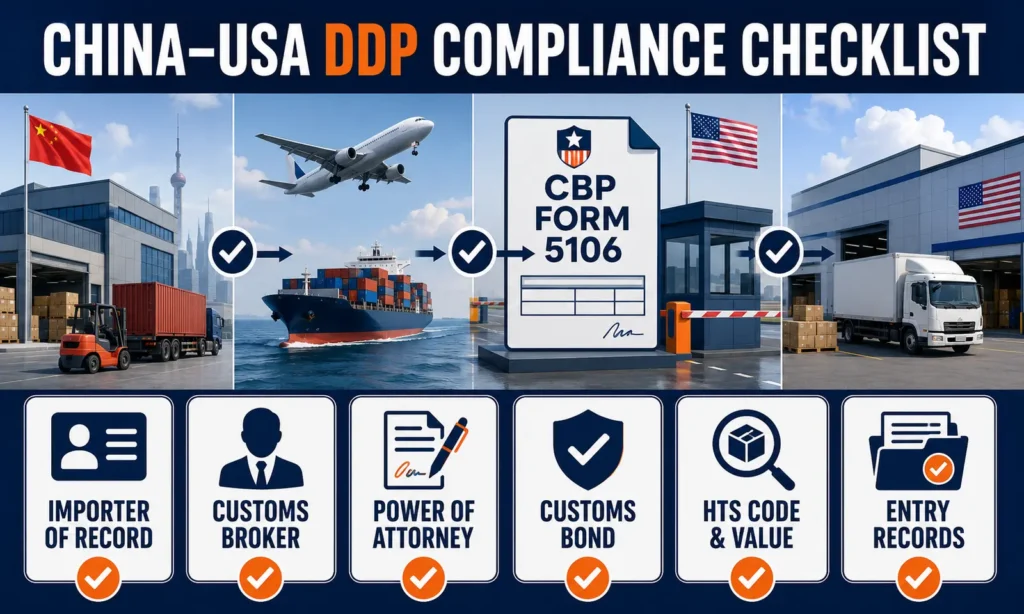
Eight Checks Before Accepting a China-to-USA DDP Quote
1. Ask Who Will Act as the Importer of Record
First, request a clear written answer. Will the foreign seller act as the IOR, will your U.S. company act as the IOR, or will another eligible party support the entry? In addition, ask whether the same structure applies to your specific product and shipment value.
If the provider refuses to identify the customs structure, do not assume that the low price includes a compliant entry.
2. Verify the IOR Identity Information
Next, confirm that the legal name, identification number, physical address, mailing address, phone number and email belong directly to the IOR. If your company will act as the importer, compare this information with your corporate and tax records.
Also, tell your broker about recent address, ownership or contact changes. A minor inconsistency can become a serious delay once CBP begins enhanced verification.
3. Identify the Licensed Customs Broker
Likewise, ask who will submit the entry and who will contact you if CBP requests additional information. When a broker acts for your company, the broker should obtain a valid Power of Attorney directly from your company.
Never send an EIN, SSN or signed customs document to an unidentified person. Instead, verify the broker or authorized service provider before sharing sensitive information.
4. Confirm the Product Description and HTS Code
Then, check whether the commercial invoice describes the actual goods in useful detail. Generic descriptions such as “parts,” “samples,” “accessories” or “general cargo” may not provide enough information for accurate classification.
In addition, one purchase order can contain several products with different HTS codes. Ask the supplier and broker to review material, function, composition and intended use instead of assigning one convenient code to every item.
5. Check the Declared Value and Duty Assumptions
Moreover, ask the provider which customs value supports the DDP price. The value should match the commercial transaction and the applicable valuation rules. In addition, the quotation should explain whether it includes ordinary duty, Section 301 tariffs and any product-specific trade remedies that may apply.
Some products can face Section 232 measures or antidumping and countervailing duties. Therefore, a normal duty estimate may not cover every product.
6. Confirm the Customs Bond Arrangement
Additionally, formal commercial entries commonly require a customs bond. Ask whose bond will support the entry and whether the provider included the bond cost in the quotation.
Repeat importers may use a continuous bond, while occasional importers may use a single-entry bond where appropriate. However, the correct structure depends on the importer, product, value and entry requirements. A licensed customs broker or surety should confirm the final arrangement.
7. Ask What Entry Records Will Be Available
Afterward, ask whether your company will appear as the IOR, ultimate consignee or delivery party. Also ask what customs evidence the provider can legally supply after clearance.
CBP Form 7501 contains entry summary information such as classification, origin and duty calculations. Access can depend on the customs structure and the party’s role. Therefore, clarify document availability in writing rather than assuming every consolidated DDP shipment will produce a separate Form 7501 in the buyer’s name.
8. Define Exceptions and Additional Charges
Finally, a DDP quotation should explain what happens if CBP orders an exam, requests corrected documents, disputes the classification or assesses additional duty. It should also address storage, demurrage, redelivery, residential service, liftgate service and other destination exceptions where relevant.
Finally, confirm who will communicate with CBP and the customs broker if the named IOR experiences a verification problem.
Legitimate DDP Quote vs Warning Signs
| Review Item | Clear DDP Structure | Warning Sign |
|---|---|---|
| Importer of Record | The provider explains who will act as IOR and why that party can support the entry. | The provider refuses to identify the IOR or changes the answer repeatedly. |
| Product information | The quote uses an accurate description, material, use and proposed HTS classification. | The provider asks the supplier to describe every product as general cargo or samples. |
| Customs value | The declaration follows the commercial documents and accepted valuation rules. | The provider promises to reduce duty by declaring a small fraction of the real value. |
| Duties and tariffs | The quote states its HTS and duty assumptions and lists exclusions. | The provider guarantees that every product has no tariff without reviewing the product. |
| Broker and bond | The customs broker, POA responsibility and bond arrangement are clear. | No one can explain who files the entry or whose bond supports it. |
| Entry records | The provider explains which records will be available under the agreed structure. | The provider promises official records before deciding who will act as IOR. |
| Exception charges | The quotation defines customs exams, storage and delivery exceptions. | The quotation says “all inclusive” but contains no scope or exception terms. |
In summary, this table helps importers ask better questions. However, it does not replace product classification, legal advice or a licensed customs broker’s entry review.
Documents Importers Should Review
Accordingly, a compliant shipment needs consistent information across the shipping and customs documents. Before departure, compare the following records:
- Commercial invoice: Seller, buyer, product description, quantity, unit value, total value, currency, Incoterm and country of origin.
- Packing list: Carton or pallet count, net weight, gross weight, dimensions and item distribution.
- Bill of lading or air waybill: Shipper, consignee, routing and cargo information.
- CBP Form 5106: Current importer identity information when registration or an update is necessary.
- Broker Power of Attorney: Direct authorization from the IOR when a broker files on its behalf.
- Customs bond: The bond that supports the applicable entry.
- Entry summary: The classification, origin, value, duty and fee information filed with CBP.
- Product compliance records: Documents required by agencies such as the FDA, FCC, EPA, CPSC or other authorities when applicable.
If the invoice lists five products but the packing list, booking and customs data describe only one, correct the inconsistency before departure. Likewise, if a supplier changes the product material or value after the quote, ask the forwarder and broker to review the shipping plan again.
For a broader document and clearance explanation, see our USA customs clearance guide for shipments from China.
Extra Checks for Regulated or High-Risk Cargo
Furthermore, the IOR review does not replace product compliance. In fact, regulated cargo usually needs more accurate data because CBP may share entry information with other government agencies.
For example, importers should perform additional checks for:
- Lithium batteries shipped from China to the USA, including battery testing, packing, marking and carrier acceptance.
- Food shipments from China to the USA, including FDA registration, Prior Notice, labeling and facility information.
- Vapes and e-cigarettes shipped to the USA, including product, carrier and regulatory restrictions.
- Oversized cargo shipped to the USA, including loading, port handling, customs and final delivery requirements.
- Cosmetics, personal-care products, medical-related goods, wireless electronics, chemicals, toys and construction materials.
In addition, aluminum products, steel products and certain manufactured goods may face Section 232 or antidumping and countervailing duty review. Consequently, importers should not select DDP solely because the all-inclusive rate appears lower than an FOB quotation.
Practical Example: Reviewing a Personal-Care DDP Shipment
For example, consider a commercial shipment from China to Florida containing 750 cartons of shampoo, shower gel, conditioner, body lotion and soap. The shipment weighs approximately 6,660 kg and measures about 11.55 CBM.
A freight quote can calculate transportation from the weight and volume. However, a compliant DDP plan also needs answers to several customs questions:
- Will each product use the same HTS code, or do shampoo, soap and lotion require separate classifications?
- Do the product descriptions and declared values match the supplier’s commercial invoice?
- Who will act as the IOR for the entry?
- Does the DDP price include the applicable duties, brokerage, bond and final delivery?
- Do the ingredients, labels or intended use trigger additional FDA requirements?
- Does the Florida delivery location need an appointment, liftgate or other special service?
In other words, these questions do not mean that DDP cannot work for the shipment. Instead, they connect the freight quotation to the actual products, customs entry and delivery conditions. As a result, the importer receives a more reliable landed-cost plan and reduces the risk of surprises after arrival.
Should You Use DDP, DAP or FOB After the New Enforcement?
Use a Transparent DDP Service When
- The provider has reviewed the actual product, value, dimensions and destination.
- The IOR, broker, bond and duty assumptions are clear.
- The quotation defines included services and exceptions.
- You need coordinated pickup, customs clearance and final delivery.
Consider FOB with Your Own U.S. Broker When
- Your company wants to act as the IOR and maintain entries under its own importer number.
- You import regularly and want direct control over classification, duty payment and customs records.
- The products face complex tariffs, agency requirements or trade remedies.
- You need a clear audit trail for accounting, compliance or potential duty claims.
Consider DAP When
You want the seller to arrange transportation to the named destination while your company handles U.S. import clearance and duties. DAP can provide more importer control, but the buyer must prepare the broker, IOR and bond arrangements before arrival.
For a detailed comparison, read our guide to DAP vs DDP shipping from China. The best Incoterm depends on the product, importer structure, shipment frequency, record requirements and commercial agreement.
Action Plan Before Your Cargo Leaves China
- Confirm the customs structure. Identify the IOR, broker and bond before booking.
- Review Form 5106 information. Check the legal name, identification number, physical address, mailing address, phone and email.
- Update changed information. Work with the broker or CBP process to correct outdated records.
- Check the product data. Confirm descriptions, materials, uses, country of origin, HTS codes and values.
- Audit the DDP quotation. Ask how the provider calculated freight, duties, brokerage, bond and delivery.
- Define available documents. Confirm which entry and delivery records your company will receive.
- Prepare a contingency plan. Decide who will respond if CBP requests information or questions the IOR.
If CBP voids an IOR number, do not continue booking entries under that number. Instead, contact the licensed customs broker, correct the inaccurate information and follow the CBP procedure for reestablishing the record. The Federal Register notice lists contact information for questions about the enforcement program.
Frequently Asked Questions
Does the September 18, 2026 rule ban DDP shipping from China?
No. The CBP notice focuses on accurate Importer of Record information. A properly structured DDP shipment can still move. However, the seller, buyer, forwarder and broker must use accurate importer and entry data.
Does a U.S. buyer always become the Importer of Record under DDP?
No. DDP allocates commercial responsibilities, but the customs entry still needs an eligible IOR. Therefore, the parties must confirm the actual structure rather than assuming the Incoterm answers the legal question.
Can a freight forwarder act as the Importer of Record?
A forwarder does not become the IOR simply because it arranges transportation. The entry must connect to an eligible owner or purchaser, with a licensed customs broker acting for that party where applicable. Ask the provider to explain the structure for your shipment.
How can I find out who is the Importer of Record?
Ask the seller or forwarder in writing before booking. If your company will act as IOR, confirm the broker, Power of Attorney, importer number and bond. Also ask what entry records will show your company’s role.
What happens if information on Form 5106 is wrong?
Beginning September 18, 2026, CBP may immediately void the related IOR number and take other enforcement action. Importers should correct outdated or inaccurate information through the appropriate CBP or licensed broker process.
Do I need to file Form 5106 for every shipment?
Importers generally use Form 5106 to create or update their identity record rather than filing a new form for every shipment. Nevertheless, the information must remain accurate. Ask your broker to confirm whether your record needs an update or reactivation.
Does a DDP price always include every U.S. customs charge?
Only the written quotation can define the commercial scope. Confirm ordinary duties, additional tariffs, brokerage, bond, delivery and exceptions. Customs exams, storage, classification changes and trade remedies may require separate treatment unless the agreement expressly includes them.
Does the end of de minimis change these requirements?
The suspension of duty-free de minimis treatment is a separate customs development, but it increases the importance of accurate product and importer data for low-value shipments. CBP states that duty-free de minimis treatment ended for shipments entering the United States from all countries on August 29, 2025, subject to applicable exceptions and entry rules. Importers should not rely on the old assumption that every shipment valued below USD 800 enters duty-free.
Why Choose VoltFreight for China-to-USA Shipping?
VoltFreight coordinates commercial shipping from suppliers across China to businesses, warehouses and Amazon fulfillment centers in the United States. Depending on the cargo and importer requirements, we can review air freight, sea freight, express, DAP and DDP door-to-door options.
Our team can help importers prepare a clearer shipping plan by reviewing:
- Supplier pickup or delivery to our Shenzhen warehouse
- Consolidation from multiple Chinese suppliers
- Carton, pallet, weight and volume information
- Product descriptions and proposed HS or HTS codes
- Air, sea, express and DDP route options
- Customs broker and Importer of Record coordination
- Final delivery requirements in the United States
VoltFreight does not replace the importer’s legal or product-compliance responsibilities. However, we can identify missing shipping information before booking and coordinate with the relevant customs-clearance professionals.
To request a China-to-USA shipping review, send us the product name, photos, material and use, quantity, commercial value, carton count, carton dimensions, gross weight, pickup address and U.S. delivery ZIP code. We will compare the suitable transportation options and explain the quotation scope before you confirm the shipment.
Conclusion
The September 18, 2026 enforcement date makes accurate Importer of Record data a priority for every company that imports into the United States. For China-to-USA DDP shipments, the most important question is no longer only whether the quotation includes freight and duties. Importers must also know who supports the customs entry and whether the identity, classification, value, bond and broker records are accurate.
A transparent DDP plan can still provide convenient door-to-door delivery. Nevertheless, buyers should reject shortcuts that depend on unidentified importer numbers, false values or vague customs descriptions. Reviewing these details before departure protects the cargo, the importer’s records and the long-term supply chain.
For a complete comparison of transportation methods, costs and delivery options, visit our shipping from China to the USA guide or contact VoltFreight for a shipment-specific quotation.