
Shipping furniture from China to USA needs a different plan from normal carton shipping. Furniture is bulky, fragile, difficult to stack and often harder to deliver at the final U.S. address. A supplier may give a simple sea freight or DDP quote, but that quote may not explain packed CBM, export packing, wood packaging marks, TSCA Title VI, residential delivery, liftgate service, unloading responsibility, cargo insurance or what happens if a large carton is damaged.
For this page, the core SEO topic is furniture from China to USA, with a commercial focus on shipping, landed cost, packing and delivery. This keeps the page separate from the broader China to USA shipping cost guide, the container shipping cost from China to USA page and the DDP shipping from China to USA guide.
The best furniture shipping plan starts before the cargo leaves China. Buyers should confirm packed dimensions, total CBM, carton strength, material details, supplier city, U.S. ZIP code, address type and unloading conditions before choosing LCL, FCL, Sea DDP or door delivery.
Need to ship furniture from a China supplier? Send VoltFreight product photos, packing photos, packed dimensions, gross weight, carton quantity, total CBM, supplier city, cargo value, material details, U.S. ZIP code and delivery address type. Then contact VoltFreight to compare LCL, FCL, Sea DDP and furniture door delivery options.
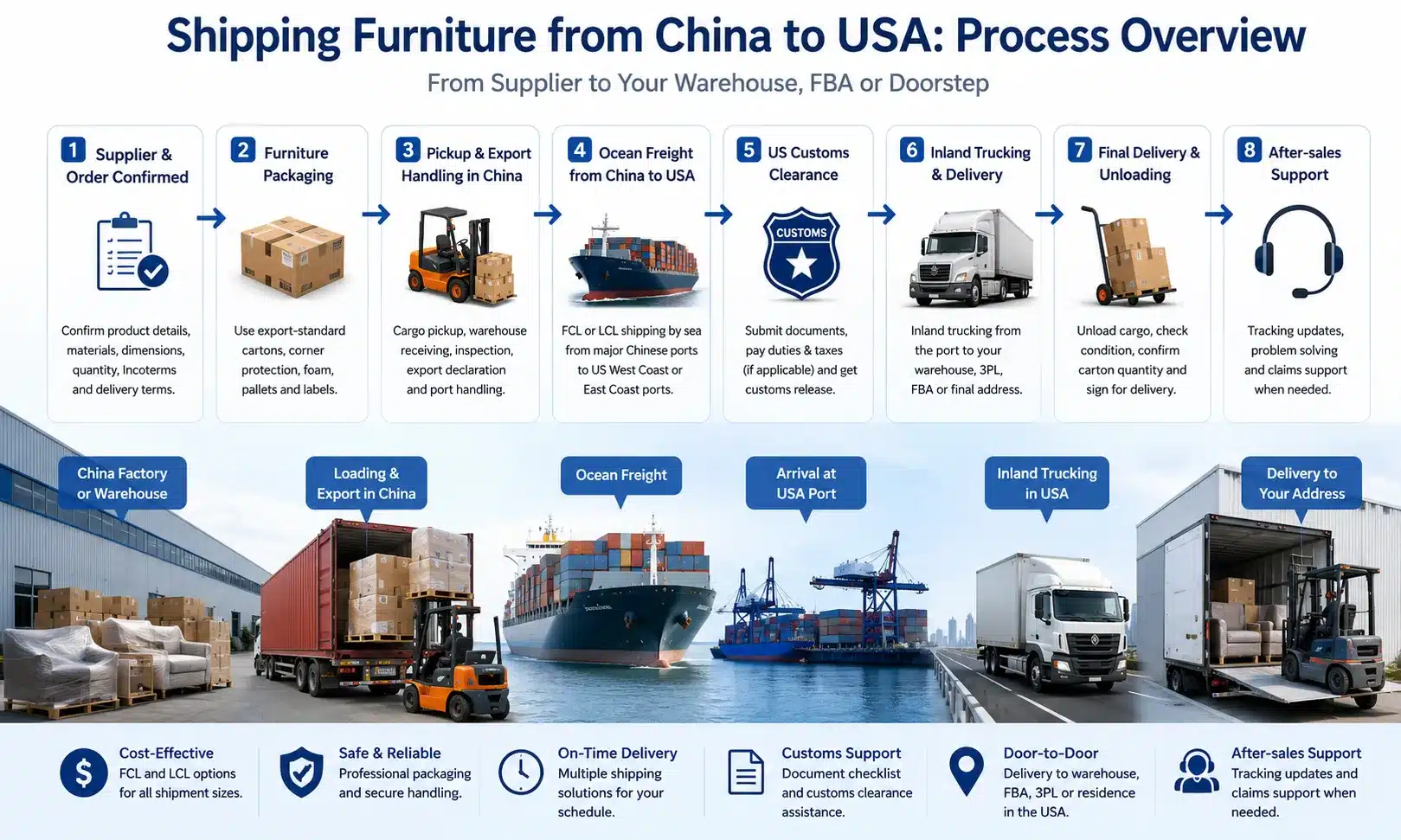
Quick Answer: Best Way to Ship Furniture from China to USA
For most furniture shipments, the best method is sea freight, either by LCL, FCL or Sea DDP. The right option depends on total CBM, packed dimensions, furniture material, carton count, packaging strength, cargo value, U.S. ZIP code, delivery address type and unloading conditions.
LCL works when the shipment does not fill a full container. However, it adds more warehouse handling, so packaging must be strong. FCL works better when the furniture volume can justify a 20GP, 40GP or 40HQ container. Sea DDP can help buyers who want customs, duties and final delivery under one confirmed scope, but the quote must clearly explain what delivery services are included.
Air freight and express courier rarely work well for furniture because the cargo is usually too bulky. Still, they may fit urgent samples, compact chairs, hardware kits, spare parts or small furniture accessories.
For broader U.S. route planning, read shipping from China to the USA. For supplier quote checks, read shipping from Alibaba to USA.
Why Furniture Shipping Is Different from Normal Cargo
Furniture creates three main logistics problems: volume, damage risk and final delivery limits. For example, a lightweight sofa can take more container space than a heavy box of hardware. Meanwhile, a glass table may need wooden framing, corner protection or special carton reinforcement. Cabinets may need edge protection and a loading plan that prevents pressure on doors, handles and panels.
For normal cartons, a freight forwarder can often quote based on weight, carton count and CBM. In contrast, furniture requires more details: shape, fragility, stackability, material, export packing, wood packaging, warehouse handling, customs documents and delivery access.
For example, two shipments may both weigh 300 kg, but the landed cost can be very different. Compact metal chairs may load efficiently in cartons. Outdoor sofas with cushions may take much more CBM, require stronger packing and need liftgate delivery in the United States. As a result, CBM and delivery conditions often matter more than gross weight.
Common Furniture Products and Shipping Risks
China suppliers export sofas, dining tables, cabinets, wardrobes, office furniture, outdoor furniture, beds, mattresses, hotel furniture, commercial displays and custom project furniture to U.S. buyers. Each product category needs a different packing, customs and delivery review.
| Furniture Type | Main Shipping Risk | What to Check Before Booking |
|---|---|---|
| Sofas and upholstered furniture | Bulky CBM, fabric protection, foam compression and possible flammability review | Packed size, fabric details, carton strength, moisture protection and delivery access |
| Dining tables and chairs | Fragile corners, tabletop scratches and mixed carton sizes | Edge protection, stackability, hardware packaging and total carton count |
| Cabinets, wardrobes and shelves | Large panels, edge damage and composite wood compliance questions | Material details, TSCA Title VI status, carton reinforcement and loading direction |
| Outdoor furniture | Large volume, cushions, mixed materials and irregular cartons | CBM, cushion packing, carton waterproofing, ZIP code and final delivery service |
| Office and commercial furniture | Project deadlines, multiple SKUs and business delivery requirements | Receiving hours, appointment, pallet labels, installation site access and unloading method |
| Flat-pack furniture | Dense cartons, heavy panels and carton damage | Carton weight, palletization, strapping, corner boards and warehouse handling |
This product-specific review is where the page should beat generic freight articles. A normal China to USA freight guide may explain sea freight and customs, but it often misses furniture packing, wood material, liftgate, residential delivery and damage prevention.
LCL, FCL or Sea DDP: Which Option Fits Furniture?
Most furniture shipments should start with sea freight comparison. However, the best structure depends on cargo volume, supplier location, number of suppliers, delivery address, customs responsibility and how much control the buyer needs after U.S. arrival.
LCL Shipping for Smaller Furniture Orders
LCL shipping works when the shipment does not fill a full container. It can fit trial orders, small wholesale batches, several sofas, mixed dining sets, outdoor furniture cartons or consolidated supplier orders. Because LCL cargo moves through consolidation and deconsolidation warehouses, packaging must be strong enough for extra handling.
LCL is not always the safest option for fragile furniture. Glass tabletops, lacquered surfaces, mirrors, marble tops and oversized cartons need careful review before booking.
FCL Shipping for Larger Furniture Orders
FCL shipping works when the order can justify a dedicated container. A 40HQ container often suits bulky furniture because it offers more internal volume than a standard container. In addition, FCL may reduce handling risk because the cargo moves in a dedicated container after loading.
FCL still needs a loading plan. The supplier should not load randomly. Heavy cartons should stay low, fragile panels need protection, and oversized cartons should not crush weaker pieces.
Sea DDP for Landed Door Delivery
Sea DDP can work when the buyer wants a more complete door-to-door plan. Under a confirmed DDP scope, the route may include China pickup, export handling, ocean freight, U.S. customs coordination, duty handling and final truck delivery.
However, DDP does not automatically include inside delivery, room-of-choice placement, white glove service, assembly, packaging removal or unloading heavy furniture. Therefore, these details must be confirmed before booking.
| Method | Best For | Main Advantage | Main Risk |
|---|---|---|---|
| LCL sea freight | Small furniture orders and mixed supplier shipments | Lower entry volume than full container shipping | More warehouse handling and higher damage risk |
| FCL 20ft | Smaller full-container orders or heavier furniture | Dedicated container with better handling control | May not use space efficiently for bulky furniture |
| FCL 40ft / 40HQ | Bulky sofas, cabinets, outdoor furniture and project cargo | Better cubic capacity and fewer handling steps | Needs careful loading, weight control and delivery planning |
| Sea DDP | Buyers needing customs, duty and door delivery under one scope | Easier landed-cost planning for suitable cargo | Unclear exclusions for liftgate, residential delivery or unloading |
| Air freight or express | Samples, compact chairs, hardware and urgent parts | Fast transit | High cost because of volumetric weight |
How Furniture Shipping Cost Is Calculated
Furniture shipping cost from China to USA is usually driven by CBM, shipping method, route and final delivery service. Weight still matters, but volume often has a larger impact because furniture cartons are large and irregular.
LCL quotes usually depend on CBM or weight/measure. FCL costs are based on container type, origin port, destination port and inland trucking. By contrast, Sea DDP may combine China-side handling, ocean freight, customs coordination, duties, taxes and delivery after reviewing the cargo.
The main cost factors are:
- Total CBM: Furniture often takes more space than importers expect.
- Packed dimensions: Product dimensions are not enough; final carton or crate size matters.
- Stackability: Non-stackable furniture can waste container space.
- Packaging type: Pallets, wooden frames and crates can increase CBM but reduce damage risk.
- Supplier city: Foshan, Guangzhou, Shenzhen, Ningbo, Yiwu, Shanghai and inland cities have different pickup costs.
- U.S. ZIP code: West Coast, East Coast and inland delivery routes can price differently.
- Address type: Warehouse, 3PL, Amazon FBA, retail store, project site and residential delivery are not the same.
- Customs and duty scope: HTS code, Section 301 exposure, MPF, HMF and broker scope affect landed cost.
- Delivery services: Liftgate, appointment, limited access, residential delivery and redelivery may add cost.
For broader freight budgeting, use China to USA shipping cost. For container-specific pricing, read container shipping cost from China to USA.
Packing and Damage Prevention for Furniture
Packing affects cost, damage risk and delivery success. A supplier may say “standard export carton”, but that may not be enough for large furniture moving through sea freight, warehouse handling and U.S. truck delivery.
Before shipping furniture, review the final export packing, not only the product design. Large cartons need enough strength to survive stacking, forklift handling and long-distance trucking. Fragile surfaces need corner boards, foam, honeycomb board, edge guards or wooden frames. Hardware kits should be packed separately and labeled clearly so they do not scratch finished surfaces.
For heavy or fragile furniture, weak cartons can create serious damage risk. In many cases, reinforced cartons, pallets, wooden frames or wooden crates are safer than simple retail packaging. However, stronger packaging can increase CBM, so the buyer should balance protection and freight cost.
Furniture Packing Checklist
- Final packed length, width and height
- Gross weight per carton, pallet or crate
- Strong export cartons instead of weak domestic cartons
- Corner protection for tables, cabinets, shelves and painted surfaces
- Separate protection for glass, stone, marble, ceramic and mirror parts
- Clear packing for screws, handles, legs and hardware kits
- Moisture protection for fabric, leather, wood and outdoor cushions
- Whether the furniture ships assembled, semi-assembled or flat-packed
- Whether the cargo can be stacked safely
- Whether pallets, wooden frames or wooden crates are needed
- Whether shipping marks and carton labels are clear
- Whether cargo insurance is needed for high-value furniture
For more general packaging planning, read how to prevent shipping damage.
Wood Packaging, TSCA Title VI and Furniture Compliance
Furniture imports can involve more compliance review than ordinary goods. The exact requirements depend on product material, intended use, age group, fabric, wood content, coating, supplier documents and HTS classification.
Wood Packaging and ISPM 15
Many furniture shipments use wooden crates, wooden frames, pallets or skids. If solid wood packaging material enters the United States, it should meet treatment and marking requirements. Non-compliant wood packaging can cause inspection problems, delays or refusal issues.
Ask the supplier whether the packing uses solid wood, plywood, pallet wood, wooden frames or wooden crates. If solid wood packaging is used, request proper treatment and visible marks before shipping.
Composite Wood and TSCA Title VI
Cabinets, shelves, wardrobes, desks, panels and flat-pack furniture may include composite wood, such as MDF, particleboard or plywood. These products may need TSCA Title VI review for formaldehyde emission standards. Therefore, buyers should ask the supplier for material details, labels and compliance documents before shipment.
Upholstered Furniture and Product Safety
Sofas, padded chairs, mattresses and upholstered furniture may need extra review for fabric, foam, filling, labels and flammability-related requirements. Children’s furniture can also trigger additional safety, labeling and testing obligations.
Lacey Act and Plant-Based Materials
Furniture with wood or plant-based materials may need Lacey Act review depending on the product and material. Importers should collect species, material and supplier information early, especially for wood furniture, bamboo products or mixed-material furniture.
| Issue | Why It Matters | What to Ask the Supplier |
|---|---|---|
| Solid wood packaging | May need compliant treatment and marks | ISPM 15 treatment, photos of marks and packaging type |
| Composite wood | May fall under TSCA Title VI formaldehyde rules | Material details, TSCA label, certificate and supplier documents |
| Upholstered furniture | May need fabric, foam and safety review | Fabric, foam, filling, label and compliance documents |
| Children’s furniture | May trigger extra safety and testing obligations | Age grade, testing documents, labels and tracking information |
| Wood or plant-based materials | May require Lacey Act review depending on material | Species, country of harvest, material details and supplier declaration |
U.S. Final Delivery: Warehouse, 3PL, FBA or Residential
Furniture delivery in the United States can create extra cost if the destination details are unclear. Warehouses with loading docks are easier than residential addresses. Retail stores may require appointments. Also, a 3PL may require labels and pallet specifications. Amazon FBA needs carton labels, shipment plans, delivery appointments and receiving rules.
Normal freight delivery does not automatically include moving furniture into a house, carrying it upstairs, placing it in a room, assembling the furniture or removing packaging. Those are special services and must be quoted separately when available.
| Delivery Destination | Planning Notes | What to Confirm |
|---|---|---|
| Commercial warehouse | Usually the easiest furniture delivery type | Dock, forklift, receiving hours, appointment and unloading method |
| 3PL warehouse | May require pallet labels, carton labels and receiving rules | Warehouse guide, appointment, labeling and pallet specs |
| Amazon FBA | Needs FBA shipment plan and label compliance | FBA labels, carton limits, pallet rules and delivery appointment |
| Retail store or project site | Often needs appointment and site contact | Receiving hours, truck access, limited access and unloading responsibility |
| Residential address | May need liftgate, appointment or special handling | Curbside vs inside delivery, stairs, gate access, street access and liftgate need |
For Amazon inventory, keep the furniture page as a short guide only. For the detailed FBA route, see our shipping from China to Amazon FBA guide.
Residential Furniture Delivery: What Buyers Must Confirm
Many buyers want delivery to a home address, apartment, garage, storage unit, showroom or small business location. This is where many furniture shipments fail. Furniture delivery is not parcel delivery.
Residential delivery may need liftgate service, appointment scheduling, truck access review, limited-access charges or extra coordination. The driver may deliver to the curbside or accessible delivery point, but standard freight delivery does not automatically include moving furniture into the house.
Before booking residential delivery, confirm:
- Can a large truck access the street?
- Does the address need appointment delivery?
- Does the cargo need liftgate delivery?
- Can the consignee unload large cartons or crates?
- Is the furniture too long, wide or heavy for liftgate service?
- Does the buyer expect curbside, garage, inside or white glove delivery?
- Are there stairs, elevators, narrow doors, gates or building restrictions?
- Is the address in a remote or limited-access area?
These details should be checked before the furniture leaves China. If the buyer adds inside delivery or special handling after the cargo arrives in the United States, extra fees and delays may happen.
Supplier and Alibaba Furniture Shipping Quote Checks
Many furniture shipments start from Alibaba, Foshan furniture suppliers, Guangzhou markets, Yiwu suppliers, home decor factories, outdoor furniture manufacturers or custom project factories. Supplier shipping quotes may look simple, but buyers should verify the full route.
A cheap supplier quote may only cover China-side delivery, port-to-port ocean freight or a limited DDP scope. It may not clearly include U.S. customs, duties, residential delivery, liftgate, unloading, delivery appointment, storage, redelivery or special address fees.
Before paying the supplier balance, ask for:
- Final packing list with carton sizes and gross weight
- Product photos and packing photos
- Material description, such as wood, MDF, plywood, particleboard, metal, fabric, leather, glass or mixed material
- Whether the product ships assembled or flat-packed
- Whether wooden crates or pallets use compliant wood packaging
- Supplier city and pickup address
- Export carton strength and damage protection details
- Commercial invoice with accurate product description and value
- Whether the quote is EXW, FOB, DAP, DDP or another term
- Whether U.S. customs, duties and final delivery are included
- Whether residential delivery, liftgate and appointment are included or excluded
This quote-audit angle helps the page avoid becoming another generic shipping article. It also supports buyer conversion because the visitor can send VoltFreight the supplier quote before paying.
Real Example: Outdoor Furniture to a U.S. Residential Address
An anonymized shipment shows why furniture shipping needs a full route review. A U.S. buyer purchased outdoor furniture from a China supplier. The shipment was about 5 CBM and packed in several large cartons and wooden frames. Courier was not suitable because the cartons were too large. Air freight was not cost-effective because of volume weight.
The supplier first offered a low shipping quote, but the quote did not clearly explain U.S. residential delivery, liftgate service or unloading responsibility. VoltFreight reviewed the supplier city, packed dimensions, gross weight, product description, cargo value, destination ZIP code, address type and unloading conditions.
After checking the delivery scope, we compared LCL and Sea DDP options, confirmed whether the address needed liftgate service, and checked whether the consignee could receive the furniture. The final plan used Sea DDP door delivery under a clarified scope, with packing photos reviewed before export.
The lesson is simple: the cheapest freight rate may fail if packaging, ZIP code, delivery address or unloading plan does not match the furniture.
Common Mistakes When Shipping Furniture from China
Most furniture shipping problems start before the cargo leaves China. Buyers often ask for a price too early without checking packing, address type, customs documents or delivery scope.
Common mistakes include:
- Using product dimensions instead of packed dimensions
- Ignoring CBM and only checking gross weight
- Assuming furniture can move by courier
- Choosing air freight for bulky goods without checking volume weight
- Using weak cartons for fragile furniture
- Forgetting wood packaging treatment and marks
- Providing a ZIP code but not the address type
- Quoting residential delivery as commercial delivery
- Assuming DDP includes unloading, inside delivery or white glove service
- Not checking liftgate, forklift or delivery appointment needs
- Using vague invoice descriptions for customs clearance
- Skipping HTS code and Section 301 tariff review
- Ignoring TSCA Title VI requirements for composite wood products
- Forgetting upholstered furniture compliance review
- Skipping cargo insurance for high-value or damage-sensitive furniture
These mistakes can create extra charges, storage fees, redelivery costs, failed delivery, customs delays or damage claims.
Furniture Shipping Quote Checklist
An accurate furniture shipping quote needs real cargo details. A product link alone is not enough because the forwarder cannot calculate CBM, truck delivery needs, customs scope or compliance review from photos only.
Send these details before booking:
Supplier city and pickup address:
Product name:
Product photos:
Packing photos:
Furniture type: sofa / chair / table / cabinet / bed / shelf / outdoor furniture / office furniture / other
Material: wood / MDF / plywood / particleboard / metal / fabric / leather / glass / mixed
Composite wood included: yes or no
Upholstered furniture included: yes or no
Final packed length, width and height:
Carton quantity:
Gross weight per carton:
Total gross weight:
Total CBM:
Stackable: yes or no
Pallets or crates needed: yes or no
Commercial invoice value:
HTS code if available:
Incoterm from supplier: EXW / FOB / DAP / DDP / other
Cargo ready date:
Preferred service: LCL / FCL / Sea DDP / door delivery
U.S. destination ZIP code:
Delivery address type: warehouse / 3PL / Amazon FBA / retail / residential / project site
Unloading method:
Appointment or liftgate needed:
With these details, VoltFreight can compare LCL, FCL, Sea DDP, West Coast, East Coast and inland delivery options more accurately.
How VoltFreight Helps with Furniture Shipping from China to USA
VoltFreight helps importers, e-commerce sellers, wholesalers, interior project buyers and furniture businesses plan furniture shipping from Chinese suppliers to U.S. addresses. We review the full shipping route, not only the ocean freight cost.
Our furniture shipping support can include:
- China supplier pickup or warehouse receiving coordination
- Furniture packing, carton measurement, CBM and gross weight review
- FCL sea freight for full-container furniture orders
- LCL sea freight for smaller furniture shipments
- Sea DDP and door-to-door shipping review
- Business, warehouse, 3PL, Amazon FBA and residential delivery review
- Liftgate, appointment and unloading condition checks
- Customs document and HTS review support
- Packaging and pallet planning review
- Cargo insurance support for high-value furniture
- Supplier quote review before balance payment
If your furniture is too large for courier, too expensive for air freight or not enough for a full container, LCL, Sea DDP or FCL door delivery may give you a practical landed shipping plan.
Get a Furniture Shipping Quote
FAQ: Shipping Furniture from China to USA
What is the cheapest way to ship furniture from China to USA?
Sea freight is usually the most cost-effective option because furniture is bulky. LCL works for smaller furniture shipments, while FCL works when the order can fill most of a container. Sea DDP may help when the buyer wants customs and final delivery under one confirmed scope.
Can I ship furniture from China to a U.S. residential address?
Yes, some furniture shipments can deliver to residential addresses. However, the route needs review because residential delivery may require liftgate service, appointment scheduling, access checks and unloading coordination.
Is Sea DDP good for furniture shipping?
Sea DDP can work well for suitable furniture shipments when the buyer wants one landed delivery plan. Still, DDP must be reviewed based on product type, value, HTS code, address type, packaging and delivery conditions.
Should furniture ship by LCL or FCL?
LCL can work when the furniture does not fill a full container. FCL can work better when the shipment volume is large enough for a dedicated container or when the buyer wants less handling during transit.
Does DDP include inside delivery or white glove service?
Usually no. DDP may include freight, customs, duties and standard delivery under an agreed scope, but inside delivery, room placement, assembly, packaging removal and white glove service require separate confirmation.
What information do I need for a furniture shipping quote?
Send product photos, packing photos, packed dimensions, gross weight, carton count, total CBM, supplier city, cargo value, material description, destination ZIP code, address type and unloading requirements.
Final Advice Before Shipping Furniture from China to USA
Do not choose a furniture shipping route only by the lowest ocean freight rate. Furniture shipping needs packing review, CBM calculation, customs document checks, material review, U.S. ZIP code review and final delivery planning.
Use LCL when the shipment is not enough for a full container and the packing can survive extra handling. Use FCL when the order can fill a container or needs dedicated loading. Also, use Sea DDP when you want a more complete landed plan and the cargo fits the confirmed DDP scope.
The safest plan starts with accurate packed dimensions, strong packaging, clear product descriptions, correct address type and realistic unloading details. Once those details are clear, VoltFreight can help compare route speed, landed cost and delivery risk before booking.
Before your furniture leaves China, send VoltFreight the supplier quote and packing details. We can help check whether the shipping plan matches the cargo, customs scope and U.S. delivery address.
Review My Furniture Shipping Plan
Useful Official Sources
- Trade.gov: Know Your Incoterms
- U.S. Customs and Border Protection: Basic Importing and Exporting
- CBP: Acceptable and Unacceptable Cargo Descriptions
- USITC: Harmonized Tariff Schedule of the United States
- EPA: Formaldehyde Emission Standards for Composite Wood Products
- CPSC: Upholstered Furniture
- USDA APHIS: File a Lacey Act Declaration
- USDA APHIS: Import ISPM 15-Compliant Wood Packaging Material into the United States
- USTR: Section 301 Tariff Actions