Mainland China vs Hong Kong air freight is not simply a choice between a cheaper airport and a more flexible airport. The correct departure gateway depends on what the cargo actually contains, whether it can legally leave mainland China, its air-transport classification, which airline will accept it, and whether the complete route works at the destination.
A shipment of ordinary machine parts may move efficiently through Shanghai Pudong, Guangzhou Baiyun or Shenzhen Bao’an. A shipment containing lithium batteries, liquid, powder, magnets, chemicals, dry ice or fuel residue may need additional review. Hong Kong International Airport can provide valuable airline and special-cargo options, but moving cargo through Hong Kong adds a cross-border stage and does not remove safety, customs or licensing requirements.
Therefore, this VoltFreight guide explains how to choose between a mainland China airport and Hong Kong Airport for international airport-to-airport air freight. It separates China export customs requirements from airline acceptance rules, explains which documents airlines or authorities may request, and shows when the extra cost of an HKG route is commercially justified.
Compliance note: VoltFreight reviewed this guide in September 2026. Dangerous-goods rules, airline variations and product controls can change. Before booking, confirm final acceptance for the actual cargo, airline, aircraft and route.
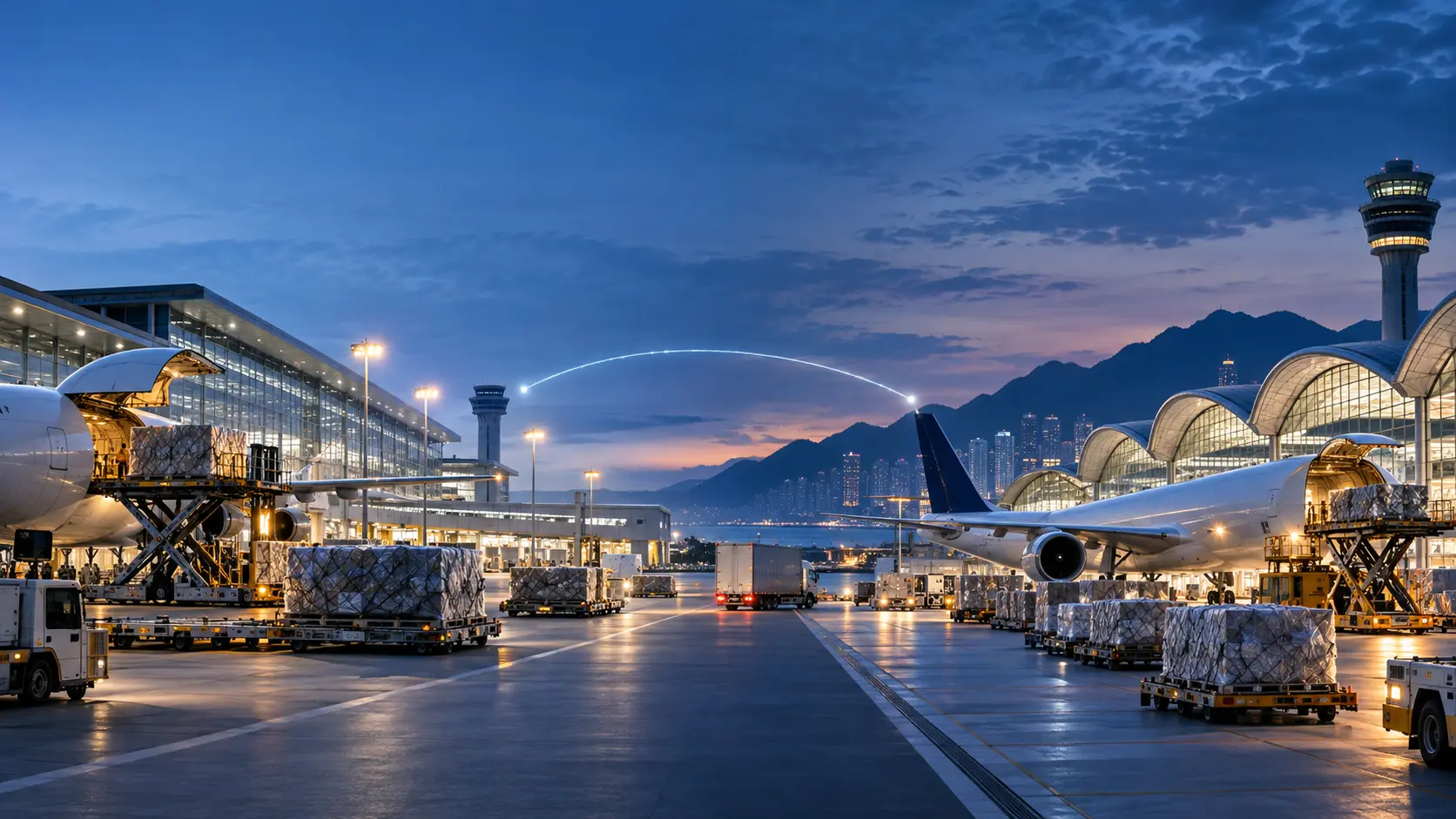
Mainland China or Hong Kong Airport: The Short Answer
For correctly described general cargo with a suitable mainland flight, a mainland airport is usually the first option to check. It keeps the origin process inside one customs jurisdiction, avoids cross-border trucking into Hong Kong and normally reduces handling points.
By contrast, Hong Kong becomes worth evaluating when it provides a real operational advantage: a better international schedule, suitable freighter capacity, an airline that accepts the confirmed cargo configuration, a specialist cargo facility, or a route that is not available from the practical mainland gateway.
Do not select Hong Kong merely because someone calls the shipment “sensitive cargo.” Freight salespeople widely use that phrase, but customs and dangerous-goods regulations do not recognize it as a formal classification. The shipment still needs an accurate product description, lawful export arrangement, correct transport classification, compliant packing and confirmed airline acceptance.
| Decision factor | Mainland China airport | Hong Kong Airport |
|---|---|---|
| Best starting point for general cargo | Usually yes, when a suitable flight is available | Usually considered only when the route or capacity is better |
| Origin customs process | Mainland China export declaration | Mainland export process plus cross-border and Hong Kong procedures |
| Ground movement from a mainland factory | Domestic pickup and airport delivery | Pickup, mainland export handling and cross-border trucking |
| International airline network | Strong but airport- and destination-dependent | Broad network with substantial freighter and passenger capacity |
| Batteries and dangerous goods | Possible on approved airlines and routes after compliance review | Possible on approved airlines and routes after compliance review |
| Ordinary origin cost | Often lower because there are fewer origin stages | Often higher for mainland-origin cargo because of cross-border handling |
| Guaranteed to be faster | No | No |
| Can bypass dangerous-goods or export rules | No | No |
Five Checks Decide Whether Cargo Can Fly
Therefore, airport selection should come after cargo screening, not before it. A low airline rate is irrelevant if the cargo cannot clear export customs or the booked airline will not accept it. VoltFreight uses five checks when comparing mainland China and Hong Kong air freight routes.
1. Is the product legal to export?
The exporter must confirm the actual product, HS classification and applicable export controls. Some goods require an export licence, inspection, quarantine certificate or approval from another competent authority. Dual-use items, strategic commodities, controlled chemicals, cultural items and certain technologies need more than an ordinary commercial invoice.
Changing the departure airport does not turn a controlled product into ordinary cargo. If a shipper trucks mainland-manufactured goods to Hong Kong, the goods still need a lawful mainland export arrangement before crossing the boundary.
2. Is the product a dangerous good for air transport?
Many common products can present an aviation risk even when their commercial name sounds harmless. Examples include lithium batteries, power banks, perfume, aerosols, paint, adhesives, refrigerants, dry ice, some medical samples, magnetized material and machinery containing fuel or batteries.
The shipper is responsible for correct classification. A seller’s catalogue name, customs HS code or the informal label “sensitive cargo” does not replace a dangerous-goods classification.
3. Are the documents and packaging correct?
As a result, the required evidence depends on the cargo. It may include an SDS, air transport conditions identification report, UN38.3 test summary, battery specification, dangerous-goods declaration, test report, export licence or dangerous-goods packaging documentation. These documents perform different functions and cannot automatically replace one another.
4. Will the selected airline, terminal and aircraft accept it?
Regulatory eligibility does not guarantee a booking. Airlines can impose restrictions beyond the base regulations. One airline may accept a UN number only on a freighter. Another may require shipper pre-approval, decline a battery configuration or limit quantities on a particular sector.
Acceptance can also change when the route includes a connection. Every operating carrier and transfer point must be compatible with the shipment, not only the airline shown on the first flight.
5. Can the cargo transit and enter the destination country?
Finally, cargo may pass the checks at PVG, CAN, SZX or HKG but still fail at a transit airport or destination. Check import permits, sanctions, product registration, health controls, telecommunications approvals and other destination requirements before finalizing the origin airport.
What Can Be Shipped from Mainland China Airports?
Mainland airports handle more than ordinary cargo. Major gateways can carry general cargo and many categories of approved special cargo. However, the shipper still needs a suitable carrier, aircraft, handling process and compliant document set for the exact shipment.
Common international gateways include Shanghai Pudong (PVG), Guangzhou Baiyun (CAN), Shenzhen Bao’an (SZX), Beijing Capital or Daxing (PEK/PKX), Zhengzhou (CGO), Ezhou Huahu (EHU), Chengdu and other regional airports. The nearest airport is not automatically the best one. Supplier location, available uplift, aircraft type, destination frequency and cargo acceptance all affect the decision.
General cargo
General cargo normally includes goods that are not prohibited, controlled or classified as dangerous goods and do not need specialist handling. Typical examples may include ordinary garments, textiles, non-powered hardware, empty plastic products, printed materials and dry machinery components without batteries, magnets, fuel, oil or pressurized parts.
Shippers must accurately describe and properly pack even general cargo. For example, vague descriptions such as “parts,” “accessories,” “samples” or “electronics” can trigger questions because they do not explain what is inside the cartons.
Dangerous goods and reviewed special cargo
China’s current Civil Aviation Dangerous Goods Transport Regulations require shippers to classify, identify, pack, mark and label dangerous goods correctly before offering them for air transport. The shipper must also provide accurate dangerous-goods documents and supporting evidence when necessary.
Airlines carrying dangerous goods in mainland China must hold the appropriate permission, and that permission can identify accepted classes and operating limitations. This is why the answer may differ between two airlines operating from the same airport.
The Civil Aviation Administration of China also published the 2026 Catalogue of Dangerous Goods for Air Transport. Classification and booking should use the current rules rather than a copied checklist from an older shipment.
Mainland China Export Customs Requirements
China export customs and airline cargo acceptance are separate stages. Therefore, passing one stage does not guarantee the other.
For an ordinary commercial export, the declaration file commonly includes:
- an accurate commercial invoice;
- a packing list showing package count, gross weight, net weight and dimensions;
- the sales contract or supporting transaction information when required;
- the correct product description and HS code;
- exporter and customs-declaration information;
- transport details; and
- any product-specific licence, inspection record or supporting certificate.
Customs requirements depend on the product, not on whether the flight departs from a mainland airport or HKG. If the supplier cannot act as exporter, review the commercial arrangement before pickup. Our guides to China export customs clearance and the China export licence question explain that stage in more detail.
Dangerous-goods packaging inspection is a separate customs issue
For applicable export dangerous goods, the producer may need inspection of the packaging performance and a packaging use appraisal. China’s official service guide for the use appraisal of export dangerous-goods packaging lists supporting materials including the packaging performance result, conformity record, dangerous-characteristics classification report and sales contract.
This should not be confused with an SDS, an air transport appraisal or an airline booking approval. It is also unsafe to assume that routing cargo through Hong Kong automatically removes every mainland obligation. The exact treatment depends on the product, export arrangement, packaging and cross-border movement.
Which Air Cargo Documents Are Actually Required?
Customers often send one document and ask whether the cargo is now “approved.” In practice, a document only answers the question it was designed to answer. A complete file may contain three different groups of evidence.
| Document group | Examples | What it supports |
|---|---|---|
| Trade and customs documents | Commercial invoice, packing list, contract, HS code, export licence | Export declaration and regulatory control |
| Transport classification and airline review | SDS, air transport conditions report, UN38.3 test summary, battery specification, product photos | Identification of hazards and pre-booking acceptance |
| Dangerous-goods preparation | Shipper’s Declaration for Dangerous Goods, permitted packaging, marks, labels and packing records | Compliant offering of a classified dangerous good |
| Product or route controls | Export permit, strategic-goods licence, health certificate, transit approval or destination import permit | Legal movement of controlled products |
Is an SDS or MSDS mandatory?
No single answer applies to every cargo. An SDS can help identify a substance’s composition, hazards, flash point and transport information. Airlines, forwarders or laboratories may request it for liquids, powders, chemicals or an unfamiliar product.
However, the International Air Transport Association explains that transport rules do not universally require an SDS or require one merely because the product qualifies as an article. IATA also warns that many SDS documents do not provide an accurate transport classification.
An SDS therefore does not automatically prove that cargo is non-dangerous, replace laboratory testing, satisfy an airline variation or guarantee airport acceptance.
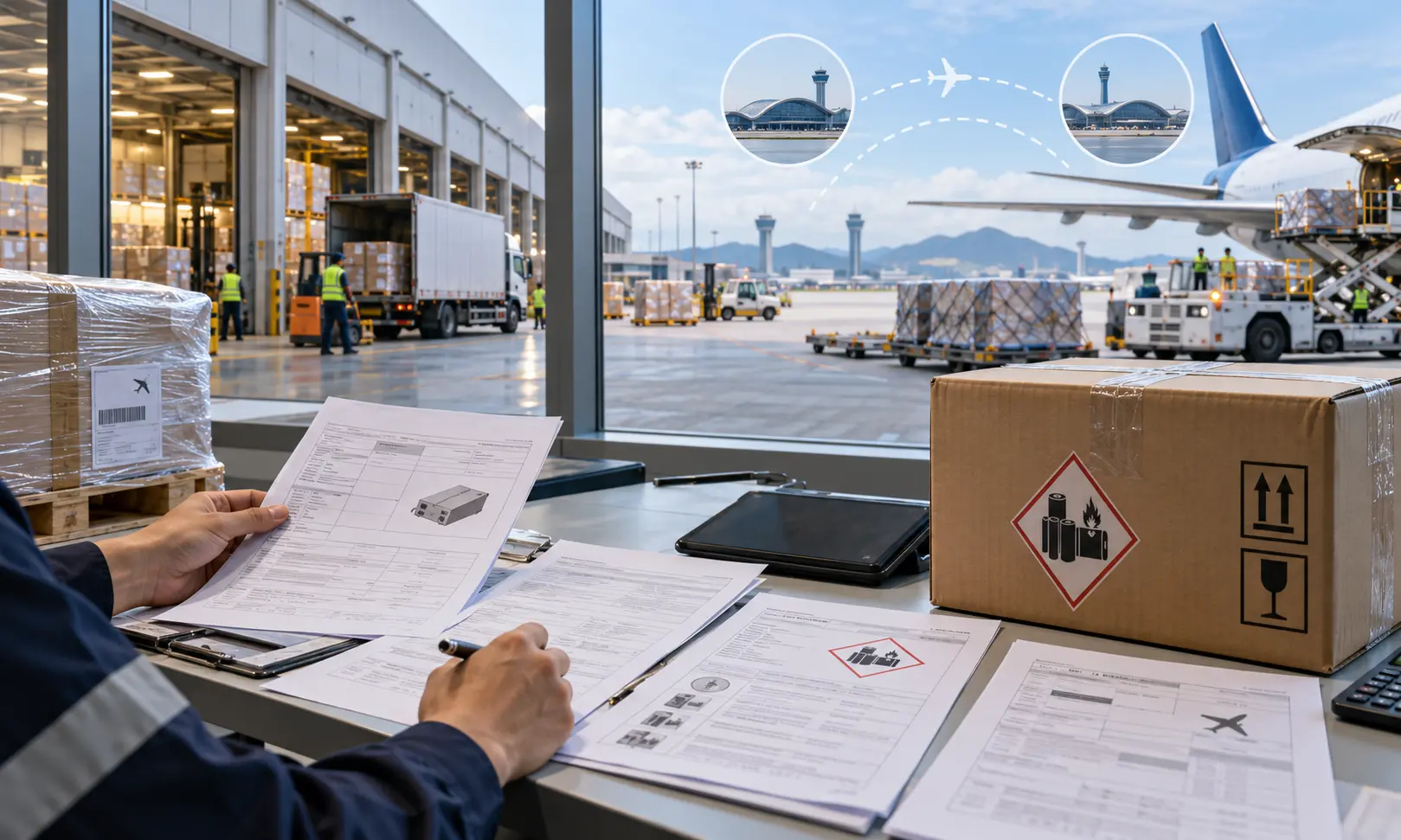
When is an air transport conditions identification report needed?
Mainland airlines, cargo terminals or security channels may request an air transport conditions identification report for cargo whose transport status is not obvious. This is common with powders, liquids, chemicals, magnets, batteries and products with an unclear composition.
It is not a universal customs document for every shipment. The current mainland regulation requires relevant evidence that cargo meets air transport conditions when necessary. Therefore, the booked operator and handling channel decide whether they require a report, which laboratory they accept, how the sample must match the shipment and how long the report remains valid.
A report for one model, formula or packing configuration should not be reused for a materially different product. Mismatches between the report, invoice, labels and actual cargo can cause rejection.
What is UN38.3?
UN38.3 relates to the design type testing of lithium cells and batteries. The test summary should match the battery model used in the shipment. It is not an airline booking, dangerous-goods declaration, export licence or packaging approval.
For a detailed method-by-method explanation, including air, sea, express and DDP options, read our guide to shipping batteries from China.
How Cargo from a Mainland Factory Reaches Hong Kong Airport
When a forwarder books mainland-origin cargo from HKG, the shipment does not move directly from the supplier into an international flight. In practice, a typical route includes:
- Collect the cargo from the mainland supplier.
- Receive and inspect it at the confirmed warehouse or handling point.
- Review the commercial, customs and air-transport documents.
- Complete the applicable mainland export process.
- Move the cargo across the mainland-Hong Kong boundary by an approved trucking arrangement.
- Complete the required Hong Kong cargo and customs procedures.
- Deliver the cargo to the correct HKG terminal.
- Pass security screening and airline acceptance.
- Build the cargo into the planned ULD or load configuration.
- Move it on the confirmed international flight.
Hong Kong Customs lists manifests, licences or removal permits when applicable, airway bills, invoices and packing lists among the documents used for cargo clearance. Its official import and export clearance guidance also explains the systems used for air and land cargo.
Hong Kong’s Civil Aviation Department separately requires shippers and freight forwarders to classify, pack, mark, label and document dangerous goods correctly before offering them for air transport. The official Hong Kong dangerous-goods guidance confirms that HKG acceptance follows a regulated process; it does not provide a workaround for incomplete cargo information.
The extra ground stage affects both cost and schedule. A late supplier handover, border issue, mismatched document or failed airline pre-check can cause the cargo to miss its planned HKG flight even when the flight itself operates on time.
What Hong Kong Airport Can Solve
Hong Kong International Airport is a major global air cargo gateway. Its value is not that it ignores cargo rules. Instead, its network, cargo infrastructure, freighter services and specialist handling capability create the advantage.
HKIA lists cargo terminals with dangerous-goods rooms, temperature-controlled facilities, valuable-cargo areas, livestock handling and IATA CEIV certifications, including CEIV Lithium Batteries at several facilities. You can review these capabilities on the official HKIA cargo infrastructure page.
An HKG route may be commercially useful when:
- the destination has a better flight schedule from Hong Kong;
- a suitable freighter is available from HKG but not from the practical mainland airport;
- the cargo requires a specialist handling facility;
- an airline at HKG accepts the confirmed dangerous-goods configuration;
- the available aircraft door or ULD plan better suits the cargo;
- capacity from the mainland gateway is unstable for the required date; or
- the HKG route reduces connection risk enough to justify the additional origin cost.
Some carriers operating at HKG have extensive dangerous-goods capabilities. For example, Cathay Cargo states that it can accept all nine dangerous-goods classes through its dangerous-goods solution, while also requiring prior approval for specified lithium-ion battery shipments. This illustrates an important point: airport capability and individual shipment approval are not the same thing.
What Hong Kong Airport Cannot Solve
HKG is not a compliance shortcut. It cannot make the following problems disappear:
- a product prohibited from air transport;
- a damaged, defective or recalled lithium battery that is not eligible for the planned service;
- a missing or mismatched UN38.3 test summary;
- incorrect dangerous-goods classification;
- non-compliant packaging, marks or labels;
- a missing mainland export licence;
- a Hong Kong import, export or transshipment control;
- a transit-country restriction;
- a destination import prohibition; or
- an airline decision not to carry the product.
Strategic and dual-use goods
Hong Kong has its own strategic trade control system. Its Trade and Industry Department guidance for carriers states that Hong Kong controls the import, export and transshipment of strategic commodities through licensing and can also require licences for more sensitive items in transit. Consequently, a mainland export licence does not automatically satisfy Hong Kong requirements.
Some air-to-air cargo remaining inside the HKIA transshipment area may qualify for specific treatment. However, do not automatically describe cargo trucked from mainland China into Hong Kong as air-to-air transshipment. Review the actual movement and licence position first.
Electronic cigarettes and alternative smoking products
Hong Kong restricts the import of alternative smoking products, including electronic cigarettes, heated tobacco products and related products. Certain transit, air-transshipment or registered intermodal arrangements may be exempt, but an ordinary truck-to-HKG plan should never be assumed acceptable. Current information is available from Hong Kong Customs.
Cargo-by-Cargo Route Comparison
The following tables provide a planning guide, not an acceptance guarantee. Before booking, review the exact product, model, composition, quantity, packaging, airline and destination.
General, Battery and Chemical Cargo
| Cargo type | What must be checked | Likely airport approach |
|---|---|---|
| Ordinary garments, textiles and non-powered goods | Accurate description, packing and normal export documents | Start with the practical mainland airport |
| Standard machinery parts | Confirm no battery, magnet, pressure vessel, fuel or oil residue | Mainland usually preferred when a suitable route exists |
| Equipment containing lithium batteries | Battery type, model, Wh rating, UN38.3, installation, quantity and packing instruction | Compare compliant mainland and HKG airline options |
| Standalone lithium batteries or power banks | UN number, battery chemistry, capacity, state of charge, test summary, packing, declaration and shipper approval | Pre-approval required; HKG may offer more options but is not automatic |
| Liquids, powders, pastes and cosmetics | Composition, flash point, hazard class, SDS and identification report when requested | Classify first; do not choose HKG solely because the cargo is called sensitive |
| Perfume, paint, adhesives and flammable products | Dangerous-goods classification, permitted quantities, packing and airline approval | Use an approved dangerous-goods route from either jurisdiction |
| Motors, speakers, magnets and magnetic assemblies | Magnetic field test, shielding and operator requirements | Choose the airport only after test and carrier review |
| Machinery containing fuel, oil or hydraulic residue | Draining, cleaning, declaration and possible dangerous-goods classification | Mainland or HKG after evidence and physical condition are confirmed |
Special, Controlled and Oversized Cargo
| Cargo type | What must be checked | Likely airport approach |
|---|---|---|
| Aerosols, gas cartridges and pressurized products | Class 2 classification, permitted packing, quantities and aircraft limitations | Approved dangerous-goods service only |
| Dry ice and temperature-controlled cargo | Dry-ice quantity, ventilation, marks, airway bill information and cold-chain capability | Compare flight reliability and specialist facilities, not only rate |
| Diagnostic specimens or biological material | UN classification, packing instruction, permits and temperature plan | Use a specialist route confirmed at origin, transit and destination |
| Food, pharmaceuticals and medical products | Transport conditions plus product, health, export and destination controls | Airport choice follows compliance and cold-chain requirements |
| Dual-use or strategic products | Mainland export control, Hong Kong control, transit and destination restrictions | Licence analysis comes before route selection |
| Oversized or heavy pieces | Piece dimensions, centre of gravity, aircraft door, ULD, loading equipment and floor limits | Select by aircraft and terminal capability; HKG is not automatically better |
| Live animals, perishables or valuable cargo | Special booking, permits, handling facility, security and connection time | Choose the route with confirmed end-to-end handling |
Lithium Batteries: Mainland or Hong Kong?
Lithium batteries are one of the main reasons customers ask about HKG, but “contains a battery” is not enough information to choose an airport.
The review should identify whether the shipment contains:
- standalone lithium-ion batteries, normally associated with UN3480;
- lithium-ion batteries packed with or contained in equipment, normally associated with UN3481;
- standalone lithium-metal batteries, normally associated with UN3090;
- lithium-metal batteries packed with or contained in equipment, normally associated with UN3091;
- power banks, which are treated as batteries rather than ordinary equipment;
- battery-powered vehicles or mobility products; or
- sodium-ion batteries subject to their applicable 2026 provisions.
The file may need a UN38.3 test summary, battery specification, product photographs, shipper information, state-of-charge confirmation, applicable dangerous-goods declaration and evidence that the packaging follows the correct instruction. The exact list depends on the configuration and operator.
From 1 January 2026, IATA’s lithium-battery guidance applies a state-of-charge limit of no more than 30% to specified lithium-ion batteries packed with the equipment they power. However, do not copy that rule indiscriminately to every battery configuration. Check the correct packing instruction, any permitted exceptions and the airline variation.
A mainland departure can be efficient when an approved airline and established acceptance process are available. Hong Kong may be useful when its carrier network, freighter capacity or approved shipper programme fits the shipment better. Neither route can compensate for a failed test, damaged battery, incorrect declaration or unsuitable packing.
Liquids, Powders, Cosmetics and Chemicals
Liquid and powder describe physical form, not transport classification. Water-based liquid, flammable perfume, corrosive cleaning fluid and an unidentified chemical solution do not follow the same rules. The same applies to protein powder, mineral powder, metal powder and an oxidizing chemical powder.
Before choosing an airport, VoltFreight may request:
- the complete commercial name and intended use;
- ingredient or composition information;
- SDS in a suitable language;
- flash point, pH or other relevant test data;
- an air transport conditions report when requested by the channel;
- inner and outer packaging details;
- product and label photographs; and
- the total quantity per inner and outer package.
If the classification identifies the product as dangerous goods, follow the applicable UN entry, packing instruction, quantity limit, marks, labels and documentation. For an example of a product that may fall under Class 3 requirements, see our guide to shipping perfume from China.
Magnetic Cargo, Motors and Speakers
Magnets can affect aircraft navigation systems when their field strength exceeds the permitted conditions. Products that deserve screening include permanent magnets, magnetic assemblies, some motors, loudspeakers, pumps, laboratory equipment and industrial components.
The fact that an item contains a magnet does not automatically make it forbidden. The field strength, distance, orientation and shielding matter. A carrier or terminal may request a magnetic inspection report or require additional shielding.
Mainland and Hong Kong routes both remain possible after review. The preferred airport is the one with a confirmed acceptance process and suitable flight, not the airport described by a salesperson as generally more relaxed.
Passenger Aircraft, Freighters and Route Acceptance
Two quotations from the same airport may use different aircraft and therefore represent different services. Passenger aircraft carry cargo in the lower deck and can have tighter restrictions on dimensions, dangerous goods and available payload. Freighters normally provide larger cargo doors and may accept categories or quantities that cannot move on a passenger aircraft.
This does not mean every dangerous good can travel on every freighter. The operating airline’s permission, aircraft limitations, loading compatibility and route variations still apply.
When comparing a mainland and HKG departure, ask:
- Is the quoted service passenger belly or freighter capacity?
- Is the booking direct or connecting?
- Has every operating carrier accepted the cargo?
- Does the aircraft door accept the packed piece dimensions?
- Is the rate based on confirmed cargo details or only a general-cargo estimate?
- What happens if the cargo fails terminal acceptance?
For the general service process, see VoltFreight’s airport-to-airport air freight service and air freight booking guide.
Is Hong Kong Air Freight More Expensive?
For cargo produced in mainland China, an HKG route often has a higher origin cost because it adds cross-border movement and another handling stage. However, “Hong Kong is always more expensive” is also too simplistic. The international airline rate, available capacity and missed-flight risk can change the final result.
A fair comparison should use the complete origin-to-destination airport cost:
Total air-freight route cost = factory pickup + export processing + inspection or testing + origin handling + cross-border trucking where applicable + terminal and security charges + dangerous-goods fees + airline freight + connection costs + expected delay risk.
| Cost item | Mainland departure | HKG departure for mainland cargo |
|---|---|---|
| Factory pickup | To mainland warehouse or airport | To the approved cross-border handling point |
| Mainland export process | Required | Still required under the applicable arrangement |
| Cross-border truck | Not applicable | Normally required |
| Additional Hong Kong handling | Not applicable | Warehouse, terminal, declaration or security costs may apply |
| International air freight | Depends on airport, airline and date | Depends on airline, route and date |
| Dangerous-goods fees | When applicable | When applicable |
| Missed-flight exposure | Depends on cutoff and acceptance | Includes the cross-border schedule and HKG cutoff |
Do not compare a mainland airport-to-airport rate with an HKG quotation that includes pickup, cross-border trucking and handling. First align the service scope. Our air freight rates from China page explains the main rate components and chargeable-weight basis.
Is Hong Kong Faster Than a Mainland Airport?
Not necessarily. HKG may offer a more frequent or direct international flight, but mainland-origin cargo must reach Hong Kong, cross the boundary and complete terminal acceptance before the HKG cutoff.
A direct mainland flight can be faster for general cargo located near PVG, CAN, SZX or another gateway. HKG can be faster when the mainland alternative has a long connection, poor capacity, an unsuitable aircraft or no approved cargo channel.
Compare the full timeline:
- supplier readiness;
- pickup and warehouse receiving;
- document review and testing;
- export customs;
- cross-border movement where applicable;
- terminal acceptance and flight cutoff;
- international flight and connection;
- destination terminal release; and
- the importer’s customs and pickup arrangement.
A two-day flight advantage is not useful if the cargo spends three extra days correcting documents before HKG acceptance.
When a Mainland China Airport Is Usually the Better Choice
Start with a mainland departure when most of the following are true:
- the cargo is accurately described general cargo;
- the supplier is close to a suitable mainland gateway;
- a practical flight serves the destination;
- the airline has confirmed the cargo type;
- the shipment does not benefit from specialist HKG handling;
- the deadline does not require a better HKG schedule; and
- the mainland route has the lower complete cost.
This is common for commercial cartons, garments, ordinary spare parts, hardware and correctly prepared non-dangerous industrial products.
When Hong Kong Airport Is Worth Considering
Evaluate an HKG departure when one or more of the following create a measurable advantage:
- HKG has a direct or substantially better connection to the destination;
- the cargo needs a freighter or specialist handling arrangement;
- the practical mainland carriers do not accept the confirmed cargo configuration;
- an HKG carrier has completed the required shipper or model approval;
- the shipment is urgent and HKG has more reliable uplift for the required date;
- the packed piece dimensions fit an HKG aircraft option better; or
- the value of avoiding a delay is greater than the additional cross-border cost.
After the document review, obtain written confirmation for the HKG option. A generic “Hong Kong sensitive cargo rate” is not enough for a commercial booking.
When Neither Route Should Be Booked Yet
Stop the booking and correct the file when:
- the cargo description is vague or inconsistent;
- the supplier cannot confirm whether the product contains a battery, liquid, powder, magnet, gas or chemical;
- the UN38.3 test summary does not match the battery model;
- the SDS is incomplete or conflicts with the product label;
- required export or import licences are missing;
- dangerous-goods packaging has not been prepared;
- the product is damaged, leaking or recalled;
- the airline has not accepted the cargo; or
- the destination or transit requirement has not been checked.
Changing the airport before solving these issues usually moves the problem rather than solving it.
Practical Routing Examples
The following examples illustrate the decision method. They are not universal acceptance promises or fixed quotations.
Example 1: General cargo from Dongguan
A supplier has 800 kilograms of ordinary metal fittings with no batteries, magnets, liquid or oil. CAN and SZX both offer suitable flights. Trucking the cargo to HKG adds border and handling costs without improving the international schedule.
Likely decision: compare CAN and SZX first. HKG has no clear operational advantage.
Example 2: Equipment containing lithium-ion batteries
A shipment contains commercial devices with installed batteries. The supplier provides matching UN38.3 information, battery specifications, product photographs and packing details. A mainland airline and an HKG airline both agree to review it.
Likely decision: compare the confirmed acceptance conditions, aircraft, total origin cost and flight reliability. Do not assume HKG wins only because the product contains batteries.
Example 3: Unidentified chemical liquid
The invoice says “cleaning solution,” but the supplier cannot provide composition, flash point or a reliable SDS. A forwarder offers a Hong Kong route without completing the classification review.
Likely decision: do not book either route. Identify and classify the product first.
Example 4: Power banks requiring a freighter route
The cargo is correctly classified, tested and packed, but the practical mainland passenger service cannot carry the planned shipment. An approved HKG freighter operator is willing to conduct pre-approval.
Likely decision: HKG may justify the higher origin cost if final approval is received and the entire connecting route accepts the cargo.
Example 5: Oversized machinery
A single packed machine is too tall for the available passenger-aircraft door at the nearest mainland airport. HKG has a possible freighter, but another mainland gateway also has suitable cargo-aircraft capacity.
Likely decision: compare aircraft door dimensions, loading plan, inland trucking and total schedule. Aircraft and route capability drive the decision, not the border.
How VoltFreight Selects the Departure Airport
VoltFreight does not select HKG, SZX, CAN, PVG or another gateway from the product name alone. We first review the cargo and then compare workable routes.
- Confirm the goods. We check the exact product, intended use, model, material and whether it contains a battery, liquid, powder, magnet, gas, chemical, dry ice, fuel or oil.
- Check the packed shipment. We review carton or crate count, gross weight, dimensions, stackability and any oversized pieces.
- Review the available documents. Depending on the product, this can include the invoice, packing list, SDS, UN38.3, technical specification, photos, appraisal report and permits.
- Identify compliant airport options. We compare the practical mainland gateways and HKG against airline acceptance and aircraft capability.
- Compare the complete cost. The comparison includes pickup, export handling, cross-border movement where applicable, terminal fees and international air freight.
- Confirm the booking conditions. VoltFreight confirms the final route only after the required operator review and cargo-space check.
VoltFreight can arrange supplier pickup, China warehouse receiving, multi-supplier consolidation, export customs coordination, cross-border trucking when HKG is selected, airline booking, Air Waybill support and flight tracking under the agreed service scope. Review our broader air freight from China service for available service levels.
Information Needed for a Mainland vs Hong Kong Route Review
Send the following information before asking which airport is better:
- exact English cargo name and intended use;
- product model and clear photographs;
- supplier city and pickup address;
- destination airport and final country;
- number of cartons, pallets or crates;
- gross weight and dimensions of every package;
- stackable or non-stackable status;
- required cargo-ready and delivery dates;
- whether the goods contain batteries, liquids, powders, magnets, gases, chemicals, dry ice, fuel or oil;
- battery chemistry, model, Wh rating, quantity and installation method where applicable;
- available SDS, UN38.3, test reports, transport appraisals or permits; and
- whether the importer has a destination customs broker and import approvals.
A packing list alone may be sufficient for an initial general-cargo comparison. However, for special cargo, send the product and technical information before requesting a meaningful route or rate.
Frequently Asked Questions
Are air cargo rules different in mainland China and Hong Kong?
Both systems apply international aviation safety principles, including ICAO technical requirements and the operating rules used by airlines. However, mainland China and Hong Kong have separate customs territories, local regulations, cargo procedures and enforcement systems. Individual airlines also apply their own variations.
Is Hong Kong always better for lithium batteries?
No. Some compliant battery shipments can depart from mainland airports, while some configurations may have more airline or freighter options at HKG. The correct route depends on the UN classification, battery configuration, test documents, state of charge, packing, shipper approval, destination and available airline.
Can Hong Kong be used to avoid mainland China export customs?
No. Goods leaving a mainland factory for Hong Kong still need a lawful mainland export arrangement. The cross-border movement also introduces Hong Kong cargo and customs procedures. HKG changes the departure gateway; it does not erase the origin of the goods.
Does every mainland air shipment need an air transport appraisal?
No. Ordinary cargo does not automatically require one. A mainland airline, terminal or security channel may request an identification report when the transport status of the cargo needs confirmation. Therefore, check the requirement against the actual product and booking channel.
Is an MSDS enough to ship chemicals by air?
Not necessarily. An SDS can support classification, but it may be incomplete or inaccurate for transport. The cargo may also need testing, a dangerous-goods declaration, compliant packaging, marks, labels, export documentation and airline approval.
Can liquids and powders depart from mainland airports?
Potentially, yes. “Liquid” and “powder” are not automatic prohibitions. First, establish the composition and transport classification. The selected carrier may then request an SDS or air transport identification report, while dangerous goods must follow the applicable requirements.
Can dangerous goods fly from mainland China?
Many dangerous goods can move from mainland airports through appropriately permitted carriers when the goods, documents, packaging, quantities and route comply with the applicable rules. Nevertheless, regulations forbid some goods, other products require special approval, and individual airlines may reject specific cargo.
Is HKG always more expensive?
HKG often adds origin cost for mainland cargo because of cross-border trucking and additional handling. However, the international airline rate and schedule can be better on a particular lane. Compare the complete route rather than one per-kilogram line.
How much time does the Hong Kong transfer add?
There is no universal number. The additional time depends on supplier location, document readiness, export processing, truck schedule, boundary conditions, HKG terminal cutoff and airline acceptance. The HKG flight may still create a faster overall solution when the mainland alternative has a poor connection.
Which airport is cheapest for air freight from China?
No airport is always cheapest. PVG, CAN, SZX, HKG and other gateways serve different factories, airlines and destinations. The cheapest usable route is the one that combines compliant acceptance, practical pickup, suitable capacity and the lowest complete cost.
Can VoltFreight quote both routes?
Yes, when both routes are operationally available. Send the complete cargo details and existing technical documents. VoltFreight can compare a practical mainland gateway with HKG and identify the assumptions, included charges and approval conditions in each option.
Choose the Airport After the Cargo Review
No simple rule such as “mainland China is cheap and Hong Kong is flexible” can decide the best departure airport. Instead, general cargo often benefits from the shorter and lower-cost mainland process. HKG becomes valuable when its network, freighter capacity, specialist facilities or airline acceptance creates a specific advantage.
The route should always follow the cargo facts. Confirm what the product contains, complete the required export and transport documents, compare airlines and aircraft, and calculate the full origin cost before booking.
Send VoltFreight your cargo name, product photos, supplier city, destination airport, package count, weight, dimensions and available SDS, UN38.3 or other technical documents. We will review whether a mainland China airport or Hong Kong Airport is the more practical starting point for your shipment.
Contact VoltFreight for a cargo and route review.
Official References
- Mainland China Civil Aviation Dangerous Goods Transport Regulations
- CAAC Catalogue of Dangerous Goods for Air Transport, 2026 edition
- China Customs guide to export dangerous-goods packaging use appraisal
- IATA dangerous-goods guidance and 2026 updates
- IATA battery guidance
- Hong Kong Civil Aviation Department dangerous-goods guidance
- Hong Kong strategic-commodities guidance for carriers
- Hong Kong Customs import and export clearance guidance
- Hong Kong International Airport cargo infrastructure and facilities