Your goods are ready, the cartons are packed, and then your supplier says: “We don’t have an export license.”
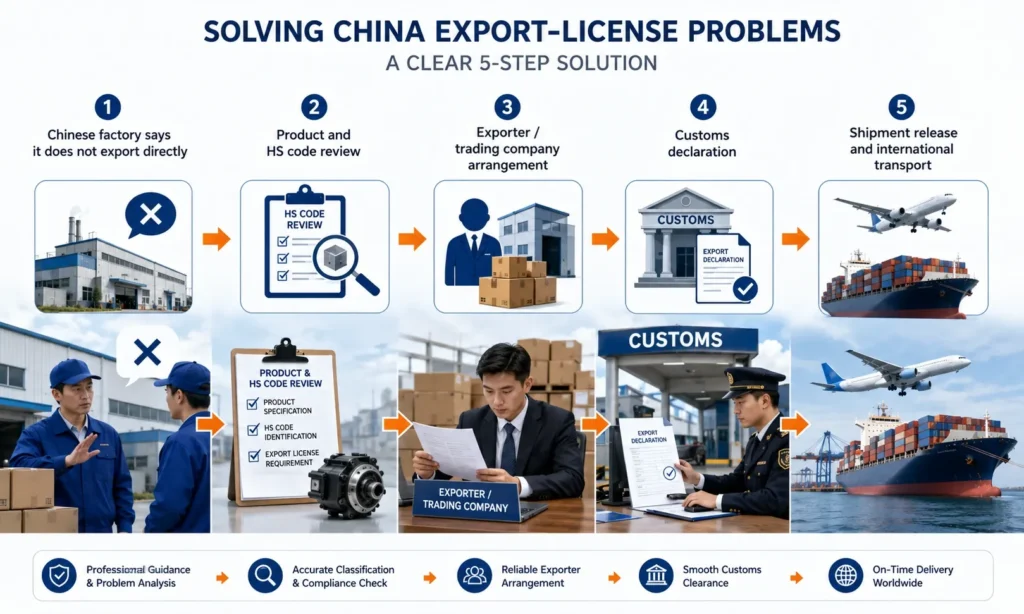
That message sounds serious, but it does not always mean the shipment is stuck in China. Quite often, the factory simply does not export under its own company or does not want to manage the China customs process. For ordinary goods, a compliant export arrangement may still be possible through an appropriate Chinese trading or exporting entity.
There is, however, a second possibility: the product itself may require a government-issued China export license or export-control authorization. If that is the case, changing the freight forwarder, trade term or exporting company does not make the legal requirement disappear.
The first job is therefore not to find someone who promises to “provide a license.” It is to find out what the supplier actually means, identify the product correctly and confirm who will handle the export declaration before anyone collects the cargo.
Important: This guide explains general shipping and customs-planning principles. It is not legal, tax or export-control advice. Product classification, licensing, customs filing and the commercial arrangement must be checked for the actual shipment.
Your Supplier Says “We Don’t Have an Export License”—What Should You Do?
Start by asking the supplier one more question:
“Do you mean your company cannot handle the export customs declaration, or do you mean this product requires a government export license?”
That one question often saves several days of confused messages between the buyer, factory and freight forwarder.
Many smaller factories mainly sell inside China. They may manufacture perfectly exportable products but have no regular export department, no established customs workflow or no interest in handling an overseas order under their own company. When they say “no export license,” they may only mean, “We cannot arrange the export side for you.”
This is an operational problem that may have a workable solution.
A product-specific licensing requirement is different. China maintains current catalogues and export-control rules for certain commodities. If the goods are covered, the responsible Chinese exporting party must complete the applicable approval process before Customs can release them.
Do not ask the factory to guess. Ask for the exact product name, material, function, model, photos and HS code if it has one. That information gives the exporting party and customs professional something concrete to review.
What “Export License” Can Mean in China
In everyday supplier conversations, “export license” is used as a catch-all phrase. It can refer to company registration, Customs filing, the ability to make an export declaration, a product license or even the supplier’s willingness to deal with international shipping.
These are not the same thing.
The Factory Does Not Export Under Its Own Company
The factory may not act as the export consignor or manage export declarations as part of its normal business. It may quote EXW prices, accept domestic RMB payments or sell its products to a Chinese trading company that handles overseas orders.
For ordinary, eligible goods, another Chinese entity may legitimately participate in the transaction and export process. The arrangement still needs to match the actual sale, invoice, payment, product and customs information. It should not be treated as borrowing a company name for a shipment that the company knows nothing about.
One outdated point causes extra confusion. China stopped requiring the former Foreign Trade Operator Registration on December 30, 2022. The official Ministry of Commerce explanation confirms that local commerce authorities stopped processing that registration.
That change did not remove export declarations, Customs filing, accurate commercial documents or product-specific licensing. China Customs still maintains a filing process for consignees and consignors of import and export goods; its current official filing guide explains the application route.
The Product Itself Requires an Export License or Control Approval
This is the situation where the word “license” must be taken literally.
The requirement follows the goods and the applicable regulation—not the shipping method. Sending the cargo by air instead of sea, buying under EXW instead of FOB or using a different forwarder does not remove a legal control.
Classification matters. A simple English product name may not reveal the material, technical specification, end use or control status that determines whether approval is required. This is why a freight quotation alone is never proof that controlled goods can legally leave China.
Quick Decision: Which Situation Are You In?
Use the following table before asking anyone to collect the goods:
| What the Supplier Means | What It Usually Indicates | Your Next Step |
|---|---|---|
| “Our factory does not export directly.” | The factory may sell domestically or avoid handling export customs. | Confirm the product is eligible, then establish a legitimate Chinese exporting and declaration arrangement. |
| “Your forwarder needs to handle export customs.” | The supplier may be offering EXW terms or expecting the buyer to coordinate the China side. | Have the forwarder review the exporter, invoice, packing list and declaration plan before pickup. |
| “This product needs government approval to export.” | The commodity may fall under export-license administration, dual-use controls or another regulated category. | Stop the booking process and obtain a product-specific regulatory review and any required authorization. |
If the supplier cannot clearly explain which row applies, send its original Chinese message to your freight forwarder. The exact wording can be more useful than a translated summary such as “no license.”
If the Factory Cannot Export Ordinary Goods
For normal commercial cargo, the practical issue is usually not whether the cartons can move. It is whether the shipment has a supportable commercial and customs structure.
The manufacturer, seller, exporting party, customs declaration enterprise and freight forwarder can be different companies. One company may also perform more than one role. What matters is that each role is understood and the documents reflect the real transaction.
Clarify the Problem Before Choosing a Solution
Ask the supplier:
- Can your company act as the export consignor for this order?
- Do you normally prepare an export commercial invoice and packing list?
- Do you export through a regular Chinese trading company?
- Is your quotation EXW, FOB or another Incoterm?
- Are you saying the company cannot export, or that the product is restricted?
If the factory normally works with a trading company, ask for the trading company’s details early. If no exporting arrangement exists, let the freight forwarder review the cargo and commercial situation before proposing one.
Avoid vague offers to “buy” or “lend” export documents. A company that participates only on paper, without a supportable relationship to the transaction, can create tax, payment and declaration risks for the Chinese parties as well as delays for the overseas buyer.
Confirm the Exporting Party and Document Chain
A Chinese trading company can legitimately purchase goods from a manufacturer and resell them overseas, or otherwise participate in a lawful agency arrangement. A customs declaration enterprise can submit an eligible declaration when properly entrusted. A freight forwarder can coordinate these parties and the movement of the cargo.
Those roles should not be blurred into “the forwarder provides a license.”
Before booking, confirm:
- Who manufactured and sold the goods
- Who received or will receive payment
- Which Chinese company will act in the export arrangement
- Who will coordinate or submit the customs declaration
- Which invoice and packing list support the declaration
- Whether the product needs any separate license, inspection or approval
For a detailed explanation of the declaration process, see our guide to customs clearance in China.
What a Freight Forwarder Can—and Cannot—Do
A freight forwarder can collect product and supplier information, check whether the invoice and packing list are usable, arrange pickup, communicate with the exporting and declaration parties, book transport and keep the origin process moving.
That does not automatically make the forwarder the seller, manufacturer, export consignor or holder of a product-specific authorization. If the forwarder says, “We can handle the export,” ask what the service actually includes:
- Is an exporting entity already confirmed?
- Who will review the product classification and declaration data?
- Does the quote include export declaration charges?
- Are any licenses or certificates excluded from the service?
A clear answer should describe the parties and process, not simply promise that “the license is no problem.” The forwarder can coordinate a compliant route for eligible cargo; it cannot make a regulated product ordinary cargo by changing the paperwork.
Arrange Pickup After the Export Plan Is Confirmed
It is tempting to move finished goods to a warehouse while the paperwork is still being discussed. That can turn a solvable document question into storage charges, missed cut-off times and an urgent rebooking.
This is especially important under EXW. EXW shifts more origin coordination to the buyer, but it does not automatically create a Chinese exporting party or solve regulatory requirements. Our EXW vs FOB shipping guide explains how the responsibilities differ.
The same rule applies when several factories deliver to one warehouse. Physical consolidation is only one part of the job; each supplier’s commercial and export information must also fit the declaration plan. If you are buying from several factories, review the process for consolidating shipments from multiple suppliers in China before arranging deliveries.
When a Real China Export License Is Required
Most importers buying ordinary consumer or industrial products will never apply for a Chinese commodity export license themselves. Even so, they need to know when the question should be escalated instead of treated as a routine freight issue.
Goods in the 2026 Export-License Catalogue
China publishes an annual catalogue of goods subject to export-license administration. The official 2026 catalogue issued by MOFCOM and China Customs covers 43 types of export goods.
The list includes specific agricultural products, raw materials, metals, fuels, vehicles and other designated commodities. It is not a general permit covering every shipment from China.
When the goods fall within the catalogue, the Chinese export operator applies to the Ministry of Commerce or an entrusted local commerce authority in accordance with the applicable rules. The overseas buyer does not normally solve this by asking a freight forwarder to place a different name on the shipping documents.
Dual-Use Items and Other Controlled Products
Dual-use items, technologies and related controlled goods follow a separate export-control framework. Review may depend on technical characteristics, control classification, end user, end use and destination.
MOFCOM and China Customs publish the current 2026 licensing catalogue for dual-use items and technologies. A product may also be affected by temporary controls or other regulatory measures even if a buyer cannot find its marketing name in a catalogue.
Other products can require inspection, quarantine, certificates or approvals under separate systems. Batteries, chemicals, liquids, powders, magnets, food, plants, animal products and branded goods also need accurate technical and compliance information, although these categories are not automatically “export-license goods.”
If there is any doubt, do not disguise the description, split the value or label commercial cargo as a “sample.” Those changes do not alter the actual product or remove a legal requirement.
What Changed for Agency Exports After October 2025?
There is a newer rule that matters when a factory exports through another Chinese company.
China’s State Taxation Administration Announcement No. 17 of 2025 took effect on October 1, 2025. Under the announcement, enterprises acting as agents for exports—including certain market-procurement and foreign-trade comprehensive-service arrangements—must report information about the actual entrusted exporting party and the relevant export amount with their enterprise income tax prepayment filing. If the agent does not report the information accurately, the export may be treated as the agent’s self-operated export for the relevant enterprise income tax responsibility.
You can read the official State Taxation Administration announcement.
This is a Chinese tax-reporting rule, not a new universal “export license” for cargo. But it reinforces an important practical point: the real supplier, actual entrusted exporter and export value should not be hidden behind an unrelated company’s name.
For overseas buyers, the sensible response is not to become a Chinese tax expert. It is to avoid last-minute, anonymous exporting arrangements and make sure the Chinese parties have reviewed the transaction before the goods move.
What Must Match Before Pickup?
You do not need every final transport document before factory pickup, but the core shipment information should already tell one consistent story.
Commercial Invoice
The invoice should identify the actual merchandise, parties, quantity, unit value, total value, currency and trade term. Use a specific description such as “stainless-steel kitchen sink, model X20” instead of “hardware,” “accessories” or “samples.”
If a trading or exporting company is involved, confirm which commercial invoice will support the export arrangement. Do not wait until the cargo reaches the terminal to discover that the supplier’s invoice and the exporting party’s documents describe different products or values.
Packing List and Physical Cargo
The packing list should agree with what is actually collected: carton or pallet count, product quantity, gross and net weight where applicable, dimensions and shipping marks.
Factories sometimes prepare packing data before final production and never update it. Ask for the final version after packing, especially if the freight price depends on chargeable weight or volume. Our packing list for international shipping guide shows the fields to check.
Exporter and Declaration Information
The product description, HS classification, quantity, value, exporting party and applicable authorization should make sense together. Small spelling differences are not the main issue; contradictory commercial facts are.
If a customs professional changes an HS code or requests a more precise product description, send the change back to the supplier and exporting party. Keeping separate versions of the invoice for different people is an easy way to create avoidable questions later.
A Realistic Buyer Example
Imagine a US buyer orders 80 cartons of metal display stands from a small factory in Foshan. The factory quotes EXW, finishes production and then says, “We have no export license. Your forwarder must handle it.”
The buyer’s first reaction may be to search for a company that can “rent” an export license. That is the wrong starting point.
Instead, the buyer sends the forwarder the factory’s Chinese company name, product photos, material, intended use, invoice, final packing list and the supplier’s original message. The forwarder checks whether the goods appear to be ordinary cargo, confirms the declaration information and coordinates with an appropriate Chinese exporting and customs declaration arrangement. Only after the parties agree on the exporter, documents and pickup instructions does the truck collect the cartons.
Now change one fact: the stands contain a controlled material or component. The same exporting arrangement cannot simply be reused. The product must first be classified and any required authorization obtained.
The lesson is simple: two suppliers can say the same sentence—“We have no export license”—while their shipments require completely different decisions.
What to Send Your Freight Forwarder
You can usually get a much clearer answer by sending one complete message instead of discussing the shipment through dozens of short chats.
Include:
- Supplier’s Chinese company name, contact person and pickup city
- Supplier’s exact explanation of why it cannot export directly
- Product name in English and Chinese, if available
- Clear photos, material, function and model or specification
- HS code, if the supplier already uses one
- Order value and purchasing term, such as EXW or FOB
- Commercial invoice and final packing list
- Carton or pallet count, weight and dimensions
- Destination country, city and postcode
- Any battery, chemical, liquid, powder, magnetic or branded characteristics
If the cargo may be controlled, also provide technical data, intended use and end-user information. A vague description protects no one; it only delays a meaningful review.
After the China export arrangement is clear, the forwarder can compare the appropriate transport route. Depending on the cargo size and deadline, that may be air freight from China, sea freight from China or door-to-door shipping from China.
How VoltFreight Helps When a Supplier Cannot Export Directly
When you send VoltFreight a message saying, “My supplier has no export license,” we will not give you a useful answer by replying with a price alone.
We first need to understand the cargo and the supplier’s problem. For eligible shipments, our China-side coordination can include supplier communication, factory pickup, warehouse receiving, document review, multi-supplier consolidation, customs declaration coordination and international freight booking.
We will also tell you when the issue is outside routine freight coordination. A commodity-specific China export license, dual-use authorization or other government approval must follow the applicable regulatory process; it cannot be replaced by a shipping booking.
The best time to review the arrangement is before pickup, while the factory can still correct documents and answer product questions without a truck, warehouse or vessel deadline waiting in the background.
To request a review, send us:
- The supplier’s explanation
- Product name, photos and material
- Cargo value and packing details
- Destination and preferred shipping deadline
- HS code and technical documents, if available
Contact VoltFreight to review the China export and shipping arrangement.
Before the Cargo Leaves the Factory
If a Chinese supplier says it has no export license, pause the pickup—but do not assume the order has failed.
First separate a factory that does not handle export customs from a product that legally needs authorization. Then confirm the goods, exporting party, declaration plan and commercial documents. If a real license or export-control approval applies, obtain it before booking. If the goods are ordinary and eligible, establish a legitimate export arrangement before the truck arrives.
That short review is far less expensive than trying to rebuild the shipment after the cargo has already reached a port, airport or export warehouse.
Official Sources and References
- Ministry of Commerce of China — Cancellation of Foreign Trade Operator Registration
- General Administration of Customs — Filing Guide for Consignees and Consignors of Import and Export Goods
- State Taxation Administration — Announcement No. 17 of 2025
- MOFCOM and China Customs — 2026 Catalogue of Goods Subject to Export License Administration
- MOFCOM and China Customs — 2026 Licensing Catalogue for Dual-Use Items and Technologies