Quick answer: Perfume can be shipped internationally from China, but many alcohol-based fragrances cannot move as ordinary cargo. The product formula, alcohol content, flash point, bottle size, total liquid quantity, packaging, destination and selected carrier all affect whether the shipment can travel by approved courier, air freight or sea freight.
Therefore, before a carrier accepts the cargo, the shipper normally needs to provide an SDS and enough product data to confirm the transport classification. In addition, commercial perfume shipments may require dangerous goods packaging, labels, declarations and destination import documents. A bottle that looks like a normal cosmetic product may still be regulated as a flammable liquid during transport.
This guide explains how businesses can ship perfume from China, which documents freight providers need, how air and sea options differ, and what importers should check before requesting a quotation. It is intended for perfume brands, wholesalers, distributors, e-commerce sellers and commercial importers rather than travellers carrying personal toiletries.
Contents
- Can perfume be shipped internationally from China?
- Why may perfume be classified as dangerous goods?
- What information is needed before a quotation?
- Approved courier, air freight or sea freight?
- Packaging and labelling requirements
- Documents required for perfume shipping
- Shipping perfume from China to the USA
- What affects the shipping cost?
- Cargo that cannot be booked as ordinary freight
- How VoltFreight reviews a perfume shipment
- Perfume shipping quotation checklist
- Frequently asked questions
Can Perfume Be Shipped Internationally from China?
Yes, commercial perfume shipments can leave China when the cargo, route, carrier and documents meet the applicable requirements. However, an importer should not assume that perfume can travel through the same service used for clothing, furniture or other general cargo.
Many fragrances contain ethanol or another flammable solvent. Consequently, a carrier may treat the shipment as dangerous goods and apply restrictions to the bottle capacity, liquid quantity per package, outer packaging, aircraft type, consolidation method and destination. Some carriers accept a particular perfume route only from approved dangerous goods shippers, while others do not accept it at all.
Alcohol-free perfume, solid perfume, perfume oil and low-flash-point spray fragrance may have different transport classifications. Therefore, the product name alone does not provide enough information. The manufacturer or shipper must supply the formulation and transport data before a freight forwarder can confirm a service.
Moreover, quantity changes the solution. A few commercial samples may be suitable for an approved dangerous goods courier channel. By contrast, dozens of cartons or several pallets may require formal dangerous goods air freight or sea freight. Large orders may be more economical by sea, although the port, shipping line and consolidation warehouse must still accept the classification.
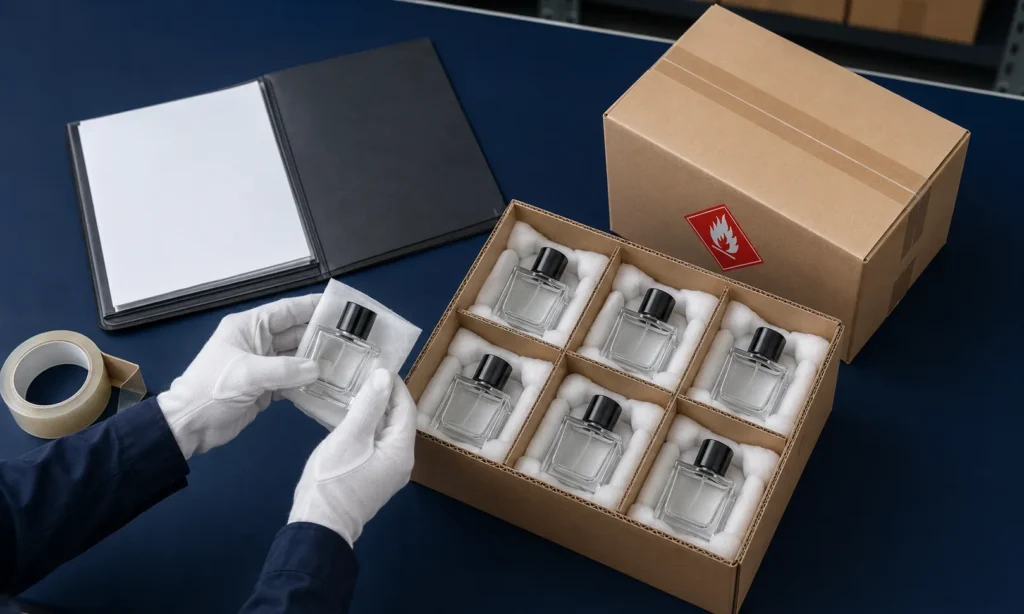
Why May Perfume Be Classified as Dangerous Goods?
Meanwhile, perfume is a cosmetic product for customs and market-compliance purposes, but transport regulations focus on its physical hazards. If the liquid contains enough flammable solvent and has a qualifying flash point, it may fall within Class 3 flammable liquids. A common proper shipping name for qualifying fragrance products is UN1266, Perfumery products. Nevertheless, a shipper should never assign that number without checking the actual formula and transport information.
The IATA Dangerous Goods Regulations provide the principal operational reference for dangerous goods transported by air. Airlines can also impose additional operator restrictions. Sea shipments follow maritime dangerous goods requirements as well as the rules of the loading port, destination port, shipping line and container operator.
Alcohol Content Is Not the Only Factor
A high alcohol percentage often indicates a flammability risk, but it is not the only figure that matters. The flash point, other solvents, packaging configuration and quantity per inner container can affect the final classification. For that reason, telling a forwarder only that the product contains “70% alcohol” is not a complete transport declaration.
The SDS Must Match the Actual Product
Therefore, an SDS should identify the product, manufacturer, composition, hazards, flash point, transport information and emergency measures. Section 14 is especially relevant, although the full document must be consistent. If the SDS belongs to a different formula, brand or fragrance concentration, the carrier may reject it.
In some cases, the booking party may also need a transport condition identification or dangerous goods classification report from an accepted testing body. Moreover, the carrier may request packaging evidence or additional clarification when the SDS does not provide a clear classification.
Limited Quantity Does Not Mean Ordinary Cargo
Small inner bottles or limited total quantities may qualify for specific relief under the applicable rules. Even so, “limited quantity” does not automatically mean that the shipment can be hidden inside ordinary cargo. Classification, packaging, marks, carrier approval and documentation may still apply. The correct treatment depends on the transport mode and the route in use.
What Information Is Needed Before a Perfume Shipping Quote?
A reliable quotation starts with product classification rather than the chargeable weight alone. Before checking space or a freight rate, provide the following information:
- Product name, brand and clear product photos
- Perfume type, such as eau de parfum, eau de toilette, perfume oil or solid perfume
- Alcohol percentage and flash point
- Current SDS or MSDS matching the actual product
- Transport classification report, if available
- Liquid volume per bottle and number of bottles per carton
- Total cartons, gross weight and carton dimensions
- Total net quantity of liquid in the shipment
- Inner packaging, cushioning and outer-carton details
- Pickup address and cargo-ready date in China
- Destination country, city and postcode
- Commercial value and Incoterm
- Required service: airport, seaport, warehouse or door delivery
- Whether the shipment contains branded or licensed products
Moreover, if several fragrances share one shipment, list each formula and bottle size separately. Different products may have different SDS documents or classifications. As a result, a mixed shipment can require more review than a single-SKU order.
Which Shipping Method Can Be Used for Perfume from China?
The best option depends on urgency, quantity, classification and destination acceptance. No single carrier or transport mode works for every shipment.
| Shipping method | Typical use | Main review points |
|---|---|---|
| Approved DG courier | Samples and small commercial consignments | Approved account, route, quantity, packaging and carrier acceptance |
| Dangerous goods air freight | Urgent, higher-value or medium-sized shipments | SDS, classification, aircraft restrictions, packaging, labels and air documents |
| LCL sea freight | Multiple cartons or pallets when an approved consolidation service is available | Class acceptance, port restrictions, warehouse approval and DG surcharges |
| FCL sea freight | Larger commercial volumes | Shipping-line approval, container loading, declaration and destination handling |
Approved Dangerous Goods Courier
For example, courier service can be convenient for small samples or limited commercial orders, but ordinary online booking may not accept perfume. The shipper may need an approved dangerous goods account, and the carrier must accept the origin, destination and classification. A service available to one European country may not be available to another.
Do not send perfume through a courier while declaring it as “cosmetics,” “samples” or “glass bottles” to avoid the dangerous goods process. Incorrect declarations can lead to warehouse rejection, return, confiscation, penalties or suspension of the shipping account.
Dangerous Goods Air Freight
Air freight from China may suit urgent perfume orders, product launches and high-value shipments. Nevertheless, airline space does not confirm dangerous goods acceptance. The booking team must first review the classification, packing instruction, aircraft limitation, operator variation and destination capability.
When applicable, a qualified party must prepare the Shipper’s Declaration for Dangerous Goods. The package marks, hazard labels and airway bill information must also agree with the declaration and SDS. In addition, some airlines require emergency contact information or extra supporting documents.
LCL or FCL Sea Freight
Sea freight from China may provide a practical option for larger perfume orders. LCL can work only when the consolidator, warehouse, port and shipping line accept the class and packing group. Because dangerous goods cannot simply be added to every shared container, route availability may be limited.
FCL can provide greater control for larger volumes, although it still requires dangerous goods approval and correct container documentation. The shipper may also need to follow separation, loading and port cut-off requirements. Therefore, sea freight should be planned before the supplier delivers cargo to a warehouse.
Packaging and Labelling Requirements for Perfume
First, retail packaging protects the appearance of a perfume bottle, but transport packaging must also control leakage, breakage and fire risk. The final design must match the confirmed classification and shipping method.
Secure Each Inner Bottle
Next, every cap, pump and closure should remain secure during vibration and pressure changes. Each glass bottle needs individual separation so that it cannot strike another bottle. Moreover, the retail box should not serve as the only protective layer for international freight.
Control Leakage
In addition, use a leak-resistant inner arrangement and enough compatible absorbent material for the liquid involved. A sealed liner or intermediate packaging may also be required. If one bottle leaks, the liquid should not spread freely through the outer carton or damage adjacent cargo.
Use a Strong Outer Package
Moreover, the outer carton must withstand normal handling and stacking. Depending on the classification and quantity, approved UN specification packaging may be necessary. Furthermore, the filled package must stay within the tested gross-weight and configuration limits.
Apply the Correct Marks and Labels
Finally, the confirmed shipment may require a proper shipping name, UN number, Class 3 hazard label, orientation arrows, limited-quantity mark or other package information. Do not apply dangerous goods labels based on an online example without checking the route-specific requirement. Conversely, do not remove required labels to make the cargo look like general goods.
For palletized orders, the cartons must remain stable and visible for inspection. Pallet wrapping should not obscure required marks and labels. Before dispatch, a warehouse inspection can help identify damaged cartons, loose bottles or inconsistent package counts. Learn more about our China inspection service before shipping.
Documents Required for Commercial Perfume Shipping
In addition, the final document list depends on the shipment, but commercial perfume cargo commonly requires the following records:
- Commercial Invoice: buyer, seller, product description, value, currency, quantity, country of origin and Incoterm
- Packing List: bottle quantity, cartons, net weight, gross weight, dimensions and total liquid quantity
- SDS or MSDS: a current document that matches the product and manufacturer
- Transport Classification Report: when requested by the carrier, airline, warehouse or booking agent
- Dangerous Goods Declaration: when required for the confirmed air or sea movement
- Packaging Certificate: when the selected packaging and regulations require supporting certification
- Brand Authorization: for branded goods when the exporter, customs broker or carrier requests proof
- Import Documents: licences, registrations, product listings or compliance records required by the destination
Descriptions must stay consistent across the invoice, packing list, SDS, declaration and booking. For instance, the commercial documents should not say “beauty accessories” while the SDS identifies an alcohol-based perfume. Inconsistent information can delay export handling and destination clearance.
Shipping Perfume from China to the USA
Perfume can reach the United States from China when the transport and import requirements are both satisfied. These are separate compliance areas: dangerous goods rules govern how the cargo travels, while customs and cosmetic regulations govern how the product enters and is marketed in the United States.
Transport Review
First, the carrier must approve the perfume classification and packaging. International postal services may prohibit flammable perfume. For example, the USPS international hazardous materials guidance identifies perfume among common products that may be nonmailable internationally. Therefore, a supplier should not assume that ordinary international mail is a compliant alternative to dangerous goods transport.
Customs and Cosmetic Compliance
Next, the U.S. importer should review product ingredients, labelling, customs classification and FDA requirements. The FDA guidance for cosmetics importers explains that imported cosmetics must comply with U.S. requirements, including rules related to ingredients, contamination, labelling and product claims.
The Modernization of Cosmetics Regulation Act also introduced facility registration, product listing, safety substantiation and other obligations. Certain small businesses may qualify for exemptions, but the importer should confirm whether an exemption actually applies. Transport acceptance does not prove FDA or customs compliance.
Door Delivery and DDP Feasibility
Finally, door delivery may be possible after the transport route and U.S. import structure are confirmed. However, DDP cannot be promised from the product name alone. The quotation must identify the importer arrangement, customs value, duties, taxes, destination postcode, dangerous goods handling and final-mile restrictions. If those elements cannot be confirmed, an airport, port or DAP-style solution may be more appropriate.
What Affects the Cost of Shipping Perfume from China?
However, perfume shipping prices vary more than ordinary-cargo rates because the cost includes both transport and compliance handling. Important factors include:
- Dangerous goods classification and packing group
- Liquid volume per bottle and total net liquid quantity
- Number of cartons or pallets
- Actual weight, dimensions and chargeable weight
- Approved courier, air freight, LCL or FCL service
- Passenger-aircraft or cargo-aircraft restrictions
- Dangerous goods documentation and handling fees
- UN packaging, absorbent material and repacking costs
- Pickup location and export warehouse requirements
- Origin and destination terminal charges
- Customs clearance, duties, taxes and final delivery
- Peak-season capacity and carrier surcharges
Consequently, a quotation based only on “10 cartons of perfume” will not be reliable. Two shipments with the same gross weight can have different prices if their bottle sizes, flash points, package configurations or destinations differ.
High-value perfume shipments should also be reviewed for cargo insurance. Standard carrier liability may not cover the full commercial value, breakage, leakage or all dangerous goods risks. Read our guide to freight insurance from China before choosing coverage.
Perfume Cargo That Cannot Be Booked as Ordinary Freight
Therefore, a freight provider should pause the booking when essential information is missing or inconsistent. Common problems include:
- No SDS or an SDS that belongs to a different formula
- Unknown alcohol content or flash point
- Leaking bottles, loose pumps or damaged outer cartons
- Commercial perfume declared as general cosmetics or samples
- Mixed fragrances without separate product information
- Counterfeit goods or branded products without authorization
- Packaging that does not match the classification or quantity
- A destination that prohibits or restricts the product
- No importer capable of completing customs and cosmetic compliance
Trying to avoid a dangerous goods surcharge by hiding the product creates a much larger risk. The cargo may be rejected after reaching an airline terminal or consolidation warehouse, which can produce return fees, storage costs, inspection charges and missed delivery dates.
How VoltFreight Reviews a Perfume Shipment
Once the product information is complete, VoltFreight reviews the full commercial shipment before confirming a route. The process normally includes the following steps:
- Collect product information. We request the SDS, product photos, bottle capacity, alcohol data, cartons, weight, dimensions, value and destination.
- Check the transport classification. We review whether the available documents clearly identify the cargo and whether an additional classification report is needed.
- Confirm route acceptance. We check the proposed carrier, origin warehouse, destination and quantity against the available service conditions.
- Review packaging. We identify visible issues and confirm whether repacking, absorbent material, labels or approved packaging may be required.
- Define the quotation scope. The offer states whether it covers pickup, export handling, freight, customs support, duties, taxes and final delivery.
- Coordinate dispatch. After approval, we arrange the agreed pickup, warehouse receiving, booking and shipment updates.
Nevertheless, available service depends on the final cargo and route. VoltFreight does not guarantee that every perfume, country or delivery postcode can be accepted. Instead, we provide a feasibility review before the supplier releases the goods.
When a door-delivery option is available, our door-to-door shipping service can coordinate the confirmed transport and final delivery scope. Customs duties, taxes and importer responsibilities remain subject to the written quotation.
Perfume Shipping Quotation Checklist
Therefore, to receive a useful quotation, send the following information in one message:
- Product name and photos
- SDS/MSDS
- Alcohol percentage and flash point
- Millilitres per bottle
- Bottles per carton and total bottle quantity
- Carton quantity, dimensions and gross weight
- Total commercial value
- Brand name and authorization status
- Supplier pickup address in China
- Cargo-ready date
- Destination country, city and postcode
- Required delivery point and preferred shipping time
If the supplier has not completed the packing, ask for the expected package information and final production date. Once the actual packing list is available, the freight provider can update the quotation before booking.
Contact VoltFreight with the checklist above to request a perfume shipping feasibility review from China.
Frequently Asked Questions
Can perfume be shipped by air from China?
Yes, some perfume can travel by air through an approved dangerous goods service. Acceptance depends on the SDS, classification, bottle size, total quantity, packaging, airline, aircraft limitation and destination. Ordinary air cargo acceptance is not automatic.
Is every perfume classified as dangerous goods?
No. The final classification depends on the formula, flammable ingredients, flash point, packaging and applicable transport rules. Many alcohol-based perfumes may fall within Class 3, while alcohol-free or solid products may have a different status. A qualified review of the actual product data is necessary.
Can DHL, FedEx or UPS ship perfume internationally?
Some approved services may accept qualifying perfume shipments, but the carrier, account, origin, destination and dangerous goods conditions must all be confirmed. A standard consumer account or ordinary parcel label does not guarantee acceptance.
Can perfume be shipped by sea?
Yes, sea freight may be available for accepted dangerous goods cargo. LCL depends on the consolidation warehouse and shipping line, whereas FCL may suit larger quantities. Both options require classification and route approval.
What documents are required to ship perfume?
A commercial invoice, packing list and matching SDS are the starting documents. The shipment may also need a transport classification report, dangerous goods declaration, packaging certificate, brand authorization and destination import records.
Can branded perfume be exported from China?
Potentially, but the shipper may need to prove that the goods are genuine and that the seller or exporter has the necessary authorization. Counterfeit or unauthorized branded products create customs, intellectual-property and carrier risks.
Can perfume be shipped to Amazon FBA?
Only after Amazon, the carrier, the importer and the destination warehouse requirements are confirmed. Dangerous goods classification, FBA product approval, labels, carton limits and delivery appointments are separate checks. Do not send the inventory before the listing and transport route are approved.
Can VoltFreight provide DDP perfume shipping?
DDP feasibility depends on the product, destination, importer structure, customs value, duties, taxes and available dangerous goods channel. VoltFreight can review the shipment, but DDP should be confirmed only in a written quotation after all product and destination information is checked.
Conclusion
In summary, shipping perfume from China is possible, but successful transport starts with accurate classification rather than a low freight rate. Alcohol content, flash point, bottle capacity, total quantity and packaging determine whether an approved courier, air freight or sea freight solution is available.
Before the supplier dispatches the cargo, collect the SDS, packing details, product photos, value and destination requirements. Then confirm the carrier route, dangerous goods documentation and importer compliance. This preparation reduces the risk of rejected bookings, damaged bottles, customs delays and unexpected charges.
VoltFreight can review commercial perfume shipments from China and coordinate an eligible solution when the cargo and destination meet the applicable requirements. Send the complete quotation checklist through our contact page before arranging pickup or warehouse delivery.