
Quick answer: A commercial invoice records the sale, customs value and commercial terms, while a packing list records the physical packing of the goods. The two documents do not need identical fields, but shared shipment facts—such as the products, quantities, parties and references—must not contradict each other.
This guide covers standard commercial shipments. However, requirements can vary by destination, product, transaction and customs procedure, so the importer or its customs broker should confirm any country-specific format before the cargo leaves China.
Preparing a shipment now? Send VoltFreight your commercial invoice, final packing list, product photos, carton or pallet count, weights, dimensions, supplier city and destination postcode. We can check for obvious inconsistencies and use the verified cargo data to compare suitable shipping options. Request a document review and freight quote.
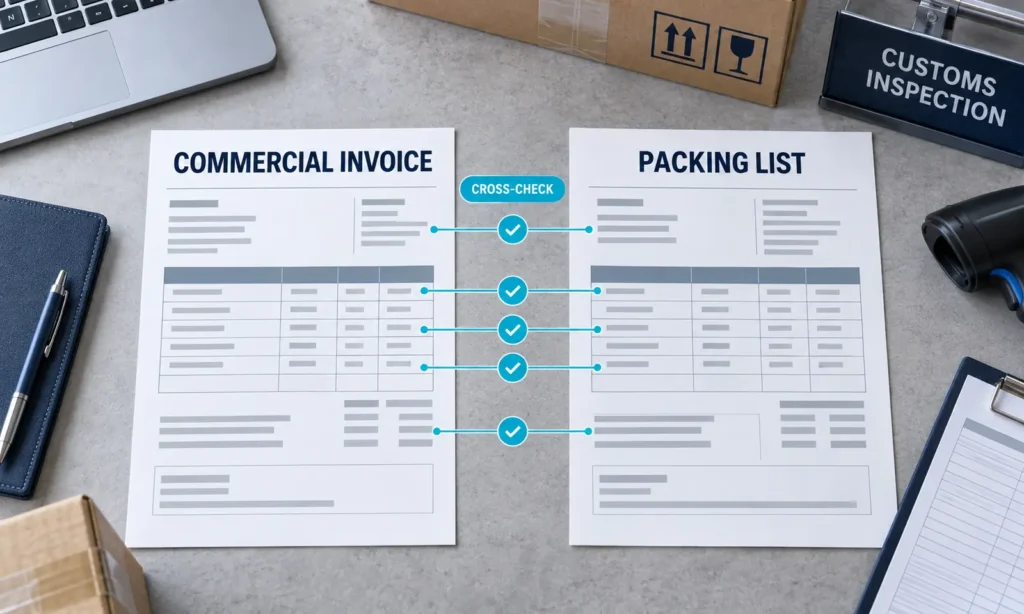
Commercial Invoice vs Packing List: Quick Comparison
A commercial invoice and packing list describe the same shipment from different perspectives. The invoice explains the transaction. Meanwhile, the packing list explains the physical cargo. Information that appears on both should agree, but you do not need to duplicate details that belong to only one document.
For example, the U.S. International Trade Administration describes the commercial invoice as a key clearance document that customs authorities use to assess duties and taxes. Its export-document guidance explains that a packing list itemizes packages, quantities, weights, dimensions and marks, and does not replace the commercial invoice. See the official commercial invoice guidance and common export documents guide.
How the two documents divide the shipment data
| Shipment Field | Commercial Invoice | Packing List | Cross-Check Rule |
|---|---|---|---|
| Main purpose | Records the transaction, value and commercial terms | Records the package structure and physical cargo | Different roles; neither normally replaces the other |
| Product description | Identifies each sold or exported item | Identifies what is packed in each package | Wording may vary slightly, but it must describe the same goods |
| Quantity and unit | Shows the invoiced quantity and unit of measure | Shows the packed quantity, often by carton or pallet | Totals and units must reconcile |
| Unit price, currency and value | Normally carries these details for a commercial sale | Usually omits these details | Invoice-specific information; do not add estimated prices to the packing list |
| Carton or pallet details | May show totals | Shows package numbers, types and contents | Use the final packing arrangement, not an early supplier estimate |
| Net and gross weight | May show both figures | Normally shows both figures | Figures must agree wherever they are repeated |
| Dimensions and CBM | Sometimes shows these measurements | Normally shows them when relevant | Use final outer-package measurements |
| Country of origin and HS classification | Commonly shows this information when required | May show this information | Information must not conflict; national tariff suffixes can differ |
| Document references | Has its own invoice number and date | May have its own number and should reference the related invoice or order | The documents should be easy to connect to the same shipment |
Why the exact format can vary
Therefore, the words “normally,” “commonly” and “may” are important. A buyer, bank, letter of credit, customs authority or internal system may request additional fields. The correct format depends on the shipment rather than a universal template.
Which Details Must Match on Both Documents?
In practice, “match” does not mean that every word and column must be identical. Instead, the two documents must tell a consistent, explainable story about one shipment. Start with the fields below.
Product description, model and material
Both documents should identify the same goods clearly enough that a forwarder, broker or warehouse can connect each invoice line to the packed cargo. A shorter description can still be consistent when it identifies the same item.
For example, “stainless-steel water bottle, 500 ml, model WB500” and “WB500 stainless-steel bottle” describe the same product. “Machine parts” and “plastic household accessories” create an unexplained contradiction.
Quantity and unit of measure
Compare both the quantity and its unit. An invoice for 500 pieces can agree with a packing list showing 20 cartons of 25 pieces. It does not automatically agree with a packing list showing 500 sets, 500 kilograms or 480 pieces.
If only part of an order is shipping, the commercial invoice and packing list should reflect the actual partial shipment rather than the original purchase-order total.
Seller, shipper, buyer and consignee roles
The company names do not always have to be identical. A factory may manufacture the goods, a trading company may sell them, another entity may export them, and a warehouse may be the consignee. Each role must be accurate and explainable. Use complete legal details where required and confirm importer information with the destination broker.
Invoice, purchase-order and shipment references
A packing list can have its own number, but it should reference the related invoice, purchase order or shipment—especially when a warehouse consolidates several orders or suppliers.
Country of origin and product classification
Country of origin generally relates to where manufacturers made or substantially transformed a product, not simply where they shipped it from. If origin or an HS code appears on both documents, the information should not conflict.
Do not assume that every digit of a Chinese export code must be identical to the final destination tariff code. Countries use the same six-digit international HS structure but can add further digits for their own tariff schedules, as explained in the official Harmonized System code guidance. The importer or destination customs broker should confirm the final local classification.
Package count, weight, dimensions and CBM
The invoice does not always contain detailed measurements. Any package count, weight or volume shown on it should reconcile with the final packing list and booking data. Also distinguish packing levels: “20 cartons on 2 pallets” can be correct while the transport document shows 2 pallets as the outer packages.
Which Differences Are Legitimate?
However, not every difference is an error. Some information belongs to only one document, while other differences reflect legitimate commercial or logistics roles.
- Prices appear only on the invoice: the packing list can omit unit prices, total value, currency and payment terms.
- Package-level detail appears only on the packing list: carton numbers, contents per carton, dimensions and shipping marks do not always need to appear on the invoice.
- Seller and shipper can be different: this may occur when a buyer purchases through a trading company or another authorized entity handles the export.
- Buyer and consignee can be different: the buyer may direct delivery to a 3PL, project site, distributor or another receiving location.
- Cartons and pallets can use different counts: 40 cartons loaded on 4 pallets are two levels of the same packing structure.
- Descriptions can use different levels of detail: they can remain consistent without matching character for character.
- Tariff-code extensions can differ by country: the classification still needs a logical connection and destination review.
A useful rule is: a difference can be acceptable when the documents describe different roles or levels of detail. In contrast, the documents contradict each other when they report the same shipment fact in incompatible ways.
Does a Packing List Include Prices?
A packing list usually does not show unit price, total commercial value, currency or payment terms. Instead, it describes the physical shipment: the contents of each carton, pallet, crate or other package, plus the cargo measurements and shipping marks.
The commercial invoice normally carries the information for the transaction and customs valuation. Some transactions accept a combined invoice-and-packing-list format, but the layout must still make the commercial and package data clear.
If a company template places prices on both documents, the values cannot conflict. Do not add approximate or invented prices simply to fill an optional packing-list field. For a detailed package-level format, see the international shipping packing list guide and example.
What Should You Do If the Commercial Invoice and Packing List Do Not Match?
Do not choose one document at random and continue booking. Instead, verify the actual cargo, identify the cause and correct the inaccurate source document.
The product quantities are different
Example: the commercial invoice shows 500 pieces, but the packing list shows 480 pieces.
Confirm whether 20 pieces were short-shipped, the invoice still reflects the original order, or the packing-list total is wrong. Update both documents to the actual shipment and identify any intentional partial shipment.
The package count changed after repacking
Example: the supplier issued a packing list for 24 cartons, but the consolidation warehouse receives 24 cartons and combines them into 22 export cartons.
The final packing list should describe the export-ready cargo. Record how the supplier cartons relate to the final packages and update any other document that repeats the old count.
The product descriptions conflict
Example: the invoice says “electronic accessories,” while the packing list says “power adapters and USB charging cables.”
Replace the vague or inconsistent wording with descriptions that identify the actual products, principal material or function and model where relevant. Do not change a truthful description merely to obtain a preferred freight or customs treatment.
The weights and dimensions are still estimates
A supplier may prepare preliminary documents before final packing. Ask the warehouse to measure the completed outer packages and update the packing list before you confirm the final freight rate and carrier booking. Then use the shipping CBM calculator with the final dimensions.
The value, currency or Incoterm is incorrect
The invoice should reflect the real transaction, currency and agreed term. If it uses an old quotation or incorrect Incoterm, ask the seller to correct it. The importer should confirm any customs-value adjustments with its broker.
Depending on the discrepancy and jurisdiction, conflicting records can lead to questions, amendments, booking changes, inspections or receiving delays. Correcting the source data before carrier handover is normally easier.
How Should Documents Be Updated After Consolidation in China?
Multi-supplier consolidation creates a common document problem: every supplier prepares records for its own goods, but the export-ready shipment changes after receiving, inspection, repacking or palletization. As a result, the final documents should describe what actually leaves the warehouse.
- Collect supplier documents: obtain each supplier’s invoice, packing list, product details and purchase-order reference.
- Receive and identify the cargo: record the supplier, carton marks, product quantities and visible condition at the China warehouse.
- Resolve shortages or extra cartons: compare the received cargo with the supplier records before combining shipments.
- Complete repacking or palletization: protect the cargo and document any change to the number or type of outer packages.
- Measure the final shipment: confirm carton or pallet count, gross weight, dimensions and total CBM.
- Prepare a final master packing list: connect each SKU and supplier shipment to the final export packages.
- Confirm the commercial invoice: the seller or responsible exporter should verify the actual shipped products, quantities, value, currency, origin and commercial terms.
- Cross-check the booking data: reconcile the final package count, gross weight and cargo description with the shipping instructions and the data used for the bill of lading or air waybill.
A freight forwarder can identify obvious inconsistencies and help coordinate corrected data, but it should not invent a sale, product value, importer identity or product classification. For the wider receiving and repacking process, see how VoltFreight can consolidate shipments from multiple suppliers in China.
Illustrative Multi-Supplier Document Check
The following example illustrates a common consolidation problem. It is an illustrative scenario, not a published customer case.
A buyer purchases lighting housings, power adapters and mounting accessories from three suppliers. The first records show:
- Commercial invoice: 1,280 units and 32 cartons
- Supplier packing lists: 1,280 units and 30 cartons
- China warehouse receiving record: 1,280 units and 31 cartons
The product quantity agrees, but the package count does not. One supplier combined two small cartons before pickup, while another added an outer protection carton after preparing its packing list. Several product descriptions were also too general, and the weights were preliminary estimates.
The warehouse recounts the cargo, confirms what is inside each carton and records the final measurements. Next, it prepares a master packing list for 31 cartons. The responsible seller or exporter confirms the commercial invoice descriptions and removes the outdated package total while retaining the correct quantity and transaction value.
This example shows why you should not treat purchase-order data, supplier packing data and final export data as interchangeable. The last check must use the cargo that is physically ready for carrier handover.
Pre-Shipment Commercial Invoice and Packing List Checklist
Finally, before booking or submitting documents for clearance, confirm the following:
- The documents relate to the same order and shipment.
- Seller, shipper, buyer, consignee and importer roles are clear.
- Product descriptions identify the actual goods and do not conflict.
- Model, SKU and material details are consistent where shown.
- Quantities and units of measure reconcile by product line.
- The documents identify partial shipments instead of using the original order total.
- The packing list reflects the final cartons, pallets, crates or other packages.
- Gross weight, net weight, dimensions and CBM use final measurements.
- The importer or broker has reviewed the country of origin and classification information.
- The commercial invoice shows the correct value, currency and commercial term.
- The packing list references the correct invoice, purchase order or shipment.
- Booking data and the draft transport document use the same final cargo facts.
Document consistency is only one part of clearance preparation. Product-specific permits, certificates, importer registrations and destination rules may also apply. For broader planning, review the customs clearance and shipping-document guide.
How Can VoltFreight Help Check the Shipment Data?
VoltFreight can connect the paperwork review to the physical cargo and planned route. Depending on the shipment, the process can include supplier pickup, China warehouse receiving, carton-count checks, consolidation, repacking, final weight and dimension measurement, label coordination and comparison of sea, air, express, rail, truck or door-to-door options.
Our review can identify obvious inconsistencies between the commercial invoice, packing list, warehouse data and booking information. However, the importer and its qualified customs broker should still confirm the final customs valuation, destination classification, tax treatment and importer compliance where required.
Frequently Asked Questions
What is the main difference between a commercial invoice and a packing list?
A commercial invoice records the commercial transaction, including product values, currency and sale terms. A packing list records the physical shipment, including packages, contents, quantities, weights, dimensions and marks. They support different tasks but should agree on shared shipment facts.
Do I need both a commercial invoice and a packing list?
Commercial cross-border clearance commonly needs a commercial invoice. In addition, a forwarder, carrier, customs authority, bank, buyer or receiving warehouse may request a packing list when it needs package-level cargo information. Exact requirements depend on the destination, commodity and procedure.
Can one document replace the other?
Normally, no. The commercial invoice contains transaction and value information that a standard packing list does not provide. The packing list contains package-level details that may not appear on the invoice. A combined document may work when the relevant parties accept it and all required information is clear.
Should the descriptions be exactly the same?
They do not always need to be character-for-character copies, but they must clearly refer to the same products. A more detailed packing-list description can be acceptable; a different product category, material or function without an explanation is not.
Check the Documents Before the Cargo Leaves China
The commercial invoice and packing list do not need to look alike. They do need to describe one shipment consistently. Verify the actual products, quantities and final packaging first; then make sure the commercial, warehouse and booking records tell the same story.
Send VoltFreight your commercial invoice, final packing list, product details, cargo photos, package measurements, supplier city and destination postcode. We can review the information for obvious inconsistencies and prepare a suitable freight quotation based on the verified shipment. Contact VoltFreight before booking.
This article provides general international-shipping information. Customs valuation, tax treatment, invoice formats and supporting-document requirements vary by jurisdiction and transaction. It does not replace advice from the importer’s customs broker, tax adviser or relevant authority.