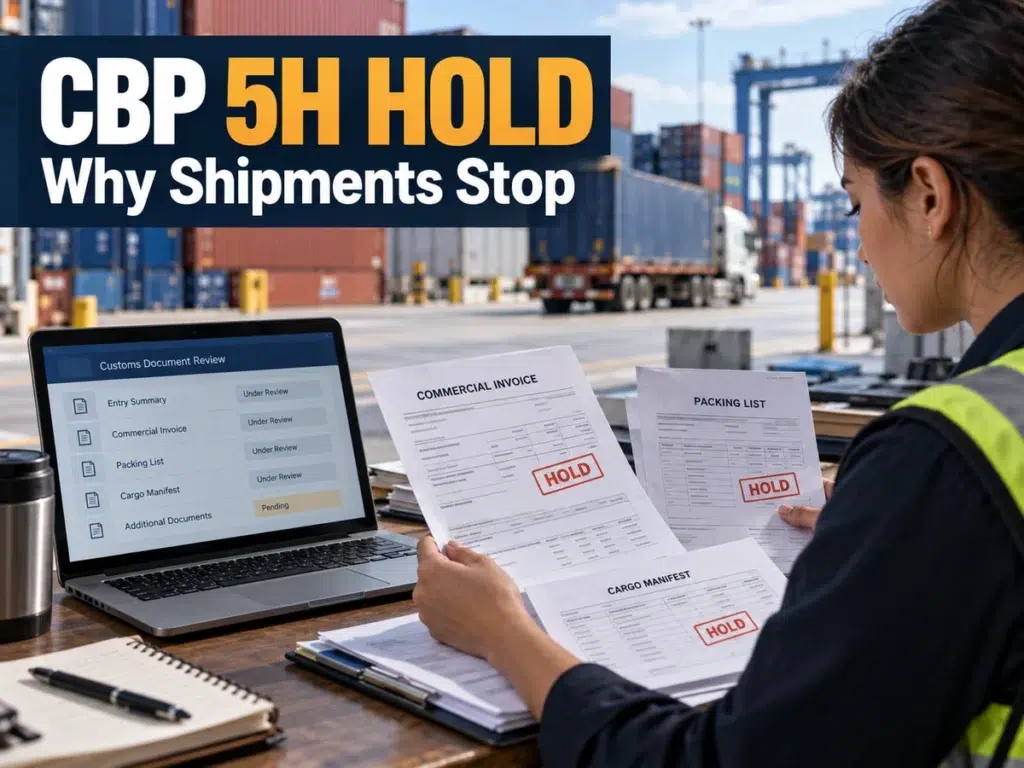
For B2B importers, a CBP 5H hold can stop goods at customs, disrupt replenishment and delay customer orders. It can also tie up cash in inventory and storage. The longer the entry remains unresolved, the greater the risk to delivery commitments and supply-chain planning. Importers therefore need to know what 5H means, what usually triggers it and which records they must check immediately.
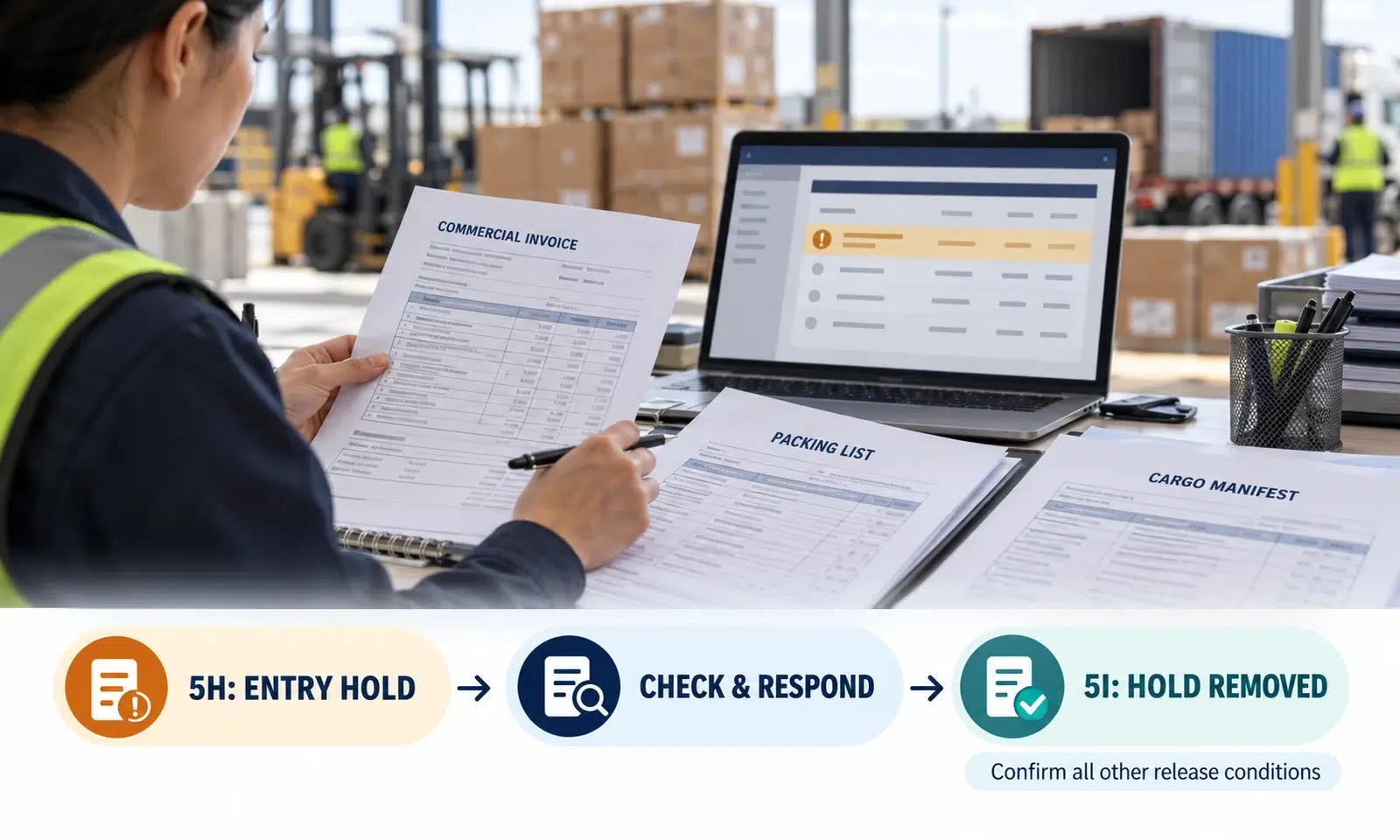
The official CBP disposition code is 5H: Entry Processing Hold. It means U.S. Customs and Border Protection has paused entry processing for document review. The cargo cannot move forward until the importer and broker resolve CBP’s concern. A 5H message does not automatically mean CBP has physically examined or seized the goods.
Quick answer: When a shipment receives a 5H hold, the importer and customs broker should obtain the exact CBP message. They should compare the entry with the invoice, packing list, manifest and product records, then submit one consistent response. Waiting without identifying the discrepancy can turn a document problem into a serious inventory and storage-cost problem.
What Is a CBP 5H Hold?
CBP uses the Automated Commercial Environment and related cargo-message systems to generate a 5H hold. It applies the code when it targets an entry for further processing review. In practical terms:
- CBP reviews the entry data and supporting documents before allowing entry processing to continue.
- The cargo remains unavailable for release under that entry while the 5H status is active.
- The importer and broker must provide accurate information that addresses the reason for the hold.
CBP may compare the commercial invoice, packing list, manifest, tariff classification and declared value. It may also check the consignee, Importer of Record and product-specific compliance records. If those documents describe different products, quantities, values or parties, the review can expand. CBP may request corrections, supporting evidence or a physical examination.
For an importer, the immediate problem is operational. Cargo cannot meet a warehouse appointment, Amazon replenishment date or customer delivery promise while the entry remains blocked. Storage, examination and demurrage-related costs may also accumulate. That is why the response should begin as soon as the broker receives the 5H message.
| CBP Code | Meaning | What It Means for the Importer |
|---|---|---|
| 5H | Entry Processing Hold | The entry has been targeted for document review and the hold must be resolved before entry processing can continue. |
| 5I | Entry Processing Hold Removed | The 5H hold has been removed. The broker should still confirm whether another CBP or partner-agency hold remains before treating the cargo as fully released. |
Which Five Compliance Areas Should Importers Check?
The following five areas form a practical pre-shipment review. They are not an official expansion of the characters in “5H”; they identify the cargo and document issues that frequently create customs risk.
- Hardware integrity: Check the physical condition, packaging and labels. The goods and outer marks should match the description supplied for transport and customs purposes.
- Dimensional accuracy: Confirm carton count, gross and net weight, dimensions and volume. Booking data, packing lists, manifests and entry records should not contradict one another.
- Dangerous-goods compliance: Declare batteries, chemicals, magnetized materials and other restricted components correctly. Use the required classification, test reports, packaging and transport documents.
- HS code classification: Select a defensible tariff classification and confirm the related duty and regulatory requirements. The Importer of Record retains reasonable-care responsibilities even when another party recommends the code.
- Health and safety requirements: Check whether food, cosmetics, medical products, children’s goods or other regulated cargo requires records or review by the FDA, CPSC or another partner government agency.
Important timing point: Under 19 U.S.C. § 1499, CBP treats detained merchandise as excluded if it does not make a final admissibility decision within 30 days after presentation for customs examination, unless another law authorizes more time. A 5H message is not automatically a formal detention notice. However, an unresolved hold that develops into detention can create return, exclusion and substantial storage risk.
How Does the 5H Review Process Work?
1. Document verification: CBP reviews the entry and relevant commercial records. Product description, material, use, quantity, weight, value, parties and tariff classification should form one consistent transaction. The broker should identify the precise issue instead of sending unrelated documents.
2. Correction or escalation: If the records answer CBP’s concern, the filer may receive a 5I message showing that CBP removed the Entry Processing Hold. If the inconsistency remains, CBP may request additional evidence, correct or reject entry data, or direct the cargo to an examination. A 5I removes the 5H hold; the broker must still check for any separate customs or partner-agency hold.
3. Final disposition: The outcome depends on what CBP finds. CBP may release the shipment, reassess value or duty, impose an authorized penalty, exclude the goods, require export or return, order destruction, or begin seizure proceedings. A forwarder cannot negotiate away a CBP enforcement decision. Complete commercial records and a prompt, coordinated response give the importer the strongest position.
Why Have Importers Seen More 5H Holds?
Importers and logistics operators reported stronger concern about 5H reviews after the 2025 Chinese New Year. The change reflects wider use of automated data checks and closer attention to importer identity, valuation and cargo descriptions. Incomplete information can now attract attention before the shipment reaches the normal release stage.
September 2025: More Automated Data Validation
ACE automation can identify missing fields, vague cargo descriptions and incomplete shipper or consignee information early in the filing process. Descriptions such as “accessories,” “samples” or “electronic products” provide too little information when the goods have a specific material, function and model. Importers should prepare exact cargo descriptions before anyone transmits the booking and entry data.
Faster Document Review
CBP personnel and Centers of Excellence and Expertise can examine the Importer of Record, customs bond, valuation, classification and commercial evidence. This makes phantom importers, unexplained values and inconsistent transaction records easier to identify. A real importer with a complete purchase and payment trail is therefore essential.
A Broader Hold-Code Network
Brokers may also receive related “H” hold and “I” hold-removal messages, including 4H/4I and 8H/8I in the relevant manifest environment. Each code has its own meaning. The importer should ask the broker for the exact message narrative instead of treating every customs hold as the same type of inspection.
What Increased U.S. Customs Enforcement Pressure?
A Bloomberg analysis reported a record USD 112 billion gap between the value China reported exporting to the United States and the value recorded as arriving in U.S. trade data. The analysis suggested that an amount equal to approximately 25% of shipments may have passed under the tariff radar through underreporting, phantom importers or other schemes.
The discrepancy does not prove that every unmatched dollar represents evasion, but it explains why declared value, importer identity and transaction authenticity receive close attention. An unusually cheap freight offer can become extremely expensive if it depends on an artificially low customs value or an importer identity the buyer does not know. The invoice, purchase order, payment evidence, entry data and actual goods should all support the same transaction.
What Common Problems Trigger a 5H Hold?
Most preventable problems begin before the cargo leaves China. The following four issues can turn a normal entry into a lengthy review.
1. Valuation Manipulation
Some logistics quotations depend on declaring a value below the real transaction price. If the value conflicts with the product, quantity, payment record, insurance value or normal commercial evidence, the entry becomes difficult to defend. Importers should know the value being declared in their name and reject quotations that depend on false customs information.
2. Documentation Inconsistencies
A commercial invoice may show one product while the packing list or manifest uses a vague or different description. Quantities, weights, carton counts and values may also conflict. The importer and broker should check the product name, material, use, model, quantity, value and packing data as one document set before filing.
3. Invalid Importer or Bond Information
A false Importer of Record, invalid customs bond, inaccurate consignee or shell-company clearance arrangement can stop the shipment immediately. The importer must be a real, authorized party that understands the declaration and recordkeeping obligations. Buyers should never accept a DDP or customs arrangement without knowing which entity will appear as importer.
4. Missing Product Compliance Records
Batteries and magnetic products need the correct transport classification and supporting records. Children’s products may require CPSC documentation. Textiles need accurate fiber and country-of-origin labeling, while regulated wood packaging requires the applicable IPPC treatment mark. Food, cosmetics and medical devices may also need partner-agency filings. Confirm these requirements before pickup, not after CBP places the shipment on hold.
How VoltFreight Helps Reduce 5H Risk
VoltFreight cannot remove a CBP hold or guarantee that CBP will never review a shipment. We can prevent many avoidable problems before departure by connecting the supplier, China warehouse, carrier, U.S. importer and licensed customs broker around one verified set of cargo information.
This matters because the lowest headline rate may hide an undervalued declaration, an unknown importer identity or fragmented subcontracting. VoltFreight focuses on a clear shipping plan, consistent documents and visible responsibility from China pickup through U.S. delivery.
1. 100% Pre-Inspection and Review
For every accepted shipment within this service scope, our team reviews the available commercial invoice, packing list, product description, carton data and transport requirements before dispatch. We compare the paperwork with the cargo information provided, flag visible inconsistencies and coordinate HS-code questions with the importer or broker. Correcting a description or carton count in China is faster and less expensive than correcting it after a 5H hold.
2. Single-Batch Customs Clearance Model
Where the shipment and customs arrangement allow, VoltFreight coordinates independent commercial documents for the importer’s shipment instead of relying on an unclear shared declaration. LCL cargo may still share container space, but the buyer should be able to identify its own invoice, packing list, customs party and declared value. This reduces the risk that another seller’s inaccurate data becomes part of the importer’s entry.
3. VIP Capacity and Speed
For eligible air cargo with complete documents and confirmed capacity, VoltFreight can target same-day warehouse receiving and next-day dispatch. Our China team coordinates supplier pickup, warehouse receiving, consolidation, packaging checks, export handling and carrier handoff. Fast execution begins with complete cargo information; it does not depend on shortcuts in customs declarations.
4. End-to-End Visibility
We provide milestone updates from pickup and export through international transport, customs coordination and final delivery. If a hold appears, we help the importer and broker identify the documents CBP requires and the party that must act. The customer receives a defined next step instead of an unexplained tracking delay.
If you are shipping from China to the United States, send VoltFreight the product name, material, use, quantity, commercial value, HS code if known, battery or regulated-product details, carton data, supplier address and U.S. delivery address. We can review the transport scope and coordinate the relevant customs-clearance documents before the cargo leaves China.
Frequently Asked Questions About CBP 5H Holds
Is a 5H Hold the Same as Customs Seizure?
No. A 5H is an entry-processing hold for review. It is not automatically a seizure. If CBP later finds a violation that supports enforcement action, the cargo may face penalties, exclusion, return, seizure or forfeiture under the applicable procedure.
Can a Customs Broker Remove a 5H Hold?
A broker cannot unilaterally remove a CBP hold. The broker can identify the message, correct entry data, submit supporting documents and communicate with CBP. CBP decides whether the response resolves the issue and whether to issue the corresponding hold-removal message.
Why Do China-to-U.S. Shipments Receive 5H Reviews?
Shipments from any country can receive CBP holds. China-to-U.S. trade receives significant scrutiny because of its volume, tariff exposure and enforcement concerns involving undervaluation, incorrect declarations, phantom importers and regulated products. The entry data and transaction risk matter more than origin alone.
How Long Can a 5H Hold Delay Delivery?
A 5H hold may delay customs processing for several days or several weeks. Timing depends on the requested evidence, the accuracy of the original filing, CBP workload and whether the case expands to a physical examination or partner-agency review. Ocean or air transit time does not include this customs-review period.
Conclusion: The most effective response to a 5H hold begins before cargo leaves China. Use a real Importer of Record, declare the actual transaction value, describe the product precisely and make the invoice, packing list, manifest and entry data agree. If CBP applies a hold, obtain the exact message and respond with one verified document set. A low freight rate cannot recover the storage cost, missed sales and customer disruption caused by an avoidable customs problem.
Official references: Review CBP’s ACE disposition codes, its explanation of the Automated Commercial Environment, and the detention rules in 19 C.F.R. § 151.16.