Shipping Tires from China: Quick Plan by Quantity and Urgency
Use the following ranges as an initial planning guide. The final recommendation should be based on packed size, chargeable weight, destination and carrier acceptance rather than quantity alone.
| Shipment profile | Method to compare | Planning transit time | Main consideration |
|---|---|---|---|
| 1–4 tires or urgent samples | Express courier or special line | 3–20 days, depending on service | Courier size limits and irregular-package surcharges |
| 5–20 tires | Air freight or rail for eligible China–Europe routes | 5–20 days | Actual weight versus volumetric weight |
| More than 10 tires, non-urgent | Sea freight LCL | 25–45 days | Total CBM, minimum charges and destination handling |
| 20 or more tires or regular wholesale orders | Sea LCL or FCL | Route-specific | Container utilization, loading plan and landed cost |
| Importer needs an agreed all-in delivery scope | DDP, subject to destination and cargo acceptance | Route-specific | Customs clearance, duties, taxes and final delivery scope |
Why Businesses Ship Tires from China
For many importers, shipping tires from China provides access to an established global tire supply chain. China plays a major role in this market. Manufacturers serve passenger vehicles, trucks, buses, motorcycles, racing applications, construction equipment and other specialist markets. This production base gives importers access to a wide selection of new and replacement tires for different climates, vehicles and price levels.
Commercial Advantages
- Cost-effectiveness: Economies of scale, efficient manufacturing and competitive production costs can create meaningful savings for distributors, retailers and automotive businesses.
- Wide product selection: Buyers can source many tire types, brands, tread patterns, sizes and performance specifications from one manufacturing market.
- Reliable manufacturing: Many Chinese tire factories follow international production standards and operate structured quality-control systems.
- Established logistics: China’s ports, airports, rail terminals and domestic trucking networks support sea, air, rail and multimodal tire shipments.
Factors Importers Still Need to Manage
- Shipping time: Cost-effective sea freight takes longer, so importers need suitable purchasing and inventory plans.
- Quality assurance: A large manufacturing base includes different quality levels. Product inspection remains necessary before shipment.
- Regulatory requirements: Import restrictions, tariffs, product requirements and trade measures vary by destination.
- Environmental impact: Tire production and international transportation consume energy. Consolidation, efficient container loading and sensible inventory planning can reduce avoidable movements.
Market Data from the Original Tire-Shipping Research
The 2019 dataset used in this guide recorded China as the world’s largest tire exporter, with more than 260 million tires shipped globally. It also described the United States as China’s leading export market, importing more than USD 2 billion in tires annually, primarily for passenger vehicles. Germany and the United Kingdom relied heavily on Chinese tire imports, while Brazil’s expanding passenger and commercial fleets supported growing demand.
| Destination market | Tires exported from China in the cited dataset |
|---|---|
| United States | 35 million |
| Germany | 26 million |
| United Kingdom | 15 million |
| Brazil | 13 million |
| Australia | 10 million |
Other important destinations in the research included Canada, Russia, Japan, South Korea and markets across Southeast Asia. These figures provide historical market context rather than current freight demand or a live forecast.
Why Tire Freight Needs Careful Planning
Tires appear durable, but their freight profile creates problems that ordinary cartons do not. They occupy substantial space relative to their weight, do not always create a flat surface for labels and can shift or deform when stacked incorrectly. A complete wheel adds more weight and exposes painted, alloy or chrome surfaces to scratches and impact.
| Cargo type | Packaging requirement | Cost profile | Main risk |
|---|---|---|---|
| Tires without rims | Heavy-duty wrap; cardboard protection when needed | Lighter and usually less expensive | Contamination, deformation, lost labels and irregular-package charges |
| Tires mounted on rims | Padding, rigid face protection and secure outer wrapping | Heavier and normally more expensive | Scratches, dents, bent edges and other cosmetic damage |
When shipping tires from China, international movements add customs documents, destination-country restrictions and domestic delivery requirements. As a result, poor preparation can lead to damaged products, carrier surcharges, customs delays, expensive returns and dissatisfied customers. For tire distributors, automotive brands, wholesalers and ecommerce sellers, the packing and freight plan should therefore be confirmed before the supplier releases the goods.
Six Steps for Shipping Tires from China
Step 1: Select a Trustworthy Tire Supplier
Begin by checking the manufacturer’s business history, product range, certifications, quality system and export experience. Compare the requested tire size, load index, speed rating, tread, production specification and branding with the purchase order. Recommendations, factory information and independent reviews can help establish whether the supplier is reliable.
Counterfeit products remain a concern in the global tire trade. Research used for the original article estimated that counterfeit tires represented about 6% of the global market. Confirm the manufacturer, product markings and authorization before paying the balance or arranging export transport.
Step 2: Complete Quality Inspection and Assurance
Inspect the quantity, specifications, appearance, labels and condition before shipment. Record photographs and check that the tires meet the buyer’s safety and performance requirements. If wheels are included, inspect the rim finish, spokes, edges, valves, caps and mounting condition.
The original research cited a 2022 report in which approximately 4% of tires from various manufacturers showed some form of defect. Consequently, a pre-shipment inspection gives the importer an opportunity to identify an incorrect size, visible defect, missing marking or packing problem while the cargo is still at the supplier.
Step 3: Pack and Load the Tires Correctly
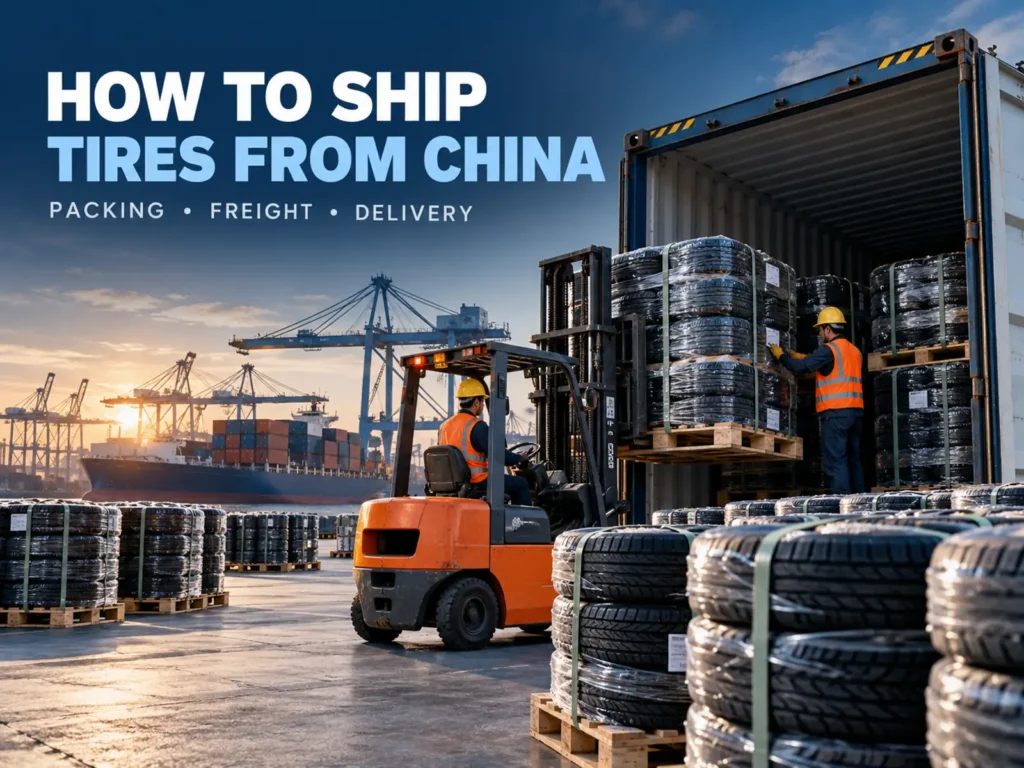
Packaging is one of the most important steps when shipping tires from China. Choose the method according to whether the shipment contains loose tires, mounted wheels or specialist tires. Keep labels visible and secure every bundle so it will not loosen during warehouse handling. For container freight, distribute the cargo to maintain stability and use the available space efficiently without applying damaging pressure.
Statistics in the original study estimated that around 2% of goods shipped globally may experience some form of transit damage, although this was not a tire-specific rate. Proper wrapping, face protection, stacking and load restraint reduce avoidable exposure.
Step 4: Prepare the Shipping Documents
Prepare a commercial invoice, packing list and bill of lading or air waybill. Depending on the destination, the importer may also need a certificate of origin, product certificate, import license or other supporting document. The description, quantity, value, tire status and country of origin should remain consistent across the paperwork.
Step 5: Arrange Customs Clearance
The shipment must meet the destination country’s classification, valuation, duty, tax and product-entry requirements. Some markets restrict used tires, and some Chinese tires may face additional tariffs, anti-dumping duties or countervailing duties. An inaccurate HS code or incomplete document set can cause a customs query, inspection, additional cost or seizure.
Step 6: Complete Final Delivery
After customs release, arrange delivery by truck, rail or a local distribution network to the warehouse, retail location, workshop or final customer. Confirm whether the receiving address can handle the weight and package dimensions, whether unloading assistance is required and whether an appointment is necessary. Domestic delivery efficiency and cost can differ substantially between destinations.
Packaging Guide for Tires and Wheels from China
The packaging method should protect the product without adding unnecessary weight or volume. Loose tires can often move with heavy-duty wrapping, subject to carrier acceptance. However, mounted wheels need cushioning and rigid layers because their surfaces are much easier to damage.
| Packaging method | Protection level | Relative cost | Best application |
|---|---|---|---|
| Stretch wrap only | Basic | Low | Loose tires without rims when accepted by the carrier |
| Stretch wrap plus cardboard | Medium | Low to medium | Standard wheel-and-tire assemblies |
| Bubble wrap plus cardboard discs | High | Medium | Alloy wheels and finished rim surfaces |
| Custom wheel packaging | Maximum | High | Premium, specialist or high-value wheels |
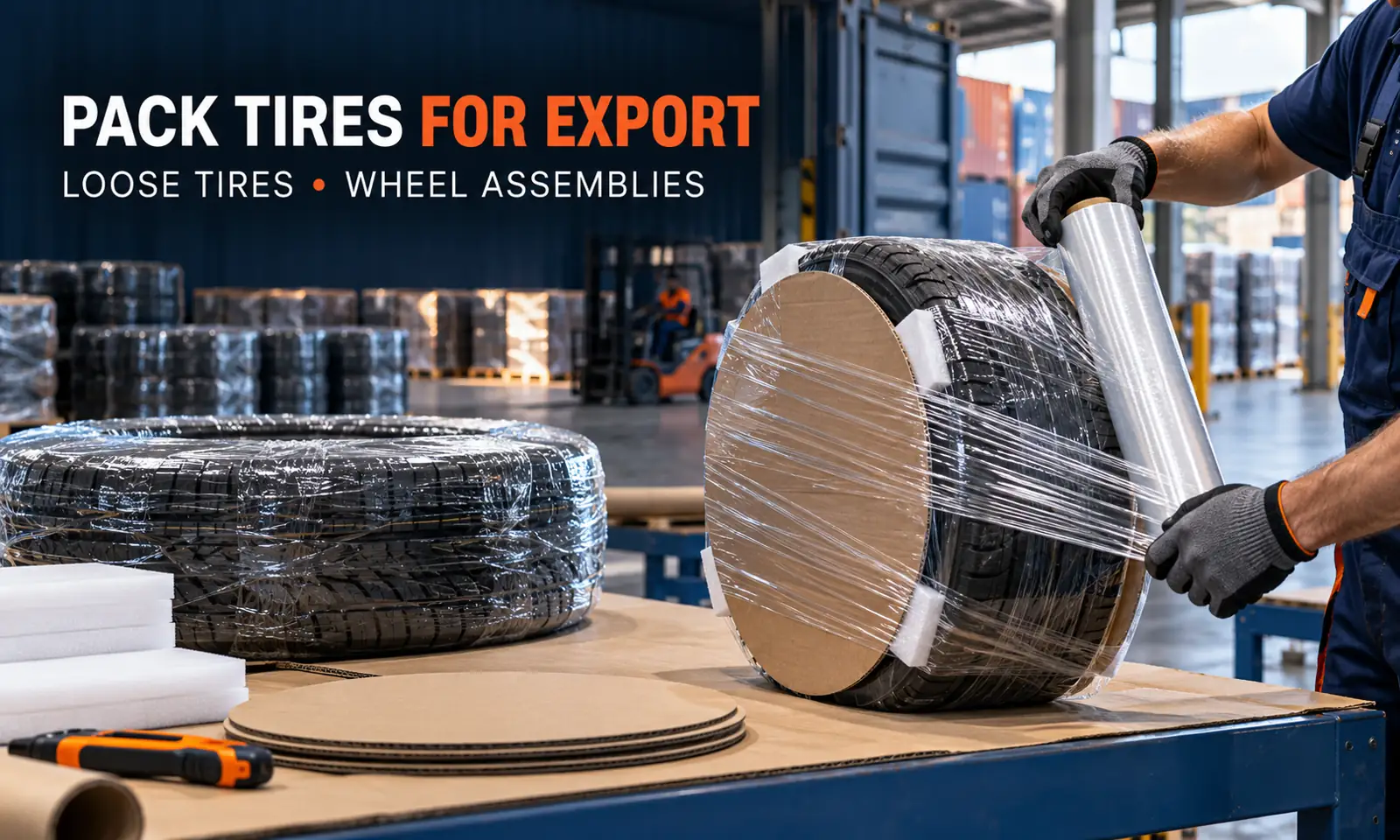
Packaging Tires Without Rims
- Clean and inspect each tire. Remove dirt, grease and loose material. Check for visible defects or existing damage, and take photographs when a condition record is required.
- Adjust pressure only when appropriate. The original packing procedure uses approximately 15–20 PSI for suitable tires. Follow the manufacturer’s guidance and confirm the carrier’s requirement first. Lower pressure may reduce bulging and improve packing stability, but it will not materially reduce the outside dimensions of every tire. Remeasure the finished package rather than assuming a lower volumetric weight.
- Apply heavy-duty wrapping. Use approximately 3–5 layers of stretch wrap or shrink wrap. Cover the tread and sidewalls so the tire remains clean and the outer surface does not catch during handling.
- Bundle efficiently. Where the tire size, weight and carrier rules allow, bundle 1–2 compatible tires together. One secure bundle may cost less than two separate pieces. Add cardboard discs to the flat sides when more protection or a better label surface is required.
- Attach two labels. Place the main shipping label on the flattest practical tread surface rather than an unstable curved sidewall. Put a backup label beneath the transparent outer wrap so the shipment can still be identified if the exposed label is damaged.
- Identify the cargo accurately. Show the product description, package number and country of origin where required. Use the correct HS classification information on the commercial documents. If the tires are genuine samples with no resale purpose, a notation such as “TIRES – SAMPLES / NO COMMERCIAL VALUE” may be added where the customs broker approves it. The invoice must still state a truthful customs value.
- Complete a final packing check. Confirm that the wrap is tight, the label is readable and no loose edge can become caught in a conveyor or handling device.
Packaging Tires Mounted on Rims
- Prepare the assembly. Clean the tire and rim. Remove or separately secure loose center caps, bolts, valves and other detachable parts. When technically suitable, the original procedure uses approximately 15 PSI before packing.
- Protect the finished surfaces. Cut two cardboard circles to the rim diameter. Wrap the wheel in bubble wrap and add extra layers around the spokes, face and outer edges. Position one cardboard disc on the front and one on the back.
- Secure the complete unit. Wrap the assembly firmly with stretch film. Tape the rigid layers with an H-tape pattern so the edges remain closed. For international handling or premium wheels, place the protected assembly in a heavy-duty corrugated carton.
- Stop movement inside the box. Fill empty spaces with suitable foam, pads or air pillows. The wheel should not strike the walls of the carton when the package is tilted or moved.
- Mark and label the package. Place the transport label on a flat side. Add “FRAGILE – WHEELS” where appropriate, together with the gross weight, outside dimensions and package sequence.
- Insure valuable assemblies. The original operating procedure treats full-value cargo insurance as a requirement for high-value wheels. Confirm that the policy covers the relevant loss and physical-damage risks rather than relying only on limited carrier liability.
Packaging Different Types of Tires
Passenger-car tires: These often move in larger quantities. For example, spiral or interlaced loading can improve space utilization, provided the pattern does not place damaging pressure on individual tires. Keep compatible sizes together and make the count easy to verify.
Truck and bus tires: These products are larger and heavier. Use stronger wrapping and load restraint, and consider fewer pieces per bundle or loading group. Check container payload and floor-loading limitations as well as cubic capacity.
Racing tires: Softer compounds provide track grip but require protection from prolonged rubbing, sharp edges and excessive pressure. Use individual wrapping or separators between tires.
Off-the-road tires: OTR tires for mining, construction and heavy equipment may be exceptionally large. They can require a flat rack, open transport equipment, specialist lifting, a detailed loading plan or another project-cargo solution.
Motorcycle tires: These tires are smaller and lighter and can usually be packed closely. Nevertheless, protect softer sidewalls from deformation caused by poor stacking or long-term pressure.
Specialty and custom tires: Vintage-vehicle tires and tires for specialist machinery may be difficult to replace. Use individual packaging, rigid separators and additional protective layers where their value or construction warrants it.
Protect Tires During Storage and Long-Distance Transit
When shipping tires from China over long distances, use reinforced plastic wrap, durable sacks, cardboard or custom protective materials to prevent cuts, scrapes and punctures. Tires can also deteriorate when exposed to sunlight, ozone and extreme temperatures. This matters during extended storage and long sea voyages as well as during transport.
Stacking must match the tire size and construction. Prolonged uneven pressure can change the shape of an unmounted tire. Accurate labels should identify the tire type, size, specifications and any handling requirement throughout warehousing, consolidation and delivery.
Shipping Tires from China by Express, Air, Rail, Sea and DDP
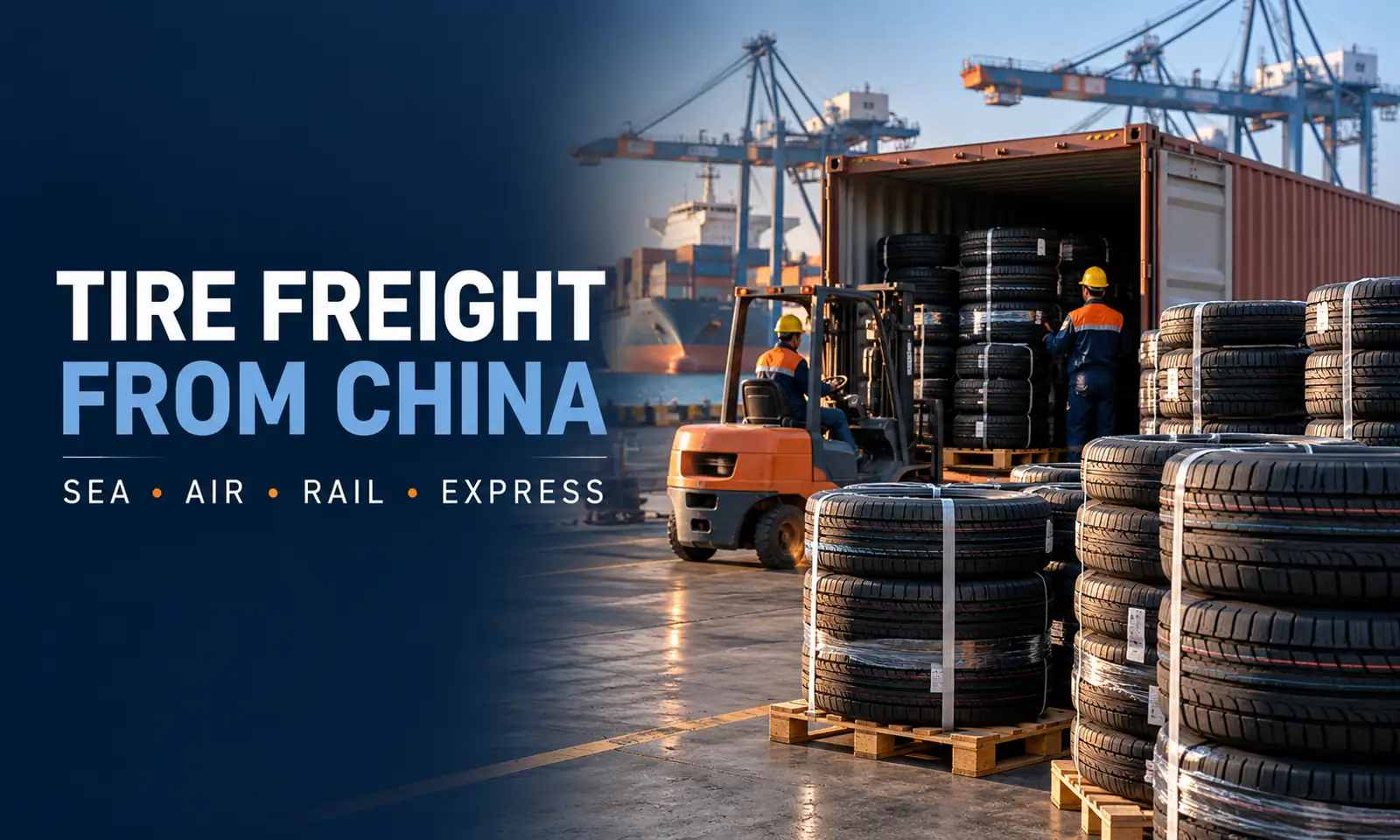
Before shipping tires from China, have the cargo packed and measured, and then choose the freight method. Booking from an estimated tire size can produce an inaccurate quote because the carrier charges the finished shipment, including cartons, discs, padding and pallets.
Express Courier
DHL, FedEx, UPS and other express services can suit approximately 1–4 tires, samples, urgent replacements and small orders. A planning transit time is about 3–7 days, with door-to-door delivery, tracking and courier customs processing. However, couriers enforce strict maximum dimensions and weights. A round or exposed tire may also attract an additional handling or irregular-package surcharge.
Even under an express service, the shipper must prepare an accurate commercial invoice and packing list and meet the destination’s import requirements. Confirm acceptance from the packed measurements before sending the tires to the courier terminal.
Air Freight
Air freight from China can suit approximately 4–20 tires or commercial shipments that cannot wait for sea freight. The original planning range is about 5–12 days. Service can be arranged airport-to-airport or with pickup, clearance and final delivery, depending on the destination.
The cargo must meet aviation packaging, labeling, handling, weight and dimension rules. Prepare the commercial invoice, packing list and air waybill. Because tires occupy substantial space, volumetric weight can make air freight expensive even when the actual weight appears moderate.
China–Europe Rail Freight
Meanwhile, rail freight from China may suit approximately 4–40 tires moving to eligible European destinations. The original planning range is about 12–20 days. It can offer a lower cost than air freight and a more stable schedule than some economy services. Availability, terminal routing, customs arrangements and final delivery should be checked for the specific country and postcode.
Sea Freight
FCL and LCL ocean freight from China usually provides the most economical option for bulk, non-urgent shipments. The original LCL planning range is about 25–45 days, although actual port-to-port and door-to-door time depends on the route, sailing schedule, transshipment, customs clearance and inland delivery.
LCL allows the tires to share container space with other cargo and can work for more than 10 tires. FCL provides a full container and becomes more attractive as volume grows. The decision should consider total CBM, weight, origin and destination charges, loading efficiency and the protection required during consolidation.
Load tires securely so they remain stable throughout the voyage. Prepare the commercial invoice, packing list and bill of lading, and follow destination customs and environmental requirements. Cargo insurance is strongly recommended because carrier liability does not necessarily equal the full commercial value.
Postal Service or Special Line
An economy special line or eligible postal service may suit samples and small test orders. The original planning range is approximately 7–20 days. Acceptance varies by country, package size and tire type, so confirm that the service handles the packed cargo before relying on it.
DDP Door-to-Door Shipping
VoltFreight can combine tire freight with door-to-door shipping from China. DDP can provide a coordinated service covering China pickup, international transport, import customs clearance, agreed duties and taxes, and delivery to the named destination. It can simplify budgeting for importers who want a defined delivery scope.
Under the ICC Incoterms® rules, DDP places extensive delivery and import responsibilities on the seller. VoltFreight can coordinate an accepted DDP logistics channel, but the quote must state the destination, importer requirements, excluded charges and exact delivery conditions. Product restrictions and customs rules still apply; DDP does not remove the need for accurate documents or lawful declarations.
Documents and Import Requirements for Tire Exports from China
Shipping tires from China requires consistent product descriptions, quantities, values and country-of-origin information across the documents. Customs requirements vary by country, tire status and intended use. Confirm the rules before collection, especially for used tires or products entering a market with trade remedies. The freight method changes the transport document, but it does not remove the need for a consistent product description, quantity, value and origin.
HS Classification
New pneumatic tires commonly fall under HS heading 4011. Retreaded or used pneumatic tires commonly fall under heading 4012. The complete classification depends on the product, construction and destination tariff schedule. Use the correct destination-country code to determine ordinary duty and any additional trade measure.
Core Shipping Documents
- Commercial invoice: Identify the buyer and seller, tire description, quantity, unit and total value, currency, country of origin and agreed trade term.
- Packing list: Show the number of packages, contents, gross and net weight, dimensions and total volume.
- Bill of lading or air waybill: Use the transport document that matches sea, air or express movement.
- Certificate of origin: Provide it when the destination, importer or trade procedure requires one.
- Additional permits or certificates: Supply any product, safety, import or environmental document required for the particular market.
Declarations, Labels and Package Marks
Declare the actual transaction or accepted customs value and use a specific product description instead of a vague term. Package marks can include “AUTO PARTS – TIRES,” the country of origin and sequential numbering such as 1/4, 2/4, 3/4 and 4/4. Tire size and handling information can also help the warehouse identify and process the cargo correctly.
If the shipment consists of genuine samples, describe them accurately and use a sample notation only where appropriate. “No commercial value” means that the goods are not intended for resale; it does not mean that customs will accept a zero value. Always give the broker a reasonable declared value.
Used Tires and Destination Restrictions
Some countries limit, license or prohibit used-tire imports because of safety, waste-management or environmental concerns. Confirm the permitted condition, remaining tread, production date, cleaning standard, certification and inspection requirement before booking. A route that accepts new tires may not accept used or retreaded products under the same procedure.
Anti-Dumping and Countervailing Duties
In addition, some destinations impose additional duties on particular Chinese tire categories. These can include anti-dumping and countervailing measures as well as ordinary customs duty. The treatment depends on the complete tariff classification, product scope, origin and current destination rules. VoltFreight can provide customs-clearance coordination and work with the relevant broker to review classification and entry requirements before the shipment departs.
How Much Does It Cost to Ship Tires from China?
The cost of shipping tires from China depends on the transport method, destination and completed packing details. There is no single per-tire international rate. The freight quote depends on the transport method, destination, number of tires, package dimensions, total gross weight, total CBM, whether rims are attached, insurance and delivery scope. Air and express services usually charge the greater of actual and volumetric weight. Sea freight is more closely connected to volume, route charges and the LCL or FCL arrangement.
| Method | Cost profile | Best use |
|---|---|---|
| Express | High cost for bulky pieces; possible additional-handling charge | Small and urgent shipments |
| Air freight | Fast but sensitive to volumetric weight | Time-sensitive commercial cargo |
| Rail freight | Middle option between air and sea on eligible China–Europe routes | Moderate quantities with a controlled deadline |
| Sea LCL | Economical for shared-container cargo, with origin and destination minimum charges | Non-urgent medium-volume orders |
| Sea FCL | Cost-effective when the shipment uses container capacity efficiently | Large wholesale orders |
| DDP | Agreed package covering freight and specified import and delivery charges | Importers seeking a coordinated door-to-door scope |
Ways to Reduce Tire Shipping Costs
- Measure the finished package. Use packed dimensions rather than catalog dimensions to compare freight options accurately.
- Bundle compatible tires. Where carrier rules permit, a secure 1–2 tire bundle can reduce the number of chargeable pieces.
- Avoid excessive packaging. Add the protection the product needs without unnecessary weight, oversized cartons or unused void space.
- Reduce irregular-package charges. A flat label surface, secure wrapping or a suitable carton may move the piece into a more favorable carrier handling category. In qualifying cases covered by the original operating data, professional repacking reduced irregular-package fees by up to 90%.
- Consolidate suppliers and orders. Combining compatible cargo at one China warehouse can reduce repeated pickup, handling and minimum freight charges.
- Compare total landed scope. For example, a low line-haul rate may exclude origin handling, destination charges, customs clearance or final delivery. Compare equivalent services.
- Use negotiated carrier rates. On comparable accepted routes and shipment profiles, the original company data recorded savings of up to 60% against direct booking.
Insurance and Risk Control
The original cost reference placed full-value cargo insurance at approximately 0.5%–1% of the insured value. The actual premium depends on the cargo, route, packaging, policy terms and insurer. Check whether the cover includes physical damage, total loss and the specific risks relevant to wheels and tires. Do not assume that carrier liability will reimburse the full replacement value.
Common Mistakes When Shipping Tires from China
Insufficient Protection
Stretch wrap alone may protect a loose tire but may leave a finished rim exposed. Match the protection to the cargo and add rigid face guards, cushioning or a carton where needed.
Ignoring Volumetric Weight
A tire can occupy much more space than its actual weight suggests. Measure the completed package before selecting express or air freight.
Poor Label Placement
A label applied to an unstable curved surface can detach or become unreadable. Use a flat surface and place a second identification label beneath the outer wrap.
Choosing a Carrier Before Confirming Acceptance
Carriers apply different rules to exposed tires, oversized pieces and heavy wheel assemblies. Check the packed size, weight and packaging format before collection.
Leaving Customs Checks Until Arrival
Therefore, confirm classification, used-tire restrictions, duties and required documents before departure. Resolving a preventable documentation problem after arrival can create storage, examination and re-export costs.
How VoltFreight Handles Tire Shipping and Fulfillment
As order volume grows, storing, packing and dispatching tires internally can consume warehouse space and staff time. VoltFreight can coordinate the work from the supplier or China warehouse through international transport and delivery.
- Supplier pickup and cargo consolidation in China
- Tire warehousing and inventory management
- Quantity checks, shipment photographs and pick-and-pack operations
- Packaging for loose tires and wheel-and-tire assemblies
- Express, air, rail, sea and accepted DDP freight solutions
- Carrier-rate comparison and loading-plan support
- Export and customs-document assistance
- Cargo insurance coordination
- B2B, wholesale and ecommerce fulfillment
- Returns-management support
Moreover, the fulfillment model can support sellers operating through Shopify, Amazon, eBay, Walmart Marketplace or their own online store. It can also serve tire distributors, automotive brands and wholesalers shipping full orders to overseas warehouses or commercial addresses.
The operating record used for the original articles includes zero international-compliance mistakes across the tire cases covered by that record. VoltFreight applies the same document review, packing checks and carrier-acceptance controls under the current brand.
Frequently Asked Questions About Shipping Tires from China
How much does it cost to ship tires from China?
Your tire-shipping quote depends on quantity, packed dimensions, gross weight, destination, shipping method, whether rims are attached, customs scope, insurance and final delivery. Send the finished packing details for an accurate comparison.
What is the best shipping method for tires?
Express or a special line can suit a few urgent tires; air freight suits time-sensitive commercial cargo; rail may suit eligible China–Europe movements; and sea LCL or FCL normally offers better economics for larger non-urgent shipments. DDP can be considered when the importer needs an agreed door-to-door scope.
Do tires need a box for international shipping?
Loose tires do not always need boxes. Many services accept securely wrapped tires, subject to their route and packaging rules. Mounted wheels, premium rims and international shipments exposed to repeated handling benefit from cardboard discs, cushioning and sometimes a heavy-duty carton.
How should wheels and tires be packaged?
Clean the assembly, secure loose components, wrap the face and edges with cushioning, add cardboard discs to both sides and apply stretch wrap. A corrugated carton with void filling provides more protection for high-value wheels.
What documents are needed to export tires?
Common documents include the commercial invoice, packing list and bill of lading or air waybill. A certificate of origin, import license or product certificate may also be required, depending on the destination and tire type.
Can used tires be shipped internationally?
Yes on some routes, but many countries restrict, license or prohibit used-tire imports. Confirm the destination rule, product condition and HS classification before collection.
How do customs regulations affect tire shipments?
Customs rules determine classification, valuation, ordinary duty, additional trade measures, document requirements and whether the tires may enter the market. Incorrect information can delay release or create extra costs.
Should a tire shipment be insured?
Insurance is strongly recommended, particularly for wheels, large wholesale orders and high-value products. Check the insured value, covered risks, exclusions and claims documents before shipment.
Can VoltFreight store and ship tires in bulk?
Yes. VoltFreight can coordinate China warehousing, inventory handling, packaging, consolidation and dispatch for wholesale, B2B and ecommerce orders. The warehouse and freight plan will depend on tire size, order volume and destination.
Request a Quote for Shipping Tires from China
To request a quote for shipping tires from China, send VoltFreight the tire type, new or used condition, quantity, size, whether rims are attached, packed dimensions, gross weight, supplier city, cargo-ready date, destination country, postcode and required delivery scope. Also tell us whether you need pickup, consolidation, repacking, insurance, customs clearance or final delivery.
VoltFreight will compare the suitable express, air, rail, sea or DDP options and provide a free shipment-specific quotation within 24 hours after receiving the complete cargo details.