Quick answer: Sea freight from China to Piraeus is usually the most economical option for commercial cargo, pallets, machinery, furniture, retail stock and full-container shipments moving into Greece. Importers can use LCL when the cargo does not fill a container or FCL when they need a dedicated 20GP, 40GP or 40HQ container.
As a general planning range, port-to-port transit from major Chinese ports to Piraeus often takes about 25–45 days. However, the complete door-to-door timeline is longer because it also includes supplier pickup, export handling, vessel scheduling, Piraeus customs clearance, port release and inland delivery.
The shipping cost depends on the Chinese origin port, FCL or LCL method, container type, cargo volume, gross weight, product classification, cargo-ready date and final delivery address in Greece. Importers should compare the full landed route rather than only the base ocean freight rate.
A complete quotation may include:
- Supplier pickup or delivery to the China origin port
- China export handling and customs declaration
- FCL or LCL ocean freight
- Piraeus terminal and destination handling
- Customs brokerage
- Inland delivery to Athens, Thessaloniki, mainland Greece or Crete
Import duty, 24% Greek VAT, customs examinations, demurrage, detention, storage and special unloading services may be calculated separately unless the quotation clearly states otherwise.
Best practical choice: Use LCL for smaller commercial shipments and trial orders. Choose FCL when the cargo is large, fragile, bulky or close to container volume. A 40HQ often works well for furniture, home goods and light bulky products, while a 20GP can be more suitable for heavy machinery, metal products, tiles or stone.
For a broader route comparison, review our shipping from China to Greece page. For customs and tax planning, read our China to Greece customs clearance guide.
Need a current China-to-Piraeus quotation? Send VoltFreight the supplier city, product name, carton quantity, dimensions, gross weight, total CBM, cargo-ready date, commercial value and final delivery postcode.
Contact VoltFreight for an FCL or LCL sea freight quote to Piraeus.
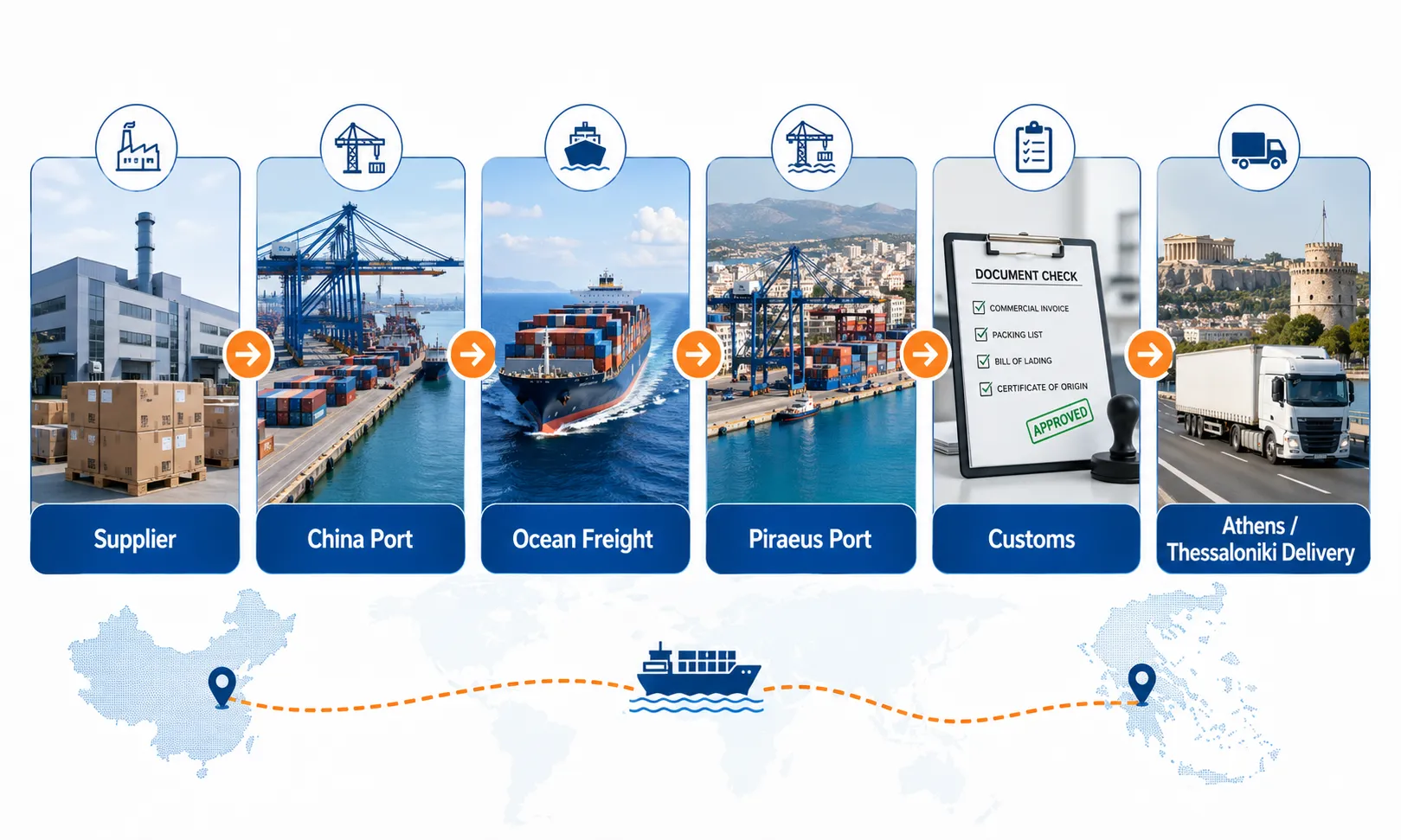
Sea Freight from China to Piraeus at a Glance
The correct shipping method depends on cargo volume, product type, packaging strength, delivery deadline and final delivery conditions.
| Shipping Option | Best For | Typical Planning Time | Pricing Basis | Main Consideration |
|---|---|---|---|---|
| LCL sea freight | Smaller commercial shipments, mixed suppliers and trial orders | Usually longer than FCL because of consolidation and deconsolidation | CBM or revenue ton | Destination handling, warehouse fees and extra cargo handling |
| 20GP FCL | Heavy and dense cargo | About 25–45 days port to port | Per container | Payload, weight distribution and delivery access |
| 40GP FCL | General commercial cargo | About 25–45 days port to port | Per container | Container utilisation and inland trucking cost |
| 40HQ FCL | Furniture, home goods, packaging and light bulky products | About 25–45 days port to port | Per container | CBM, carton stacking strength and unloading arrangements |
| Port-to-port | Importers with their own Greek customs broker and trucking | Vessel transit plus port handling | Ocean freight and agreed port charges | Importer arranges customs clearance and delivery |
| Door delivery | Importers needing a coordinated final route | Port transit plus customs and inland delivery | Container or CBM plus destination services | Duty, VAT, unloading and conditional charges must be confirmed |
These are planning ranges rather than guaranteed schedules. Carrier changes, blank sailings, transshipment, Suez or Red Sea routing, customs inspections and port congestion can extend the final timeline.
How Sea Freight from China to Piraeus Works
A China-to-Piraeus shipment normally follows several connected stages. Planning each stage before pickup helps reduce customs delays, destination charges and delivery problems.
- Confirm the final cargo data. Collect the product name, carton count, dimensions, gross weight, CBM, commercial value and cargo-ready date.
- Choose FCL or LCL. Compare cargo volume, handling risk, container utilisation and destination charges.
- Select the origin port. The forwarder reviews the supplier city, pickup cost and available sailings.
- Prepare export documents. The commercial invoice, packing list, HS code and exporter details should match the actual goods.
- Arrange China pickup or port delivery. The supplier can deliver under FOB terms, or the forwarder can collect the cargo under EXW terms.
- Complete export declaration and loading. FCL cargo is loaded into a dedicated container, while LCL cargo enters a consolidation warehouse.
- Move the cargo to Piraeus. The vessel follows a direct or transshipment route depending on the carrier and schedule.
- Complete Greek customs clearance. The importer or broker handles the declaration, duty, VAT and possible inspection.
- Obtain port release. The carrier and terminal release the container or LCL cargo after the required charges and documents are completed.
- Deliver to the final address. Cargo moves to Athens, Piraeus, Thessaloniki, mainland Greece or Crete where service is available.
The cheapest ocean freight rate does not always produce the lowest final cost. A route with unclear destination charges, insufficient free time or difficult final delivery can become more expensive after arrival.
Main Chinese Ports for Piraeus Shipments
The best origin port normally depends on the supplier’s location and the available carrier service.
| China Origin Port | Common Supplier Areas | Planning Notes |
|---|---|---|
| Shenzhen / Yantian | Shenzhen, Dongguan, Huizhou and South China | Suitable for electronics, retail goods, machinery and containerised commercial cargo |
| Guangzhou / Nansha | Guangzhou, Foshan, Zhongshan and the Pearl River Delta | Often used for furniture, building materials, lighting and home goods |
| Shanghai / Ningbo | Shanghai, Zhejiang, Jiangsu and East China | Strong FCL and LCL networks for machinery, furniture and general cargo |
| Qingdao / Tianjin | Shandong, Hebei, Beijing and North China | Useful for industrial cargo, metal products, machinery and heavy goods |
| Xiamen / Fuzhou | Fujian and nearby manufacturing areas | Compare pickup cost, service frequency and transshipment before booking |
A lower ocean rate from a distant port may not save money after domestic trucking and origin handling are added. Therefore, supplier location should always be part of the route comparison.
FCL vs LCL Shipping to Piraeus
FCL gives the importer a dedicated container. LCL combines several importers’ cargo inside one container and charges according to CBM, weight or a revenue-ton calculation.
When FCL Is Usually Better
FCL is generally more practical when:
- The cargo volume is large or close to container capacity
- The products are fragile, bulky or high value
- The importer wants better loading control
- The shipment contains many cartons or mixed SKUs
- The cargo needs fewer warehouse handling stages
- The final address can receive a container or full truck
FCL can also become more economical before the cargo completely fills a container. When a shipment reaches a substantial volume, ask the forwarder to compare LCL with 20GP and 40GP options.
When LCL Is Usually Better
LCL works well when:
- The cargo does not justify a complete container
- The buyer is testing a new supplier or product
- Goods from several factories need consolidation
- The importer wants to avoid paying for unused container space
- The products can tolerate additional warehouse handling
However, LCL cargo passes through origin and destination warehouses. As a result, weak cartons, glass, furniture, solar panels and other fragile products need stronger packaging.
| Factor | FCL | LCL |
|---|---|---|
| Pricing | Per container | By CBM or revenue ton |
| Handling | Fewer cargo-handling stages | Consolidation and deconsolidation required |
| Damage risk | Usually lower when loading is controlled | Higher for weak or fragile cartons |
| Best volume | Large or container-level cargo | Small and medium shipments |
| Destination charges | Container and port-based charges | Warehouse and deconsolidation charges may be significant |
| Delivery | Container delivery or devanning | Loose-carton or pallet delivery after warehouse release |
Should You Use a 20GP, 40GP or 40HQ Container?
Container selection should consider both cubic volume and gross weight. A 20GP is not always the lowest-cost option per cubic metre, while a 40HQ is not always suitable for very heavy cargo.
| Container Type | Best For | Common Cargo | Main Risk |
|---|---|---|---|
| 20GP | Heavy and dense cargo | Tiles, stone, hardware, machinery and metal parts | Payload and floor-loading limits |
| 40GP | General commercial cargo | Retail stock, spare parts, cartons and mixed products | Unused height compared with a 40HQ |
| 40HQ | Light bulky cargo | Furniture, home goods, packaging, textiles and large cartons | Carton compression, stacking and unloading access |
Before booking, the supplier should provide:
- Final carton quantity
- Dimensions of each package type
- Gross weight per carton
- Total gross weight
- Total CBM
- Loading method
- Packaging and loading photos
Heavy cargo may reach payload limits before filling the container. By contrast, furniture and home goods often reach the volume limit first.
Furniture and Bulky Cargo Container Planning
Furniture, cabinets, sofas, hotel equipment, shop fittings and other bulky goods are commonly shipped from China to Piraeus by FCL.
A 40HQ often works well for flat-pack furniture, wardrobes, cabinets, chairs and upholstered products because these goods use a large amount of cubic space without always reaching the maximum container weight.
Nevertheless, a 40HQ is not automatically the right choice for every furniture order. Stone tabletops, metal frames, dense hardwood furniture and heavy fittings may require a 20GP or a carefully reviewed loading plan.
| Cargo Type | Common Option | Main Planning Issue |
|---|---|---|
| Flat-pack furniture | 40HQ | Efficient use of CBM and carton stacking strength |
| Sofas and upholstered furniture | 40GP or 40HQ | Moisture, fabric protection and carton compression |
| Hotel and project furniture | FCL with loading sequence | Load by room, floor, product group or delivery stage |
| Stone or metal furniture | 20GP or weight-reviewed FCL | Payload and balanced weight distribution |
| Furniture samples | LCL | Extra handling and stronger export packaging |
For hotel, apartment or retail projects, the supplier can organise the loading sequence according to room, floor or installation phase. This makes unloading and local distribution easier after customs clearance in Greece.
Importers should also confirm whether the furniture will be floor-loaded or palletised. Floor loading normally uses container space more efficiently, but the destination needs enough labour and time to unload loose cartons.
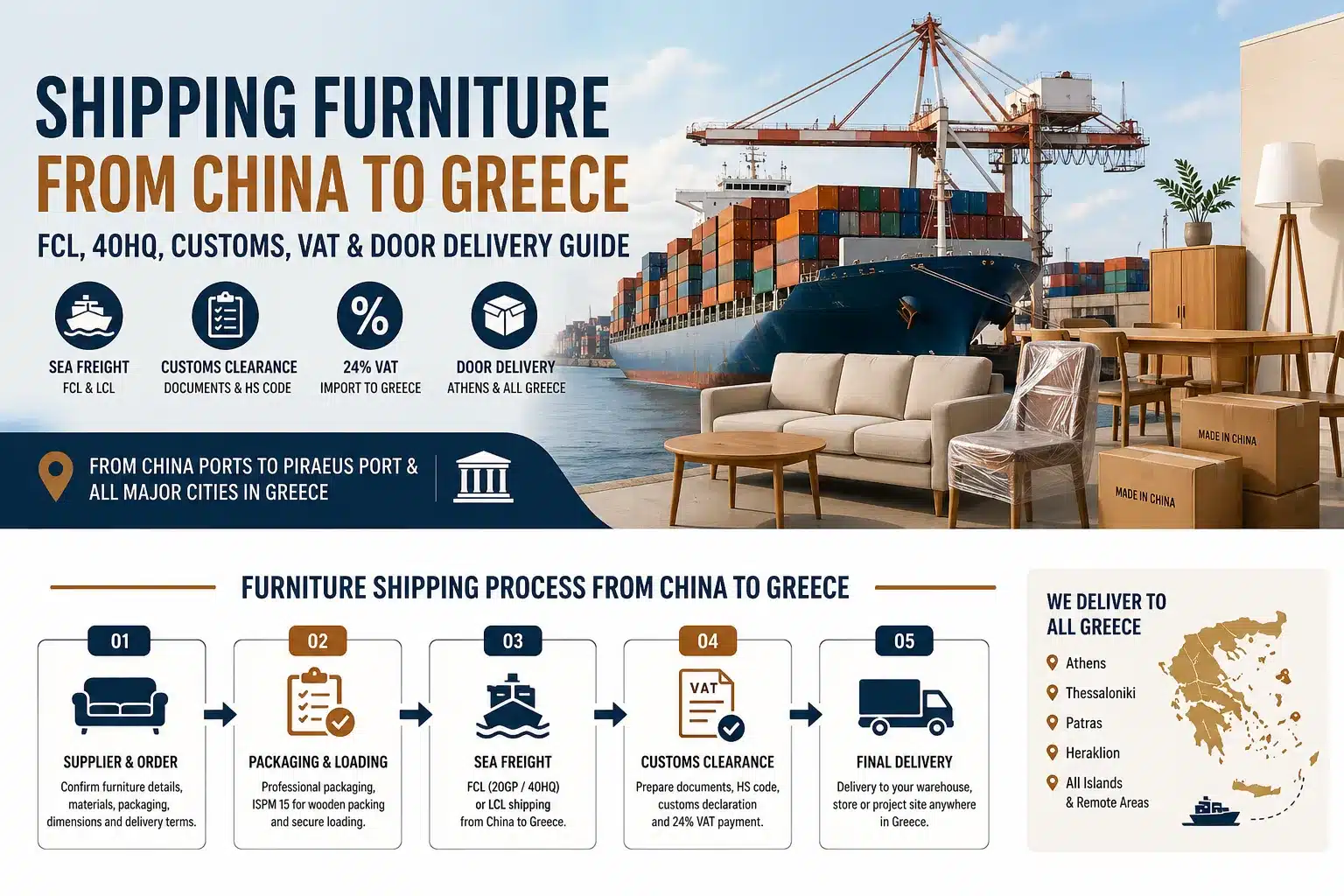
Packaging, Moisture Control and ISPM 15
Packaging designed for domestic transportation inside China may not be strong enough for international sea freight.
Export packaging should protect the cargo during:
- Factory loading
- Container stacking
- Ocean transportation
- Port handling
- Customs inspection
- Warehouse unloading
- Final truck delivery
Furniture, fragile cargo and large cartons may require:
- Export-strength outer cartons
- Reinforced carton corners
- Foam and edge protection
- Separate protection for mirrors, glass and stone
- Water-resistant wrapping for upholstered products
- Container desiccants for moisture-sensitive cargo
- Secure packaging for hardware kits and spare parts
- Separation between heavy and fragile cartons
Temperature and humidity can change during long ocean transit. Wood panels, MDF, particleboard, cartons, fabric and leather may suffer from mould, moisture or packaging weakness without suitable protection.
When solid wood pallets, crates or dunnage are used, the importer should confirm ISPM 15 treatment and official markings before departure. The requirement applies to regulated wood packaging materials and does not automatically mean that all wooden furniture itself needs an ISPM 15 mark.
What Does Sea Freight from China to Piraeus Cost?
There is no fixed rate that applies to every shipment. Ocean freight changes according to carrier capacity, season, container availability, fuel, routing, port congestion and geopolitical disruption.
The total cost may include:
China Origin Costs
- Supplier pickup
- China domestic trucking
- Warehouse receiving
- LCL consolidation
- Container loading
- Export declaration
- Terminal handling
- Documentation
International Freight
- LCL ocean freight by CBM or revenue ton
- 20GP, 40GP or 40HQ ocean freight
- Carrier surcharges
- Fuel-related charges
- Peak-season or equipment surcharges
Piraeus Destination Costs
- Terminal handling
- Delivery order or release fee
- LCL deconsolidation
- Destination warehouse handling
- Customs brokerage
- Port or terminal security charges
- Container trucking
- Loose-carton or pallet delivery
Taxes and Conditional Costs
- EU customs duty
- Greek import VAT
- Customs examination
- Demurrage
- Container detention
- Port or warehouse storage
- Truck waiting time
- Redelivery
- Tail-lift, forklift or special unloading
Two quotations can appear similar but cover different service stages. Therefore, compare quotations using the same:
- China pickup point
- Origin port
- Container type or LCL volume
- Destination charge scope
- Customs scope
- Final delivery postcode
- Unloading requirements
Example Cost Structure: One 40HQ from Yantian to Piraeus
A complete quotation for one 40HQ may be divided into:
- Supplier-to-Yantian trucking or FOB origin handling
- Export declaration and terminal charges
- Yantian-to-Piraeus ocean freight
- Piraeus destination and release charges
- Customs broker service
- Container trucking to the final warehouse
- Chassis, waiting or unloading services where applicable
Customs duty and VAT should be calculated separately according to the commodity code, customs value and importer arrangement unless a transparent duty-paid service has been confirmed.
For a wider cost explanation, review our shipping cost from China to Greece guide.
Transit Time from China to Piraeus
Port-to-port transit commonly falls within a broad 25–45 day planning range. However, the exact schedule depends on the origin port, carrier, transshipment, blank sailings and current route conditions.
| Origin Port | Planning Transit Range | Notes |
|---|---|---|
| Shenzhen / Yantian | About 25–40 days | Suitable for South China cargo when the selected carrier has a workable schedule |
| Guangzhou / Nansha | About 28–45 days | Feeder arrangements and sailing frequency can affect timing |
| Shanghai / Ningbo | About 28–45 days | Schedule depends on carrier routing and Mediterranean connections |
| Qingdao / Tianjin | About 30–45 days | North China shipments may require a larger schedule buffer |
| Xiamen / Fuzhou | About 28–45 days | Transshipment and service frequency should be checked before booking |
The complete supplier-to-door timeline also includes:
- Supplier preparation
- China pickup
- Warehouse receiving
- Export customs processing
- Port cut-off waiting
- Piraeus customs clearance
- Port release
- Final delivery
Therefore, a 30-day ocean transit does not mean that the customer will receive the goods exactly 30 days after factory pickup.
For a broader comparison, read our China to Greece shipping time guide.
What Happens After the Cargo Arrives at Piraeus?
Arrival at Piraeus is not the end of the shipment. The container or LCL cargo still needs customs, port and delivery handling.
- Arrival notice: The carrier or destination agent provides vessel-arrival and cargo-release information.
- Document review: The broker checks the commercial invoice, packing list, bill of lading, HS code and consignee information.
- Customs declaration: The broker submits the import entry using the product classification, origin, value and importer details.
- Duty and VAT: Customs duty follows EU tariff classification, while the normal Greek VAT rate is 24% unless another rate applies.
- Inspection: Customs may request documents, scanning or physical examination.
- Port release: The cargo is released after the customs and carrier requirements are completed.
- Final delivery: The shipment moves to the importer’s warehouse, 3PL, shop, factory or project site.
Commercial Invoice and Packing List
Commercial invoices should use clear product descriptions. Avoid generic terms such as:
- Goods
- Accessories
- Parts
- Samples
- Household products
Instead, describe the actual product, material and use, such as:
- Wooden bedroom cabinets
- LED street-light fixtures
- Aluminium window frames
- Plastic packaging containers
- Metal machinery spare parts
The invoice should show:
- Seller and buyer details
- Product descriptions
- Model numbers
- Materials
- Quantity
- Unit price
- Total value
- Currency
- Country of origin
- Incoterms
The packing list should show carton quantity, dimensions, gross weight, net weight, CBM and packaging type.
HS Codes, EORI, Duty and VAT
The importer should confirm the EU HS or TARIC classification before the cargo arrives.
The classification can affect:
- Customs duty
- Import restrictions
- Product compliance requirements
- Anti-dumping or additional measures
- Customs declaration data
An EORI number is normally relevant for customs operations in the European Union. The customs broker also needs accurate importer information before submitting the declaration.
Greece’s normal VAT rate is 24%. Import VAT can become a major cash-flow cost for high-value container shipments, so it should be estimated before booking.
For detailed customs planning, read our Greece customs clearance, VAT and EORI guide.
Piraeus Destination Charges Importers Should Check
Destination charges can materially change the total landed cost, particularly for LCL shipments.
Before booking, confirm whether the quotation includes:
- Destination terminal handling
- Delivery order or release fee
- Customs brokerage
- LCL warehouse and deconsolidation
- Container lift-on and lift-off
- Port security charges
- Document charges
- Container trucking
- Chassis or equipment usage
- Appointment delivery
Also confirm how the following conditional charges will be billed:
- Customs inspection
- Container demurrage
- Container detention
- Port storage
- LCL warehouse storage
- Truck waiting time
- Failed delivery
- Second delivery attempt
- Forklift or crane use
Demurrage usually relates to the container remaining inside the port beyond the allowed free time. Detention generally relates to the container remaining outside the terminal beyond the carrier’s free period.
The exact definitions and free-time rules should be checked with the selected carrier and destination agent.
Delivery from Piraeus to Athens, Thessaloniki and Crete
Piraeus is often only the import gateway. The cargo may still need delivery to a warehouse, store, 3PL, factory or project site.
| Delivery Area | Planning Notes | What to Confirm |
|---|---|---|
| Athens / Piraeus | Usually the most straightforward area after port release | Warehouse hours, access, unloading method and appointment |
| Thessaloniki | Requires longer inland trucking from Piraeus | Postcode, pallet status, tail-lift needs and delivery window |
| Mainland Greece | Cost depends on distance, postcode and road access | Full address, truck restrictions and unloading conditions |
| Crete | Requires separate routing and delivery planning | Cargo size, postcode, ferry or local delivery conditions |
| Other Greek islands | Not supported under VoltFreight’s standard Greece delivery service | A separate local delivery solution is required |
Can the Final Address Unload a Floor-Loaded Container?
This question is especially important for furniture, machinery, solar panels, building materials and other bulky cargo.
Before arranging delivery, confirm:
- Whether the address can receive a 20GP, 40GP or 40HQ container
- Whether the site has a loading dock
- Whether a forklift is available
- Whether the consignee can unload loose cartons
- Whether a tail-lift vehicle is required
- Whether a crane is needed
- How much unloading time is allowed
- Whether the container must be returned on the same day
- Whether a delivery appointment is required
- Whether large trucks can legally access the road
A floor-loaded 40HQ may take much longer to unload than palletised cargo. If the warehouse cannot receive the full container, the shipment may need to enter a local facility for devanning and smaller-truck delivery.
Waiting time, warehouse handling and secondary delivery should be included in the route comparison.
When Is Piraeus the Best Port for Your Shipment?
Piraeus is usually a practical option when the final market is Greece, especially Athens, the Piraeus area, mainland Greece or supported delivery locations.
It can be suitable when:
- The importer needs direct access to the Greek market
- The final address is near Athens or Piraeus
- The shipment requires a Greek customs entry
- The inland delivery plan is already confirmed
- The available carrier schedule is competitive
Another European port may be more practical when the final destination is outside Greece or when the importer has a different customs and distribution structure.
The decision should compare:
- Total ocean transit
- Port reliability
- Customs setup
- Destination charges
- Inland delivery cost
- Total supplier-to-door time
Do not choose a destination port based only on the lowest base ocean rate.
Common Mistakes When Shipping to Piraeus
Many unexpected charges start before the cargo leaves China.
Common mistakes include:
- Comparing only the ocean freight rate
- Ignoring Piraeus destination charges
- Choosing LCL for fragile goods with weak cartons
- Booking a 20GP without comparing 40GP or 40HQ unit cost
- Using inaccurate supplier weight and CBM estimates
- Using vague descriptions on the commercial invoice
- Confirming an incorrect HS code
- Failing to prepare EORI and importer information
- Forgetting customs duty and 24% VAT
- Waiting until arrival to appoint a customs broker
- Ignoring demurrage, detention and storage risk
- Shipping furniture without moisture protection or a loading plan
- Using solid wood packaging without checking ISPM 15 requirements
- Booking full-container delivery without checking warehouse access
- Failing to confirm forklift, crane or unloading requirements
- Sending cargo before the final Greek delivery address is ready
Early document, packaging and delivery checks usually cost less than solving problems after the vessel arrives.
What Information Is Needed for a Sea Freight Quote?
A reliable quotation requires cargo, customs and delivery information.
Cargo Information
- Product name and photos
- Material and intended use
- Supplier city and loading address
- Carton, pallet or crate quantity
- Dimensions of each package type
- Gross weight per package
- Total gross weight
- Total CBM
- Cargo-ready date
- Commercial value and currency
Shipping Information
- Preferred method: FCL or LCL
- Preferred container: 20GP, 40GP or 40HQ
- EXW, FOB or another supplier Incoterm
- Preferred origin port if known
- Required delivery deadline
- Whether the cargo needs consolidation
- Whether the shipment will be floor-loaded or palletised
Customs Information
- Commercial invoice
- Packing list
- HS code if available
- Country of origin
- Importer and EORI information
- Product certificates or compliance documents where required
- Battery, chemical, branded, textile, toy or CE-regulated product details
Delivery Information
- Complete Greek delivery address
- Postcode
- Business or residential address type
- Warehouse operating hours
- Delivery appointment requirements
- Loading dock availability
- Forklift or crane availability
- Tail-lift requirement
- Maximum truck size allowed
- Expected unloading time
For furniture and bulky cargo, also provide packaging photos, material information, loading plans and details of solid wood pallets, crates or dunnage.
How VoltFreight Helps with China-to-Piraeus Sea Freight
VoltFreight helps importers coordinate FCL, LCL and door delivery from Chinese suppliers to Piraeus and supported destinations in Greece.
Our services can include:
- Supplier pickup across China
- China warehouse receiving and consolidation
- Carton, pallet, weight and CBM checks
- FCL booking from major Chinese ports
- LCL consolidation for smaller shipments
- 20GP, 40GP and 40HQ container comparison
- Furniture and bulky-cargo loading review
- Packaging and moisture-protection checks
- Export documentation coordination
- Piraeus customs document preparation
- Destination-charge review
- Delivery planning to Athens, Piraeus, Thessaloniki, mainland Greece and Crete
- Full-container, pallet or loose-carton delivery coordination
- Comparison with DDP, air freight or other routes when appropriate
We do not recommend a route only because it has the lowest ocean freight price. Instead, our team compares total cost, transit time, cargo risk, customs requirements and final delivery feasibility.
Send the cargo details before the supplier books transportation. Early review makes it easier to identify packaging, documentation or unloading problems before the container leaves China.
Request a sea freight quote from China to Piraeus.
Related China-to-Greece Shipping Guides
- Shipping from China to Greece
- Shipping Cost from China to Greece
- China to Greece Customs Clearance, VAT and EORI
- DDP Shipping from China to Greece
FAQ About Sea Freight from China to Piraeus
How long does sea freight from China to Piraeus take?
Port-to-port transit is commonly planned at about 25–45 days from major Chinese ports. The final supplier-to-door time also includes pickup, export handling, customs clearance, port release and inland delivery.
How much does sea freight from China to Piraeus cost?
The price depends on the origin port, FCL or LCL method, cargo volume, gross weight, container type, carrier, season and final delivery address. Importers should compare origin charges, ocean freight, Piraeus destination costs, customs brokerage and inland delivery.
Should I choose FCL or LCL?
LCL is usually suitable for smaller shipments that do not justify a complete container. FCL is generally better for larger, fragile, bulky or high-value cargo that needs better loading control.
Is a 20GP always cheaper than a 40GP or 40HQ?
Not necessarily. A 20GP may have a lower total rate, but a 40GP or 40HQ can offer a lower cost per cubic metre. Heavy cargo often suits a 20GP, while light bulky goods may suit a 40HQ.
What destination charges apply in Piraeus?
Possible charges include terminal handling, delivery order, customs brokerage, destination warehouse handling, LCL deconsolidation, trucking, demurrage, detention, storage and inspection fees.
What documents are needed for customs clearance?
Common documents include the commercial invoice, packing list, bill of lading, HS or TARIC code, customs value, importer details, EORI information and product-specific compliance documents.
Can Piraeus cargo be delivered to Athens or Thessaloniki?
Yes. Athens and the Piraeus area are common delivery locations. Thessaloniki and other mainland areas require inland trucking after customs release.
Can VoltFreight arrange delivery to Crete?
Crete delivery can be reviewed separately based on the postcode, cargo size, delivery access and unloading requirements. Other Greek islands are not supported under VoltFreight’s standard delivery service.
Is furniture better shipped by FCL or LCL?
Larger furniture orders normally work better by FCL because the goods receive fewer handling stages. LCL can work for samples and smaller orders when the cartons and fragile components have strong export packaging.
Does solid wood furniture need ISPM 15?
ISPM 15 generally applies to regulated solid wood packaging materials such as pallets, crates and dunnage. It does not automatically apply to every finished wooden furniture product. The importer should confirm the applicable product and packaging rules before shipment.
Official Information Sources
- European Commission Access2Markets: Customs Clearance Documents and Procedures
- European Commission Access2Markets: Guide for Import of Goods
- Hellenic Ministry of Economy and Finance: Value Added Tax
- European Commission: Wood Packaging and Dunnage Requirements
- Piraeus Container Terminal
- Reuters: Chinese Import Fraud Investigation via Greece
Important note: This guide supports logistics planning and does not replace customs, tax, legal or product-compliance advice. Sea freight rates, vessel schedules, destination charges, customs duty, VAT, inspections, demurrage, detention, ISPM 15 requirements and inland delivery costs depend on the actual cargo, carrier, season, tariff classification, customs decision and final address. Confirm the final quotation and requirements before booking.