China to Greece customs clearance is one of the most important steps when importing goods from Chinese suppliers into Greece. It affects cargo release, import duty, Greek VAT, product compliance, delivery time and the final landed cost of your shipment.
Many importers focus on freight cost first. However, customs clearance can create bigger problems if the invoice value is unclear, the HS code is wrong, the importer has no EORI number, product documents are missing or the shipment arrives before the buyer prepares duty and VAT payment.
Greece is part of the European Union, so imports from China must follow EU customs rules and Greek tax requirements. In most cases, importers should prepare the commercial invoice, packing list, transport document, HS code, importer details, EORI number, VAT information and product compliance files before the cargo leaves China.
This guide explains China to Greece customs clearance, including importer of record, EORI number, 24% Greek VAT, import duty, HS code classification, customs documents, CE, RoHS, WEEE, EPR, battery and product compliance risks, DDP vs DAP shipping, Piraeus customs checks, clearance delays and the information needed for a customs clearance quote.
Need help checking customs risk before shipping from China to Greece? Send your product name, photos, HS code if available, invoice value, packing list, cargo weight, CBM, Incoterms, importer details and final delivery address. Contact VoltFreight to review the shipping method, customs document checklist and delivery plan.
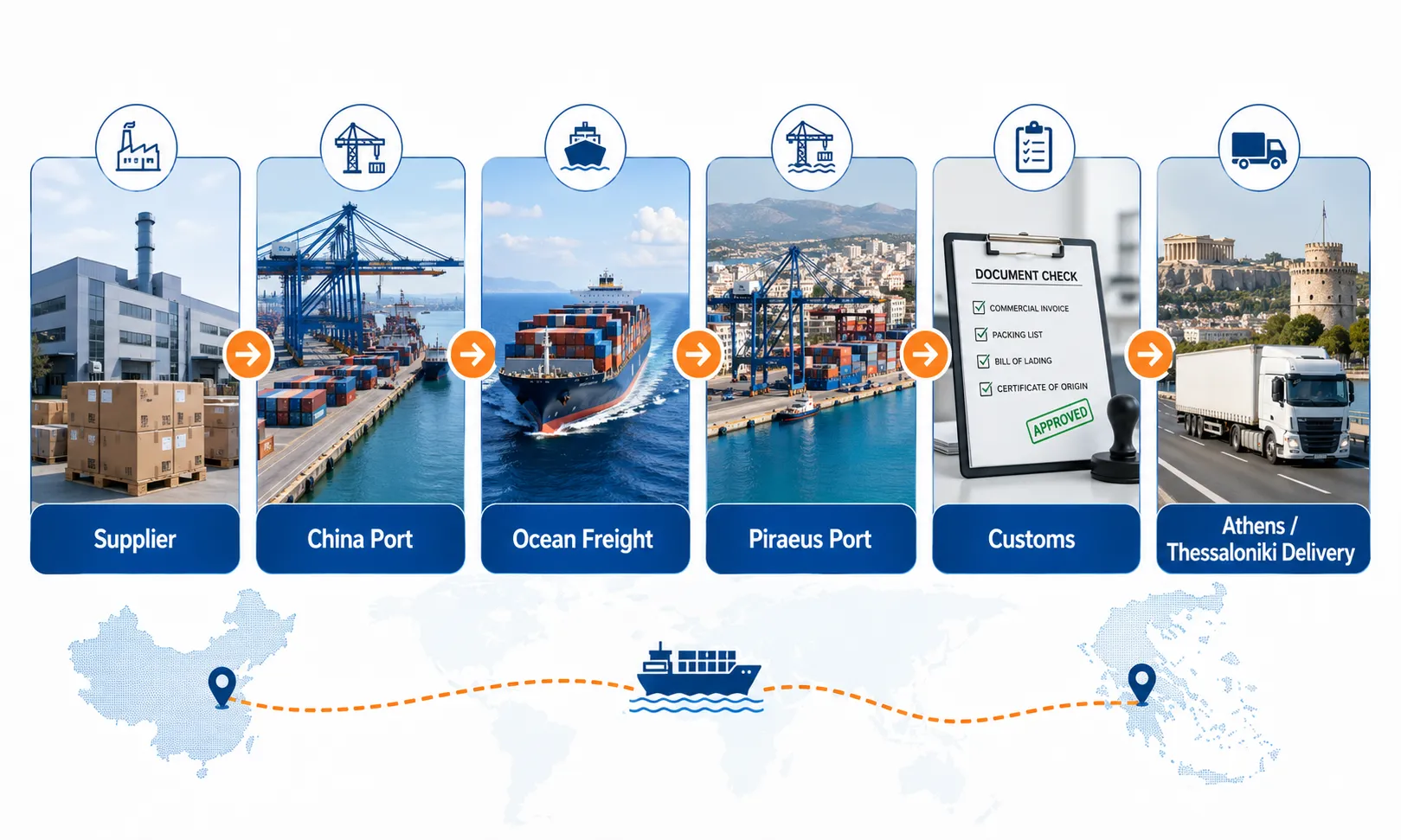
Quick Answer: What Importers Need Before China to Greece Customs Clearance
Before shipping goods from China to Greece, importers should confirm who will act as importer of record, which EORI number will be used, which HS code applies, how duty and VAT will be paid, and which product compliance documents may be required.
Greece’s standard VAT rate is 24%. Customs duty is separate from VAT and depends on the HS code, customs value and product origin. Therefore, importers should calculate landed cost before shipment instead of waiting until the goods arrive at Piraeus, Athens airport or another EU entry point.
In addition, customs clearance is not only about tax. Electronics, LED lights, toys, batteries, textiles, cosmetics, machinery, PPE, food-contact products and branded goods may need extra documents, labels, registrations or authorizations before they can enter the Greek or wider EU market.
| Customs Item | Why It Matters | Importer Action |
|---|---|---|
| Importer of record | Identifies the party responsible for customs, duty, VAT and product information | Confirm the legal importer before shipment leaves China |
| EORI number | Used for EU customs transactions | Check whether the importer has a valid EORI number |
| HS code | Determines duty rate, restrictions and compliance checks | Ask a customs broker to verify EU import classification |
| Commercial invoice | Supports customs value, product description and Incoterms | Use real value, clear product names and correct buyer/seller details |
| Packing list | Shows cartons, weight, dimensions and package details | Make sure it matches the shipment and transport document |
| Greek VAT | Can strongly affect landed cost and cash flow | Plan VAT payment or tax treatment before arrival |
| Compliance documents | May be required for regulated products | Prepare CE, RoHS, WEEE, EPR, battery, textile, toy or other files early |
Who Is the Importer of Record in Greece?
The importer of record is the party responsible for the import declaration, product information, customs value, duty, VAT and import compliance. For a China-to-Greece shipment, this party may be the Greek buyer, an EU company or another legally arranged importing party depending on the sales contract and shipping method.
This role matters because customs may ask the importer to support the declared value, HS code, product description, origin, compliance documents and tax treatment. If the importer cannot answer customs questions, the shipment may face delay, inspection, storage or extra cost.
Before cargo leaves China, the buyer should confirm the importer name, EORI number, VAT number if applicable, customs broker, payment responsibility for duty and VAT, and final delivery plan after release.
Importer of record checklist
- Importer legal name
- EORI number
- VAT number if applicable
- Customs broker or clearance agent
- Commercial invoice buyer and consignee details
- Incoterms such as DAP, DDP, FOB or CIF
- Who pays customs duty and VAT
- Who answers customs questions
- Who provides product compliance documents
- Final delivery address after clearance
EORI Number for Importing Goods from China to Greece
An EORI number is the Economic Operators Registration and Identification number used for customs transactions in the European Union. If a company acts as an importer in Greece or another EU member state, it generally needs an EORI number for customs procedures.
Importers should not wait until the container arrives to check EORI status. If the importer setup is incomplete, the shipment may wait at port or airport while the buyer, broker and customs office correct the information.
| EORI Question | Why It Matters | What to Do |
|---|---|---|
| Does the importer have an EORI number? | EU customs transactions usually require one | Confirm before booking shipment |
| Does the EORI match the importer? | Mismatch can delay customs entry | Check company name and registration details |
| Is the importer in Greece or another EU country? | Customs setup can differ by importer location | Confirm with customs broker |
| Who will provide EORI details to the forwarder? | Forwarder and broker need correct data before arrival | Share details early |
Greece Import VAT: How the 24% VAT Affects Landed Cost
Greece’s standard VAT rate is 24%. Some goods or services may qualify for reduced rates, but importers should plan ordinary commercial imports using the standard rate unless a customs broker or tax advisor confirms another treatment.
Import VAT is not always based only on the factory price. Depending on customs valuation, the VAT base may include customs value, freight, insurance and customs duty. As a result, the final landed cost can be much higher than the product cost shown by the Chinese supplier.
For this reason, importers should calculate landed cost before shipment. This is especially important for high-value products, electronics, machinery, e-bikes, scooters, branded goods, textiles, shoes and bulk commercial cargo.
| Cost Element | Why It Matters | Importer Action |
|---|---|---|
| Customs value | Forms the basis for duty and VAT calculation | Use real invoice value and payment evidence |
| Freight and insurance | May affect taxable base depending on customs valuation | Provide Incoterms and freight cost clearly |
| Customs duty | Can increase the final taxable amount | Confirm duty rate through HS code review |
| Greek VAT | Standard rate is 24% unless a reduced rate applies | Plan cash flow before cargo arrives |
| Destination charges | Port, storage, inspection or delivery charges may add cost | Ask whether they are included in the quote |
Customs Duty and HS Code Classification
Customs duty in Greece follows EU tariff rules. The duty rate depends on the HS code, customs value and product origin. A wrong HS code can lead to underpaid duty, overpaid duty, customs questions, inspection, penalties or delayed delivery.
Importers should not rely only on the supplier’s export HS code. Chinese export classification and EU import classification can differ. Therefore, for higher-value or regulated shipments, the importer should ask a licensed customs broker to confirm the EU import classification before booking.
Why HS code accuracy matters
- It affects duty rate.
- It affects import restrictions.
- It affects product compliance checks.
- It affects trade defence measures where applicable.
- It affects customs data and declaration accuracy.
- It may affect whether extra documents are required.
Documents Needed for China to Greece Customs Clearance
Clean documents are the foundation of smooth customs clearance. The commercial invoice, packing list and transport document should match each other. If values, weights, consignee details or product descriptions are inconsistent, customs may ask for clarification.
In addition, some goods need product-specific documents. For example, electronics may need CE and RoHS files, LED lights may need energy label or EPREL-related information, battery products may need MSDS and UN38.3, and branded goods may need authorization documents.
| Document | Why It Matters | Common Error |
|---|---|---|
| Commercial invoice | Shows seller, buyer, goods, value, currency and Incoterms | Undervalued invoice or vague product description |
| Packing list | Confirms carton count, dimensions, gross weight and net weight | Weights do not match bill of lading or warehouse records |
| Bill of lading / air waybill | Transport document needed for release and customs processing | Consignee details do not match importer setup |
| HS code / TARIC review | Determines duty rate, restrictions and possible compliance checks | Using supplier’s guess without EU tariff verification |
| Importer documents | Supports EORI, VAT and customs entry | Importer setup not ready before arrival |
| Product compliance files | May support customs or market surveillance review | Only preparing documents after customs requests them |
| Authorization documents | May be required for branded or licensed goods | No proof of brand authorization |
Product Compliance: CE, RoHS, WEEE, EPR, Batteries, Textiles and Toys
Customs clearance is not only about tax. Many products imported from China to Greece must also meet EU product compliance rules. Customs or market surveillance authorities may ask for technical documents, labels, declarations or proof of registration depending on the product type.
The exact requirements depend on the goods. Importers should check compliance before shipment, not after arrival. If documents are missing, the cargo may face customs hold, inspection, storage cost or even refusal for market placement.
| Product Category | Common Compliance Points | What to Check Before Shipping |
|---|---|---|
| Electronics and electrical goods | CE, RoHS, WEEE, EMC, LVD and product labeling where applicable | Declaration of conformity, test reports, model list and labels |
| LED lights and lighting products | CE, RoHS, WEEE, energy label and EPREL-related requirements where applicable | Technical datasheet, energy information, label and model details |
| Batteries and products with batteries | Battery transport documents, safety data and EU battery obligations | MSDS, UN38.3, battery type, watt-hour rating and packing method |
| E-bikes and e-scooters | Battery documents, CE, product safety and anti-dumping/tariff review where applicable | Model details, battery files, technical documents and classification review |
| Textiles, clothing and shoes | Labels, material composition, origin, HS code and value support | Composition label, invoice details and product photos |
| Toys | CE, toy safety documents and age-related warnings | Test reports, declaration of conformity, labels and product photos |
| Cosmetics | EU cosmetics compliance, responsible person and notification requirements | Formula, labels, safety assessment and CPNP-related planning |
| Food-contact products | Material safety and EU food-contact compliance | Material declaration, test reports and product specifications |
| Branded goods | Trademark and authorization risk | Brand authorization, purchase documents and genuine product proof |
| Packaging | EPR or packaging obligations after goods enter the market | Packaging material details and local compliance planning |
Product Risk Table: Which Goods Need More Customs Preparation?
Not all products carry the same customs risk. A simple plastic household item usually needs fewer documents than an e-bike, LED light, battery product, branded item, cosmetic product or toy.
However, even lower-risk products still need clear invoices, correct HS codes and accurate packing information. Customs risk increases when the declared value is too low, the product description is vague or the importer cannot provide supporting documents.
| Risk Level | Product Examples | What to Check Before Shipping |
|---|---|---|
| Lower risk | Simple household goods, non-branded accessories, basic plastic products | Invoice, packing list, HS code, product description and value support |
| Medium risk | Textiles, furniture, lighting, electronic accessories, tools | Labels, materials, CE if applicable, HS classification and customs value |
| Higher risk | E-bikes, scooters, batteries, branded goods, toys, cosmetics, PPE, food-contact goods, medical-related items | CE, RoHS, WEEE, EPR, battery files, brand authorization, test reports and safety documents |
DDP vs DAP vs FOB/CIF: Who Pays Duty and VAT?
Shipping terms affect who arranges freight, customs clearance, duty, VAT and final delivery. Misunderstanding Incoterms is a common reason importers face unexpected charges after goods arrive.
DAP and FOB/CIF usually require the buyer or importer to handle import customs, duty and VAT. DDP may simplify the landed delivery process for suitable shipments, but it must be handled transparently and legally under an agreed scope.
For Greece-related DDP services, importers should confirm whether the route uses Greek clearance or an agreed EU gateway clearance and final delivery to Greece. DDP is not a tax-free shortcut, and it does not remove product compliance obligations.
| Term | Who Usually Uses It? | Duty and VAT Responsibility | Main Risk |
|---|---|---|---|
| DDP | Importers wanting a coordinated landed-cost option | Handled under an agreed duty-paid scope | Must be legally declared; avoid non-transparent “tax-free” offers |
| DAP | Importers with their own EORI, broker and VAT setup | Buyer/importer usually handles import customs, duty and VAT | Extra cost if buyer expects duty/VAT to be included |
| FOB | Experienced buyers controlling ocean or air freight | Buyer handles destination customs, duty and VAT | More coordination work after departure from China |
| CIF | Buyers using supplier-arranged freight to destination port | Buyer still handles destination charges, customs, duty and VAT | Destination charges may surprise new importers |
For a detailed landed-cost service guide, review DDP Shipping from China to Greece.
Piraeus Customs Risk: Why Clean Invoices and Accurate HS Codes Matter
Piraeus is a major gateway for China-to-Greece sea freight. Because of its role in EU imports, shipments through Piraeus can receive attention when customs suspects undervaluation, wrong classification, false invoices, missing VAT or risky product declarations.
Recent enforcement cases involving Chinese imports through Greece show why compliant importers should avoid shortcuts. The goal is not to scare importers, but to show that clean paperwork and accurate declarations protect legitimate businesses.
Customs risk increases when:
- The commercial invoice value is unrealistically low.
- The product description is too vague.
- The HS code does not match the product.
- The packing list does not match the real shipment.
- The importer cannot provide payment evidence.
- CE, WEEE, RoHS, battery or safety documents are missing.
- Branded goods have no authorization documents.
- The DDP provider cannot explain customs and VAT handling.
- The importer waits until arrival to prepare documents.
For ocean route planning, review Sea Freight from China to Piraeus Greece.
How Long Does Greece Customs Clearance Take?
There is no fixed customs clearance time for every shipment. If documents are complete and customs does not request inspection, clearance can move relatively quickly. However, delays can occur when customs asks for extra documents, scans the cargo, inspects the container or questions the declared value or HS code.
The clearance timeline also depends on the product type, shipment value, customs workload, duty and VAT payment, importer response speed and whether the cargo arrives by sea, air or courier.
| Situation | Likely Impact | How to Reduce Risk |
|---|---|---|
| Complete documents and low-risk goods | Clearance is more likely to move smoothly | Prepare invoice, packing list, HS code and importer details early |
| Vague invoice or wrong HS code | Customs may request clarification | Use specific product names and broker-reviewed classification |
| High-risk product category | Customs may request compliance documents | Prepare CE, RoHS, WEEE, battery, textile, toy or other documents before shipment |
| Customs inspection | Release may take longer and storage cost may increase | Keep documents consistent and respond quickly |
| Duty or VAT payment delayed | Cargo release and delivery may wait | Plan cash flow before arrival |
Common Reasons Greece Customs Clearance Is Delayed
Most customs delays come from missing information, inconsistent documents or unclear responsibility. Many of these problems can be avoided before the cargo leaves China.
- The importer of record is not confirmed.
- The EORI number is missing or incorrect.
- The commercial invoice value looks too low.
- The product description is too vague.
- The HS code does not match the product.
- The packing list weight does not match the transport document.
- The consignee details do not match the importer setup.
- CE, RoHS, WEEE, battery or other compliance files are missing.
- Branded goods have no authorization documents.
- The customs broker receives documents too late.
- Duty or VAT payment is not ready.
- The final delivery address is incomplete.
How to Prepare Before Shipping from China to Greece
A customs clearance plan should start before supplier pickup in China. The forwarder, buyer, supplier and customs broker should check documents, product details and importer information before the vessel or flight departs.
This preparation helps reduce customs questions, storage cost, demurrage, delivery delay and last-minute document correction. It also helps the importer calculate landed cost more clearly.
Before departure, confirm:
- Supplier name and pickup address in China
- Product name, material, usage and photos
- HS code or TARIC review
- Commercial invoice value and currency
- Incoterms such as EXW, FOB, CIF, DAP or DDP
- Packing list with carton count, dimensions, gross weight and net weight
- Importer of record and EORI number
- VAT number if applicable
- Customs broker or clearance agent
- Product compliance documents if required
- Battery, chemical, cosmetic, toy, textile or branded-goods documents if applicable
- Final delivery address in Greece
- Whether delivery is needed after customs release
Customs Clearance Quote Checklist: What to Send Before Shipping
The fastest way to check whether your shipment can clear customs in Greece is to send complete cargo and importer information before booking. This helps the forwarder and customs broker identify risk early.
- Commercial invoice
- Packing list
- Bill of lading or air waybill draft if available
- Product photos
- Product use and material information
- HS code if known
- Detailed product description if HS code is not available
- Importer name
- EORI number
- VAT number if applicable
- Incoterms: DDP, DAP, FOB, CIF or another agreed term
- CE, RoHS, WEEE, EPR, textile, toy, cosmetics, battery or brand documents if applicable
- Final delivery address in Greece
- Whether inland trucking is needed after clearance
- Whether the cargo includes batteries, liquids, cosmetics, branded goods, medical-related items or oversized cargo
How VoltFreight Helps with China to Greece Customs Clearance Planning
VoltFreight helps importers review customs documents, shipping methods, cargo risk and delivery options before goods move from China to Greece. Our team can check the logistics scope, product details, invoice information, route options and final delivery requirements before booking.
For DAP or FOB/CIF shipments, the importer should work with a licensed customs broker for Greek import customs clearance, duty, VAT and EORI setup. For DDP requests, VoltFreight can review whether the cargo is suitable for an agreed duty-paid route and final delivery to Greece.
- China supplier pickup and warehouse coordination
- FCL and LCL sea freight to Greece
- Air freight and express options for urgent cargo
- DDP feasibility review for suitable shipments
- Document checklist before departure
- Product risk review for batteries, electronics, textiles, cosmetics and branded goods
- Sea freight planning to Piraeus
- Delivery planning to Athens, Piraeus, Thessaloniki, mainland Greece and Crete
- Support for quote comparison between DAP, DDP, sea freight and air freight
Related China to Greece Shipping Guides
Use these VoltFreight guides to compare customs clearance, shipping time, shipping cost, DDP, sea freight and delivery options before booking your shipment from China to Greece.
- Shipping from China to Greece
- Sea Freight from China to Piraeus Greece
- DDP Shipping from China to Greece
- Shipping Cost from China to Greece
- China to Greece Shipping Time
- Sea Freight from China
- Air Freight from China
- Express Freight from China
- Contact VoltFreight
FAQ About China to Greece Customs Clearance
Do I need an EORI number to import from China to Greece?
If you act as the importer in the EU, you generally need an EORI number for customs transactions. Confirm your EORI setup before the shipment leaves China, especially for sea freight and commercial imports.
What is Greece’s standard import VAT rate?
Greece’s standard VAT rate is 24%. Some reduced rates exist, but most ordinary imported goods should be planned using the standard rate unless a tax advisor or customs broker confirms otherwise.
How are customs duties calculated in Greece?
Greece follows EU tariff rules. The duty rate depends on the HS code, customs value and product origin. Importers should ask a customs broker to confirm the EU import classification before shipment.
What documents are needed for China to Greece customs clearance?
Common documents include commercial invoice, packing list, bill of lading or air waybill, HS code, importer details, EORI number and product compliance documents where required.
Can I use the supplier’s Chinese HS code for Greek customs?
You can use it as a reference, but you should not rely on it completely. Chinese export classification and EU import classification may differ, so the importer or customs broker should confirm the EU/TARIC classification.
How long does customs clearance take in Greece?
There is no fixed clearance time for every shipment. Complete documents and low-risk goods usually reduce delay risk. However, inspections, value questions, wrong HS codes or missing compliance files can extend the process.
Can DDP shipping avoid Greek VAT and duty?
No. DDP is not a tax-free shortcut. A proper DDP route should still have a legal customs and tax handling structure under an agreed scope. Product compliance requirements also still apply.
What is the difference between DDP and DAP shipping to Greece?
Under DAP, the buyer usually handles import customs, duty and VAT after arrival. Under DDP, the seller or forwarder handles duty-paid delivery under an agreed scope. However, DDP must be reviewed carefully for product restrictions, customs handling and VAT treatment.
Why does Piraeus customs clearance sometimes face delays?
Delays can happen because of customs workload, document mismatch, undervaluation concerns, wrong HS codes, inspection, missing compliance documents or late duty and VAT payment.
What products need extra customs preparation when importing to Greece?
Electronics, LED lights, batteries, e-bikes, scooters, branded goods, toys, cosmetics, PPE, food-contact products, textiles and medical-related items usually need more preparation than simple low-risk goods.
Can VoltFreight help with China to Greece customs clearance?
VoltFreight can help review the shipping plan, document checklist, DDP feasibility, cargo risk and delivery requirements. For formal Greek import customs entry, importers should work with a licensed customs broker or tax advisor where required.
Final Thoughts
China to Greece customs clearance should not be treated as a last-minute paperwork step. It affects cargo release, duty, VAT, delivery time, compliance risk and final landed cost.
Importers should confirm the importer of record, EORI number, HS code, customs value, documents, product compliance files and delivery plan before cargo leaves China. In addition, they should avoid undervaluation, vague product names and unclear DDP offers.
If you need help checking customs risk before shipping from China to Greece, contact VoltFreight with your cargo details. Our team can review shipping method, document checklist, route options and delivery planning based on your real shipment requirements.
Information Sources
- gov.gr: Greece basic VAT rates
- Hellenic Ministry of Economy and Finance: Value Added Tax
- European Commission: Economic Operators Registration and Identification number
- European Commission Access2Markets: Customs clearance documents and procedures
- European Commission Access2Markets: Guide for import of goods
- Reuters: EU prosecutors uncover criminal scheme involving Chinese imports via Greece
Important note: This guide is for logistics planning only. Customs clearance, duty, VAT, EORI, importer of record, DDP feasibility, product classification, CE, RoHS, WEEE, EPR, battery rules, product compliance and final delivery requirements depend on cargo type, HS/TARIC code, declared value, product origin, Incoterms, importer setup, customs decisions and current EU/Greece regulations. Always confirm final requirements with a licensed customs broker, tax advisor and product compliance specialist before shipment.