Package stuck in customs is one of the most stressful problems importers face after shipping goods from China. The cargo may have already left the supplier, the tracking status may stop updating, and the buyer may not know whether the delay comes from missing documents, unpaid duties, product inspection, customs review or courier handling.
For commercial importers, a package or shipment stuck in customs usually means the customs authority, courier, carrier, broker or local clearance agent needs more information before the goods can be released. The problem may be simple, such as a missing commercial invoice. It may also be more serious, such as an incorrect HS code, unclear product description, restricted product, trademark issue, unpaid tax or importer information problem.
This guide explains why packages and import shipments from China get stuck in customs, what documents usually matter, how HS code and declared value problems create delays, why DDP shipments can still face customs holds, and what importers should ask their supplier or freight forwarder when clearance slows down.
This article focuses on commercial shipments from China, including air freight, sea freight, express, DDP shipping, Amazon FBA cargo, 3PL delivery and door-to-door freight. If you are only tracking a small personal parcel from an online marketplace, you may need to contact the platform or courier directly. If you are importing business cargo from China, VoltFreight can help review shipping documents, customs risk and clearance preparation before the cargo leaves China.
Quick Answer: Why Is Your Package Stuck in Customs?
A package stuck in customs usually means the shipment cannot be released until customs, the courier, the broker or the local clearance agent finishes document review, duty and tax processing, product inspection or importer verification.
Common reasons include missing commercial invoices, incomplete packing lists, wrong HS codes, unclear product descriptions, low declared value, unpaid duties, customs inspection, restricted goods, brand or trademark concerns, missing importer tax ID, EORI or EIN, and DDP route issues.
For importers shipping from China, the fastest first step is to ask three questions:
- What exact customs status or hold reason has the carrier, courier or broker provided?
- Which document, payment or importer information is missing, unclear or under review?
- Who is responsible for customs response: supplier, importer, courier, customs broker or freight forwarder?
A customs delay does not always mean the goods are lost. In many cases, the shipment is waiting for document correction, duty payment, importer confirmation or customs examination.
What Should You Do First When a Package Is Stuck in Customs?
When a package is stuck in customs, do not only ask “where is my cargo?” The better first step is to identify the exact reason for the customs hold and confirm who must take action.
Use this simple process:
- Check the latest tracking status, broker message, courier notice or freight forwarder update.
- Ask whether the delay is caused by documents, duty payment, customs inspection, HS code review, declared value review or importer information.
- Prepare the commercial invoice, packing list, product description, HS code support, payment proof and importer tax information if requested.
- Confirm who must reply: importer, supplier, courier, customs broker or freight forwarder.
- Do not send random documents before confirming what customs, the broker or the courier actually needs.
Fast response matters. Many customs delays become longer because the importer, supplier and forwarder do not know who should reply.
For related import planning topics, you can also read DAP vs DDP shipping from China, freight insurance from China, China inspection service before shipping and CBM calculator for shipping from China.
Need help reviewing a China shipment before customs problems happen? Send your product name, invoice, packing list, HS code if available, cargo value, destination country and delivery address. Then, contact VoltFreight to review shipping and customs preparation before cargo leaves China.
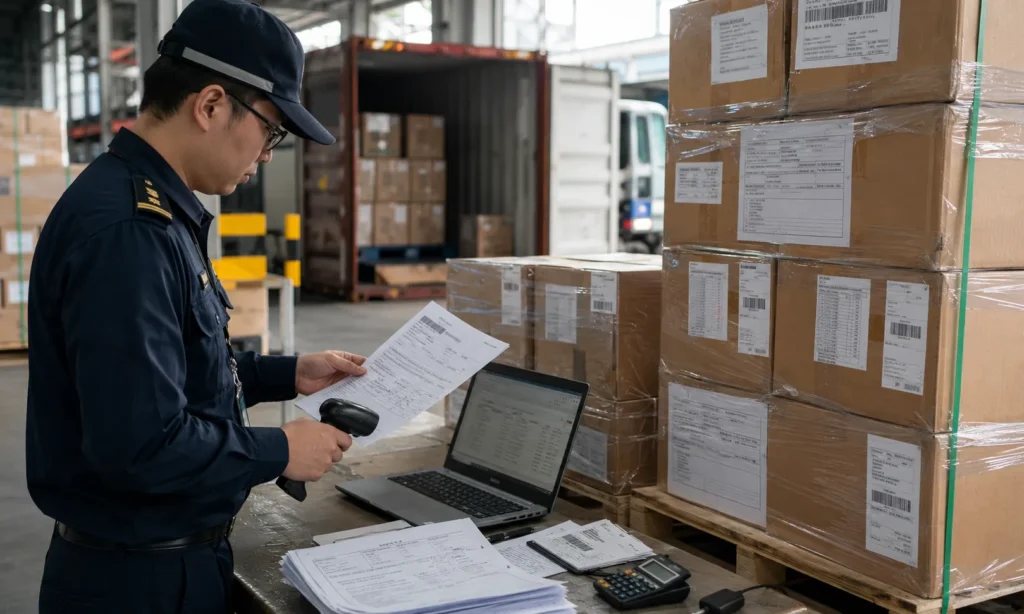
What Does “Package Stuck in Customs” Mean?
“Package stuck in customs” means the shipment has reached a customs checkpoint or clearance process but has not yet been released for final delivery. The shipment may sit at an airport, seaport, bonded warehouse, courier facility, customs examination site or destination-country clearance hub.
For small parcels, the status may show “held in customs,” “customs clearance delay,” “awaiting customs clearance,” “import scan,” “pending clearance,” “clearance event” or “customs processing.” For commercial freight, the issue may appear through the customs broker, local agent, airline, shipping line, courier or freight forwarder.
The word “package” is often used by consumers, but the same problem can happen to larger import shipments. A pallet, LCL shipment, air cargo shipment, Amazon FBA delivery or DDP shipment can also face customs review.
The key point is simple: customs release depends on correct information, proper documentation, importer eligibility, duty and tax handling, and product compliance. If any part is missing or unclear, the shipment may stop until the issue is resolved.
Common Reasons Packages and Shipments from China Get Held by Customs
Customs delays happen for many reasons. Some are simple document problems. Others involve product compliance, duties, inspections or destination-country rules.
| Customs Hold Reason | What It Usually Means | What Importers Should Check |
|---|---|---|
| Missing invoice | Customs needs a commercial invoice to review goods, value and seller/buyer details. | Check commercial invoice, seller, buyer, product description, value and currency. |
| Incorrect packing list | Carton quantity, weight or packaging data does not match the shipment. | Check packing list, carton count, gross weight, net weight and dimensions. |
| HS code issue | The declared classification may be wrong, incomplete or unclear. | Review product material, function, use and HS code with broker or importer. |
| Low declared value | Customs may question whether the invoice value reflects the real transaction. | Prepare purchase order, payment proof or supplier invoice if requested. |
| Duties or taxes unpaid | Clearance cannot finish until import charges are paid or arranged. | Confirm who pays duties and taxes under DAP, DDP or other trade terms. |
| Customs inspection | The shipment has been selected for document review, X-ray or physical examination. | Wait for inspection result and prepare supporting documents if needed. |
| Restricted goods | The product may require licenses, certificates or special import approval. | Check destination-country requirements before shipment. |
| Importer information issue | Customs may need tax ID, EORI, EIN, VAT number or importer confirmation. | Confirm importer of record details and local registration requirements. |
A customs hold may involve more than one issue. For example, a shipment may have an unclear product description and a low declared value at the same time. The solution depends on the exact hold reason, destination country and shipping method.
Commercial Invoice and Packing List Problems
The commercial invoice and packing list are two of the most important customs documents. If they are missing, unclear or inconsistent, the package may get stuck in customs.
The commercial invoice usually shows the seller, buyer, product description, quantity, unit price, total value, currency, Incoterms, country of origin and shipment details. Customs uses this information to review import value, product classification, duty and tax calculation, and compliance risk.
The packing list usually shows carton quantity, package type, gross weight, net weight, dimensions and packing details. It helps customs, carriers, warehouses and delivery agents understand what is inside the shipment and how the cargo is packed.
Common invoice and packing list problems include:
- Product description is too vague, such as “parts,” “goods,” “samples” or “accessories”
- Quantity on invoice does not match packing list
- Gross weight does not match carrier data
- Declared value looks too low compared with the product
- Currency is missing
- Buyer or importer details are incomplete
- Country of origin is missing
- Invoice does not match the actual shipment
For commercial imports from China, ask your supplier to prepare clear documents before pickup. If the goods are already stuck, ask the carrier or broker which field is causing the delay.
HS Code, Product Description and Declared Value Issues
HS code problems are a common reason for customs clearance delay. The HS code helps customs classify the product and decide which duty rate, tax rule, restriction or compliance requirement may apply.
A wrong HS code can delay clearance because customs may ask for more product details. A vague product description can create the same problem. For example, “plastic product” may not be enough. Customs may need to know whether the product is a storage box, toy, kitchenware, electronic accessory, packaging material or industrial part.
Declared value also matters. If the invoice value looks too low, customs may question it. The importer may need to provide payment proof, purchase order, product listing, supplier contract or other supporting documents.
To reduce HS code and value problems, importers should prepare:
- Clear product name
- Material
- Function and intended use
- Photos or product link if helpful
- Invoice value and currency
- Country of origin
- HS code if already confirmed by broker or importer
A freight forwarder can help review whether the description looks clear for shipping preparation, but the final classification responsibility may depend on the importer, customs broker and destination-country rules. For high-risk or regulated products, consult a qualified customs broker before shipment.
Duties, Taxes or Import Fees Are Not Paid
A package may be held in customs because duties, VAT, GST, import tax, brokerage charges or other import fees have not been paid or arranged. This is common when the shipment is not shipped under DDP terms.
Under DAP-style shipping, the seller or forwarder may handle transportation to the destination, but the buyer usually remains responsible for import customs clearance, duties and taxes. If the importer does not pay or respond, the shipment may remain on hold.
Under DDP shipping, the seller or freight forwarder may quote a service that includes duties and taxes. However, DDP does not mean customs will never review the shipment. Customs can still inspect goods, ask for documents or question product details.
Payment-related customs holds often happen when:
- The importer did not expect duties or taxes
- The courier needs the receiver to pay import charges
- The broker cannot reach the importer
- The invoice value needs confirmation before tax calculation
- The shipment terms are unclear
Before shipping from China, confirm whether your quote is DAP, DDP, port-to-port, airport-to-airport or door-to-door. Many customs delays start because the buyer and supplier do not clearly understand who pays import fees.
Customs Inspection, Random Exam or Document Review
Sometimes a shipment gets stuck in customs even when the documents look correct. Customs may select shipments for inspection, X-ray, document review or physical examination.
This can happen for many reasons. Some inspections are random. Others may relate to product type, declared value, origin, importer history, brand risk, compliance rules or inconsistent documents.
During customs inspection, the shipment may wait at a facility until customs finishes the review. The timeline can vary by country, port, airport, courier network, workload and inspection type.
If customs requests more information, respond quickly. Delayed responses can extend the hold.
Useful supporting information may include:
- Product photos
- Commercial invoice
- Packing list
- Product description
- Material and function
- HS code support
- Payment proof
- Import license or certificate if required
A customs inspection does not always mean there is a violation. However, it does mean the shipment cannot move forward until customs releases it.
Restricted, Branded or Sensitive Products
Some products face more customs attention than others. If your package is stuck in customs after shipping from China, product type may be the reason.
Higher-risk categories may include:
- Branded goods or goods with logos
- Electronics
- Battery-powered products
- Magnetic goods
- Liquids, powders or chemicals
- Medical-related products
- Food-contact products
- Children’s products
- Cosmetics
- Textiles with labeling requirements
- Wood packaging or products made with plant or animal materials
Restricted does not always mean prohibited. It often means the product may need extra documents, certification, labeling, testing, licenses or importer approval.
Branded goods can create trademark concerns. If customs suspects counterfeit goods or unauthorized brand use, the shipment may face longer review, document requests or seizure risk. Importers should make sure they have the right to import branded products before shipping.
Sensitive product risk should be checked before goods leave China. After the cargo is already held, options may become limited and costs may increase.
Importer Tax ID, EORI, EIN or IOR Problems
A shipment may get stuck because the importer information is missing, incorrect or not valid for customs clearance. Different countries use different importer identification systems.
For the European Union, importers often need an EORI number for customs clearance. For the United Kingdom, importers may also need an EORI number when moving goods into or out of the UK. For the United States, commercial imports may require importer information such as EIN, IRS number, SSN or customs broker details depending on the case.
The importer of record, also called IOR, is important because customs needs a responsible party for import declaration, duties, taxes and compliance.
Common importer information problems include:
- No EORI number for EU or UK import
- Wrong company name or address
- Importer does not match invoice or shipping document
- Tax ID is missing or invalid
- Courier cannot contact receiver
- Importer is not prepared to act as importer of record
If your freight forwarder, courier or broker asks for importer information, respond carefully. Wrong importer data can delay clearance and may create compliance problems.
Why DDP Shipments Can Still Face Customs Delays
Many importers think DDP shipping means customs problems cannot happen. That is not true. DDP shipping can reduce the buyer’s direct work, but it cannot remove customs control.
A DDP shipment from China can still face delays if:
- The product description is unclear
- The HS code needs review
- Customs selects the cargo for inspection
- The product is restricted or sensitive
- The invoice value looks incorrect
- The cargo does not match documents
- The destination-country route has temporary congestion
- The forwarder needs extra information from the supplier or buyer
DDP works best when the product is suitable for the route, the documents are accurate, and the buyer sends complete cargo details before shipping.
If you use DDP, ask what is included in the quote. Does it include duties and taxes? Does it include customs clearance? Does it include final delivery to a business address, Amazon FBA, 3PL warehouse or residential address? Does the forwarder accept your product type?
Clear answers before shipment can prevent delays later.
How Long Can Customs Clearance Take?
Customs clearance time depends on the country, product type, shipping method, documents, importer response, customs workload and whether the shipment is selected for inspection.
Some express packages clear quickly. Some air freight shipments may clear within a few days if documents are complete. Sea freight shipments may take longer because they involve ports, terminals, brokers, customs systems and destination handling.
If customs asks for more information, the delay depends heavily on how fast the importer, supplier or forwarder responds.
A customs hold may last longer when:
- The broker cannot contact the importer
- The invoice or packing list must be corrected
- HS code classification is disputed
- Duties and taxes are not paid
- Customs requires physical inspection
- The product needs licenses, certificates or compliance documents
- Brand or trademark review is involved
There is no single guaranteed timeline for every customs delay. The safest approach is to identify the exact hold reason first, then respond with the required document or action.
What Documents Help Clear Customs Faster?
The right documents can reduce customs delays. They do not guarantee instant clearance, but they help the broker or customs authority review the shipment more clearly.
For commercial shipments from China, prepare:
- Commercial invoice
- Packing list
- Bill of lading or air waybill
- Product photos if needed
- Product description with material and function
- HS code if available
- Country of origin details
- Purchase order or sales contract if requested
- Payment proof if value is questioned
- Import license or certificate if required
- Importer tax ID, EORI, EIN or VAT number when applicable
- Amazon FBA labels or delivery references if shipping to Amazon
The commercial invoice should match the packing list and shipment. If the product name, quantity, weight or value conflicts across documents, customs may ask questions.
If your cargo is going to Amazon FBA or a 3PL warehouse, make sure labels and delivery references are ready. Customs clearance and warehouse receiving are different processes, but mistakes in labels or carton information can still create delivery delays after customs release.
What Should You Ask Your Supplier or Freight Forwarder?
When a package is stuck in customs, do not only ask “where is my cargo?” Ask for the exact hold reason.
Useful questions include:
- What is the current customs status?
- Is the shipment waiting for document review, inspection or duty payment?
- Which document is missing or incorrect?
- Does customs need a better product description?
- Is the HS code being questioned?
- Is the declared value being reviewed?
- Does the importer need to provide tax ID, EORI, EIN or VAT number?
- Is the shipment under DDP, DAP, express, air freight or sea freight?
- Who is responsible for contacting customs or the broker?
- What is the next action and who must take it?
If the supplier arranged shipping, ask the supplier to contact the courier or forwarder immediately. If you arranged shipping through your own freight forwarder, send all requested documents to the forwarder or broker as soon as possible.
Fast response matters. Many customs delays become worse because the importer, supplier and forwarder do not know who should reply.
Practical Cases: Why Shipments from China Get Stuck in Customs
Case 1: Vague Product Description Delayed Clearance
In daily China freight work, one common customs delay starts with a vague invoice description. A supplier may write “accessories,” “parts” or “plastic goods” on the invoice because it seems simple. However, customs may need to know the exact product, material and use.
For example, a shipment of plastic display accessories may be described only as “plastic parts.” The courier or broker may then ask for a clearer description before clearance. The importer must confirm what the product is, how it is used, what material it contains and whether any restrictions apply.
This type of delay is avoidable. Before shipping, the buyer should ask the supplier to use a clear commercial product description on the invoice. Product photos and a short explanation can also help the forwarder or broker prepare more accurate clearance information.
Case 2: DDP Shipment Delayed Because Product Details Were Incomplete
Another common case involves DDP shipping. The buyer may believe everything is included, so they send only carton quantity and weight. However, the forwarder still needs product name, material, use, value and destination details to review customs risk.
If the goods are electronics, branded items, battery-powered products or goods with special compliance requirements, the route may need extra review before shipment. If the buyer does not provide those details early, the shipment may face questions during customs clearance.
In this situation, the delay does not mean DDP is wrong. It means the shipment details were not complete enough. A better process is to review product information, invoice, packing list and destination requirements before cargo leaves China.
How VoltFreight Helps Reduce Customs Delay Risks
VoltFreight helps importers reduce customs delay risks before cargo leaves China. We do this by reviewing shipment details, documents and route suitability during the quote and booking stage.
Our team can help review:
- Product name and material
- Commercial invoice and packing list
- Carton quantity, weight and dimensions
- HS code if provided by the importer or broker
- Declared value and currency
- Pickup city in China
- Destination country and delivery address
- Whether the shipment is suitable for sea freight, air freight, express, DDP or door-to-door delivery
- Whether the goods may need extra documents, labels, certificates or pre-shipment checks
VoltFreight can also help with China warehouse receiving, cargo photos, carton checks, consolidation, packaging review, freight insurance planning and final delivery arrangement.
For Amazon FBA shipments, we can help review cargo preparation, carton data and shipping labels before goods leave China. For B2B import shipments, we can help check whether the quote scope, customs clearance responsibility and final delivery plan are clear before booking.
A freight forwarder cannot control every customs decision. However, better documents and clearer shipment details can reduce avoidable delays.
Ask VoltFreight to Review Your Shipment Before Customs Problems Happen
Related China Shipping Guides
Use these related guides to prepare your shipment before customs problems happen:
- DAP vs DDP Shipping from China
- Freight Insurance from China
- China Inspection Service Before Shipping
- CBM Calculator for Shipping from China
- China Warehouse Service for US Importers
- Shipping from China to the USA
- China to USA Shipping Cost
- DDP Shipping from China to USA
FAQ About Packages Stuck in Customs from China
Why is my package stuck in customs after shipping from China?
Your package may be stuck in customs because documents are missing, duties are unpaid, the HS code is unclear, the declared value is being reviewed, customs selected the shipment for inspection, or importer information is incomplete.
What does package held in customs mean?
Package held in customs means the shipment has not been released yet. Customs, the courier, the broker or the local agent may need to review documents, collect duties, inspect the goods or verify importer information before delivery can continue.
How long does customs clearance take?
Customs clearance time varies by country, product type, shipping method, customs workload, document quality and inspection status. If customs requests more information, clearance time depends on how quickly the importer, supplier or forwarder responds.
Can a DDP shipment from China get stuck in customs?
Yes. DDP can reduce the buyer’s direct customs work, but customs can still inspect the shipment, request documents, question HS code or value, or delay release if product details are unclear.
What documents are needed when a shipment is stuck in customs?
Common documents include commercial invoice, packing list, bill of lading or air waybill, product description, HS code support, payment proof, importer tax ID and any required license or certificate. The exact requirement depends on the hold reason.
Can VoltFreight help if my shipment is stuck in customs?
VoltFreight can help review China shipment documents, product details and customs-related information for shipments arranged through our service. For cargo shipped by another courier, platform or forwarder, the importer should first ask that provider for the exact customs hold reason.
Conclusion
A package stuck in customs after shipping from China usually means customs, the courier, the broker or the local clearance agent needs more information, payment, inspection or importer confirmation before release.
The most common causes include missing commercial invoices, incorrect packing lists, unclear HS codes, vague product descriptions, low declared value, unpaid duties, restricted goods, customs inspection and missing importer tax ID, EORI or EIN.
For commercial importers, the best way to reduce customs delays is to prepare before shipment. Ask your supplier for clear product details, correct invoice data, accurate packing information and final carton details. Confirm whether your shipment is DDP, DAP, express, air freight, sea freight or door-to-door delivery, and make sure you understand who handles customs clearance and duties.
VoltFreight can help importers review shipping documents, cargo details, customs risk and delivery plans before goods leave China. If your next shipment needs smoother customs preparation, send your product details, invoice, packing list, destination country and delivery address before booking.
Contact VoltFreight for China Shipping and Customs Preparation Support
Useful Official Sources
- CBP: Basic Importing and Exporting
- CBP: Tips for New Importers and Exporters
- European Commission: EORI Number
- GOV.UK: Import Goods into the UK
- GOV.UK: Get an EORI Number
- Amazon Seller Central: Shipping Label Requirements
- Amazon Seller Central: Shipping and Routing Requirements
Important note: Customs rules, clearance timelines, tax requirements, importer obligations and product restrictions vary by destination country, product type, carrier, customs broker and service agreement. This guide is for general freight planning only and does not replace advice from a licensed customs broker, tax adviser, legal adviser or destination-country customs authority.