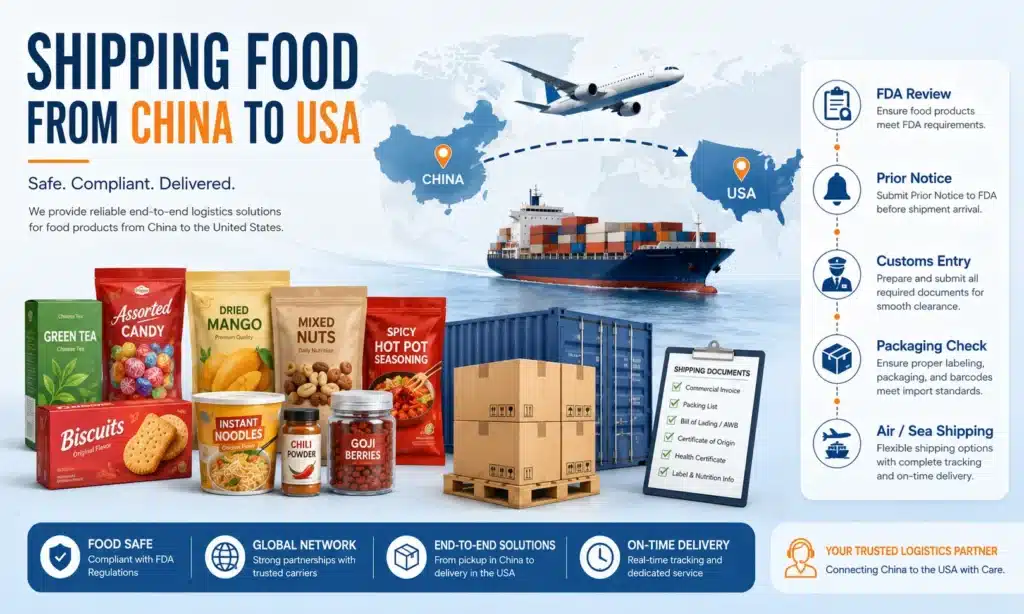
Shipping food from China to USA is possible for many commercially packaged and shelf-stable products, including tea, candy, biscuits, spices, dried snacks, instant noodles and selected beverages. However, the shipment should be reviewed before booking because the ingredients, label, manufacturer, importer, packaging and intended use can change the FDA and customs requirements.
The practical answer is: yes, many food products can be shipped, but not every product can use the same freight or DDP route. Products containing meat, dairy, seafood, fresh plant material, liquids, supplements or temperature-sensitive ingredients usually need additional review.
For most FDA-regulated food imports, the importer should confirm Prior Notice, food facility registration, FSVP responsibility, English labeling, CBP entry data and any USDA or APHIS requirements. A freight quotation alone cannot confirm that a food product is eligible for import.
This guide explains how to import and ship food from China to the USA, including FDA Prior Notice, facility registration, FSVP, food labeling, CBP customs entry, APHIS checks, product categories, air and sea freight, DDP feasibility, packaging and quote preparation.
Need a food shipping review from China to the USA? Send your product name, ingredient list, label photos, brand, packaging type, shelf life, carton quantity, gross weight, CBM, supplier city, U.S. destination and importer or FSVP information if available. Contact VoltFreight to review the route, documents, packaging risk and delivery plan before cargo leaves China.
Quick Answer: Can You Ship Food from China to the USA?
Yes, importers can ship many commercially packaged and shelf-stable food products from China to the USA. Common examples include tea, candy, biscuits, packaged snacks, spices, roasted coffee, dried noodles and some processed foods. However, the importer should check each product before booking because ingredients, processing method, packaging and intended use can change the import requirements.
For example, plain dried tea may be easier to review than a food product with animal-origin ingredients. Likewise, packaged candy may be simpler than a bottled sauce, low-acid canned food, dietary supplement, seafood product or chilled product. Therefore, importers should not rely only on the supplier’s statement that a product is “safe to ship.”
| Question | Short Answer | Importer Action |
|---|---|---|
| Can food be imported from China to the USA? | Often yes, when compliant | Review FDA, CBP, labeling, facility and product-specific requirements |
| Does food usually need Prior Notice? | Most FDA-regulated food imports need it unless an exemption applies | Confirm who files Prior Notice before arrival |
| Does FDA approve every food shipment before export? | No | Prepare documents because FDA may inspect the shipment at entry |
| Can DDP solve food import compliance? | No | Use DDP only after confirming product eligibility and importer responsibility |
| Can food samples skip FDA rules? | Not automatically | Check Prior Notice and FDA review even for samples or small parcels |
Why Low-Value Food Shipments Still Need FDA Review
Low-value parcels and samples should not be treated as ordinary non-regulated cargo. On July 9, 2025, U.S. Customs and Border Protection stated that all FDA-regulated products, regardless of quantity or value, must be submitted to FDA for review. It also confirmed that Prior Notice requirements still apply to food and feed shipments unless an exemption applies.
Therefore, importers should not assume that a sample order, low-value parcel or e-commerce shipment can bypass normal food-import requirements. If the product falls under FDA food rules, the shipment may still require FDA data, Prior Notice, accurate product information and proper entry handling.
| Shipment Type | Old Assumption | Better Import Approach |
|---|---|---|
| Food samples | Small sample parcels are simple | Check FDA review, Prior Notice and product details before shipping |
| Low-value e-commerce parcels | Low value means less compliance work | Prepare FDA data when the product is FDA-regulated |
| Tea, snacks or candy parcels | Courier can handle everything automatically | Confirm product description, ingredients, Prior Notice and entry route |
| DDP food shipments | DDP removes the importer’s responsibility | Clarify importer, FDA, FSVP, label and customs responsibilities |
What Food Products Are Usually Easier to Review?
Commercially packaged, shelf-stable and clearly labeled food products are usually easier to review than fresh, frozen, refrigerated or animal-origin products. Even so, “easier to review” does not mean “automatically approved.” The importer still needs to check FDA, CBP, labeling and product-specific requirements.
For better planning, start with the ingredient list, label photo, manufacturer details and packaging method. Then, compare the product against the destination rules before asking for a final freight quote.
| Food Category | Examples | Main Checks |
|---|---|---|
| Tea and herbal tea | Loose tea, bagged tea, flower tea and some blended teas | Ingredients, plant material review, labeling and packaging condition |
| Candy and confectionery | Ginger candy, hard candy, gummies and packaged sweets | Ingredients, additives, allergens, shelf life and retail label |
| Dried snacks | Fruit chips, vegetable chips and packaged snack foods | Ingredients, APHIS risk if plant-based, label and moisture control |
| Spices and seasonings | Dried chili, pepper, seasoning powder and spice blends | Ingredient list, contamination risk, label and packaging |
| Biscuits and bakery snacks | Packaged biscuits, cookies and dry bakery products | Ingredients, allergens, shelf life and Nutrition Facts if required |
| Instant noodles | Dried noodles without meat packets or restricted ingredients | Sauce packets, ingredients, label, shelf life and carton packaging |
| Roasted coffee | Roasted beans or ground coffee | Labeling, packaging, facility information and retail requirements |
Food Products That Need Extra Review Before Shipping
Some food products are not automatically prohibited, but they need extra review because they may involve FDA, USDA, APHIS, animal-origin ingredients, plant health rules, low-acid canned food rules, temperature control, allergens, claims or special labeling.
Before booking these products, ask the supplier for product photos, full ingredients, label artwork, manufacturer details, processing method, shelf life, HS code, storage conditions and available certificates.
| Product Type | Why Extra Review Is Needed | What to Ask the Supplier |
|---|---|---|
| Dried fruits, nuts and plant-based snacks | APHIS may inspect plant products at arrival | Processing method, botanical name if needed, country of origin and packaging details |
| Low-acid canned foods and acidified foods | FDA may check LACF/AF requirements depending on product type | Processing method, acidity, manufacturer information and product registration details where applicable |
| Sauces, oils and bottled foods | Leakage, label, ingredient and processing risks may affect shipment | Ingredient list, bottle type, cap seal, shelf life and storage method |
| Dietary supplements | FDA treats supplements differently from ordinary food | Supplement Facts panel, ingredients, claims, dosage and manufacturer details |
| Seafood or fish-based food | Seafood HACCP and other requirements may apply | Species, processing method, producer details and compliance documents |
| Juice and beverage products | Juice HACCP, labeling or other agency rules may apply | Ingredient list, processing method, bottle type and label artwork |
| Food with animal-origin ingredients | USDA, APHIS or animal health rules may apply | Ingredient source, animal-origin content, processing method and certificates |
| Frozen or refrigerated food | Cold-chain planning and temperature records matter | Temperature range, shelf life, packaging and reefer or dry ice requirement |
| Private-label retail food | Labeling and importer responsibility become critical | English label, Nutrition Facts, allergens and distributor information |
High-Risk or Usually Restricted Food Products
Some food products create high import risk because of animal disease, plant pest risk, temperature sensitivity, food safety rules or product-specific restrictions. Do not ship these goods until a customs broker or compliance specialist confirms the import path.
- Fresh meat, poultry or meat-containing food products
- Fresh fruits and vegetables without proper import review
- Fresh dairy, milk, cheese or other high-risk dairy products
- Egg products or foods containing regulated animal-origin ingredients
- Frozen or chilled foods without a confirmed cold-chain solution
- Homemade or unregistered food products for commercial sale
- Unlabeled or poorly labeled retail food
- Food with unclear ingredients or no manufacturer information
- Products listed on FDA import alerts or with compliance history issues
- Products that require permits or certificates the supplier cannot provide
FDA Requirements for Food Imports into the United States
FDA requires imported food to meet the same legal standards as food produced in the United States. Importers must make sure the food is safe, sanitary and labeled according to U.S. requirements. Meanwhile, FDA may inspect or examine imported food when the shipment reaches a U.S. port of entry.
Importers should understand one important point: FDA does not usually pre-approve individual food importers, products, labels or shipments before import. Therefore, a supplier’s claim that a product is “FDA approved” does not replace real import review.
| FDA-Related Item | Why It Matters | Importer Action |
|---|---|---|
| Food facility registration | Many facilities that manufacture, process, pack or hold food need FDA registration | Confirm supplier and facility information before shipment |
| Prior Notice | FDA needs advance shipment information for most imported foods | Confirm who files it and when the filer submits it |
| FSVP | Many U.S. importers must verify foreign suppliers | Identify the FSVP importer and confirm records before shipping |
| Labeling | Imported food needs truthful and informative English labeling | Check product name, ingredients, allergens, Nutrition Facts and distributor details |
| Product category | Different food types trigger different requirements | Review ingredients, processing method and intended use |
| Inspection risk | FDA may sample, examine, detain or refuse products | Prepare product records and respond quickly to requests |
Prior Notice: What It Means, Who Files It and When to Submit
Prior Notice gives FDA advance information about food imported or offered for import into the United States. FDA uses this information to review shipments before arrival and target inspections more effectively.
A broker, importer, filer, exporter, manufacturer or another party with the required information may submit Prior Notice. In many commercial shipments, the customs broker or entry filer handles it through the CBP/FDA interface. However, the importer should still confirm the information before the shipment departs.
Common Prior Notice information may include:
- Submitter and transmitter information
- Importer, owner or consignee information
- Manufacturer or grower information where required
- Food product identity and common product name
- FDA product code where applicable
- Estimated quantity and packaging details
- Country of production
- Shipper information
- Carrier and transport mode
- Anticipated arrival information
- Prior refusal information if applicable
Prior Notice timing by transport mode
Timing rules matter because late or inaccurate Prior Notice can delay the shipment. As a planning rule, confirm the filing timeline with your broker before cargo leaves China.
| Transport Mode | Common Planning Requirement | Importer Reminder |
|---|---|---|
| Truck | Prior Notice generally needs submission before arrival, often at least 2 hours before arrival | Useful for cross-border trucking or final entry scenarios |
| Rail | Prior Notice generally needs submission before arrival, often at least 4 hours before arrival | Confirm entry timing with the broker and carrier |
| Air | Prior Notice generally needs submission before arrival, often at least 4 hours before arrival | Air freight moves fast, so documents must be ready early |
| Ocean | Prior Notice generally needs submission before arrival, often at least 8 hours before arrival | Sea freight gives more time, but missing data can still cause holds |
| International mail | Prior Notice generally needs submission before the food is sent | Small parcels may still need FDA review and Prior Notice |
Food Facility Registration, Importer Responsibility and FSVP
Many food importers focus first on freight cost. However, importer responsibility often matters more than the route. For commercial food imports, the buyer or responsible U.S. party may need to confirm food facility registration, FSVP responsibility, FDA product information and recordkeeping before booking.
FSVP means Foreign Supplier Verification Program. In many cases, the FSVP importer must verify that the foreign supplier produces food according to U.S. food safety standards and that the food does not violate key safety or allergen labeling requirements.
| Responsibility | What It Means | Why It Matters |
|---|---|---|
| Importer of record | The party responsible for customs entry and import compliance | CBP and partner agency requirements need a responsible importer |
| FSVP importer | The party responsible for foreign supplier verification where applicable | It may not be the same party as the CBP importer of record |
| Food facility registration | Many food facilities must register with FDA | FDA data and entry review may depend on accurate facility information |
| U.S. agent or representative | Some foreign facility situations require a U.S. contact | The supplier and importer should clarify this before shipment |
| Records and documents | Product, supplier, safety and shipment records | FDA, CBP or the broker may request them during entry review |
Food Labeling Requirements: What Importers Should Check
Food labels need careful review before shipment. Imported food should carry truthful and informative labeling in English where required. For retail products, the label may need more than a product name and “Made in China.”
Before printing labels or shipping cartons, ask the supplier for a clear label photo or artwork. Then, review the content with a qualified compliance specialist when the food will enter the U.S. retail market.
Common label items to check:
- Product name or statement of identity
- Ingredient list in English
- Major allergen declaration where applicable
- Nutrition Facts panel where required
- Net quantity statement
- Manufacturer, packer or distributor information
- Country of origin marking
- Lot number, production date or expiration date where applicable
- Storage instructions if needed
- Claims such as organic, natural, functional or health-related statements
Labels should be reviewed before mass printing. Otherwise, importers may face relabeling costs, warehouse delays or detention risk after the cargo reaches the United States.
CBP, USDA APHIS, FSIS and Other Agency Checks
Food imports do not involve FDA alone. CBP manages the U.S. import entry process and works with partner government agencies. Depending on the product, USDA APHIS, USDA FSIS, TTB, EPA or another agency may also review the shipment.
For example, APHIS lists many dried, cured, cooked or processed fruits and vegetables as generally admissible without an import permit or phytosanitary certificate, but it also notes that the list is not all-inclusive and commodities may still face inspection at arrival. Therefore, importers should still review plant-based snacks, dried fruit, nuts, spices and herbal products before booking.
| Agency or Area | When It May Matter | Importer Action |
|---|---|---|
| FDA | Most human food, animal food, dietary supplements and related products | Check facility, Prior Notice, labeling, FSVP and product rules |
| CBP | All U.S. import entries | Prepare invoice, packing list, HTS code, entry details and importer information |
| USDA APHIS | Plant products, fruits, vegetables, nuts, seeds and animal-origin materials | Check admissibility, permit needs and inspection risk |
| USDA FSIS | Meat, poultry and certain egg products | Do not ship without specialist review |
| TTB | Alcoholic beverages | Check alcohol import, label and permit requirements |
| State-level rules | Some food businesses, resale activities and warehouses | Check local business and resale requirements |
Shipping Tea, Snacks, Candy, Spices and Instant Noodles from China
Importers often ask about specific food categories rather than general rules. These products may look simple, but the correct answer depends on ingredients, label, processing method and intended use.
| Product Search | Typical Review Focus | Planning Note |
|---|---|---|
| Ship tea from China to USA | Plant material, ingredient list, label and packaging | Check whether the tea includes herbs, flowers or mixed ingredients |
| Ship candy from China to USA | Ingredients, additives, allergens, shelf life and retail label | Review dairy, gelatin, coloring and claims before shipping |
| Ship snacks from China to USA | Ingredient list, allergens, label, APHIS risk and FDA data | Plant-based or animal-origin ingredients may change the review |
| Ship spices from China to USA | Product identity, contamination risk, label and packaging | Send photos and ingredient details before quotation |
| Ship instant noodles from China to USA | Noodle ingredients, seasoning packets, meat content and labeling | Meat-flavored or meat-containing packets need extra review |
| Ship dried fruit from China to USA | Processing method, APHIS review, label and moisture control | Dried products may still face inspection at arrival |
For product-specific guidance, read our guide to shipping instant noodles and herbal tea from China to the USA. For gum products, ingredient claims, labeling and packaging may require a different review, so also see importing chewing gum from China.
Shipping Methods for Food from China to the USA
The best shipping method depends on product type, shelf life, cargo value, order volume, urgency, packaging and destination. Food shipments should not be quoted only by weight because product risk and entry requirements can change the route.
For example, a small tea sample may move by express if the carrier accepts it and the entry data is ready. By contrast, a bulk shelf-stable snack shipment may work better by air freight or sea freight. Meanwhile, frozen or refrigerated food needs a cold-chain plan before any route makes sense.
| Shipping Method | Best For | Main Advantage | What to Check |
|---|---|---|---|
| Express freight from China | Samples, small packages and urgent documents | Fast and practical for small shipments | Food acceptance, declared value, FDA data and carrier restrictions |
| Air freight from China | Urgent shelf-stable food and small commercial batches | Faster than sea freight | FDA documents, carton strength, broker coordination and delivery method |
| Sea freight from China | Large-volume shelf-stable food and wholesale shipments | Lower cost per unit for bulk cargo | Shelf life, moisture protection, container conditions and port clearance |
| Door-to-door shipping from China | Commercial buyers needing pickup, freight and final delivery coordination | Reduces separate logistics steps | Customs scope, importer responsibility and delivery appointment rules |
| Cold-chain or reefer solution | Frozen, chilled or temperature-sensitive food | Protects the required temperature range | Temperature records, packaging, dry ice or reefer plan, permits and cost |
DDP Food Shipping from China to USA: Useful, but Not for Every Product
DDP food shipping from China to the USA can help importers coordinate pickup, freight, customs entry support and final delivery under one logistics plan. However, DDP does not remove FDA, CBP, FSVP, labeling or product compliance responsibilities.
Most importantly, DDP does not make restricted food acceptable. A proper DDP food quote needs product review, ingredient review, declared value, HS/HTS code, FDA data, importer responsibility and delivery address details.
| DDP Food Shipping Item | What to Confirm | Why It Matters |
|---|---|---|
| Product eligibility | Can the product move under the planned route? | Not every food product fits DDP shipping |
| FDA documents | Are facility data, Prior Notice data and product details ready? | Missing data can delay or stop entry review |
| Importer and FSVP responsibility | Who handles FDA and customs responsibility? | DDP does not erase legal responsibility |
| Declared value and HS/HTS code | Are invoice value and classification accurate? | Customs entry, duty and tax planning depend on them |
| Labeling | Does the label show required English information? | Incorrect labels can create detention or relabeling risk |
| Excluded charges | Who pays inspection, storage, relabeling, return or destruction costs? | Clear exclusions prevent disputes after arrival |
Packaging Requirements for Food Shipments
Food packaging must protect quality, prevent leakage, reduce moisture risk and support customs inspection. Poor packaging can damage the product, contaminate other goods or make FDA and warehouse review harder.
For shelf-stable food, use sealed retail packaging, strong outer cartons, moisture protection and clear carton marks. In addition, protect glass jars, bottles, cans and fragile retail packs with dividers, inner cartons or cushioning.
Food packaging checklist
- Use sealed retail packaging suitable for international transport.
- Confirm shelf life and expiration date before shipment.
- Keep food away from moisture, odor and contamination risk.
- Use strong cartons and avoid reused weak boxes.
- Protect glass jars, bottles and fragile packaging with dividers or cushioning.
- Use inner bags or leak protection for liquids, sauces and oils.
- Keep cartons clean, dry and clearly marked.
- Prepare pallet wrapping for larger shipments.
- Do not mix food with chemicals, perfumes, batteries or goods with strong odors.
- Take packaging photos before pickup.
Food Shipping Cost Factors from China to USA
Food shipping rates should be quoted case by case. Fixed per-kg prices from old articles or supplier screenshots can mislead importers because food shipping cost changes with product risk, packaging, route, customs work and delivery address.
For instance, a tea shipment, candy shipment, dried fruit shipment and bottled sauce shipment may show different costs even at the same weight. Ingredients, packaging, FDA data, leakage risk, carton size, chargeable weight and customs review all affect the final quote.
| Cost Factor | Why It Changes Price | What to Send for Quote |
|---|---|---|
| Product type | Different foods create different compliance and handling risks | Product name, ingredients and photos |
| Weight and volume | Air and express often depend on chargeable weight; sea freight depends heavily on CBM | Carton quantity, carton size, gross weight and CBM |
| Shipping method | Express, air, sea and door-to-door routes use different cost structures | Preferred delivery speed and budget |
| FDA and customs work | Food shipments may need more document coordination than general cargo | Facility, Prior Notice and importer details |
| Destination address | Final delivery cost changes by state, ZIP code and delivery type | Full delivery address or at least ZIP code |
| Packaging risk | Fragile, leaking or temperature-sensitive goods may need stronger packaging | Packaging photos and storage requirements |
| DDP or non-DDP scope | Duty, tax, customs and final delivery scope affect landed cost | Confirm DDP, DAP, DDU or broker-managed import |
Documents Needed Before Shipping Food from China
Prepare food shipping documents before cargo leaves the supplier. Waiting until the shipment reaches the United States can create delays, storage charges, FDA holds or customs questions.
| Document or Information | Why It Matters | Who Usually Provides It |
|---|---|---|
| Commercial invoice | Shows product value, seller, buyer and shipment details | Supplier or exporter |
| Packing list | Shows carton count, weight, dimensions and packaging | Supplier or exporter |
| Ingredient list | Supports product and label review | Manufacturer or supplier |
| English label photo or artwork | Supports labeling review before shipping | Supplier, brand owner or importer |
| Manufacturer details | Supports FDA, Prior Notice and supplier verification checks | Manufacturer or supplier |
| FDA facility registration information | May be needed for facilities that produce, pack or hold food | Manufacturer, facility or importer |
| Prior Notice information | Needed for most FDA-regulated imported food shipments | Importer, broker, filer or responsible party |
| HS code / HTS code | Supports customs classification and duty estimate | Importer, broker or classification specialist |
| Certificate or permit if required | Supports product-specific import requirements | Supplier, importer or issuing authority |
| FSVP records where applicable | Supports importer supplier verification responsibility | FSVP importer |
What Happens If FDA Holds or Refuses a Food Shipment?
FDA may hold, detain, examine, sample or refuse a food shipment when the product appears to violate U.S. requirements or when the entry data raises questions. In that situation, the importer should respond quickly with accurate product documents and broker support.
A hold does not always mean the goods will be destroyed. However, delays can create storage charges, demurrage, relabeling costs, return costs or product loss. Therefore, preparation before shipment is much cheaper than emergency correction after arrival.
| Issue | Possible Result | What Importers Should Do |
|---|---|---|
| Missing Prior Notice | Delay, refusal or hold | Confirm Prior Notice before arrival |
| Incorrect product description | FDA or CBP questions | Use accurate product name, ingredients and manufacturer details |
| Label problem | Detention or relabeling request | Review English labels before shipment |
| Import alert concern | Higher detention risk | Check supplier and product history before booking |
| Plant or animal ingredient issue | APHIS, USDA or FDA review | Prepare permits, certificates or specialist review where needed |
| Poor packaging or leakage | Inspection, rejection or damage claim | Improve packaging and keep photos before pickup |
Common Mistakes That Cause FDA or Customs Delays
Most food shipment delays begin before the cargo leaves China. The problem often comes from missing product information, unclear importer responsibility, weak labeling, wrong classification or incomplete FDA data.
- The importer books food cargo as general cargo without accurate product details.
- The supplier cannot provide a full ingredient list.
- The retail label is not in English or lacks key product information.
- The filer submits Prior Notice late or with inaccurate information.
- The facility registration status remains unclear before booking.
- The importer does not identify the FSVP importer.
- The food contains animal-origin ingredients but no one reviews the extra risk.
- The product may need APHIS, USDA, TTB or another agency review.
- The shipment relies on a fixed quote without product-specific compliance review.
- The buyer treats DDP as a way to avoid FDA responsibility.
- Cartons are weak, wet, leaking or poorly sealed.
- The seller ships samples without checking whether food rules still apply.
Quote Checklist for Food Shipping from China to USA
To get an accurate quote for shipping food from China to USA, send complete product, packaging, document and delivery information. A freight forwarder cannot properly review food cargo with only the weight and destination city.
- Product name
- Product photos
- Ingredient list, including any meat, dairy, seafood or other animal-origin ingredients
- English label photo or label artwork
- Brand name and brand authorization information if applicable
- Product category: candy, tea, snack, spice, sauce, beverage, supplement or other
- Manufacturer name and address
- FDA facility registration information if available
- Intended use and sales channel: wholesale, retail, e-commerce, Amazon FBA, samples or food service
- HS code or HTS code if available
- Carton quantity
- Carton dimensions
- Gross weight per carton and total gross weight
- Total CBM
- Shelf life and expiration date
- Storage condition: ambient, chilled, frozen or temperature-sensitive
- Packaging type: pouch, bottle, can, jar, bag, carton or pallet
- Supplier city and pickup address in China
- Destination city, ZIP code and delivery address type in the USA
- Delivery requirement: warehouse, Amazon FBA, business address, residential address or trade show
- Preferred shipping method: express, air, sea, door-to-door or DDP review
- Whether you already have a U.S. importer, broker and FSVP importer
- Whether Prior Notice, FDA data or special permits are already prepared
How VoltFreight Helps Review Food Shipping from China
VoltFreight helps importers review food shipping from China to the USA before booking. We can compare express freight, air freight, sea freight, door-to-door shipping and DDP feasibility for suitable food products.
Our role focuses on logistics planning and document coordination support. We do not replace the importer’s legal, FDA, FSVP, customs broker or food safety responsibilities. However, we can help buyers identify missing logistics and document information before cargo leaves China.
- China supplier pickup coordination
- Product and packaging information review before quotation
- Air freight, sea freight, express and door-to-door shipping comparison
- DDP feasibility review for suitable shelf-stable food products
- Customs document checklist support
- Coordination with importer, broker and delivery party where needed
- Packaging and carton condition review before pickup
- Delivery planning to warehouses, Amazon FBA or business addresses
- Route recommendation based on weight, CBM, shelf life and urgency
Related China to USA Shipping Guides
Use these VoltFreight guides to compare shipping methods, customs clearance, door-to-door delivery and China-to-USA logistics before booking food shipments.
- Shipping Instant Noodles and Herbal Tea from China to the USA
- Importing Chewing Gum from China
- Shipping from China to USA
- Air Freight from China
- Sea Freight from China
- Express Freight from China
- Door-to-Door Shipping from China
- Customs Clearance
- Contact VoltFreight
FAQ About Shipping Food from China to USA
Can I ship food from China to the USA?
Yes, many commercially packaged and shelf-stable food products can move from China to the USA. However, the importer should check FDA, CBP, labeling, Prior Notice, facility, FSVP and product-specific requirements before booking.
Does FDA approve food before I import it?
No. FDA does not generally pre-approve individual food importers, products, labels or shipments before import. However, FDA may inspect, examine, detain or refuse imported food at entry.
What is FDA Prior Notice for imported food?
Prior Notice gives FDA advance information before food enters or is offered for import into the United States. FDA uses it to review shipment information and target inspections more effectively.
Who can file Prior Notice?
A person with the required shipment information may file Prior Notice. In commercial shipping, the customs broker, entry filer, importer or another responsible party often handles the filing.
Do low-value food shipments still need FDA review?
Yes, FDA-regulated products may need FDA review regardless of shipment quantity or value. Food and feed shipments also still need Prior Notice unless an exemption applies.
Do I need FDA facility registration to import food?
Many facilities that manufacture, process, pack or hold food for U.S. consumption must register with FDA. Importers should confirm the relevant facility information before shipping.
What is FSVP?
FSVP stands for Foreign Supplier Verification Program. Many importers must verify that foreign suppliers produce food in a way that meets U.S. safety standards and that the food does not violate key safety or allergen labeling rules.
Can I ship tea from China to the USA?
Tea may be easier to review than fresh or animal-origin food, but it still needs ingredient, label, facility, Prior Notice and plant material review before shipping.
Can I ship snacks or candy from China to the USA?
Packaged snacks and candy may be possible when ingredients, labels, facility details, shelf life and FDA information are clear. Products with dairy, meat, restricted additives or unclear ingredients need extra review.
Can I ship instant noodles from China to the USA?
Instant noodles may be possible, but importers should review the noodles, seasoning packets, additives, meat content, label, facility data and Prior Notice requirements before shipping.
Can I ship dried fruit or plant-based snacks to the USA?
Dried or processed plant products may be possible, but importers should check FDA, APHIS and customs requirements. Commodities may still face inspection at arrival.
Can I use DDP shipping for food from China to the USA?
DDP may work for suitable food products, but it needs careful review. DDP does not remove FDA, FSVP, labeling, importer or product compliance responsibilities.
How much does it cost to ship food from China to USA?
Food shipping cost depends on product type, ingredients, weight, CBM, packaging, shipping method, FDA and customs work, destination address and whether the quote includes door delivery or DDP scope.
What documents are needed to ship food from China to USA?
Common documents and information include commercial invoice, packing list, ingredient list, label photos, manufacturer details, facility registration information, Prior Notice data, HS/HTS code, importer details and any product-specific certificates or permits.
What happens if FDA holds or refuses a food shipment?
The importer may need to provide documents, correct entry information, relabel goods, return goods, destroy goods or take another action allowed by the authorities. Delays may also create storage, inspection or redelivery charges.
Final Thoughts
Shipping food from China to USA can become a practical business opportunity, but only when the importer treats compliance and logistics as one process. The cheapest freight route cannot fix missing FDA data, unclear ingredients, weak labels or an unprepared importer.
For shelf-stable packaged foods such as tea, candy, spices, biscuits, dried snacks and some noodles, the review process may be more manageable. By contrast, fresh food, meat, dairy, frozen products, animal-origin ingredients, seafood, juice, supplements and low-acid canned foods need extra review before shipment.
Before booking, collect product photos, ingredients, labels, manufacturer details, facility information, carton data and destination information. Then, compare the shipping method, FDA checklist, customs entry route, packaging risk and DDP feasibility.
If you are planning to ship food from China to the USA, send VoltFreight your product photos, complete ingredient list, English label, brand, packaging type, shelf life, carton dimensions, weight, CBM and U.S. destination. Request a product-specific shipping review and quotation before the supplier dispatches the cargo.
Information Sources
- FDA: Importing Food Products into the United States
- FDA: Prior Notice of Imported Foods
- FDA: Filing Prior Notice of Imported Foods
- FDA: What You Need to Know About Prior Notice of Imported Food Shipments
- FDA: Importing Human Foods
- FDA: Foreign Supplier Verification Programs for Importers of Food
- U.S. Customs and Border Protection: Basic Importing and Exporting
- CBP CSMS #65581188: Section 321 Shipments of FDA-Regulated Products
- USDA APHIS: Generally Authorized Non-Propagative Plant Products
Important note: This guide is for logistics planning and general information only. Food import rules, FDA requirements, Prior Notice, facility registration, FSVP, labeling, USDA/APHIS checks, CBP entry, DDP feasibility, customs clearance, product restrictions and final delivery requirements depend on product ingredients, supplier, importer, destination, intended use and current regulations. Always confirm final requirements with your customs broker, FDA compliance specialist, food safety consultant, supplier and responsible importer before shipment.