Your supplier says the order is ready, but your customer or production team in Canada cannot wait several weeks for ocean freight. Air freight sounds like the obvious answer. The difficult part is deciding which airport, which service level and which quotation actually gives you the lowest usable cost.
A rate per kilogram does not tell the whole story. Airlines bill the higher of actual and volumetric weight. A low rate to Vancouver may become expensive if the cargo ultimately needs to reach Toronto. An airport-to-airport price may also leave the importer responsible for Canadian terminal handling, customs brokerage, duties, GST, storage, pickup and inland delivery.
This guide focuses on commercial airport-to-airport air freight from China to Canada. It explains planning costs, transit times, chargeable weight, major cargo gateways, large-pallet acceptance and what the Canadian importer should arrange before departure. For a comparison with sea freight, express courier, DDP and complete door delivery, use our broader shipping from China to Canada guide.
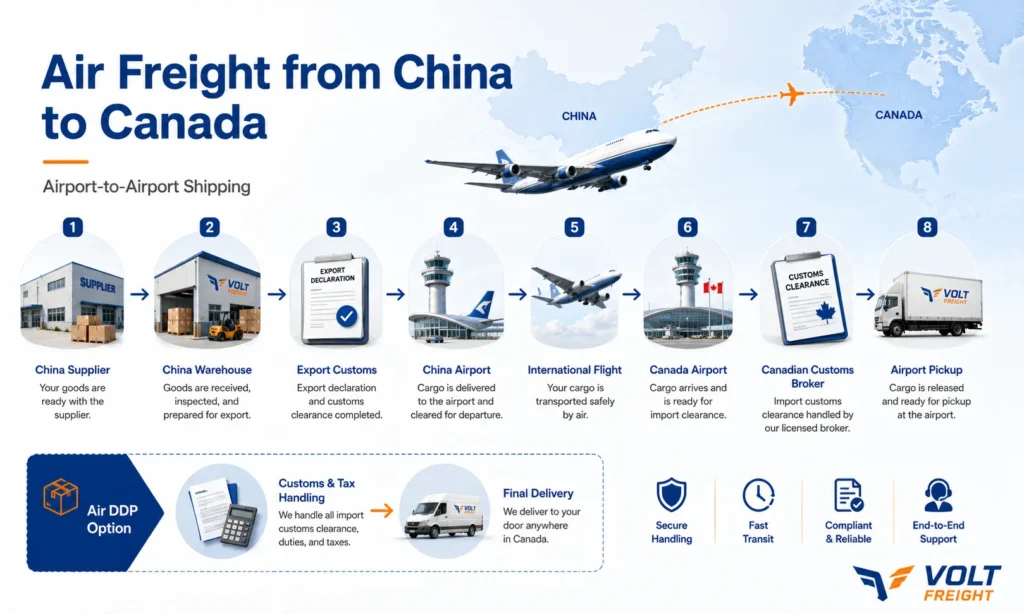
Air Freight from China to Canada: Quick Answer
For ordinary, stackable general cargo, airport-to-airport air freight may cost approximately USD 4.50–9.50 per chargeable kilogram as a planning range. Standard airport transit commonly takes around 3–8 business days after airline acceptance. Priority or fewer-transfer space can move faster, while economy capacity, special cargo and regional connections may require 6–11 business days.
The most common Canadian gateways are Toronto Pearson (YYZ) and Vancouver (YVR). Montréal cargo may use YUL passenger-aircraft capacity or YMX all-cargo and courier facilities, depending on the booking. Calgary (YYC) can be useful for Alberta, although the available China routing and aircraft may be more limited.
Air freight is usually worth considering when the cargo is commercially urgent, reasonably dense and valuable enough to justify the extra transportation cost. Typical examples include machinery parts, electronics, automotive components, medical equipment, prototypes, retail launches and replacement stock. Low-value, bulky goods are normally better suited to sea freight.
What is not automatically included? Unless the written quote says otherwise, the Canadian importer or its broker handles customs clearance, duty, GST, destination-terminal charges, storage, airport collection and domestic delivery. Ask for the service boundary in writing before comparing prices.
Last reviewed: September 2, 2026. Rates, schedules, airline acceptance and destination charges can change before booking. The figures below are planning references, not final offers.
Air Freight Costs and Transit Times
The final price depends on the China departure airport, Canadian arrival airport, chargeable weight, single-piece dimensions, stackability, product type, cargo-ready date and available airline capacity. General cargo with flexible timing usually receives more options than batteries, liquids, oversized cases or cargo that must remain upright.
The following ranges apply to ordinary commercial cargo with suitable packaging and complete documents. They do not include Canadian brokerage, duties, GST, destination handling, examinations, storage, airport pickup or inland transportation unless the quotation lists those items.
| Route and Chargeable Weight | Planning Rate | Estimated Airport Transit | Typical Use |
|---|---|---|---|
| Major China airport to YYZ, 100–299 kg | USD 6.00–9.50/kg | About 3–8 business days | Urgent cartons, prototypes and replacement stock |
| Major China airport to YYZ, 300–499 kg | USD 5.20–8.00/kg | About 3–8 business days | Electronics, parts and commercial inventory |
| Major China airport to YYZ or YVR, 500 kg+ | USD 4.50–7.20/kg | About 3–8 business days | Dense general cargo and larger replenishment orders |
| China to YUL/YMX or YYC | Live route quotation | About 4–10 business days | Québec, Alberta and selected regional distribution |
| Batteries, oversized or other special cargo | Separate acceptance and quotation | Route dependent | Approved sensitive, restricted or non-standard cargo |
Why Does the Rate Change with Weight?
Airlines commonly quote weight breaks such as +45 kg, +100 kg, +300 kg, +500 kg and +1,000 kg. A larger shipment may receive a lower rate per kilogram, but only after the airline confirms the chargeable weight and available space. A 500 kg rate is not automatically available to five unrelated 100 kg shipments moving on different dates.
Rates also have short validity. A quotation prepared before the cargo is packed may change if the final cartons are larger, the ready date moves, a direct flight fills up or the airline classifies the cargo differently. This is why VoltFreight first prepares a planning estimate and then confirms the booking against final warehouse measurements.
How to Compare Two Air Freight Quotations
Before choosing the lowest number, compare the same scope:
- China departure airport and Canadian destination airport
- Actual weight, volumetric weight and quoted chargeable weight
- Direct, one-stop or connecting service
- Estimated transit measured from airline acceptance
- Supplier pickup, China warehouse and export charges
- Air Waybill, fuel, security and airline surcharges
- Canadian terminal, brokerage, tax, storage and delivery exclusions
- Rate validity, cargo cut-off and cancellation conditions
A quote that appears USD 0.30/kg cheaper can cost more overall if it uses a distant airport, excludes origin charges or creates an expensive domestic truck movement. For a broader explanation of rate components, see our air freight rates from China guide.
Is Air Freight the Right Choice for Your Shipment?
Air shipping from China to Canada makes the most sense when speed protects something valuable: a production line, a customer commitment, a product launch or inventory that is about to run out. “Fast” alone is not enough. The value of arriving earlier should be greater than the extra freight cost.
Air Freight or Express Courier?
DHL, UPS and FedEx are often simpler for documents, samples and small parcels because one network can handle pickup, international movement, customs processing and final delivery. Commercial air freight usually becomes more attractive as the shipment grows into multiple cartons, pallets or higher chargeable weights.
Below roughly 45 kg, start by checking courier. Between about 45 and 100 kg, compare both. Above 100 kg, traditional air cargo may offer a better line-haul price, but the importer must account for brokerage, terminal handling and pickup. A cheap airport rate is not automatically cheaper than an express door-delivery price. Our express shipping from China page explains the courier option in more detail.
Air Freight or Sea Freight?
Sea freight normally wins for furniture, building materials, low-value wholesale goods, large machinery and cargo occupying several cubic metres. Air freight is easier to justify for dense, high-value or time-critical goods.
Do not use one fixed weight rule for every shipment. A dense 800 kg shipment of urgent machine parts may be a sensible air booking. A lightweight 300 kg display shipment occupying 8 CBM may be uneconomical because its volumetric weight is far higher. Compare our sea freight from China options when the order can tolerate a longer lead time.
Should You Ship the Whole Order by Air—or Only the Urgent Part?
This is often the best question for a large commercial order. Suppose 2,000 kg of components are ready, but only 300 kg are needed immediately to keep production running. Flying all 2,000 kg may waste money. Shipping the urgent 300 kg by air and the balance by sea can protect the deadline without paying an air rate for the entire order.
The split must be planned with the supplier. Identify which SKUs are urgent, create separate packing lists and invoices, and make sure the factory can divide the cartons without delaying both shipments. This works especially well for replacement parts, launch inventory and orders in which a small number of missing components blocks the use of the remaining goods.
How Chargeable Weight Changes the Final Quote
Airlines compare the shipment’s actual gross weight with its volumetric weight and normally charge whichever is higher. Gross weight includes the products, cartons, pallets and other packaging. Volumetric weight represents the aircraft space occupied by the cargo.
For standard commercial air freight, a common planning formula is:
Length × Width × Height in centimetres ÷ 6,000 × Number of packages
This equals approximately 167 kg per cubic metre. The booked airline or service may apply different rounding or density rules, so the final quotation always takes precedence.
A Worked Chargeable-Weight Example
Imagine 24 cartons, each measuring 65 × 48 × 42 cm:
65 × 48 × 42 ÷ 6,000 × 24 = 524.16 kg
If the total gross weight is 460 kg, the planning chargeable weight is approximately 525 kg. At an agreed line-haul rate of USD 5.80/kg, that freight item would be:
525 kg × USD 5.80 = USD 3,045
That calculation does not automatically include supplier pickup, export handling or Canadian destination costs. It only calculates the freight item covered by the per-kilogram rate.
Mixed cargo deserves extra attention. If one product group is dense and another is bulky, the airline or consolidator may calculate chargeable weight by shipment, Air Waybill, package group or accepted booking conditions. Send every package type rather than only the combined CBM.
How to Reduce Volumetric Weight Without Weakening the Cargo
Remove unnecessary empty space, use cartons that fit the packed products and confirm pallet height before wrapping. Multi-supplier consolidation can also help when several small pickups would otherwise create separate minimum charges.
Do not sacrifice protection simply to reduce volume. Cartons and cases must withstand warehouse handling, security screening, airline transfers and airport collection. Final measurements should come from the packed cargo at the warehouse—not an early factory estimate. You can use our CBM calculator for an initial estimate.
Choosing the Best China Departure Airport
The nearest airport is not always the best one. A larger gateway may offer more airline capacity, a better connection or an aircraft that can accept a tall pallet. A regional airport may reduce domestic trucking but provide fewer international options.
For South China suppliers, VoltFreight commonly compares Guangzhou (CAN), Shenzhen (SZX) and Hong Kong (HKG). HKG can provide additional routes for some approved batteries or sensitive cargo, but cross-border trucking and Hong Kong handling add cost and time. It never guarantees acceptance.
Shanghai Pudong (PVG) is a major option for Shanghai, Jiangsu and Zhejiang cargo. Beijing-area suppliers may use PEK or PKX, while Zhengzhou, Ezhou, Chengdu, Chongqing and other regional airports can make sense for selected origins. The choice should be based on the supplier location, total origin cost, aircraft, space and Canadian destination—not a habit of routing every order through Shenzhen.
Choosing YYZ, YVR, YUL/YMX or YYC
The best Canadian airport is the one that creates the best complete route after air freight, terminal costs and inland delivery are considered. Always provide the final Canadian postcode even when you initially request airport-to-airport service.
YYZ for Ontario and Eastern Distribution
Toronto Pearson (YYZ) is usually the first airport to compare for Toronto, Mississauga, Brampton, Hamilton, Ottawa and broader Ontario distribution. Pearson reports that it processes more than 45% of Canada’s air cargo and connects directly with a large warehouse and trucking market. See the official Toronto Pearson cargo services page.
YYZ often offers more choices for commercial cartons, pallets and time-sensitive inventory. The importer still needs to identify the correct airline terminal, arrange customs and pay release charges before collection.
YVR for British Columbia and Western Canada
Vancouver (YVR) is a natural trans-Pacific gateway for cargo moving to Vancouver, Richmond, Burnaby, Surrey and other British Columbia destinations. Its location and air-to-truck network can also support western Canadian distribution. The official YVR cargo information describes its links with Asian markets and local logistics providers.
YVR is not automatically the right airport for every western shipment. Cargo going to Alberta, Saskatchewan or Manitoba may need a long domestic truck movement. Compare that cost with a booking to YYC or another route before choosing the lower international rate.
Montréal and Calgary Options
For Québec, a quotation must clearly identify YUL or YMX. YUL handles cargo carried with passenger services, while YMX supports all-cargo and courier activity. Depending on the product, schedule and aircraft, routing through YYZ followed by truck delivery may still be more economical. The Aéroports de Montréal cargo pages explain both facilities.
Calgary (YYC) can reduce inland transportation for Alberta cargo, including selected industrial and oversized shipments. China-origin space and connections can differ from YYZ or YVR, so confirm the actual routing, aircraft limits and transit rather than assuming a direct flight. See the official YYC air cargo page.
What an Airport-to-Airport Quote Includes
“Airport-to-airport” describes a service boundary; it is not an Incoterm. Two forwarders can use the same phrase while including different China-origin charges. Ask for a written breakdown.
Services Commonly Included When Listed
Depending on the quotation, VoltFreight can arrange:
- Supplier pickup or receiving at the nominated China warehouse
- Carton count, shipping-mark check and final measurement
- Compatible multi-supplier consolidation
- China export customs coordination and origin handling
- Security screening, airline booking and Air Waybill preparation
- International air transportation to the confirmed Canadian airport
- Flight updates and pre-alert documents for the importer or broker
Charges Normally Excluded Unless Added
The Canadian side may include separate charges for:
- Customs brokerage, duty, GST and other government amounts
- Airline-terminal receiving, handling and document release
- Customs examination, product-agency review or cargo movement
- Storage when documents, payment or collection are delayed
- Forklift, breakdown, special handling or Air Waybill amendment
- Airport pickup and delivery to the final Canadian address
If you need pickup, import coordination and delivery rather than airport arrival only, request that scope separately. Our airport-to-airport air freight guide explains how this differs from airport-to-door and door-to-door services.
What Must Be Ready in Canada Before Departure
Air cargo can reach Canada before a new importer has finished setting up its customs account. That is when a fast shipment becomes an expensive storage problem. The Canadian side should be arranged while the goods are still in China.
Importer and Customs Setup
For a standard commercial import under the buyer’s own account, confirm:
- The legal importer name and Canadian business address
- A Canada Revenue Agency nine-digit Business Number
- An active RM import-export program account
- Registration in the CARM Client Portal
- Delegated authority for the appointed customs broker
- Release Prior to Payment and security arrangements when applicable
- The HS classification, origin, value and required permits
- Who will pay duty, GST, brokerage and terminal charges
Importers must register their own businesses in CARM; a broker cannot complete the business registration for the client. The official CBSA CARM registration guidance explains the current process.
The party named as Importer of Record also needs to understand its responsibilities. From January 1, 2026, the Importer of Record can have direct and shared liability for duties, corrections, records and later reassessments. Keep this reminder brief but settle the arrangement before booking. The details are in the CBSA Importer of Record memorandum.
Pre-Alert, Arrival and Airport Pickup
Send the broker the commercial invoice, packing list, product description, origin information and draft or final Air Waybill as early as possible. Regulated goods may need licences, certificates, test reports or agency approval before departure. A broker cannot correct an undisclosed product feature after arrival without delay and possible cost.
The destination handler normally issues an arrival notice showing the Air Waybill, cargo terminal, arrival date and charges required for release. The importer or trucker should know which terminal holds the cargo, when it becomes available and what documents are required for collection.
Airport storage can increase quickly when clearance, payment or pickup is not ready. Weekend arrival, a missing broker instruction or an unsuitable collection vehicle can consume the available free time. Heavy pallets and wooden cases may require a dock-height truck, forklift, liftgate or appointment. Arrange the collection plan before the flight departs.
Large Pallets, Oversized Cargo and Sensitive Goods
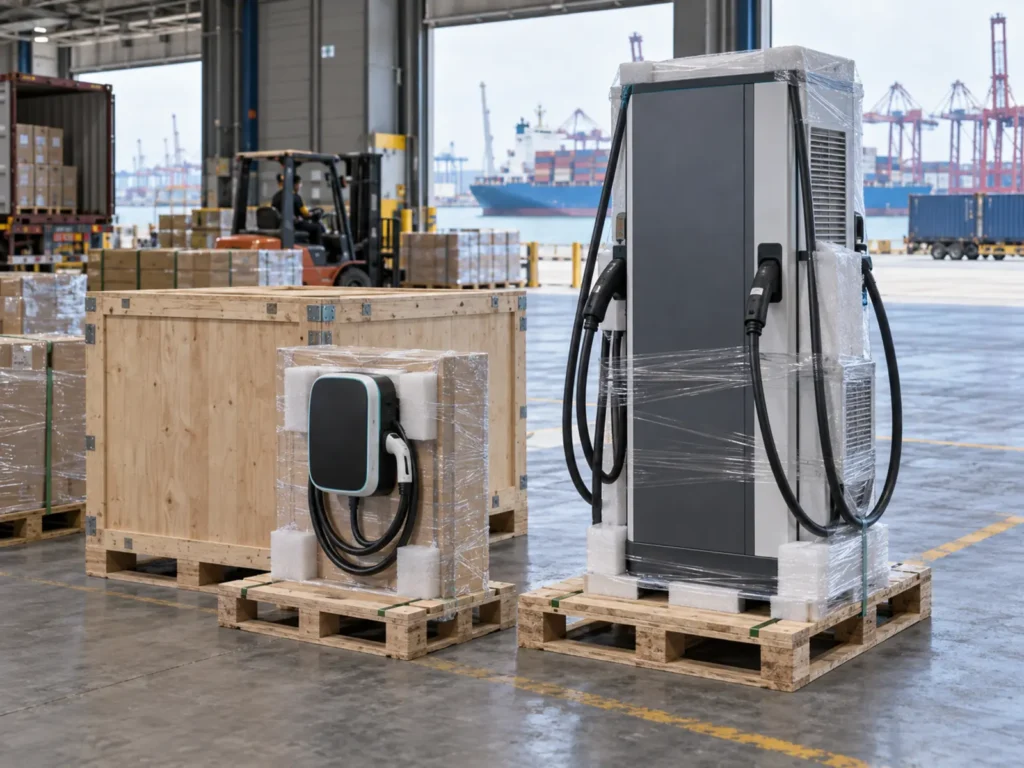
Total shipment weight does not determine acceptance by itself. Every pallet, carton or wooden case must fit the aircraft door, cargo compartment, loading equipment and connecting route. A shipment accepted on a wide-body flight to YYZ may not fit a smaller aircraft used for a regional connection.
Heavy and Oversized Pieces
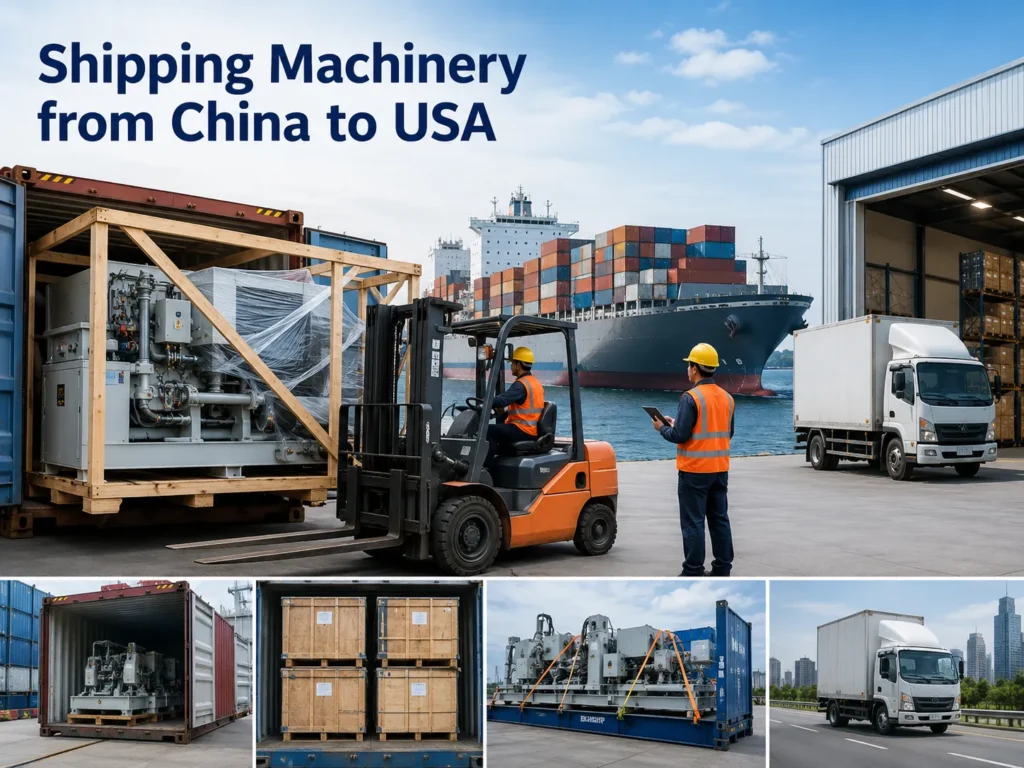
For machinery, moulds, motors, transformers and large cases, provide the length, width, height and gross weight of every piece—not only the total shipment. Also send photographs, stackable status, forklift or crane requirements and information about whether the case can be safely tilted.
Non-stackable cargo can use more aircraft position space than its standard volumetric calculation suggests. Very heavy pieces may need reinforced skids, forklift pockets, lifting points, centre-of-gravity markings or main-deck freighter review. Confirm limits before the supplier builds an expensive case that cannot be accepted on the planned route.
Batteries and Other Sensitive Cargo
Lithium battery acceptance depends on chemistry, UN classification, Watt-hour rating, quantity, state of charge, packaging, airline policy and whether the battery is installed in equipment, packed with equipment or shipped separately. Common classifications include UN3480, UN3481, UN3090 and UN3091.
Send the battery model, specification, UN38.3 test summary, SDS or MSDS and packing photographs before requesting a final route. A Dangerous Goods Declaration or approved packaging may also be required. See our detailed guide to shipping batteries from China and the current IATA battery guidance.
Liquids, powders, magnets, aerosols, chemicals, cosmetics, medical products, food, branded goods and temperature-sensitive cargo may also need an acceptance or Canadian admissibility review. Air-transport acceptance and Canadian import approval are separate questions. Send complete product information before the factory delivers the goods to the airline warehouse.
From Supplier Pickup to the Canadian Airport
A well-planned air shipment usually follows these steps:
- Share the cargo details. Provide the product, photographs, cartons, weight, dimensions, supplier location, value and ready date.
- Review acceptance. Identify general cargo, batteries, liquids, magnets, oversized pieces and other special handling needs.
- Estimate chargeable weight. Compare the supplier’s gross and volumetric measurements.
- Compare routes. Select the China gateway and Canadian airport using the complete cost and deadline.
- Prepare the Canadian side. Confirm importer, broker, product admissibility and pickup arrangements.
- Book airline space. Confirm rate validity, cut-off, transit, route and package acceptance.
- Receive and measure the cargo. Check the final packages before export and airline handover.
- Send the pre-alert. Provide documents so the broker can prepare before arrival.
- Release and collect. After customs and terminal release, the importer’s authorized trucker collects the cargo.
For a more detailed booking checklist, see our air freight booking from China guide.
How VoltFreight Handles China-to-Canada Air Cargo
VoltFreight coordinates the China side of commercial air cargo from China to Canada while making the Canadian service boundary clear. We can collect from suppliers, receive goods at our warehouse, consolidate compatible orders, verify final measurements, prepare export handling, compare airline routes and send pre-alert documents to the importer or its broker.
The goal is not to force every shipment onto the fastest flight. We compare the cargo deadline, density, package dimensions and final destination. Sometimes the best answer is standard air freight. Sometimes courier is simpler, YVR is cheaper, YYZ produces a lower complete cost, or only part of the order should move by air.
Cargo insurance can also be arranged when required. Airline liability is not the same as full cargo-value protection, particularly for high-value equipment and components. Review our freight insurance from China guide before booking valuable goods.
What to Send for an Accurate Quote
Please provide:
- Product name, material, use and clear photographs
- HS code when available
- Number of cartons, pallets or wooden cases
- Gross weight and dimensions for every package type
- Individual dimensions and weight for heavy pieces
- Supplier city or pickup address and cargo-ready date
- Commercial value and currency
- Battery, liquid, powder, magnet or chemical details
- Preferred Canadian airport and required arrival date
- Final Canadian postcode if inland delivery must be compared
Request an air freight quote from China to Canada. We will review the cargo and explain the route, estimated chargeable weight, transit time, included origin services and Canadian charges that remain outside the quotation.
Frequently Asked Questions
How Much Does Air Freight from China to Canada Cost?
Ordinary airport-to-airport general cargo may cost approximately USD 4.50–9.50 per chargeable kilogram as a planning range. Larger, dense shipments can receive a lower rate per kilogram, while small, oversized, non-stackable, urgent or sensitive cargo may cost more. A final quote requires package-level weights and dimensions, the China origin, Canadian airport, product type and cargo-ready date.
How Long Does Air Freight from China to Canada Take?
Standard airport transit commonly takes about 3–8 business days after airline acceptance. Priority or fewer-transfer capacity may move faster; economy space and regional connections may take 6–11 business days. Supplier pickup, warehouse receiving, export handling, Canadian clearance and airport collection sit outside the flight time, so the full factory-to-warehouse journey is longer.
Is Commercial Air Freight Cheaper Than DHL, UPS or FedEx?
It can be cheaper for multiple cartons, pallets and higher chargeable weights, but commercial air freight leaves more work at destination. Courier is often simpler for small parcels because it combines more stages in one network. Compare the complete amount—including brokerage, terminal handling and delivery—not only the international rate.
Do I Need a Canadian Customs Broker for Airport Cargo?
The importer may transact directly with CBSA if it can manage the process, but many businesses appoint a licensed Canadian customs broker. The importer still remains responsible for correct product information, classification, origin, value and legally owed amounts. Arrange the importer account, CARM access, broker delegation and payment process before departure.
Can Large Pallets or Lithium Batteries Be Shipped by Air?
Possibly, but acceptance is not automatic. Large pallets need piece-level dimensions, weight, photographs, stackability and handling information so the forwarder can check aircraft limits. Batteries need their UN classification, Watt-hour rating, technical documents and packaging reviewed against the chosen airline and route. Do not finish final packing or send sensitive goods to the airport until acceptance has been checked.
Ready to compare the route? Send VoltFreight the cargo details, China pickup city and preferred Canadian airport. We will help you determine whether standard air freight, courier, a different gateway or a split air-and-sea plan is the most practical choice.
Important notice: Air freight rates, airline schedules, package acceptance, customs requirements, duties, GST, destination charges and storage conditions can change. Confirm the final booking using the actual cargo information and the Canadian importer’s agreed customs arrangement.