
Quick answer: For most commercial furniture orders from China to Greece, sea freight is the practical choice. FCL usually gives bulky or fragile cartons better protection because it reduces handling, while LCL can work for samples and smaller trial orders with reinforced export packaging. Choose between 20GP, 40GP and 40HQ only after checking the final packing list, total weight, loading plan and delivery access.
This guide is for Greek importers, wholesalers, retailers and commercial furniture projects—not personal household removals. Packaging, container use, material compliance, customs responsibility and unloading conditions can all affect the final cost and risk.
If you need a furniture shipping plan, send VoltFreight the supplier location, final packing list, product materials, cargo photos, Incoterm and delivery postcode. We can review the cargo before comparing FCL, LCL, consolidation and suitable delivery options. Request a furniture freight review.
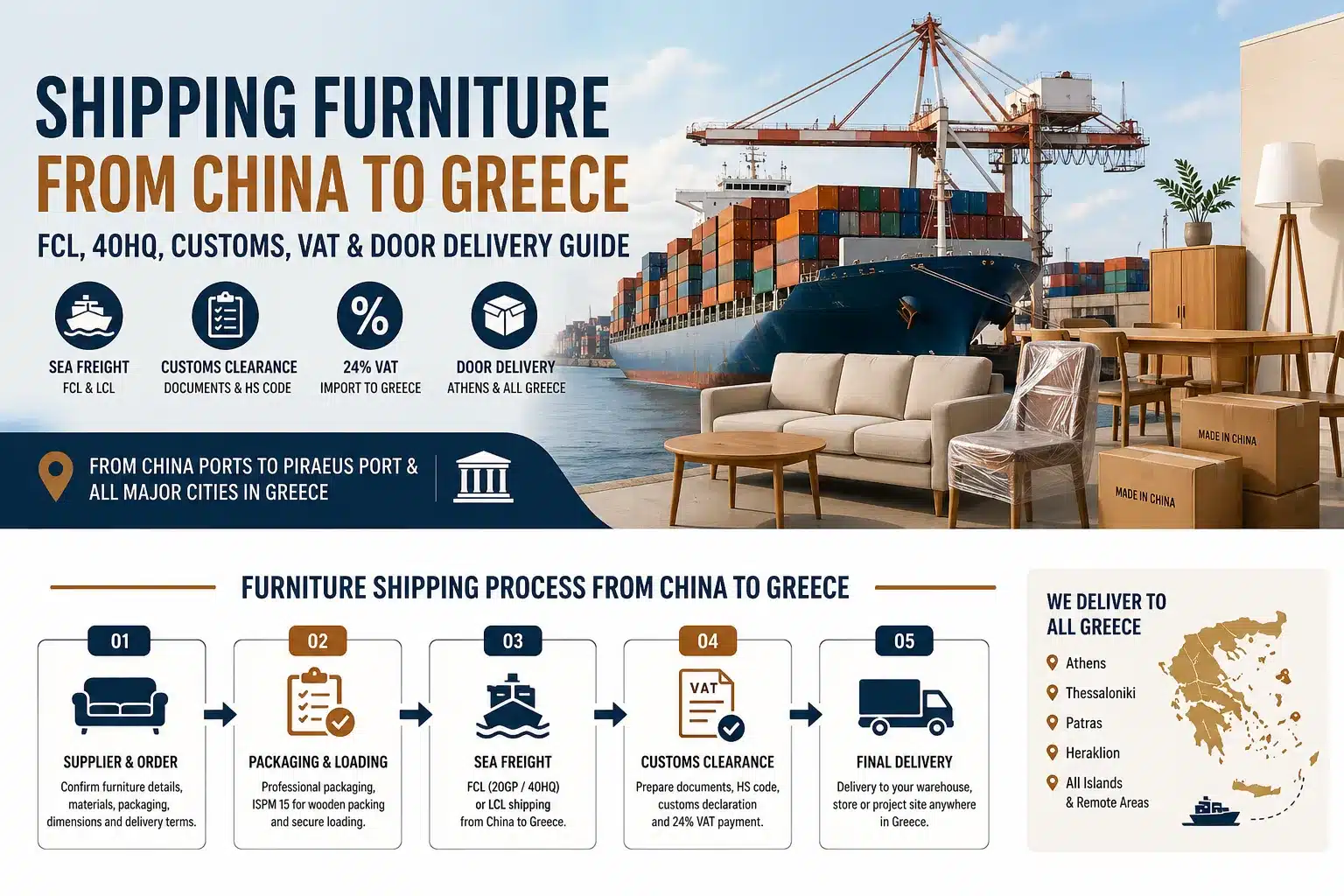
Which Shipping Method Fits Your Furniture Order?
FCL sea freight is usually the first option to evaluate for commercial furniture because the shipper controls how the container is loaded and sealed. It also avoids some of the extra warehouse handling associated with LCL. However, a full container is not automatically economical for every order, and the right method depends on the packed cargo rather than the number of furniture pieces.
| Shipment Profile | Option to Evaluate | Main Deciding Factors | Main Risk to Control |
|---|---|---|---|
| Samples, hardware or replacement parts | Air freight or LCL | Urgency, packed dimensions and chargeable weight | High unit cost or insufficient protection |
| Small trial order | LCL sea freight | Total CBM, value, fragility and carton strength | Extra handling during consolidation and deconsolidation |
| Retail or wholesale stock | FCL sea freight | Container utilization, SKU mix and delivery schedule | Poor loading order, compression or moisture |
| Flat-pack or project furniture | 40GP or 40HQ | Volume, gross weight, stacking strength and unloading plan | Using the wrong container based on CBM alone |
| Goods from several Chinese suppliers | Warehouse consolidation plus FCL | Factory ready dates, inspection and SKU control | Missing cartons, mixed labels or delayed suppliers |
Air freight is normally reserved for urgent samples, fittings, hardware kits or replacement components. Large furniture cartons can create high volumetric weight even when the actual weight is low. For a broader route overview, see shipping from China to Greece.
What Should Be Confirmed Before the Supplier Packs the Furniture?
Freight planning should begin before production packaging is finalized. A quotation based on estimated product dimensions may change after cartons, foam, crates or pallets are added. Ask the supplier for the final packed data and make sure the product descriptions match the commercial documents.
- Final packing list: carton count, external dimensions, gross weight, net weight and total CBM.
- Product and material details: solid wood, MDF, particleboard, plywood, metal, plastic, fabric, leather, glass, stone or mixed materials.
- Packaging method: export cartons, pallets, solid-wood crates, processed-wood cases or floor-loaded loose cartons.
- Handling limits: whether cartons can be stacked, tilted or clamped and whether any piece requires a forklift.
- Fragile components: mirrors, glass panels, stone tops, finished metal surfaces and upholstered sections.
- Shipment terms: supplier address, Incoterm, cargo-ready date and responsibility for loading.
- Destination details: complete postcode, business or residential location, truck access, unloading equipment and appointment requirements.
For hotel, apartment, office or restaurant projects, the packing list should also identify each SKU by room, floor, area or delivery phase. Clear carton markings make unloading and onward distribution much easier than opening mixed cartons at the destination.
When Should You Use FCL, LCL, 40GP or 40HQ?
FCL for control and reduced handling
FCL is commonly selected when an order fills or nearly fills a container, when cartons are difficult to handle, or when damage from repeated movement is a major concern. The supplier or loading warehouse can arrange the loading sequence, protect fragile zones, record the loading condition and seal the container after completion.
LCL for smaller commercial orders
LCL can make sense for samples, replacement pieces and small trial orders. Because the cargo passes through consolidation and deconsolidation warehouses, it normally experiences more handling than FCL. Upholstered furniture, glass, mirrors and polished surfaces may justify a pallet or suitable crate despite the extra volume.
20GP, 40GP and 40HQ container planning
A 40HQ is a high-cube 40-foot container; it should not be treated as something separate from all “40ft containers.” The correct comparison is normally 20GP versus 40GP versus 40HQ. Flat-pack wardrobes, cabinets and chairs may benefit from the extra internal height of a 40HQ, while dense hardwood, stone and metal furniture may reach operational weight limits before all available volume is used.
Before booking, review the payload, internal dimensions, door opening, single-piece dimensions, weight distribution and carton stacking strength. Carrier-confirmed equipment data and the supplier’s final packing list should control the decision.
How Should Furniture Be Packed and Inspected for Ocean Freight?
Domestic factory packaging is not always suitable for export transport. It must protect the product through trucking, warehousing, port handling, ocean transit and final unloading in Greece.
Flat-pack furniture and wood-based panels
Use cartons with suitable compression strength, reinforced edges and protection around exposed corners. Hardware bags should be sealed and secured inside the correct carton. Long panels need enough support to reduce bending, while finished surfaces should be separated to prevent rubbing and scratches.
Sofas and upholstered furniture
Fabric, leather and foam need clean wrapping and moisture protection without creating damaging pressure points. Do not assume that compressing a sofa is safe simply because it saves volume. Confirm the supplier’s approved packing method and whether the product can recover its intended shape after unpacking.
Glass, mirrors and stone tops
Fragile panels should be separated from heavy cartons and packed in a way that supports the correct transport orientation. Suitable foam, edge protection and crates may be required. The package should show the center of gravity and lifting points when they are not obvious.
Loading and quality-control evidence
Before departure, request packaging photos, carton labels and a final count. For significant orders, an inspection can verify condition, model numbers, quantities and packaging. During loading, record the container and seal numbers, loading sequence, fragile-item separation and cargo condition.
Suitable desiccants and protective wrapping may reduce moisture risk, but they cannot correct wet timber, damp cartons or products packed before drying. Consider cargo insurance for valuable or damage-sensitive shipments and document the pre-loading condition.
Does a Furniture Shipment Need ISPM 15?
ISPM 15 normally concerns the solid-wood packaging used to transport the furniture—not the finished furniture simply because it contains wood. Under the EU requirements for wood packaging arriving from non-EU countries, qualifying solid-wood pallets, crates and dunnage must be treated according to ISPM 15, debarked and marked with the recognized IPPC mark.
Processed-wood packaging made entirely from materials such as plywood, oriented strand board or veneer is exempt, as is wood that is 6 mm thick or less. The exact packaging construction still needs to be checked before departure. The supplier should send a clear photo of each relevant IPPC mark; an unmarked solid-wood crate can create avoidable inspection, treatment or disposal problems. See the European Commission requirements for wood packaging and dunnage.
How Do Customs, VAT and Landed Cost Work in Greece?
Furniture classification depends on the product’s function, construction and material. Wooden furniture, metal furniture, upholstered seats, mattresses and furniture parts do not automatically use the same HS or TARIC code. A vague invoice description such as “furniture” is not enough for a clean declaration.
The commercial invoice should identify the actual product, model, principal material, quantity, unit price, total value, currency, country of origin and Incoterm. The packing list should match the shipment and show carton details, gross and net weight, and volume. Product photos and material breakdowns can help the importer and customs broker review classification before shipment.
For a standard import declared in Greece, the standard VAT rate is 24%, but the applicable duty and VAT treatment depend on the tariff classification, customs value, importer and transaction. Import VAT can also be a significant cash-flow item for a container order. Confirm the importer’s EORI, declaration responsibility and tax treatment before the cargo departs, not after it reaches Piraeus. Refer to the Hellenic Republic’s VAT information and obtain shipment-specific advice where required.
A realistic landed-cost review should consider origin pickup, consolidation or loading, export handling, ocean freight, destination charges, duty, VAT, customs brokerage, possible storage or demurrage, unloading and inland delivery. The Greece customs, VAT and EORI guide covers the standard import process in more detail.
Which EU Compliance Checks Matter for Imported Furniture?
Freight documents do not replace product-compliance work. Applicable rules can change with the materials, intended user, electrical features and sales channel, so the importer should review the exact product before ordering.
General Product Safety Regulation
The EU General Product Safety Regulation has applied since 13 December 2024. It covers consumer products and strengthens requirements concerning risk assessment, traceability and the responsible economic operator in the EU. Importers should be able to connect the product to the manufacturer, model or batch and retain the relevant safety information. The European Commission’s GPSR overview explains the main obligations.
Ordinary furniture does not automatically require CE marking. A specific product may fall under additional legislation because of electrical, motorized, lighting, children’s-product or other regulated features, so the applicable requirements must be checked product by product. A generic “CE certificate” should not be treated as proof that every part of a furniture shipment is compliant.
Formaldehyde emissions from furniture and wood-based articles
Commission Regulation (EU) 2023/1464 is now directly relevant to many indoor furniture imports. After 6 August 2026, furniture and wood-based articles generally cannot be placed on the EU market when formaldehyde released under the specified test conditions exceeds 0.062 mg/m³. The regulation includes defined exemptions, including certain exclusively outdoor, professional-use and second-hand articles.
Importers of products containing MDF, particleboard, plywood or formaldehyde-based resins should confirm the board type, adhesive system and applicable test evidence with the supplier. Check that a report covers the actual product or relevant material, uses an appropriate method and remains applicable to the model being purchased. The binding limits and test conditions are set out in the EUR-Lex text of Regulation (EU) 2023/1464.
EU Deforestation Regulation
Some wood-derived products, including certain furniture, can fall within the EU Deforestation Regulation. Scope should be checked against the relevant commodity and CN code; the presence of wood does not automatically put every furniture product in scope. The European Commission currently states application dates of 30 December 2026 for large and medium operators, 30 June 2027 for micro and small operators, and 30 December 2026 for micro and small operators already covered by the former EU Timber Regulation.
If a product is covered, the importer should prepare the required supply-chain and due-diligence information early enough that missing traceability does not stop the shipment from being placed on the market. Use the European Commission’s current EUDR guidance and application dates and verify the exact CN code and operator obligations.
How Does Delivery from Piraeus to the Final Address Work?
For a standard FCL or LCL import through Piraeus, the Greek importer normally needs an appropriate importer setup, EORI and customs-broker arrangement. After release, the cargo can move by container truck, pallet network or another agreed inland-delivery method. Read the dedicated guide to sea freight from China to Piraeus for port and mode planning.
A VoltFreight DDP solution, when available and approved for the specific furniture, uses a different structure. Clearance is arranged through a selected EU gateway, followed by transfer through the European logistics network and final delivery in Greece. The exact route and delivery provider depend on the product, shipment size and compliance review. DDP does not remove product-safety obligations, and the quotation must state the customs, tax and delivery responsibilities clearly. See our DDP shipping to Greece guide for the service boundary.
VoltFreight’s current standard delivery coverage includes Piraeus, Athens, Thessaloniki, mainland Greece and Crete. Other Greek islands are outside the standard DDP delivery scope. Availability should always be confirmed against the complete postcode before booking.
Furniture delivery also requires more information than an address:
- Can a container truck or large delivery vehicle enter and turn at the site?
- Is there a loading dock, forklift, pallet jack or receiving team?
- Does the consignee need a tail-lift vehicle or delivery appointment?
- Can the site unload a container within the allowed waiting time?
- Are there narrow streets, vehicle restrictions or limited receiving hours?
- Will the shipment be delivered as loose cartons, pallets or a complete container?
Unless separately confirmed in writing, freight delivery should not be understood as crane service, furniture assembly, indoor placement or delivery to an upper floor. These requirements need separate equipment, labor and pricing.
What Does the Furniture Shipping Process Look Like?
- Cargo review: collect the packing list, materials, photos, value, Incoterm and destination details.
- Route and container check: compare LCL, FCL, consolidation and the appropriate container based on packed cargo.
- Supplier coordination: confirm ready dates, pickup addresses, labels and responsibility for loading.
- Packaging and inspection: review export protection, fragile items, wood packaging, quantities and compliance documents.
- Loading and export: record the cargo condition, container and seal information before departure.
- Import arrangement: follow either the standard Piraeus import process or an approved DDP route, with responsibilities confirmed in advance.
- Final delivery: coordinate the vehicle, appointment, unloading method and receiving contact for the agreed destination.
For multi-supplier projects, allow time for every factory to deliver to the consolidation warehouse and correct discrepancies before the vessel cut-off. Late checks for missing cartons or inconsistent labels can cause a rolled booking or incomplete delivery.
What Information Is Needed for an Accurate Furniture Freight Quote?
- Supplier city and complete pickup or factory address in China
- Furniture type, model list and product photos
- Principal materials and any glass, stone, electrical or motorized parts
- Final carton count, dimensions, gross weight and total CBM
- Whether the cargo is floor-loaded, palletized or packed in crates
- Number of suppliers and each supplier’s cargo-ready date
- Commercial value, Incoterm and preferred shipping method
- Available safety, material, formaldehyde and traceability documents
- Complete Greek delivery address and postcode
- Truck access, unloading equipment, appointment and delivery-site restrictions
VoltFreight can coordinate China pickup, multi-supplier consolidation, packaging review, FCL or LCL shipment planning, document checks and delivery to supported Greek destinations. The final service plan depends on the cargo, importer arrangement and compliance review; it should be agreed before the shipment is booked.
Frequently Asked Questions
Is FCL or LCL better for shipping furniture from China to Greece?
FCL is usually better for larger, fragile or project-based orders because it reduces handling and gives the shipper more control over loading. LCL can be suitable for samples and small trial orders, provided the cartons or crates are strong enough for warehouse handling and shared-container transport.
Should furniture ship in a 40GP or 40HQ container?
A 40HQ can be useful for bulky, relatively light flat-pack furniture because it offers additional internal height. A 40GP may be sufficient for other orders, while dense wood, metal or stone products may be limited by operational weight before volume. Decide from the final packing list and loading plan rather than the product catalogue.
Does wooden furniture require ISPM 15?
The finished furniture is not automatically subject to ISPM 15 simply because it contains wood. The rule mainly applies to qualifying solid-wood pallets, crates and dunnage used as packaging. Processed-wood packaging may be exempt, so the packaging material and markings should be verified before shipment.
Does all furniture imported into Greece need CE marking?
No. Ordinary furniture does not automatically require CE marking. Additional requirements may apply to furniture with electrical, motorized, lighting, children’s-product or other regulated features. The importer should identify the legislation for the exact product instead of relying on a generic certificate.
Plan Your Furniture Shipment Before Booking
The safest plan is built from the final packed cargo, not an early estimate. Confirm the container choice, export packaging, loading sequence, customs responsibility, material compliance and receiving conditions before the goods leave China. This reduces the chance that a low initial freight quote becomes an expensive shipment after repacking, storage, inspection or failed delivery.
Send VoltFreight your packing list, cargo photos, material details, Incoterm, supplier address and Greek delivery postcode. We will review the shipment and help you compare a practical route, container plan and delivery scope. Contact VoltFreight for a furniture shipping quote.
This article is for logistics planning and does not replace legal, customs, tax or product-compliance advice. Final classification, duty, VAT and regulatory obligations should be confirmed for the specific product and transaction with the importer, customs broker or qualified compliance adviser.