
Shipping electronics and LED lights from China to Greece requires more than a basic freight quote. Electrical products may need CE documents, RoHS compliance, LVD or EMC files, RED review for wireless devices, energy label checks, EPREL registration, WEEE/EPR planning, HS code classification, 24% Greek VAT planning and final delivery coordination.
For larger orders, FCL sea freight usually gives better cargo control and lower handling risk. Meanwhile, LCL sea freight can work for trial orders, mixed supplier cargo and smaller LED lighting shipments. Air freight or express courier may help with urgent samples, replacement parts or high-value small devices, but batteries, magnets, power banks and wireless products need extra review before booking.
However, the cheapest shipping method is not always the safest option. Electronics and LED lighting products can face customs delays, warehouse storage, inspection, failed delivery or market compliance problems if the invoice, HS code, product labels or compliance files are unclear.
This guide explains how to plan electronics and LED lights shipping from China to Greece. It covers freight method selection, CE, RoHS, LVD, EMC, RED, EPREL, WEEE/EPR obligations, customs clearance, 24% Greek VAT, DDP feasibility, delivery to Athens, Piraeus, Thessaloniki, mainland Greece and Crete, plus the information needed for an accurate quote.
Need a quote for electronics or LED lights from China to Greece? Send your product photos, model list, carton quantity, carton dimensions, gross weight, total CBM, supplier city, invoice value, HS code if available, compliance documents and final delivery address. Contact VoltFreight to review FCL, LCL, air freight, express, DDP feasibility and delivery options.
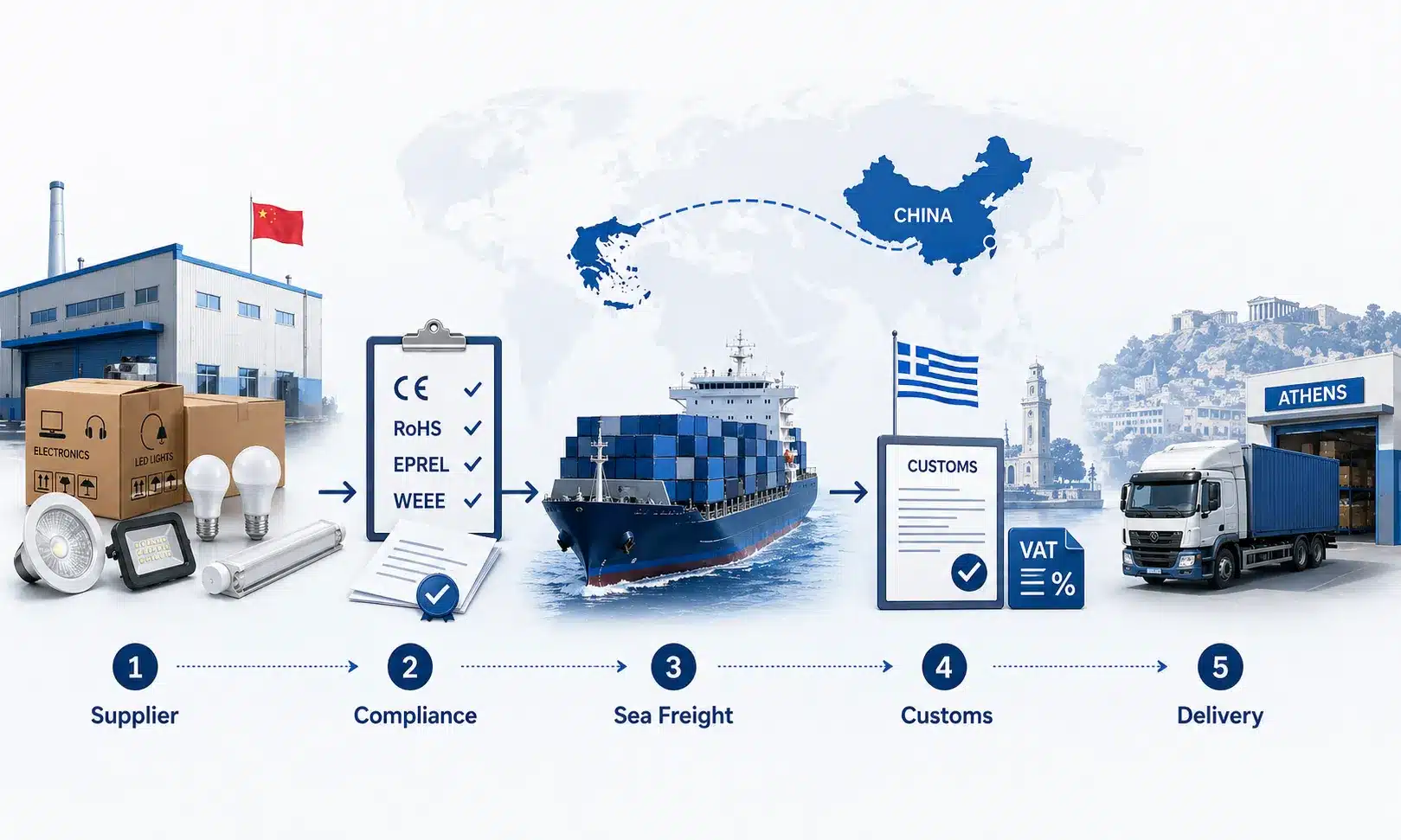
Quick Answer: What Should Importers Check First?
Importers should start with the product type, not the freight price. LED bulbs, LED luminaires, power supplies, smart devices, battery-powered electronics, chargers, adapters and electronic accessories may have different HS codes, compliance documents and transport requirements.
Next, confirm whether the product needs CE, RoHS, LVD, EMC, RED, battery documents, energy label files, EPREL registration or WEEE/EPR review. This step is important because customs clearance and market sales can both be affected by missing product documents.
Then compare shipping methods. FCL is usually better for larger distributor shipments. LCL can work for smaller orders, although it adds more handling. Air freight and express are useful for urgent samples or small parts, but the forwarder should check battery, magnet, power supply and wireless device status before accepting the cargo.
- Best method for large shipments: FCL sea freight from China to Greece.
- Best method for smaller shipments: LCL sea freight after carton and product review.
- Best method for urgent goods: Air freight or express for samples, replacement parts or small high-value electronics.
- Key customs check: HS/TARIC code, invoice value, product description and importer/EORI information.
- Key compliance check: CE, RoHS, LVD, EMC, RED, EPREL, WEEE/EPR and battery documents where applicable.
- Delivery areas: Athens, Piraeus, Thessaloniki, mainland Greece and Crete can be reviewed. Other Greek islands are not supported under VoltFreight’s delivery service.
What Electronics and LED Lighting Products Can Be Shipped?
China-to-Greece electronics freight can cover many product categories. Before quoting, the forwarder needs to know whether the shipment contains LED lights, luminaires, drivers, power supplies, chargers, smart devices, batteries, sensors, routers, small appliances or mixed electronic accessories.
For example, LED bulbs may need energy label and EPREL checks, while smart LED lights may also require wireless or RED review. In addition, power banks and battery-powered devices need battery transport checks before air freight, express courier or some warehouse services can accept them.
| Product Type | Logistics Notes | Documents to Check |
|---|---|---|
| LED bulbs and light sources | Small cartons, high SKU count, fragile packaging and energy label requirements | CE, RoHS, energy label, EPREL information, test reports and model list |
| LED fixtures and luminaires | Bulky cartons, drivers, control gears, glass parts or aluminum parts | CE Declaration of Conformity, LVD/EMC/RoHS files, driver specifications and installation manual |
| Consumer electronics | Higher value, multiple models, possible lithium batteries or wireless functions | CE, EMC, LVD, RED if applicable, RoHS, battery documents and user manual |
| Power supplies, chargers and adapters | Small but compliance-sensitive products often checked with the main device | LVD/EMC test files, CE Declaration of Conformity, RoHS, labels and model list |
| Smart devices and wireless products | May include Wi-Fi, Bluetooth, radio modules or app-connected functions | RED review, EMC files, safety reports, RoHS and product labels |
| Battery-powered devices | Transport acceptance depends on battery type, capacity and packing method | MSDS, UN38.3, battery specification, packing method and product photos |
FCL, LCL, Air Freight, Express or DDP: Which Option Works Best?
The best freight method depends on cargo volume, value, urgency, packaging, battery status and customs plan. For large distributor orders or project lighting shipments, FCL sea freight usually gives better protection because the container holds only your cargo.
LCL sea freight can help importers ship smaller batches or combine goods from several suppliers. However, LCL cargo moves through consolidation and deconsolidation warehouses, so fragile LED fixtures, weak retail cartons and high-value electronics need stronger packaging.
Air freight and express courier can support urgent samples, small electronics, replacement parts or high-value components. Nevertheless, battery-powered devices, power banks, magnets and wireless devices need product checks before booking.
DDP may help some small business shipments, but it is not a tax-free shortcut. For electronics and LED lights, any DDP quote should explain customs scope, VAT handling, product restrictions, WEEE/EPR responsibility and delivery limits before booking.
| Shipping Method | Best For | Main Risk |
|---|---|---|
| FCL sea freight | Large LED lighting orders, electronics distributors, project cargo and repeated imports | Poor loading plan, carton compression, missing compliance files or unclear delivery access |
| LCL sea freight | Trial orders, mixed suppliers, smaller LED cartons and accessories | More handling and possible damage to weak retail packaging |
| Air freight | Urgent samples, high-value components, replacement parts and smaller electronics | Battery restrictions, high chargeable weight and security checks |
| Express courier | Small parcels, documents, samples and urgent low-volume shipments | Parcel restrictions, battery limits and higher cost for heavy cargo |
| DDP service | Selected suitable shipments where customs and compliance scope are clear | Unclear VAT, WEEE, CE or product compliance responsibility |
For sea freight planning, review Sea Freight from China to Piraeus Greece and Sea Freight from China. For standard Greece route planning, review Shipping from China to Greece.
CE, RoHS, LVD, EMC and RED: Documents Importers Should Check
CE documents for LED lights and electronics shipped to Greece should match the exact product model. A generic certificate without model scope, test standard, product photo or supplier details is not enough for serious import planning.
For many electrical products, the importer should check whether the Low Voltage Directive, EMC Directive, RoHS Directive or Radio Equipment Directive applies. The answer depends on voltage, power supply, wireless function, product category and intended use.
In practical terms, the importer should not wait until customs asks for documents. It is safer to request compliance files from the supplier before paying the balance or arranging pickup in China.
| Compliance Area | Why It Matters | What to Ask Supplier |
|---|---|---|
| CE Declaration of Conformity | Shows the manufacturer’s declared conformity with applicable EU rules | Signed DoC, product model list, applicable directives, standards and manufacturer details |
| LVD safety file | Relevant for many mains-powered electrical products within applicable voltage ranges | Safety test report, rated voltage, plug type, power supply and label photos |
| EMC file | Important for products that may emit electromagnetic interference or be affected by it | EMC test report, model scope, PCB details, driver configuration and product photos |
| RoHS compliance | Restricts hazardous substances in electrical and electronic equipment | RoHS report, material declarations and supplier compliance statement |
| RED review | Relevant for products with Wi-Fi, Bluetooth, radio modules or wireless functions | RED test files, frequency information, module details and user manual |
| Battery documents | Needed for lithium battery transport acceptance and risk review | MSDS, UN38.3, battery model, watt-hour rating and packing method |
LED Lights: Energy Labels, EPREL and Product Data
LED lighting imports need special attention because EU lighting rules can cover energy efficiency, product information and energy labelling. Some products are light sources, while others are luminaires or containing products. The distinction matters for documentation and EPREL review.
EPREL is the European Product Registry for Energy Labelling. For relevant light sources, it provides product information from energy labels, such as energy efficiency class and energy consumption. Therefore, importers should confirm whether their LED product needs EPREL registration before placing it on the EU market.
For LED projects, the supplier should also provide model list, wattage, luminous flux, color temperature, driver specifications, energy label file, product data and packaging artwork. These details help the importer check both customs documents and sales compliance.
| LED Item | Why It Matters | What to Check |
|---|---|---|
| Light source or luminaire | Different product types may have different energy label obligations | Product category, replaceable light source status and model description |
| Energy label | Required for certain products sold in the EU market | Energy efficiency class, label artwork and product data |
| EPREL information | Relevant for products in scope of EU energy labelling rules | EPREL status, model identifier, brand and technical data |
| LED driver | Drivers and control gears can affect safety and EMC compliance | Driver model, voltage, certification and compatibility with the lamp or fixture |
| Packaging artwork | Retail packaging may need correct labels and product information | CE mark, energy label, warnings, importer details and user instructions |
WEEE and EPR Planning for Electronics Sold in Greece
WEEE and EPR planning is a commercial issue, not only an environmental topic. If a company places electrical or electronic equipment on the Greek market, it should confirm whether it needs registration, reporting or participation in an approved compliance system.
This matters for LED lighting, small appliances, electronic devices, chargers, power supplies, battery products and many other electrical products. It may also affect marketplace sales, distributor agreements, product labels and after-sales responsibilities.
VoltFreight can help with logistics planning, but WEEE/EPR responsibility should be confirmed with a qualified compliance consultant or the importer’s local advisor before sales begin.
| EPR / WEEE Item | Why It Matters | Importer Action |
|---|---|---|
| EEE producer responsibility | Applies when placing electrical or electronic equipment on the Greek market | Check whether your company must register or join a compliance scheme |
| WEEE marking | May be required for products sold in the EU market | Review product labels, packaging and user manual with a compliance advisor |
| Packaging EPR | Packaging may trigger separate responsibility from the electronic product itself | Review cartons, retail boxes and packaging obligations before sales launch |
| Battery EPR | Battery products may create additional obligations | Check batteries, built-in battery devices and separate battery packs |
| Marketplace requirements | Online platforms may request compliance evidence | Prepare WEEE/EPR registration evidence before listing products |
Customs Clearance in Greece: HS Code, Duty and 24% VAT
Customs clearance starts with accurate product classification. LED bulbs, LED strips, fixtures, drivers, power supplies, smart switches, sensors, chargers and complete electronic devices may use different HS/TARIC codes. As a result, duty rate, import documents and inspection risk can differ by product type.
Greece’s normal VAT rate is 24%. Therefore, import VAT can become a major part of landed cost for electronics and LED lighting importers. Do not calculate total cost only from the supplier’s EXW or FOB price.
The commercial invoice should use real product names, model numbers, quantities, values, Incoterms and product descriptions. Vague terms such as “lamps,” “accessories,” “goods” or “parts” can increase customs questions when the shipment contains specific electrical products.
| Customs Item | Why It Matters | Importer Action |
|---|---|---|
| HS / TARIC code | Controls duty, restrictions and customs declaration details | Confirm classification before shipment leaves China |
| Commercial invoice | Supports customs value and VAT calculation | Use real product names, model numbers, values and Incoterms |
| Greek VAT | The normal VAT rate is 24% | Plan VAT cash flow before cargo arrival |
| EORI / importer details | EU import procedures require correct importer identification | Confirm EORI and importer setup before arrival |
| Compliance files | Customs or market surveillance may request product documents | Prepare CE, RoHS, energy label, EPREL, WEEE and battery documents where relevant |
For a broader import guide, review China to Greece Customs Clearance.
Can You Use DDP for Electronics and LED Lights to Greece?
DDP can help some small importers when the product, documents, value and delivery address fit the route. However, electronics and LED lights are not always simple DDP cargo because CE, RoHS, WEEE/EPR, batteries, wireless functions and VAT handling may affect the shipment.
For this reason, DDP electronics shipping to Greece should be reviewed case by case. A reliable DDP quote should ask for product photos, model list, invoice value, HS code, battery status, wireless function, compliance files and final delivery address.
VoltFreight does not recommend treating DDP as a “tax-free” shortcut. If the route is suitable, the quote should explain customs scope, VAT handling, delivery method and cargo restrictions. If the product is not suitable, standard freight with proper import clearance may be safer.
- Do not use DDP if the provider does not ask for product details.
- Do not accept “tax-free” claims without customs and VAT explanation.
- Do not ship battery electronics without battery documents.
- Do not use vague product names to reduce declared value.
- Do not ignore WEEE/EPR obligations when selling products in Greece.
For more detail on the DDP route, review DDP Shipping from China to Greece.
Packaging and Cargo Protection for Electronics and LED Lights
Electronics and LED lights often use retail packaging, fragile housings, glass parts, drivers, adapters and small accessories. Good packaging reduces damage, missing parts, warranty disputes and warehouse complaints.
Before pickup, importers should ask the supplier for carton photos, master carton details, SKU list, pallet plan and packing list. In addition, the forwarder should know whether the cargo contains fragile items, batteries, magnets, branded goods or high-value devices.
- Use strong export cartons instead of weak retail cartons only.
- Protect LED fixtures, glass covers, drivers, plugs and accessories.
- Place clear shipping marks on every carton.
- Separate SKUs clearly when the shipment has many models.
- Use pallets when the cargo is fragile or high value, but check the extra CBM cost first.
- Confirm whether the destination warehouse requires pallet delivery.
- Take carton photos and loading photos before departure.
- Prepare a model list and carton list for customs and warehouse receiving.
Delivery in Greece: Athens, Piraeus, Thessaloniki, Mainland Greece and Crete
After customs release, final delivery depends on destination type. The cargo may move to an Athens warehouse, Piraeus-area distributor, Thessaloniki buyer, lighting project site, retail store, 3PL warehouse or e-commerce fulfillment location.
Fragile LED fixtures, retail electronics and high-value devices need careful unloading and delivery appointment planning. Meanwhile, Thessaloniki and remote mainland deliveries require more inland trucking time than Athens or Piraeus-area deliveries.
For VoltFreight-arranged delivery, Athens, Piraeus, Thessaloniki, mainland Greece and Crete can be reviewed. Other Greek islands are not supported under VoltFreight’s delivery service.
| Destination | Delivery Notes | What to Confirm |
|---|---|---|
| Piraeus / Athens | Common destination for import warehouses, retailers and distributors | Truck access, unloading method, warehouse hours and carton count |
| Thessaloniki | Needs inland trucking and delivery appointment planning | Palletization, tail-lift or forklift needs, delivery window and consignee contact |
| Mainland Greece | Cost and timing vary by postcode, access and distance | Full address, business hours, unloading conditions and delivery restrictions |
| Crete | Can be reviewed separately because routing and delivery cost may differ | Crete postcode, carton count, cargo size, access details and unloading needs |
| Other Greek islands | Not supported under VoltFreight’s delivery service | Use another local import or delivery solution if needed |
Common Mistakes That Delay Electronics and LED Light Shipments
The biggest risks are not always freight cost. In many cases, delays come from missing CE documents, unclear HS codes, weak retail packaging, missing EPREL information, WEEE/EPR gaps, battery restrictions or unclear delivery instructions.
Importers should fix these issues before the supplier ships the goods. Otherwise, the shipment may face warehouse rejection, booking delay, customs inspection, storage fees, delivery failure or product compliance problems after arrival.
- Using vague product names such as “lamps,” “accessories” or “electronics.”
- Shipping LED lights without checking energy label or EPREL requirements.
- Using CE documents that do not match the exact model.
- Ignoring RoHS, LVD, EMC or RED requirements where applicable.
- Forgetting WEEE/EPR obligations before selling in Greece.
- Choosing air freight before checking battery or magnet restrictions.
- Using weak retail cartons for LCL shipments.
- Booking DDP without clear customs, VAT and compliance scope.
- Sending cargo without final delivery address and unloading details.
- Calculating landed cost without Greek VAT and customs duty review.
How VoltFreight Helps with Electronics and LED Lights Shipping to Greece
VoltFreight helps importers review electronics and LED lighting shipments from China to Greece before booking. Our team checks supplier location, cargo size, carton details, freight method, product type, customs risk and final delivery address.
For larger orders, we can compare FCL and LCL sea freight through suitable routes. For urgent samples or spare parts, we can check whether air freight or express courier is practical. For DDP requests, we review whether the product, documents, declared value and delivery address fit the service scope.
- Supplier pickup and warehouse coordination in China
- FCL and LCL sea freight planning to Greece
- Air freight and express review for urgent samples or parts
- Carton measurement, CBM and gross weight review
- Battery, magnet and product sensitivity checks
- Customs document checklist for Greece importers
- DDP feasibility review for suitable cargo
- Delivery planning to Athens, Piraeus, Thessaloniki, mainland Greece and Crete
- Comparison with standard freight, DDP, air freight or express when needed
Quote Checklist: What to Send Before Asking for a Price
The fastest way to get an accurate electronics or LED lights shipping quote is to send cargo, compliance and delivery information together. This helps the forwarder compare FCL, LCL, air freight, express, DDP feasibility, customs clearance and final delivery options correctly.
- Supplier city and factory or loading address in China
- Product type: LED lights, luminaires, electronics, power supplies, chargers, smart devices or parts
- Product photos and model list
- Wattage, voltage, plug type and technical datasheets
- Whether the product has batteries, magnets or wireless functions
- MSDS and UN38.3 if the product contains lithium batteries
- CE Declaration of Conformity
- LVD, EMC, RoHS or RED test reports where applicable
- For LED light sources: energy label, EPREL details, luminous flux and color temperature
- WEEE/EPR status if goods will be sold in Greece
- Carton quantity and carton dimensions
- Gross weight per carton and total gross weight
- Total CBM and pallet plan if any
- Commercial invoice value and currency
- HS/TARIC code if available
- Preferred service: FCL, LCL, air freight, express, DDP or standard import
- Cargo ready date
- Final delivery address in Greece
- Whether delivery is to Piraeus, Athens, Thessaloniki, mainland Greece or Crete
- Unloading method, warehouse hours and appointment requirements
Related China to Greece Shipping Guides
Use these published VoltFreight guides to compare route planning, customs requirements, DDP scope and sea freight options before shipping electronics or LED lights from China to Greece.
- Shipping from China to Greece
- Sea Freight from China to Piraeus Greece
- China to Greece Customs Clearance
- DDP Shipping from China to Greece
- Sea Freight from China
- Contact VoltFreight
FAQ About Shipping Electronics and LED Lights from China to Greece
Which shipping method works best for electronics from China to Greece?
For large distributor shipments, FCL sea freight is usually the best option because it reduces handling and improves cargo control. LCL can work for smaller mixed orders, while air freight or express may suit urgent samples, replacement parts or high-value small devices.
Can I ship LED lights from China to Greece by LCL?
Yes, LCL can work for LED lights, especially trial orders or smaller shipments. However, importers should check carton strength, fragile parts, consolidation handling, destination charges and customs documents before booking.
Do LED lights need CE and RoHS documents for Greece?
In many cases, LED lighting products sold in the EU need applicable CE documentation and RoHS compliance files. Importers should also check LVD, EMC, energy label, EPREL and WEEE/EPR requirements depending on the product type.
What is EPREL for LED lights?
EPREL is the European Product Registry for Energy Labelling. For relevant light sources, EPREL provides product information from energy labels, including energy efficiency class and energy consumption. Importers should confirm whether their LED product falls within the scope before selling it in Greece.
Do electronics importers need WEEE registration in Greece?
Companies placing electrical or electronic equipment on the Greek market should review WEEE/EPR obligations. The exact responsibility depends on the business model, product type, selling channel and local compliance setup.
Does Greece charge VAT on imported electronics and LED lights?
Greece’s normal VAT rate is 24%. Importers should confirm the correct customs duty, VAT treatment and taxable base with a customs broker or tax advisor before shipping.
Can I use DDP for electronics and LED lights to Greece?
DDP must be reviewed case by case. Electronics and LED lights may involve CE, RoHS, WEEE/EPR, battery documents, wireless functions and VAT handling, so vague “tax-free” DDP offers can create risk.
Can VoltFreight deliver electronics to Athens or Thessaloniki?
Yes, VoltFreight can help coordinate China pickup, sea freight, document review and final delivery planning to Athens, Piraeus, Thessaloniki and mainland Greece. Delivery to Crete can be reviewed separately.
Can VoltFreight deliver electronics to Greek islands?
For VoltFreight-arranged delivery, Crete can be reviewed separately. Other Greek islands are not supported under VoltFreight’s delivery service.
What should I check before paying a Chinese electronics supplier?
Check product model, voltage, plug type, battery status, wireless function, CE files, RoHS reports, EPREL status, WEEE/EPR obligations, HS/TARIC code, invoice value, carton dimensions, gross weight and final delivery requirements before paying the balance.
Final Thoughts
Shipping electronics and LED lights from China to Greece requires more than booking a cheap freight rate. Importers need to review product classification, CE documents, RoHS, LVD, EMC, RED, EPREL, WEEE/EPR, HS code, VAT, packaging and final delivery conditions before shipment.
For larger shipments, FCL sea freight usually gives the best control. Meanwhile, LCL can support smaller orders if cartons are strong and destination charges are clear. Air freight and express should mainly serve urgent samples, replacement parts or high-value small devices after battery and product checks.
If you need help planning electronics or LED lights shipping from China to Greece, contact VoltFreight with your cargo details. Our team can review FCL, LCL, air freight, express, DDP feasibility, customs documents and final delivery options based on your real shipment requirements.
Information Sources
- European Commission: RoHS Directive
- European Commission: Electromagnetic Compatibility Directive
- European Commission: Light Sources
- EPREL: Light Sources
- Electrocycle Greece: EEE Producers and WEEE Obligations
- European Commission Access2Markets: Customs Clearance Documents and Procedures
- Hellenic Ministry of Economy and Finance: Value Added Tax
Important note: This guide is for logistics planning only. Electronics and LED lighting shipping, CE marking, LVD, EMC, RED, RoHS compliance, EPREL energy labelling, WEEE/EPR obligations, customs classification, duty, VAT, DDP feasibility and delivery requirements depend on product specifications, HS/TARIC code, importer setup, supplier documents, Incoterms, customs decision and current EU/Greece regulations. Always confirm final requirements with a licensed customs broker, product compliance specialist, WEEE/EPR consultant and tax advisor before shipping.