Shipping cosmetics from China to the USA starts with the products, not a freight rate. A non-pressurized cream, a glass-bottle serum and an alcohol-based spray may need different transport reviews even when the same supplier makes all three. Before booking, identify each product, check the carrier’s acceptance requirements and confirm how the factory will pack it.
VoltFreight helps U.S. importers arrange China supplier pickup, cargo receiving and consolidation, express or air and sea freight, and delivery to an agreed U.S. address. This guide walks through the decisions that matter for a commercial cosmetics shipment: what to check before pickup, which documents to request, how to protect the goods and what information we need to plan your route.
Can You Ship Cosmetics from China to the USA?
In many cases, yes. U.S. importers can arrange freight for makeup, skincare and personal care products made in China. However, no freight forwarder should approve a shipment from a broad description such as “cosmetics” alone. The actual formulation, container, quantity and transport mode determine the next review.
Start by answering three questions:
- What exactly is in the shipment? List every product or SKU, including its intended use, formulation and retail packaging.
- Can the chosen carrier accept it? Liquids, alcohol-containing products and pressurized containers may need an SDS, further classification information or a different service.
- Is the product ready for the U.S. market? The importer must separately check applicable product, labeling and entry requirements. Carrier acceptance does not establish U.S. regulatory compliance.
If your purchase order mixes ordinary makeup with perfume, nail products or aerosols, flag that combination before the supplier ships anything to a consolidation warehouse. We can then review whether the products can travel under one approved plan or need separate arrangements.
Which Cosmetics Need Extra Carrier Review?
Use the following table as a screening guide, not a dangerous goods classification. Two products with the same retail name can have different ingredients, flash points or propellants. VoltFreight reviews the specific product information and confirms the proposed carrier’s requirements before a route is booked.
| Product examples | What to check | Planning response |
|---|---|---|
| Non-pressurized lipstick, pressed powder and other dry makeup | Formula, product description and protection against crushing or breakage | Submit the product list and packing details for a standard-cargo review. |
| Creams, lotions, serum, foundation, shampoo and body wash | Liquid formulation, SDS if requested, container closure and leak protection | Confirm acceptance as a liquid product and agree on packaging before pickup. |
| Perfume, nail polish, remover, aerosols and alcohol-heavy products | Flammability, pressure, transport classification and carrier restrictions | Arrange a separate review; some products need a dangerous goods service and specific documentation. |
For example, a water-based lotion in a sealed plastic bottle may qualify for a different route from a pressurized setting spray. Likewise, a solid cosmetic is not automatically problem-free if its ingredients or presentation call for further review. For fragrance-specific shipping, see our separate guide to shipping perfume from China.
If a product is regulated as dangerous goods, its shipper must use the correct classification, packaging, marks and documents for the chosen mode. An SDS can help identify transport hazards, but the supplier’s product name or a “non-dangerous” claim on an invoice does not settle the issue. IATA explains the shipper and forwarder’s respective roles in air dangerous goods handling.
What Should Your Chinese Supplier Provide Before Pickup?
Ask your supplier for the product details before arranging pickup. If the first inspection happens only after the goods reach a warehouse, a missing SDS, an unlisted spray or unsuitable packaging may force a change of route after you have already paid for domestic transport.
Product information for the transport review
- Product name, intended use and a separate list for every formula or SKU.
- Clear photos of the retail product, ingredients or label, inner packaging and outer carton.
- Ingredient information and an SDS or MSDS where available or requested; flash point information when relevant.
- Whether any item contains alcohol or solvent, uses an aerosol or sits inside another pressurized container.
- Net contents per unit, container material and the number of units in each carton.
A supplier may need to obtain additional classification or transport documents if the carrier asks for them. In that case, confirm the exact requirement for the product and transport mode before assuming a document for one route will satisfy another. An SDS supports the transport review; it does not certify that a cosmetic has FDA approval or meets every U.S. sales requirement.
Shipment information for booking and delivery
- Commercial invoice with accurate product descriptions, quantities, values, seller and buyer details.
- Packing list showing carton count, units per carton, gross weight, carton dimensions and any pallets.
- Supplier pickup address and contact, cargo-ready date, and the agreed handover terms.
- U.S. delivery address and ZIP code, including the warehouse’s receiving or appointment requirements.
Use descriptions that tell the forwarder and broker what the goods actually are. “Non-pressurized facial moisturizer in plastic tubes” is more useful than “beauty items.” If several factories supply one order, request a packing list from each factory so the combined shipment can still be checked by product and carton.
Which Shipping Method Fits Your Cosmetics Shipment?
Product acceptance comes first. Once we know which services will carry the goods, we compare the usable options against your delivery deadline, packed dimensions, gross weight and U.S. destination. The lowest quoted rate per kilogram or cubic meter does not always produce the lowest delivered cost.
| Method | Typical use | What to confirm |
|---|---|---|
| Express courier | Samples, a small test order or urgent replenishment | Acceptance of the exact product, billed weight and the complete U.S. delivery scope. |
| Air freight | Time-sensitive commercial stock that can use an approved air service | Carrier approval, chargeable weight, handling at both ends and the final delivery plan. |
| Sea freight LCL | A commercial order that does not need a full container | Consolidator acceptance, carton or pallet protection, destination handling and inland delivery. |
| Sea freight FCL | A larger order that justifies its own container | Loading plan, container use, unloading capability and total origin-to-destination cost. |
For a small launch sample, approved express may keep the process simple. For a store opening or urgent stock gap, air freight may justify its higher cost. Meanwhile, cases of bottled skincare or mixed retail cosmetics often warrant an LCL comparison if the deadline allows. For repeat, larger orders, compare LCL and FCL based on the final packing list rather than a rule of thumb about carton count.
Why the final packaging matters to the freight quote
Consider two orders with the same number of retail units. Compact powder makeup may occupy fewer cartons but need protection against crushing. Glass-bottle serum may weigh more, need dividers and require secondary leak protection. Their shipping options and delivered costs will differ even if the factories quote similar product values. Air services may charge for dimensional rather than actual weight when the cartons are bulky, while sea freight comparisons depend heavily on the packed volume and destination handling. If your supplier changes bottle size, carton count or pallet design, send the revised packing list before we confirm the booking.
Compare the same service scope. Ask whether each offer includes China pickup, export handling, international freight, U.S. brokerage coordination, destination charges and delivery to your ZIP code. Clarify who acts as the importer of record and whether duties and taxes are part of an eligible DDP quotation. Customs exams, storage, special handling and warehouse appointment fees also need a clear treatment in the quote. For general route choices beyond cosmetics, see our China-to-USA shipping service.
How Should Cosmetics Be Packed for Freight?
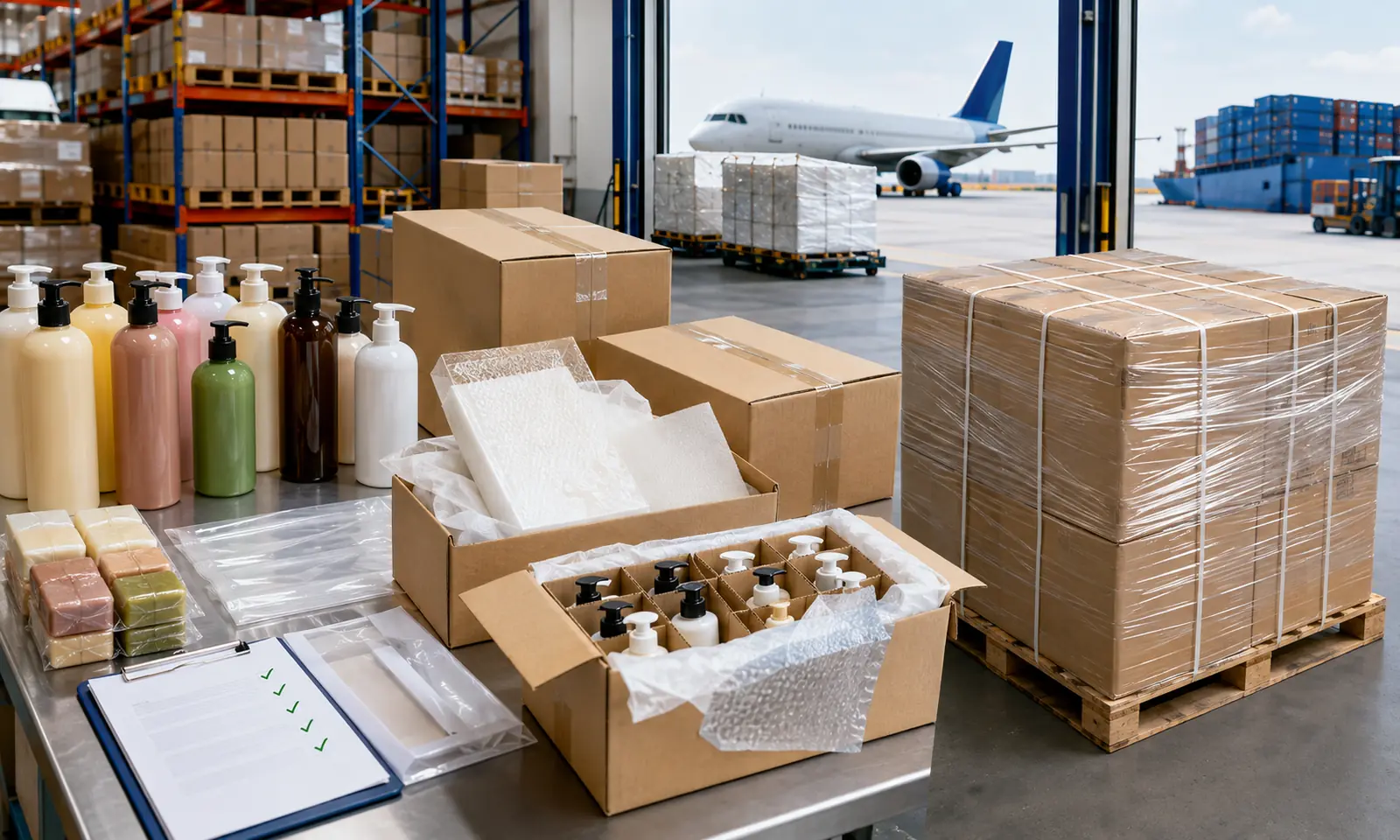
Good packaging starts at the factory. A retail bottle may survive a shelf display but still leak after repeated handling, stacking or temperature changes during an international shipment. Ask the supplier to test its closure and master-carton design against the actual product and route; agree on any extra protection before the order leaves the factory.
Liquids, creams and pump bottles
- Check each cap and pump. Lock pumps or fit protective clips where the packaging design allows.
- Use the manufacturer’s appropriate inner seal or tamper-evident closure; a loose cap should never rely on an outer carton for leak prevention.
- Add suitable secondary containment for units that could leak, and use absorbent material if the product and carrier call for it.
- Keep the unit count and product description consistent across cartons, packing lists and booking documents.
Glass containers, makeup and master cartons
- Separate glass bottles with fitted dividers or protective inserts so they cannot strike one another.
- Support makeup palettes and pressed powders against compression and movement inside their retail boxes.
- Use outer cartons strong enough for the packed weight; avoid empty spaces and overly heavy cartons.
- If the shipment needs pallets, check carton strength, pallet condition, securing method and receiving requirements at the destination warehouse.
Handling arrows and “fragile” labels can help identify the shipment, but they do not replace a sealed bottle or a strong inner pack. When an item needs dangerous goods packaging, a suitable specialist must confirm the applicable packing, marking and documentation; the ordinary-cosmetics checklist above is not a substitute.
How Does China Pickup and Consolidation Work?
A cosmetics shipment can involve more than one factory: one supplies skincare, another supplies makeup, and a third prepares display cartons. Instead of asking every supplier to arrange a separate international shipment, you can send us their product lists and handover details. VoltFreight can coordinate the agreed China pickup and consolidation plan after reviewing the products and chosen services.
- Review before collection. We check the product descriptions, available SDS and packaging information needed to request carrier acceptance. Products that need special handling are identified before they are placed on a standard-cargo plan.
- Coordinate supplier handover. We arrange pickup or warehouse receipt according to the agreed terms, addresses and cargo-ready dates. Each supplier provides its own carton and SKU list.
- Reconcile the cargo. On warehouse receipt, the team can check carton quantities, marks and measured weight and dimensions against the information received. Photographs or additional visual packing checks can be arranged when they form part of the agreed service.
- Resolve discrepancies before dispatch. If actual cartons differ from the packing list, or visible packaging needs attention, we confirm the proposed correction and any extra handling with you before booking or repacking.
- Book the accepted route. We consolidate compatible goods where appropriate, finalize the freight details and coordinate onward transport to the agreed U.S. destination.
Consolidation does not mean every cosmetic can share one carton, pallet or transport declaration. A fragrance, solvent-containing nail product or aerosol may need a separate review or shipment even when another supplier’s lotions can use a general-cargo route. Keep those product lines identifiable from supplier pickup through delivery.
What a warehouse check can—and cannot—confirm
A receiving check can compare carton labels and visible packaging with the supplier’s paperwork. When agreed in advance, photographs can help you spot a crushed master carton, inconsistent carton count or a supplier that sent an unlisted SKU. This gives you a chance to clarify the shipment before consolidation or export. However, a visual check cannot establish a product’s ingredient composition, prove that every retail bottle is sealed or replace a laboratory test. The manufacturer must supply reliable product information, and the U.S. importer remains responsible for reviewing the product’s market requirements. If you need sampling, individual-unit inspection or repacking, request those services and their scope separately.
What Happens When the Cargo Reaches the USA?
Before the goods leave China, confirm the U.S. importer, customs broker arrangements and the receiving address. VoltFreight can coordinate the freight handover, customs-related shipment information and final delivery under the agreed service scope. If your cargo goes to a 3PL or Amazon FBA facility, provide its delivery instructions, reference numbers and appointment requirements in advance. A commercial address, residential address and fulfillment warehouse may each require a different last-mile plan.
Also keep transport acceptance separate from product compliance. The U.S. importer and other responsible parties must check the product’s applicable FDA requirements, ingredients, labeling and claims. Some products marketed as cosmetics may also meet the definition of a drug because of therapeutic claims; MoCRA facility registration and product listing requirements may apply to cosmetics, subject to relevant exemptions. VoltFreight can help coordinate shipping information with the appointed broker, but a shipping quote or SDS does not establish FDA approval. The FDA’s overview of cosmetics and U.S. law explains the distinction.
If you request DDP, we will first check cargo eligibility and set out the proposed scope, duties and tax treatment, importer responsibilities and exclusions in writing. The same shipment may also be quoted under an importer-controlled arrangement. Compare the two against your actual responsibilities, not just the headline freight rate. If you need a broader explanation of duties by product, use our separate guide to import tax from China to the USA.
What Do We Need to Quote Your Cosmetics Shipment?
A useful quotation begins with the real cargo, the intended delivery and the services you want included. Send VoltFreight:
- Product names, intended uses and clear photos for every SKU.
- Ingredient or SDS information where available, plus details of alcohol, aerosols or pressurized packaging.
- Units and net contents per retail container, cartons per product and total carton count.
- Gross weight and dimensions of each carton or pallet.
- Chinese supplier pickup address or addresses and expected cargo-ready dates.
- U.S. ZIP code and full delivery type: 3PL, FBA, commercial warehouse or another address.
- Your required delivery window and whether you need pickup, consolidation, customs coordination or an eligible DDP option.
With those details, we can screen the products, identify workable services and explain what each quotation includes. Send your cosmetics shipment details to VoltFreight to request a China-to-USA freight plan.
Frequently Asked Questions
Can I ship makeup and skincare products from China to the USA?
Many commercial shipments can be arranged, but acceptance depends on the exact formula, container and transport mode. Send a product list and photos first. For creams, serums and other liquids, include the SDS or other formulation information the carrier requests.
Can I send liquid cosmetics by air?
Possibly. A liquid is not automatically prohibited from air transport, and it is not automatically accepted either. The airline or approved service must review the product, packaging and any relevant transport classification before we confirm a booking.
Does every cosmetics shipment need an SDS?
Document requests vary by product and carrier. An SDS is particularly useful when a formula contains liquids, alcohol, solvents or ingredients that need a transport assessment. Ask the manufacturer for one before booking if available; if they cannot supply it, tell us early so we can check what the proposed carrier requires.
Can you combine products from several Chinese suppliers?
Yes, when the cargo and chosen service permit consolidation. Provide a separate product and packing list for each supplier. We can plan pickup and receiving, check the delivered carton information and combine compatible cargo under the agreed warehouse service. Items needing special classification may require a separate arrangement.
Can VoltFreight deliver cosmetics to a U.S. 3PL or Amazon FBA warehouse?
We can plan delivery to a U.S. warehouse or fulfillment facility under the confirmed service scope. Send the destination ZIP code, warehouse instructions and any labeling, reference or appointment requirements before booking so the quote includes the right final-mile service.