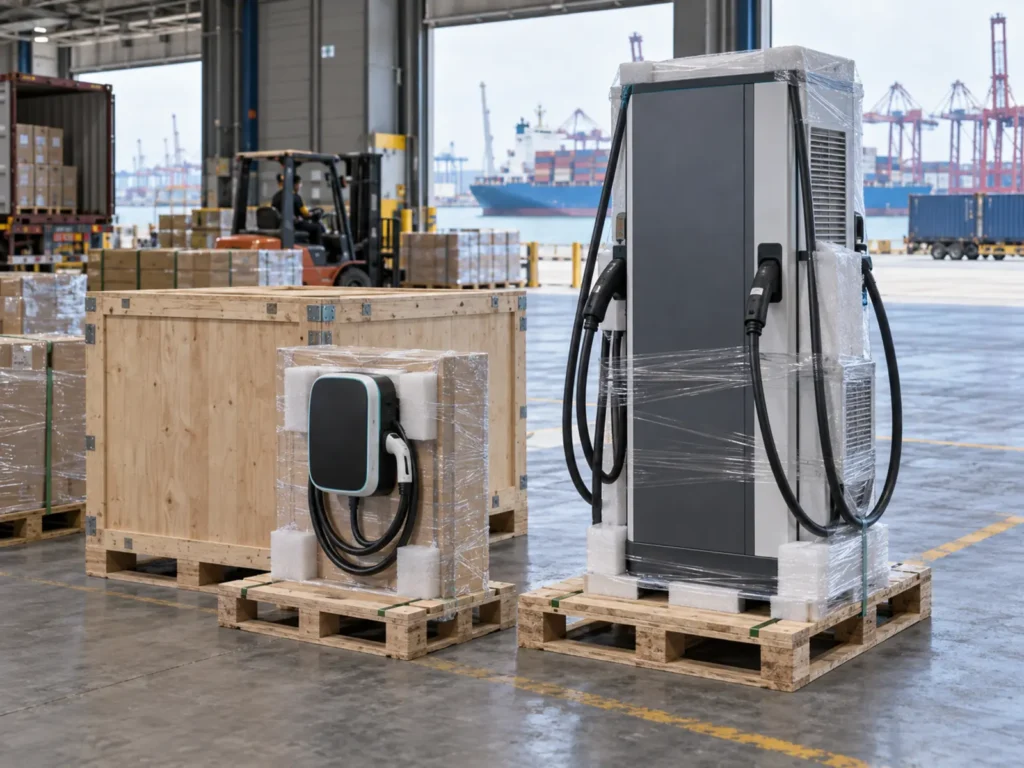
Shipping air conditioners from China to Greece requires more planning than ordinary appliance freight. Air conditioners are bulky, cartonized and often shipped as matched indoor and outdoor units. In addition, many AC products need CE documents, energy label information, HS code review, refrigerant details, F-gas checks, customs clearance and final delivery planning.
Large appliance distributors and HVAC importers usually choose FCL sea freight for seasonal stock because a full container reduces cargo handling and protects cartons better. Meanwhile, smaller buyers may use LCL for trial orders, spare parts or mixed appliance shipments when the cartons are strong enough for consolidation.
However, the best shipping method depends on product type, model quantity, refrigerant status, cargo volume, gross weight, delivery deadline and importer setup. Therefore, importers should check documents, loading plan, customs value and delivery access before the shipment leaves China.
This guide explains how to plan air conditioner shipping from China to Greece. It covers FCL, LCL, air freight, DDP feasibility, 40ft and 40HQ container planning, CE documents, energy label checks, F-gas obligations, HS code classification, Greek VAT, customs clearance and final delivery to Athens, Piraeus, Thessaloniki, mainland Greece and Crete.
Need an air conditioner shipping quote from China to Greece? Send your supplier city, product type, model list, indoor and outdoor unit quantity, carton dimensions, gross weight, total CBM, refrigerant details, invoice value and final delivery address. Contact VoltFreight to compare FCL, LCL, air freight, DDP feasibility and door delivery options.
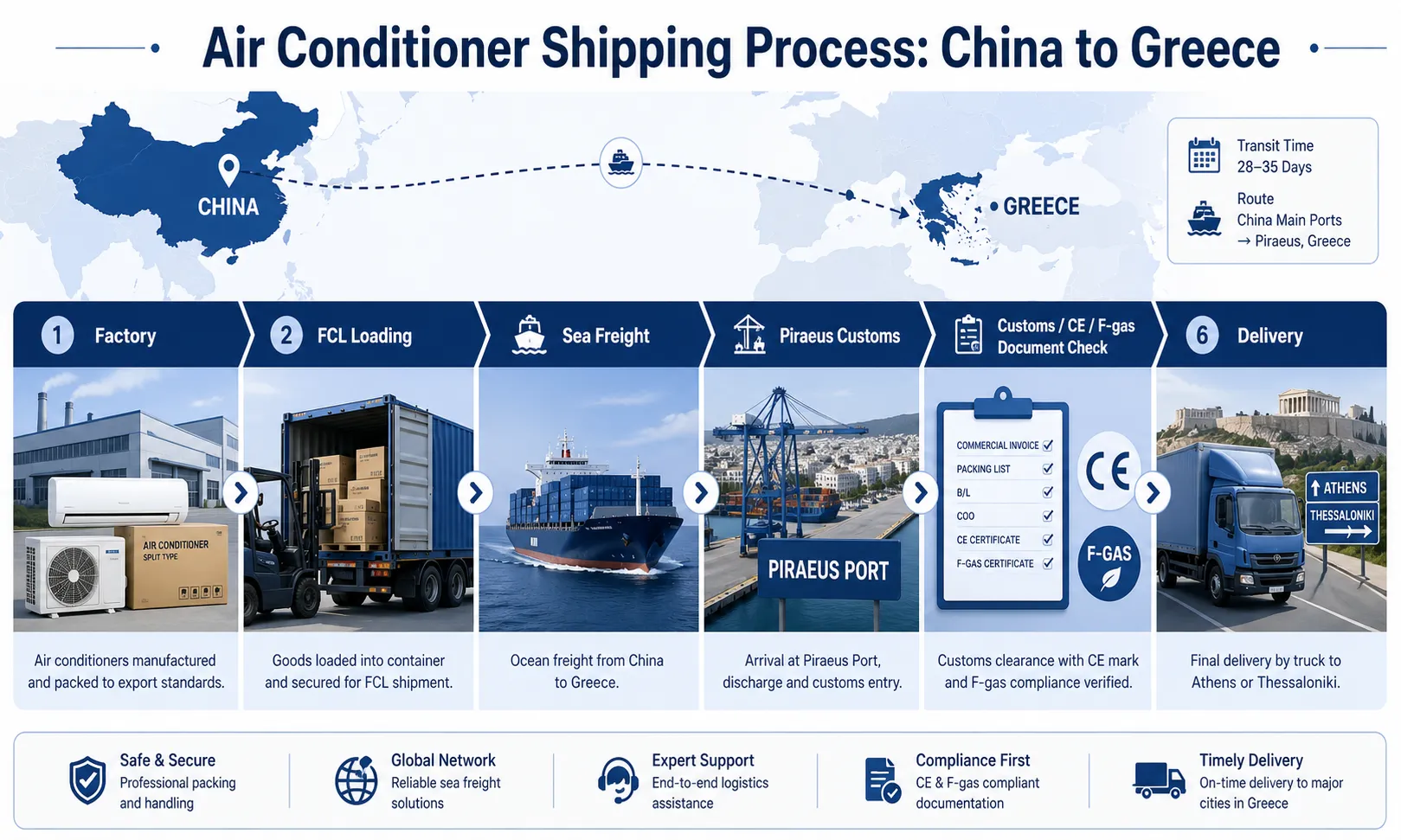
Quick Answer: What Makes Air Conditioner Shipping to Greece Different?
Air conditioners are different from many other appliance shipments because they are bulky, model-sensitive and compliance-sensitive. A split AC shipment often includes indoor units, outdoor units, remote controls, accessories, copper pipe sets and installation parts. If the model list or packing ratio is wrong, the importer may receive mismatched inventory.
Refrigerant also matters. Some AC units contain pre-charged refrigerant, so the importer should confirm the refrigerant type, charge amount and F-gas obligations before booking. In addition, many air conditioners sold in the EU need CE documents, energy label information and technical files that match the exact model.
From a freight perspective, FCL sea freight usually works best for large seasonal orders. By contrast, LCL can work for smaller shipments, although consolidation adds more handling. Air freight normally fits urgent spare parts better than complete AC units because air conditioner cartons are large and air cargo charges by chargeable weight.
- Best method for large orders: FCL sea freight by 40ft or 40HQ container.
- Possible method for smaller orders: LCL sea freight after carton and document review.
- Air freight use case: Urgent spare parts, inverter boards, samples or warranty items.
- Main compliance checks: CE documents, energy label data, refrigerant details and F-gas obligations.
- Main customs checks: HS code, customs value, commercial invoice, packing list, importer/EORI and 24% Greek VAT planning.
What Air Conditioner Products Can Be Shipped from China to Greece?
China-to-Greece appliance freight can include residential split systems, portable air conditioners, heat pumps, commercial HVAC equipment, fan coils, outdoor condensers, spare parts and accessories. Each product type has different carton sizes, loading requirements and compliance risks.
Before quoting, the supplier should confirm model numbers, cooling capacity, refrigerant type, packaging size, gross weight and whether the units contain pre-charged refrigerant. As a result, the forwarder can review freight method, customs documents and delivery requirements more accurately.
| Product Type | Logistics Notes | Documents to Check |
|---|---|---|
| Split AC indoor and outdoor sets | Bulky cartons, model matching, paired inventory and possible refrigerant controls | CE documents, model list, refrigerant details, energy label information and technical files |
| Portable air conditioners | Retail cartons, seasonal demand and possible pallet or loose-carton shipping | CE documents, energy label, user manual, HS code and invoice value |
| Heat pumps | Higher compliance sensitivity and technical data requirements | Technical datasheet, CE file, energy performance data and refrigerant details |
| Commercial HVAC equipment | Larger dimensions, project delivery and unloading coordination | Technical datasheet, compliance file, installation documents and project delivery plan |
| Spare parts and accessories | Smaller shipments that may use air freight or express courier | Part list, invoice, packing list, HS code and product description |
FCL, LCL, Air Freight or DDP: Which Method Should You Choose?
FCL sea freight is usually the best choice for wholesale AC imports. A full container reduces rehandling, lowers carton damage risk and helps importers manage peak-season inventory more predictably.
LCL sea freight can work for smaller appliance orders if the cartons are strong and the shipment does not contain unusual restrictions. Nevertheless, LCL adds handling during consolidation and deconsolidation, so weak retail cartons may face higher damage risk.
Air freight mainly suits urgent spare parts, samples, inverter boards, controllers or warranty components. Complete AC units rarely move economically by air because the cartons are large and volumetric weight can make the cost high.
DDP may help some small business shipments, but air conditioners need careful review before DDP booking. The quote should explain customs scope, VAT handling, product restrictions, refrigerant details and F-gas responsibility. Otherwise, a vague “tax included” quote can create customs or compliance risk.
| Method | Best For | Main Risk |
|---|---|---|
| FCL sea freight | Large seasonal inventory, split AC sets, distributor stock and HVAC projects | Incorrect loading plan, carton compression, mismatched models or missing documents |
| LCL sea freight | Small trial orders, accessories and mixed appliance shipments | More handling during consolidation and destination deconsolidation |
| Air freight | Urgent spare parts, inverter boards, samples and warranty items | High chargeable weight and possible restricted items |
| Express courier | Small parts, documents and urgent low-volume shipments | Parcel restrictions, high cost and limited suitability for bulky AC units |
| DDP service | Selected small shipments after product and compliance review | Unclear VAT, refrigerant, F-gas or product compliance responsibility |
For larger sea freight shipments, review Sea Freight from China to Piraeus Greece and Sea Freight from China. For urgent parts, compare Air Freight from China and Express Freight from China.
40ft and 40HQ Container Planning for AC Units
Container planning matters because AC units have different carton sizes, weights and stacking limits. Split systems also need model matching between indoor and outdoor units. If the packing list does not control the ratio, the importer may receive too many indoor units or too many outdoor units.
For lightweight retail cartons, a 40HQ container often gives better cubic capacity. Meanwhile, heavier commercial HVAC equipment may require a standard 40ft container or a special loading plan because weight distribution matters.
Before booking, ask the supplier for carton photos, carton dimensions, gross weight per model, packing ratio, pallet plan and loading photos. This information helps reduce wasted space, carton damage and mismatch between models.
| Planning Item | Why It Matters | What to Confirm |
|---|---|---|
| Indoor and outdoor unit ratio | Split AC sets must arrive as complete matched inventory | Model list, SKU list and packing ratio |
| Carton dimensions | Air conditioners are bulky and may fill volume before weight | Length, width, height and gross weight per carton |
| Stacking strength | Weak cartons can deform inside the container | Carton strength, loading method and pallet plan |
| 40ft or 40HQ choice | Container type affects unit cost and loading capacity | Total CBM, total weight and product dimensions |
| Loading photos | Photos reduce disputes and help verify loading quality | Factory loading photos, seal photo and container number |
CE Documents, Energy Labels and EU F-Gas Checks
CE documents for air conditioners shipped to Greece should match the exact model being imported. A generic certificate from another model is not enough. Importers should check the Declaration of Conformity, technical file, energy label information, product fiche, user manual, label details and model plate before shipment.
EU requirements apply to many air conditioners and comfort fans, including requirements for minimum energy performance, maximum sound levels and product information for covered products. Therefore, the importer should check energy label and product data before the goods leave China.
Many AC units also contain fluorinated greenhouse gases. If the equipment is pre-charged with F-gases, the importer may need valid registration as an equipment importer in the F-gas Portal before import. For this reason, F-gas checks should happen before production, payment balance or container loading.
| Compliance Item | Why It Matters | What to Ask the Supplier |
|---|---|---|
| CE Declaration of Conformity | Supports EU market access and product compliance | Signed DoC, exact model coverage and applicable regulations or directives |
| Energy label and product data | Many AC products sold in the EU need energy performance information | Energy class, SEER/SCOP data, product fiche and technical file |
| F-gas information | Pre-charged equipment may create importer obligations | Refrigerant type, GWP, charge amount and F-gas support documents |
| Manuals and labels | Customs or market surveillance may request product information | EU-market labels, user manual, model plate and packaging labels |
| Importer responsibility | Customs and compliance obligations usually sit with the importer of record | EORI, VAT setup, F-gas registration status and compliance advisor review |
Air Conditioner Customs Clearance in Greece: HS Code, Duty and VAT
Customs planning starts with the correct EU import HS code. Split systems, portable AC units, heat pumps, parts, fans and commercial HVAC equipment may not use the same classification. Therefore, a customs broker should check the HS code before shipment.
Greece’s normal VAT rate is 24%. As a result, import VAT can become a significant cash-flow item for large summer inventory. Customs value, freight, insurance and duty can all affect the taxable base depending on the declaration.
In addition, product descriptions should stay specific. Avoid vague invoice terms such as “appliances,” “parts” or “goods” when the shipment contains complete air conditioners, heat pumps or matched split AC sets.
| Customs Item | Why It Matters | Importer Action |
|---|---|---|
| HS code | Determines duty rate, restrictions and customs declaration requirements | Confirm EU import classification before shipping |
| Customs value | Affects duty and VAT calculation | Use real invoice value and payment support |
| Greek VAT | The normal VAT rate is 24% | Plan cash flow before seasonal orders arrive |
| Compliance documents | Customs or market surveillance may request product files | Prepare CE, energy label, refrigerant and technical documents early |
| Inspection risk | Inconsistent values, models or documents can cause delays | Prepare model list, invoices, packing list and compliance files before loading |
For a broader customs overview, review China to Greece Customs Clearance.
Seasonal Demand: When Should AC Importers Ship to Greece?
Air conditioner demand often rises before and during hot summer periods. Because sea freight needs production time, booking time, transit time, customs clearance and final delivery, importers should avoid waiting until the peak season has already started.
A better plan separates inventory into layers. First, use pre-season FCL stock for main models. Next, use mid-season replenishment for fast-moving SKUs. Finally, use air freight or express only for urgent spare parts or critical replacement items.
For appliance distributors, early planning also protects container space and warehouse capacity. Moreover, it gives the importer more time to check CE documents, energy labels, F-gas obligations, HS code and VAT cash flow before arrival.
- Start supplier confirmation before the peak summer period.
- Book FCL earlier for main seasonal models.
- Keep spare parts separate when urgent replacement demand is likely.
- Confirm warehouse space before the container arrives.
- Check documents before production balance payment where possible.
- Use air freight only when the sales value justifies the cost.
Delivery in Greece: Piraeus, Athens, Thessaloniki, Mainland Greece and Crete
After customs clearance, delivery planning becomes the next risk point. Air conditioner cartons need space, careful unloading and sometimes delivery appointments. Large orders may move to appliance distributors, HVAC warehouses, installer networks, retail stores or project sites.
Delivery to Athens or Piraeus is usually easier to arrange from Piraeus. Meanwhile, Thessaloniki requires longer inland trucking, and mainland Greece delivery depends on postcode, truck access, unloading method and appointment rules.
For VoltFreight-arranged delivery, Athens, Piraeus, Thessaloniki, mainland Greece and Crete can be reviewed. Other Greek islands are not supported under VoltFreight’s delivery service.
| Destination | Delivery Notes | What to Confirm |
|---|---|---|
| Piraeus / Athens | Common warehouse and distributor destination | Truck access, unloading method, warehouse hours and contact person |
| Thessaloniki | Needs inland trucking from port or warehouse | Delivery appointment, pallet handling, unloading capacity and consignee contact |
| Mainland Greece | Cost and timing vary by postcode, access and distance | Full address, business hours, unloading conditions and delivery restrictions |
| Crete | Requires separate review because routing and delivery cost may differ | Crete postcode, carton count, cargo size, delivery access and unloading needs |
| Other Greek islands | Not supported under VoltFreight’s delivery service | Use another local import or delivery solution if needed |
Common Risks When Shipping Air Conditioners from China to Greece
The biggest risks are not only freight rates. Many delays come from missing CE or F-gas documents, unclear importer responsibility, wrong HS codes, mismatched model numbers, poor carton loading, unprepared VAT payment or incomplete delivery details.
Therefore, importers should check the full route before booking. A low ocean rate can become expensive when the shipment faces document problems, customs delay, storage fees, carton damage or failed delivery.
- Missing CE Declaration of Conformity or technical documents.
- Energy label or product data that does not match the exact model.
- Unclear refrigerant type, charge amount or F-gas responsibility.
- Indoor and outdoor unit quantities that do not match.
- Weak cartons that cannot handle stacking pressure.
- Vague invoice descriptions or incorrect HS codes.
- Unprepared VAT cash flow before arrival.
- Warehouse space not ready before container delivery.
- Delivery address without unloading details or appointment rules.
- Booking DDP without clear customs, VAT and compliance scope.
Can You Use DDP for Air Conditioners from China to Greece?
DDP can help small importers when the product, documents, value and delivery address fit the service scope. However, air conditioners are not simple DDP cargo because refrigerant, F-gas obligations, CE documents, energy labels, HS codes and VAT handling may affect the shipment.
VoltFreight reviews DDP feasibility case by case. If the shipment fits the route, the quote should explain service scope, customs handling, VAT handling, delivery method and cargo restrictions. If the shipment does not fit DDP, standard sea freight with proper import clearance may be safer.
Be careful with any DDP quote that does not ask for refrigerant details, F-gas information, CE documents, model list, invoice value, HS code or final delivery address. A vague “tax included” offer can create compliance and customs risk later.
How VoltFreight Helps with AC Shipping to Greece
VoltFreight helps appliance importers, HVAC distributors and B2B buyers plan air conditioner shipping from China to Greece. Our team reviews supplier location, model list, carton dimensions, CBM, gross weight, shipping method, document status and final delivery address before recommending a route.
For larger shipments, we compare FCL sea freight options and help plan 40ft or 40HQ container loading. For smaller shipments, we review LCL feasibility, carton strength and destination charges. In addition, we can check whether air freight or express courier fits urgent spare parts.
- Supplier pickup and warehouse coordination in China
- FCL and LCL sea freight planning to Greece
- 40ft and 40HQ container loading review
- Carton measurement, CBM and gross weight checks
- Model list and indoor/outdoor unit matching review
- CE, energy label and F-gas document checklist
- China-to-Piraeus sea freight planning
- Customs document checklist for Greece importers
- DDP feasibility review for suitable cargo
- Final delivery planning to Athens, Piraeus, Thessaloniki, mainland Greece and Crete
Quote Checklist: What to Send for an Accurate AC Freight Quote
The fastest way to get an accurate air conditioner shipping quote is to send cargo, compliance and delivery information together. This helps the forwarder compare FCL, LCL, air freight, DDP, customs clearance and final delivery options correctly.
- Supplier city and factory or loading address in China
- Product type: split AC, portable AC, heat pump, commercial HVAC, spare parts or accessories
- Product photos and model list
- Indoor and outdoor unit matching list
- Cooling capacity and technical datasheet
- Refrigerant type and charge amount
- F-gas compliance information if applicable
- CE Declaration of Conformity
- Energy label information and product fiche
- User manual, labels and model plate photos
- Carton quantity and carton dimensions
- Gross weight per carton and total gross weight
- Total CBM and pallet plan if any
- Commercial invoice value and currency
- HS code if available
- Preferred service: FCL, LCL, air freight, express, DDP or standard import
- Cargo ready date
- Final delivery address in Greece
- Whether delivery is to Piraeus, Athens, Thessaloniki, mainland Greece or Crete
- Unloading method, warehouse hours and delivery appointment requirements
Related China to Greece Shipping Guides
Use these published VoltFreight guides to compare route planning, cost, delivery time and customs documents before shipping air conditioners from China to Greece.
- Shipping from China to Greece
- Sea Freight from China to Piraeus Greece
- China to Greece Customs Clearance
- Shipping Cost from China to Greece
- China to Greece Shipping Time
- Sea Freight from China
- Air Freight from China
- Express Freight from China
FAQ About Shipping Air Conditioners from China to Greece
What is the best way to ship air conditioners from China to Greece?
For large seasonal orders, FCL sea freight is usually the best option because it reduces handling and protects cartons better. For smaller orders, LCL can work after carton strength and destination charges are reviewed.
Should I use 40ft or 40HQ containers for AC units?
Many air conditioner shipments use 40ft or 40HQ containers because AC cartons are bulky. A 40HQ may help light retail cartons, while heavier commercial HVAC equipment needs weight and loading-plan review.
Do air conditioners need CE documents for Greece?
Yes. Importers should confirm CE Declaration of Conformity, technical documents, energy label information, model coverage and user manuals before shipment.
Do AC imports need F-gas compliance?
If the equipment contains pre-charged fluorinated greenhouse gases, the importer may need to meet EU F-gas obligations, including valid registration as an equipment importer in the F-gas Portal where applicable.
Does Greece charge VAT on imported air conditioners?
Greece’s normal VAT rate is 24%. Importers should confirm the correct customs duty, VAT treatment and taxable base with a customs broker or tax advisor before shipment.
Can air conditioners ship by air from China to Greece?
Air freight can work for urgent spare parts, samples or high-value components. However, complete AC units usually cost much more by air because cartons are large and chargeable weight can be high.
Can VoltFreight arrange delivery to Athens or Thessaloniki?
Yes, VoltFreight can help coordinate China pickup, sea freight, document review and delivery planning to Athens, Piraeus, Thessaloniki and mainland Greece. Delivery to Crete can be reviewed separately.
Can VoltFreight deliver AC units to Greek islands?
For VoltFreight-arranged delivery, Crete can be reviewed separately. Other Greek islands are not supported under VoltFreight’s delivery service.
What should I check before paying an AC supplier in China?
Check model list, indoor and outdoor unit matching, refrigerant type, CE documents, energy label information, F-gas obligations, HS code, invoice value, carton dimensions, gross weight and loading plan before paying the balance.
Final Thoughts
Shipping air conditioners from China to Greece requires more than a cheap freight rate. Importers need to review container loading, model matching, CE documents, energy labels, F-gas obligations, HS code, VAT, customs clearance and final delivery before booking.
For large seasonal orders, FCL sea freight usually gives the best control. Meanwhile, LCL can support smaller shipments if cartons are strong and destination charges are clear. Air freight should mainly serve urgent parts or critical models because complete AC units are bulky and expensive to fly.
If you need help planning air conditioner shipping from China to Greece, contact VoltFreight with your cargo details. Our team can review FCL, LCL, air freight, DDP feasibility, customs documents and final delivery options based on your real shipment requirements.
Information Sources
- European Commission: Air Conditioners and Comfort Fans
- European Commission: F-Gases in Equipment and Products
- European Commission Access2Markets: Customs Clearance Documents and Procedures
- Hellenic Ministry of Economy and Finance: Value Added Tax
Important note: This guide is for logistics planning only. Air conditioner shipping, CE documentation, energy label requirements, F-gas obligations, customs duty, HS code classification, VAT, DDP feasibility, delivery access and importer responsibilities depend on product type, refrigerant, capacity, declared value, Incoterms, customs decision and current EU/Greece regulations. Always confirm final requirements with a licensed customs broker, product compliance specialist, tax advisor and F-gas compliance professional before shipping.