China’s freight forwarding network is built around several major manufacturing regions, seaports, cargo airports, railway terminals and consolidation hubs. There is no single shipping city that works best for every importer.
For example, a buyer sourcing electronics from Shenzhen or Dongguan will often start by comparing Shenzhen, Yantian, Shekou or nearby air cargo options. Meanwhile, machinery produced in Suzhou or Kunshan will usually be more practical through Shanghai. Zhejiang suppliers may use Ningbo, while buyers sourcing mixed small commodities from several vendors often consolidate cargo in Yiwu.
Choosing the wrong China freight forwarding hub can increase domestic trucking, warehouse handling, transit time and cargo risk. In some cases, a lower international freight rate becomes more expensive after the importer adds long-distance transportation inside China.
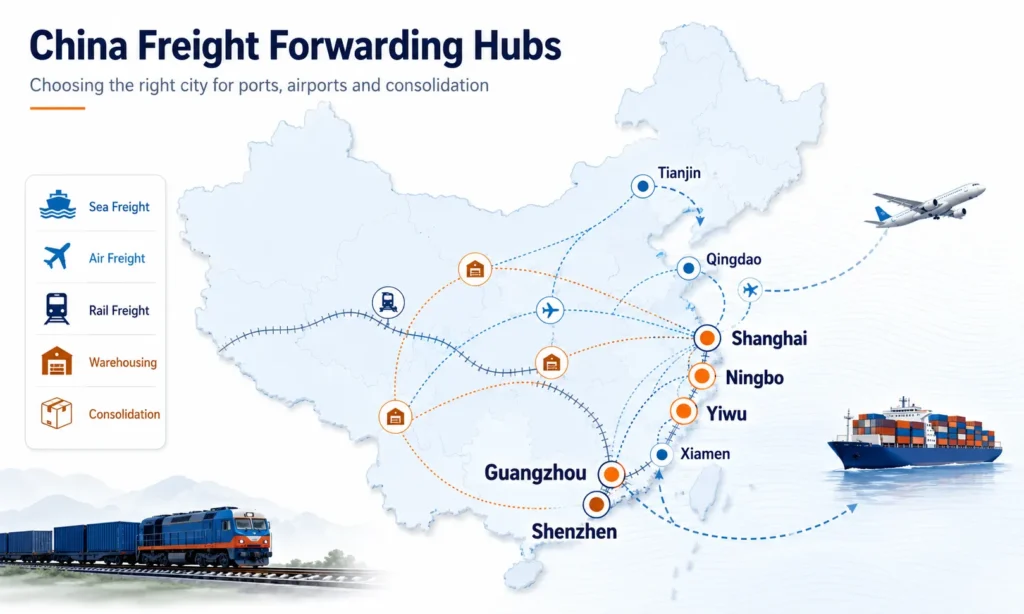
This guide compares the main freight forwarding hubs in China, including Shenzhen, Guangzhou, Shanghai, Ningbo, Yiwu, Qingdao, Tianjin and Xiamen. More importantly, it explains how supplier location, cargo type, shipping method, consolidation requirements and destination affect the best origin choice.
Need help choosing the right China shipping hub? Send VoltFreight each supplier’s city, product name, carton quantity, gross weight, dimensions, cargo-ready date and final destination. We can compare domestic pickup, consolidation, sea freight, air freight, rail freight, express courier and door-to-door options before the goods move across China unnecessarily.
Ask VoltFreight to Compare Your China Shipping Hubs
Quick Answer: Which Freight Forwarding Hub in China Should You Use?
In most cases, start with the major port, airport or freight warehouse closest to the supplier. Keeping cargo inside the same manufacturing region usually reduces pickup cost, repeated handling, delay and damage risk.
However, supplier location is only the starting point. A better international route, cargo-acceptance rule or consolidation program can sometimes justify moving the goods to another city.
Before choosing the origin hub, compare:
- Supplier city and exact factory location
- Number of suppliers
- Cargo type and product restrictions
- Gross weight, carton dimensions and CBM
- FCL, LCL, air freight, courier, rail or DDP requirements
- Domestic trucking cost inside China
- Available carrier and airline schedules
- Warehouse consolidation needs
- Cargo-ready dates from different suppliers
- Final destination country and delivery address
For example, Shenzhen often works well for electronics and South China suppliers. Guangzhou and Foshan support large furniture, lighting, garment and consumer-product clusters. Shanghai and Ningbo serve the Yangtze River Delta, while Yiwu is especially useful for multi-supplier small-commodity consolidation.
By contrast, factories in Shandong, Hebei or northern China may save substantial domestic transportation cost by using Qingdao or Tianjin rather than moving heavy cargo south to Shenzhen or Shanghai.
How China’s Freight Forwarding Network Works
China does not rely on one central export city. Instead, manufacturing regions connect with nearby ports, airports, railway terminals and freight warehouses.
Manufacturing Regions
Guangdong contains major electronics, furniture, lighting, appliance, garment and consumer-product industries. Zhejiang supports textiles, hardware, household goods and small commodities. Shanghai and Jiangsu contain large machinery, automotive, electronics and industrial supply chains.
Farther north, Shandong, Hebei and Tianjin export machinery, tires, steel products, construction materials and industrial goods. Fujian is important for footwear, sportswear, stone products, garments and bags.
Therefore, the supplier’s location directly affects pickup cost, warehouse choice, port access and international route planning.
Major Seaports
China’s major commercial ports include Yantian, Shekou, Nansha, Shanghai, Ningbo-Zhoushan, Qingdao, Tianjin and Xiamen.
Still, the cheapest ocean rate should not automatically decide the port. Importers should also compare container trucking, terminal charges, carrier schedules, transshipment risk and destination routing.
For general ocean-shipping options, see our sea freight from China service.
Major Cargo Airports
Air cargo commonly moves through Shenzhen, Guangzhou, Hong Kong, Shanghai, Beijing, Zhengzhou, Chengdu and other regional airports.
Airline routes, cargo type, available space and product restrictions can change the best airport. This becomes especially important for batteries, liquids, magnets, powders and other sensitive cargo.
For air-cargo planning, see air freight from China.
Railway and Cross-Border Truck Hubs
Selected inland cities provide railway and truck services to Europe, Russia and Central Asia. These routes can sit between air freight and sea freight in both cost and transit time.
However, the closest railway terminal is not always the correct one. A particular route may operate through another consolidation terminal because of destination, customs or schedule requirements.
Freight Warehouses and Consolidation
A freight warehouse can receive cargo from suppliers, confirm carton quantities, measure weight and volume, apply shipping marks and combine goods before export.
The warehouse location should normally match the supplier network. Several Guangdong suppliers may consolidate in Shenzhen or Guangzhou, while Zhejiang suppliers may use Yiwu, Ningbo or another nearby hub.
Major China Freight Forwarding Hubs Compared
| Freight Hub | Common Supplier Regions | Often Suitable For | Main Transport Options |
|---|---|---|---|
| Shenzhen | Shenzhen, Dongguan, Huizhou and eastern Guangdong | Electronics, e-commerce goods, batteries, higher-value products and consolidation | Sea freight, air freight, Hong Kong transfer, courier and DDP |
| Guangzhou / Foshan | Guangzhou, Foshan, Zhongshan, Jiangmen and western Guangdong | Furniture, lighting, garments, cosmetics, appliances and auto parts | Sea freight, air freight, courier and door-to-door |
| Shanghai | Shanghai, Suzhou, Kunshan, Wuxi, Changzhou and nearby Jiangsu | Machinery, automotive products, electronics and commercial cargo | FCL, LCL, air freight, courier and rail connections |
| Ningbo | Ningbo, Shaoxing, Taizhou, Wenzhou and Zhejiang | Hardware, textiles, household goods, machinery and containers | FCL, LCL, air transfer and door-to-door shipping |
| Yiwu | Yiwu, Jinhua and multi-supplier sourcing across Zhejiang | Small commodities, mixed orders and supplier consolidation | LCL, courier, railway and transfer to Ningbo |
| Qingdao | Qingdao, Jinan, Weifang, Linyi and Shandong | Machinery, tires, industrial goods and heavy cargo | FCL, LCL, air freight and inland trucking |
| Tianjin | Beijing, Tianjin, Hebei and northern China | Machinery, steel, industrial equipment and heavy shipments | FCL, LCL, air freight and regional rail |
| Xiamen | Xiamen, Quanzhou, Jinjiang and Fujian | Footwear, sportswear, garments, stone products and consumer goods | Sea freight, air freight, courier and door delivery |
This table is a starting point rather than a fixed routing rule. The final origin should be confirmed after reviewing the actual supplier address, cargo, destination and available carrier service.
Shenzhen as a Freight Forwarding Hub
Shenzhen sits inside one of China’s largest electronics and e-commerce manufacturing regions. It also provides convenient access to suppliers in Dongguan, Huizhou and other parts of the Pearl River Delta.
Depending on the shipment, cargo may move through Yantian or Shekou for sea freight, Shenzhen Airport for air cargo or Hong Kong Airport when additional airline or cargo-acceptance options are required.
When Shenzhen Is a Practical Choice
Shenzhen should usually enter the first comparison when:
- The supplier operates in Shenzhen, Dongguan or Huizhou.
- The cargo includes electronics or electronic components.
- Several South China suppliers need one consolidation point.
- The importer wants to compare air freight and courier services.
- The shipment requires DDP or e-commerce delivery.
- Batteries or sensitive products require additional route review.
Yantian and Shekou for Sea Freight
Yantian and Shekou support container exports from South China. However, the final choice depends on the factory address, shipping line, destination, sailing schedule, cutoff time and domestic container-trucking cost.
Shenzhen vs Hong Kong for Air Freight
Hong Kong may provide more airline choices or different acceptance rules for certain cargo. Nevertheless, moving mainland cargo to Hong Kong adds trucking, cross-border handling and export procedures.
Therefore, Hong Kong should be used when the international route advantage is large enough to justify the extra China-side movement.
Shenzhen Warehouse Consolidation
A Shenzhen warehouse can receive cargo from several Guangdong suppliers, use separate receiving references, confirm package quantities and consolidate the goods before export.
For importers with several suppliers, see our China warehouse and consolidation service.
Guangzhou and Foshan as Freight Hubs
Guangzhou and Foshan support large furniture, lighting, garment, cosmetics, appliance and auto-parts industries. The region is also important for buyers sourcing through the Canton Fair and local wholesale markets.
Nansha or Shenzhen Port?
Nansha can be particularly practical for factories in Guangzhou, Foshan and the western Pearl River Delta. Shenzhen ports may still offer a better shipping-line service for certain destinations.
Importers should compare:
- Factory-to-port trucking
- Port and documentation charges
- Shipping-line availability
- Departure frequency
- Transit time
- Destination port
- Transshipment risk
Moving cargo from Foshan to Shenzhen can make sense when Shenzhen creates a meaningful schedule or price advantage. Otherwise, Nansha often reduces domestic transportation.
Guangzhou Air Freight
Guangzhou Baiyun Airport is a major air-cargo gateway for Guangzhou, Foshan and surrounding industrial areas. For local suppliers, it can reduce domestic trucking compared with transferring the cargo to Shenzhen or Hong Kong.
Shanghai as a Freight Forwarding Hub
Shanghai connects one of China’s largest manufacturing regions with major international ocean and air routes.
Factories in Shanghai, Suzhou, Kunshan, Wuxi, Changzhou and nearby areas frequently use Shanghai for machinery, automotive products, electronics, industrial parts and higher-value commercial cargo.
When Shanghai Is a Practical Choice
- The supplier operates in Shanghai or southern Jiangsu.
- The cargo needs international air freight from Pudong.
- The shipment contains machinery or commercial equipment.
- Several Shanghai-Suzhou-Kunshan suppliers need consolidation.
- The buyer wants to compare FCL, LCL, air and courier services.
Shanghai or Ningbo?
Some factories in Zhejiang and Jiangsu can use either Shanghai or Ningbo. The better option depends on domestic trucking, carrier schedules, destination routes and total origin charges.
For example, a factory near Suzhou will normally find Shanghai more practical than Shenzhen. Likewise, a factory close to Ningbo should not automatically move cargo to Shanghai just because one ocean rate appears slightly lower.
Ningbo as a Freight Forwarding Hub
Ningbo supports suppliers across Zhejiang, including Ningbo, Shaoxing, Taizhou and Wenzhou. Major exports include hardware, textiles, household products, machinery and general commercial goods.
When Ningbo Works Well
- The supplier operates in Zhejiang.
- The shipment uses FCL or LCL sea freight.
- The cargo includes hardware, textiles or household goods.
- Yiwu purchases need transfer to a major container port.
- Ningbo provides a suitable direct sailing to the destination.
Ningbo can reduce domestic trucking for many Zhejiang factories. However, Shanghai may still provide a better air or ocean service for a particular shipment.
Yiwu as a Consolidation and Freight Hub
Yiwu is not a major ocean port. Its strength is sourcing and consolidation.
Importers often buy toys, accessories, household products, decorations, packaging and promotional goods from several vendors around Yiwu. A local warehouse can receive the individual orders before transferring the consolidated shipment to Ningbo, a railway terminal or a courier gateway.
When Yiwu Consolidation Makes Sense
- The buyer purchases from several suppliers.
- The products come from Yiwu wholesale markets.
- Suppliers finish production on different dates.
- The goods need labels, repacking or shipping marks.
- The final shipment will move by LCL, courier or rail.
For small shipments, compare courier or air options before choosing LCL. Minimum CFS, documentation and destination handling charges can make very small LCL shipments less economical than expected.
Qingdao as a Northern China Freight Hub
Qingdao serves factories throughout Shandong, including Qingdao, Jinan, Weifang and Linyi. Common cargo includes machinery, tires, industrial parts, agricultural equipment and construction materials.
Heavy Shandong Cargo Should Usually Stay Regional
Long-distance trucking can add substantial cost to dense industrial cargo. Moving several tons of machinery from Shandong to Shenzhen may add tolls, handling and delay without improving the international route.
Therefore, importers should normally compare Qingdao first. Another port only becomes attractive when it creates a meaningful schedule, route or total-cost advantage.
Tianjin as a Freight Hub for Northern China
Tianjin supports suppliers in Beijing, Tianjin, Hebei and other northern regions. These areas produce machinery, steel products, construction materials, automotive components and industrial equipment.
For heavy cargo, using a northern port can avoid long-distance transportation to Shanghai, Ningbo or South China.
When Tianjin Is a Practical Choice
- The supplier is in Beijing, Tianjin or Hebei.
- The shipment is heavy or oversized.
- The goods will move by full container.
- The importer wants to reduce cross-province trucking.
- Tianjin has a suitable route to the destination.
Xiamen as a Freight Hub for Fujian
Xiamen serves manufacturing centers including Xiamen, Quanzhou and Jinjiang. Fujian is especially important for footwear, sportswear, garments, bags, stone products and consumer goods.
For Fujian cargo, Xiamen should normally enter the first route comparison. Shenzhen or Guangzhou may still make sense when they provide a materially better airline, shipping-line or consolidation service.
Inland Freight Hubs: Chengdu, Chongqing, Zhengzhou and Xi’an
Not every Chinese shipment should first move to a coastal port.
Chengdu and Chongqing support manufacturers in western China, while Zhengzhou and Xi’an provide selected air and railway options.
Importers with inland suppliers normally compare two approaches:
- Export through a nearby air or railway terminal.
- Move the cargo to a major coastal port or cargo airport.
The inland option may shorten domestic transportation, whereas the coastal route can still provide lower international cost for large and non-urgent shipments.
Choose the Freight Hub Based on Supplier Location
Suppliers in Guangdong
Compare Shenzhen, Guangzhou, Foshan and nearby warehouses first. Electronics in eastern Guangdong often favor Shenzhen, while furniture and suppliers in western Pearl River Delta locations may find Guangzhou or Nansha more practical.
Suppliers in Zhejiang
Ningbo often provides a strong sea-freight option. Yiwu supports multi-supplier consolidation, while Shanghai may provide stronger air or selected ocean services.
Suppliers in Jiangsu
Factories in Suzhou, Kunshan and Wuxi commonly use Shanghai. Other Jiangsu locations may require comparison with Ningbo, Qingdao or regional ports.
Suppliers in Shandong
Qingdao should normally be evaluated first, particularly for machinery, tires and heavy cargo.
Suppliers in Hebei and Northern China
Tianjin often provides the first sea-freight comparison. Beijing-area airports may be considered for urgent or higher-value cargo.
Suppliers in Fujian
Xiamen should usually enter the first comparison. Shenzhen or Guangzhou should only replace it when the international service provides a clear route advantage.
Should You Move Cargo to Another Chinese City?
Sometimes a different China origin provides a lower international freight rate or a better service. However, moving the goods across provinces adds transportation, tolls, warehouse handling and time.
Moving Cargo May Make Sense When
- Several suppliers need one consolidation warehouse.
- The nearest port or airport does not serve the destination well.
- Another airport can accept the product.
- Another origin provides a significantly better schedule.
- A particular DDP route operates from a specific warehouse.
- The international saving exceeds the domestic transfer cost.
Moving Cargo Often Does Not Make Sense When
- The shipment is heavy or bulky.
- The goods already fill a container.
- The domestic transfer distance is long.
- The freight-rate difference is small.
- The transfer may cause a missed cutoff.
- The cargo is fragile or difficult to handle.
Always compare the total China origin cost. Domestic pickup, highway tolls, warehouse receiving, unloading, reloading and storage can erase the apparent saving from a lower international rate.
Choose the China Freight Hub Based on Cargo Type
Electronics and Electronic Components
Shenzhen and Dongguan support large electronics supply chains. However, electronics produced around Shanghai, Suzhou or another region should normally stay within that regional logistics network unless another origin creates a clear advantage.
Lithium Batteries and Battery-Powered Products
Battery shipments require review of battery type, configuration, watt-hour rating, packaging and transport documents before selecting an airport.
Shenzhen, Guangzhou, Hong Kong, Shanghai and other gateways may follow different airline acceptance conditions. Carriers may request documents such as MSDS, UN38.3 reports, test summaries or product specifications depending on the shipment.
Furniture and Lighting
Foshan, Guangzhou and Zhongshan contain major furniture and lighting clusters. Nansha and Shenzhen can both provide ocean options depending on factory location and destination.
Because furniture occupies significant space, domestic trucking and container-loading efficiency can strongly affect the final cost.
Machinery and Industrial Equipment
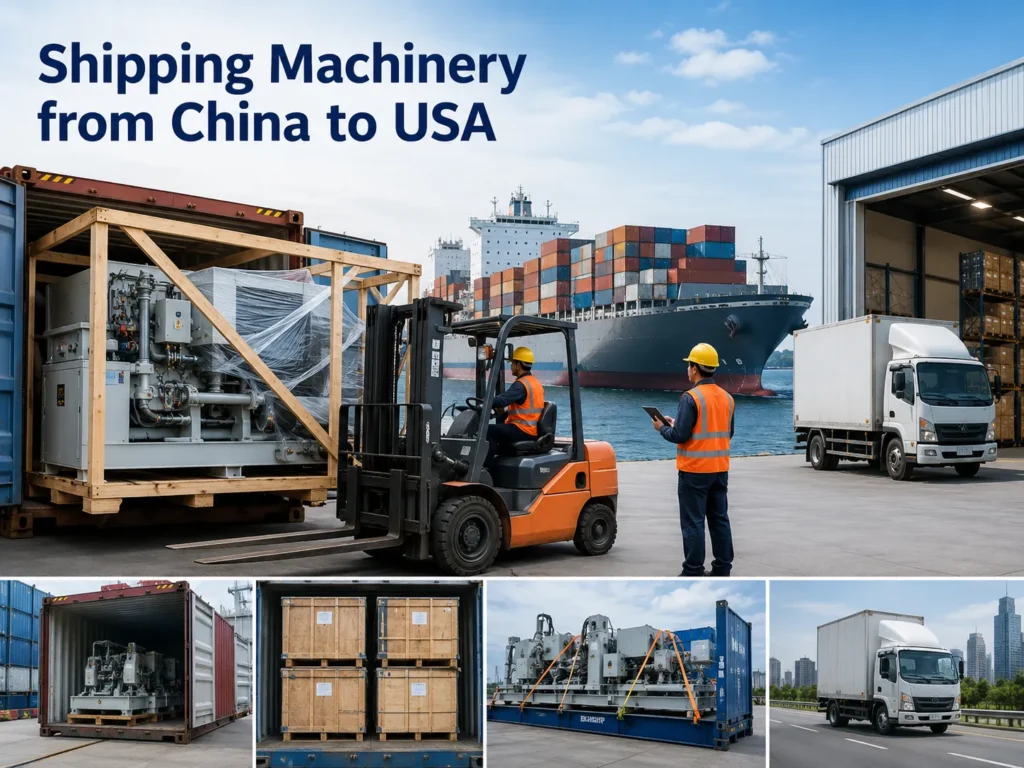
Heavy machinery should generally use a regional port close to the factory. Qingdao may suit Shandong equipment, while Shanghai can serve machinery produced around Jiangsu.
Oversized cargo may require open-top containers, flat racks, special lifting or project-cargo planning.
Small Commodities and Mixed Products
Yiwu is particularly useful when buyers purchase smaller quantities from multiple suppliers. After consolidation, cargo may move through Ningbo, rail freight or courier networks.
Textiles, Clothing and Footwear
The best hub depends on the manufacturing region. Guangzhou, Fujian, Zhejiang and Jiangsu all contain major textile, clothing and footwear supply chains.
Choose the Hub Based on Shipping Method
FCL Sea Freight
Full-container cargo should normally use a port close to the factory. Long-distance container trucking can quickly remove the saving from a slightly lower ocean rate.
LCL Sea Freight
LCL services use regional consolidation warehouses. Therefore, compare CFS charges, warehouse handling, domestic trucking, documentation and destination costs together with the ocean rate.
Air Freight
Air freight depends on airline routes, chargeable weight, cargo acceptance and available capacity. Shenzhen, Guangzhou, Hong Kong and Shanghai may all provide different options for the same destination.
Express Courier
Courier shipping works particularly well for samples, replacement parts and smaller commercial parcels. Domestic collection can move the cargo to a major DHL, UPS or FedEx gateway.
Rail Freight
Rail freight operates through selected terminals. Destination route, cargo acceptance, customs procedure and final delivery determine the correct departure point.
DDP and Door-to-Door Shipping
Door-to-door shipping from China may rely on a specific consolidation warehouse rather than the closest port or airport.
Before moving the cargo, ask the forwarder to explain the warehouse, international route, customs model, duty and tax scope, transit time and final-delivery process.
Multi-Supplier Consolidation in China
Combining cargo from several suppliers can reduce repeated international shipments and simplify coordination. However, the consolidation city must still make economic sense.
Use a Regional Warehouse When Possible
When most suppliers operate in the same region, a nearby warehouse usually reduces pickup cost. For example, several Guangdong factories may consolidate in Shenzhen, while Zhejiang suppliers may use Yiwu or Ningbo.
Compare Supplier Cargo-Ready Dates
One late supplier can delay the entire consolidated shipment. Therefore, compare the freight saving with storage cost and the risk of waiting for unfinished cargo.
Confirm the Warehouse Services Before Delivery
Ask whether the warehouse can:
- Receive cargo under individual supplier references
- Provide receiving photos
- Confirm carton quantities
- Measure weight and dimensions
- Check visible package damage
- Replace weak cartons
- Apply shipping marks
- Palletize or repack cargo
- Store goods while waiting for other suppliers
What Affects Domestic Pickup Cost Inside China?
Domestic pickup is an important part of freight-hub selection. A cheap international freight rate may no longer be attractive after expensive China-side transportation is added.
Pickup cost can depend on:
- Supplier city and exact address
- Distance to the warehouse, port or airport
- Number of cartons or pallets
- Total gross weight and CBM
- Required truck size
- Factory loading capability
- Forklift or tail-lift requirements
- Highway tolls
- Traffic and pickup appointments
- Sensitive, dangerous or oversized cargo
Small shipments may use ordinary domestic delivery to a warehouse. Larger cargo may require a dedicated truck, container pickup or direct factory loading.
How VoltFreight Coordinates Freight Across China
VoltFreight is a China-based freight forwarder headquartered in Shenzhen. We coordinate supplier pickup, warehouse receiving, consolidation and international shipping for importers sourcing goods from factories across China.
Our Shenzhen warehouse can receive cargo from Guangdong and other regions when Shenzhen consolidation makes practical sense. However, we do not recommend moving every shipment to Shenzhen.
For goods produced around Shanghai, Ningbo, Qingdao, Tianjin, Xiamen or inland manufacturing regions, our team can compare local export arrangements with a Shenzhen consolidation route.
We review:
- Supplier locations
- Cargo weight and volume
- Product type
- Shipping method
- Destination country
- Carrier schedule
- Domestic pickup cost
- Cargo acceptance requirements
- Customs and final-delivery requirements
VoltFreight can coordinate supplier pickup, warehouse consolidation, FCL and LCL sea freight, air freight from China, rail freight from China, express courier, DDP, DAP and destination delivery.
The goal is not to route every shipment through the same city. It is to choose the origin that produces the most practical total route for the actual cargo.
Information Needed to Choose the Right China Freight Hub
Send information for every supplier so that the domestic pickup and international route can be compared correctly.
- Product name and photos
- Supplier city and pickup address
- Number of suppliers
- Cargo-ready date for each supplier
- Carton quantity
- Carton dimensions
- Gross weight
- Total CBM
- Cargo value
- HS code if available
- Destination country and address
- Preferred shipping method
- Required delivery deadline
- Whether suppliers can deliver to a domestic warehouse
- Whether consolidation, repacking or labels are required
- Whether the goods contain batteries, liquids, powders, magnets or branded products
With these details, VoltFreight can compare the complete origin plan instead of quoting one port or warehouse without considering domestic transportation.
FAQ About China Freight Forwarding Hubs
Which city is the best freight forwarding hub in China?
There is no single best city for every shipment. Shenzhen often suits South China electronics and e-commerce cargo, Shanghai serves the Yangtze River Delta, Ningbo handles many Zhejiang exports, Yiwu supports small-commodity consolidation, and Qingdao or Tianjin often work better for northern industrial cargo.
Should Shenzhen suppliers use Yantian, Shekou or Guangzhou?
The best option depends on the factory address, destination, shipping line, container trucking and local port charges. Yantian or Shekou normally makes sense for many Shenzhen-area factories, while Nansha may be more practical for western Pearl River Delta suppliers.
Is Ningbo or Shanghai better for Zhejiang cargo?
Ningbo can reduce domestic trucking for many Zhejiang suppliers. Shanghai may still provide a better airline or shipping-line service for some routes. Compare the complete origin cost rather than the basic international rate alone.
Can goods from different Chinese cities be consolidated?
Yes. A freight forwarder can collect goods from several suppliers and combine them in one warehouse. However, the importer should compare the consolidation saving with domestic trucking, storage and the risk of waiting for suppliers with different production schedules.
Is it cheaper to move cargo to another port in China?
Sometimes, but not always. A lower international rate can be offset by domestic trucking, tolls, warehouse handling and repeated loading. Compare the total route before transferring the cargo.
Which China airport is best for battery cargo?
There is no universal airport for all battery shipments. The correct gateway depends on battery configuration, watt-hour rating, documentation, airline acceptance and destination. Shenzhen, Guangzhou, Hong Kong, Shanghai and other airports can follow different carrier requirements.
Why is Yiwu important for international freight?
Yiwu is primarily a sourcing and consolidation center rather than a major ocean port. It is useful when buyers purchase small commodities from multiple suppliers and need one warehouse before moving the combined cargo to Ningbo, railway service or courier networks.
Can VoltFreight collect goods from different cities in China?
Yes. VoltFreight can coordinate supplier pickup from cities across China. We compare the supplier address, cargo characteristics, destination and shipping method before deciding where the shipment should be consolidated or exported.
Choose the Freight Hub Before Moving the Cargo
The best China freight forwarding hub normally begins with supplier location, but the nearest city is not automatically the final answer.
Importers should compare domestic pickup, warehouse handling, available port or airport routes, cargo acceptance, carrier schedules and final delivery together.
Regional consolidation usually works well when suppliers operate within the same manufacturing area. Moving cargo across China should only happen when another hub provides a clear advantage in cost, route availability, cargo acceptance or delivery schedule.
If you are unsure whether to use Shenzhen, Guangzhou, Shanghai, Ningbo, Yiwu, Qingdao, Tianjin or another origin, send VoltFreight your supplier locations and shipment details before arranging domestic delivery.
Compare the Best China Freight Hub for Your Shipment
Planning note: Port routes, airline acceptance, rail schedules, freight rates, cargo restrictions and DDP availability change by shipment and destination. Confirm the final route, cost and documentation requirements before collecting the goods.