Freight broker vs freight forwarder is a common comparison for importers, exporters and companies arranging domestic or international transportation. However, these providers do not always perform the same work, issue the same documents or accept the same responsibility for cargo.
The terminology becomes even more confusing when a shipment also involves an NVOCC, shipping agent, customs broker, air cargo agent, carrier or third-party logistics provider. A single shipment may involve several of these companies, and one logistics group may perform more than one role.
Legal definitions also vary by country and transportation mode. In the United States, motor freight brokers and freight forwarders fall under Federal Motor Carrier Safety Administration rules. Ocean freight forwarders and non-vessel-operating common carriers operate under a different maritime framework. Customs brokers, meanwhile, require separate customs authorization.
This guide explains the practical differences between a freight broker, freight forwarder, NVOCC, shipping agent, customs broker, air cargo agent and 3PL. It also explains who may issue transportation documents, who coordinates customs clearance, who may assume carrier responsibility and which provider an importer may need for a specific shipment.
Need help arranging international freight from China? Contact VoltFreight with the product, supplier location, shipment weight, dimensions, destination and delivery requirements. Our team can help coordinate the appropriate transport providers for your route.
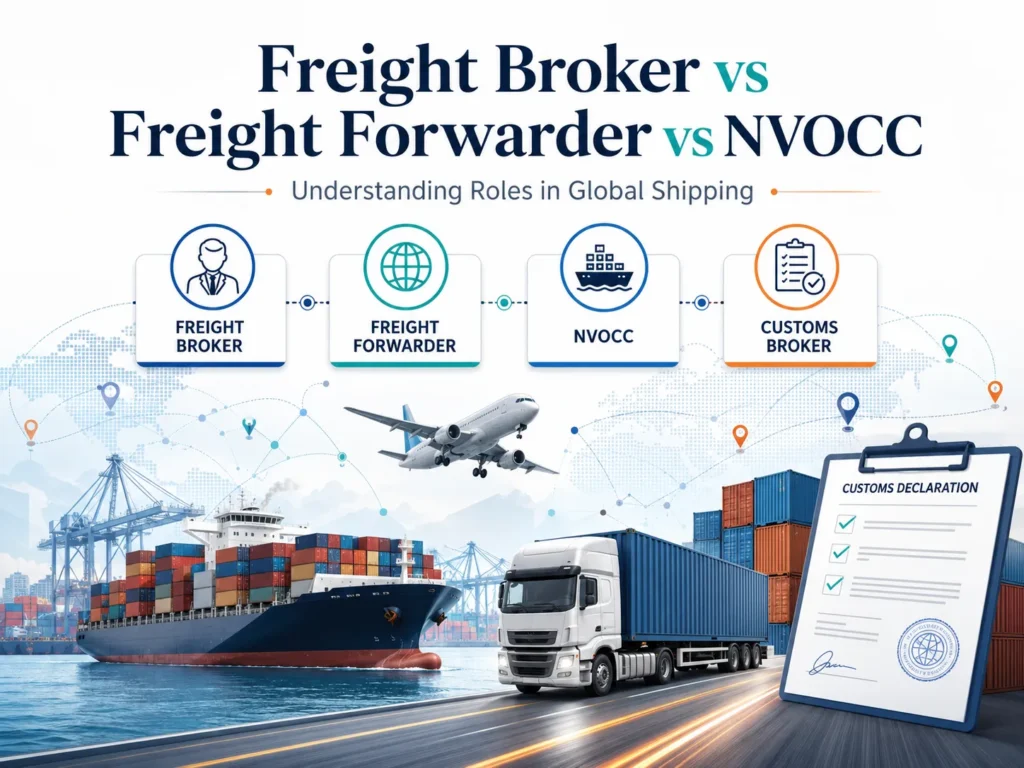
Quick Answer: Freight Broker vs Freight Forwarder
A freight broker generally connects a shipper with an authorized carrier. The broker arranges transportation but does not normally take possession of the cargo or perform the transportation itself.
A freight forwarder usually coordinates a broader logistics process. Depending on the service and legal framework, the forwarder may receive cargo, consolidate shipments, arrange carriers, issue house transport documents and accept responsibility for moving goods from origin to destination.
An NVOCC operates specifically in ocean transportation. It does not operate the vessel, but it may act as the contractual ocean carrier toward the shipper and issue its own house bill of lading.
A customs broker performs a different function. It represents importers or exporters in customs business, which may include customs entries, product classification, valuation, duty calculation and communication with customs authorities.
Therefore, the correct provider depends on the shipment:
- Use a freight broker when you need someone to arrange motor-carrier capacity, especially for domestic trucking.
- Use a freight forwarder when you need broader international logistics coordination.
- Use an NVOCC when the company provides ocean transportation under its own house bill of lading.
- Use a customs broker when you need authorized customs representation.
- Use a shipping agent when a carrier, vessel owner or logistics principal appoints an agent to perform specified local tasks.
- Use a 3PL when you mainly need warehousing, fulfillment, inventory management or local distribution.
Why Logistics Terms Often Cause Confusion
Importers often use freight broker, shipping agent, cargo agent and freight forwarder as interchangeable commercial terms. In everyday conversations, a customer may call any company that arranges shipping a “shipping agent.”
However, marketing language does not always reveal the company’s actual legal or contractual role. A company may act as a freight forwarder for one shipment, an NVOCC for another route and a booking agent for a different carrier.
The company’s role affects important questions:
- Who contracts with the actual carrier?
- Who receives or consolidates the cargo?
- Who issues the house bill of lading or house air waybill?
- Who controls the destination agent?
- Who handles customs entries?
- Who accepts responsibility for cargo claims?
- Which license, registration, bond or insurance applies?
- Which terms and conditions govern the shipment?
For this reason, importers should not rely only on a company name or job title. They should ask what role the provider will perform under the actual booking.
Freight Broker, Freight Forwarder, NVOCC and Customs Broker Compared
| Provider | Main Role | Typical Cargo Involvement | Transport Documents | Customs Role |
|---|---|---|---|---|
| Freight broker | Connects a shipper with motor carriers or other transport providers | Usually does not take possession or consolidate cargo | Usually does not issue a carrier bill of lading in its own name | Does not automatically hold customs authority |
| Freight forwarder | Coordinates transportation, routing, consolidation and related logistics | May receive, store, consolidate or redistribute cargo | May issue house transport documents depending on its role | May coordinate customs clearance but may need a licensed broker |
| NVOCC | Provides ocean transportation without operating the vessel | May consolidate cargo and purchase vessel space from ocean carriers | Usually issues its own house bill of lading | May coordinate clearance but does not automatically act as customs broker |
| Shipping agent | Acts for a carrier, vessel owner or other principal under an agency appointment | Depends on the appointment and local service | May prepare or release documents on behalf of the principal | Normally coordinates rather than performs licensed customs business |
| Customs broker | Conducts customs business for an importer or exporter | Normally handles information and filings rather than physical transportation | Files customs entries and related declarations | Primary customs representation role |
| Air cargo agent | Books and coordinates air cargo with airlines | May receive cargo and coordinate airport handling | May issue or manage house and master airway bill data | Usually coordinates with a customs broker |
| 3PL provider | Provides warehousing, fulfillment and distribution services | Usually receives and handles inventory | Normally does not issue international carrier documents unless it also acts as a forwarder | May coordinate customs services through a partner |
The table provides a general comparison. Actual responsibility depends on the jurisdiction, contract, transport mode, licensing status and shipment documents.
What Is a Freight Broker?
A freight broker connects a shipper that needs transportation with a carrier that can move the freight. In the United States, the term commonly refers to property transportation by motor carrier.
The broker does not usually operate the truck, employ the driver or physically carry the goods. Instead, it identifies available carriers, negotiates rates, coordinates pickup and delivery information and helps manage communication between the shipper and carrier.
What a Freight Broker Commonly Does
- Receives shipment requirements from the shipper
- Finds a suitable authorized motor carrier
- Negotiates or confirms the transportation rate
- Shares pickup and delivery instructions
- Coordinates appointment information
- Monitors shipment progress
- Communicates delays or service problems
- Handles carrier payment according to the broker agreement
What a Freight Broker Normally Does Not Do
A broker normally does not:
- Operate the truck that transports the cargo
- Employ the carrier’s driver
- Consolidate cargo in its own warehouse
- Act automatically as an international freight forwarder
- Act automatically as a customs broker
- Issue an ocean house bill of lading as an NVOCC
Contracts still matter. A company that calls itself a broker may accept additional obligations through its service agreement. Importers and shippers should therefore review the contract instead of relying only on the provider’s title.
Freight Broker vs Bona Fide Agent or Dispatcher
The terms broker, agent and dispatcher can overlap in U.S. trucking conversations, but they do not always describe the same authority.
A bona fide agent generally acts as part of a motor carrier’s normal organization under a continuing relationship with that carrier. By contrast, an independent intermediary that allocates traffic among several carriers and exercises broad discretion may perform broker activity.
A dispatcher may provide administrative support to a motor carrier, such as finding loads, handling documents or communicating with shippers. However, the service model can cross into broker activity when the dispatcher independently arranges transportation between shippers and multiple carriers.
Companies using dispatch or agent services should ask:
- Does the agent represent one carrier or several carriers?
- Who negotiates directly with the shipper?
- Who receives payment from the shipper?
- Who selects the final carrier?
- Does the service provider have the required authority?
This distinction matters most in regulated motor-carrier markets. It does not automatically define the role of a China-based international freight forwarder.
What Is a Freight Forwarder?
A freight forwarder coordinates the movement of goods on behalf of importers, exporters and cargo owners. Unlike a broker that mainly connects two parties, a forwarder may manage several operational stages of the shipment.
Depending on the route and service, a freight forwarder may:
- Arrange supplier pickup
- Receive cargo at a warehouse
- Measure weight and dimensions
- Consolidate goods from several suppliers
- Repack or label cartons
- Book sea, air, rail, truck or courier transportation
- Coordinate export declarations
- Prepare transport documentation
- Work with destination agents and customs brokers
- Arrange final delivery
- Provide tracking and milestone updates
- Support insurance and cargo claims
A forwarder may interact directly with the cargo through warehousing, consolidation or handling. It may also assume contractual responsibility for transportation, depending on the applicable legal framework and the documents it issues.
For a separate guide about reviewing a Chinese logistics provider, read how to choose a freight forwarder in China.
Does a Freight Forwarder Own Ships, Aircraft or Trucks?
Most freight forwarders do not own every asset used in a shipment. They purchase or arrange services from shipping lines, airlines, railway operators, truck carriers, couriers, warehouses and customs specialists.
This asset-light structure allows a forwarder to compare several routes. Nevertheless, the forwarder’s contractual responsibility may extend beyond that of a simple booking intermediary.
Can a Freight Forwarder Issue a Bill of Lading?
A freight forwarder may issue a house bill of lading or house air waybill when its service structure allows it to act as the contractual transport provider. However, not every company that markets itself as a forwarder issues house documents.
Before booking, importers should ask:
- Who will issue the house bill of lading?
- Who will appear as carrier on the document?
- Which company will receive the master bill of lading?
- Which terms and conditions govern cargo liability?
- Who controls the destination release?
Freight Broker vs Freight Forwarder: Main Differences
The central difference involves the provider’s function and degree of responsibility.
A freight broker generally arranges a transaction between the shipper and carrier. The broker does not normally take possession of the cargo or provide transportation under its own transport document.
A freight forwarder may combine several shipments, organize the full route and assume responsibility for delivering the cargo under agreed terms. It may also issue house transport documents and manage destination agents.
Transportation Scope
Freight brokers commonly focus on a specific transportation transaction, especially domestic trucking. Freight forwarders often coordinate multimodal and international routes involving truck pickup, sea or air freight, customs coordination and final delivery.
Physical Cargo Handling
A broker normally does not receive the cargo. A freight forwarder may operate or use warehouses that receive, consolidate, repack or label goods.
Carrier Relationship
The broker connects the shipper with the actual carrier. A forwarder may buy carrier capacity and sell a combined logistics service to the customer.
Transport Documents
A broker normally works with carrier documents. A forwarder may issue a house document when acting as the contractual transportation provider.
Cargo Responsibility
Freight forwarders may accept broader responsibility for transportation than brokers. Still, liability depends on the contract, bill of lading, service terms, insurance and applicable law.
Warehousing and Consolidation
Freight forwarding services frequently include consolidation. This service helps importers combine cartons from multiple suppliers before international shipping. Brokers do not normally provide this physical operation unless the company also holds another logistics role.
What Is an NVOCC?
NVOCC stands for Non-Vessel-Operating Common Carrier. An NVOCC provides ocean transportation services without operating the actual vessel.
The NVOCC purchases vessel space from a vessel-operating ocean carrier. It then offers ocean transportation to its customers under its own service terms.
What an NVOCC Commonly Does
- Purchases or negotiates space with ocean carriers
- Accepts cargo bookings from shippers
- Consolidates LCL cargo where applicable
- Issues its own house bill of lading
- Receives a master bill of lading from the ocean carrier
- Sets service terms and customer rates
- Coordinates destination deconsolidation or release
- Acts as carrier toward the customer under the house bill
An NVOCC does not own or operate the vessel simply because it issues the house bill. The shipping line still performs the physical ocean voyage.
House Bill of Lading and Master Bill of Lading
The NVOCC may issue a house bill of lading to the shipper. At the same time, the ocean carrier issues a master bill of lading for the vessel booking.
The house bill governs the contractual relationship between the NVOCC and its customer. The master bill governs the relationship between the ocean carrier and the NVOCC or booking party.
Importers should check both document structures when release instructions, consignee details or destination charges appear unclear.
Ocean Freight Forwarder vs NVOCC
The U.S. Federal Maritime Commission groups ocean freight forwarders and NVOCCs under the broader term Ocean Transportation Intermediaries. However, the two roles differ.
Ocean Freight Forwarder
An ocean freight forwarder generally acts for the shipper. It arranges cargo movement, books vessel space, prepares documents and performs related export services.
The ocean freight forwarder may receive compensation for arranging the shipment, but it does not necessarily act as the ocean carrier toward the shipper.
NVOCC
An NVOCC acts as a common carrier toward its customer while acting as a shipper toward the vessel-operating carrier. It may issue its own house bill of lading and publish or provide ocean transportation terms.
Can One Company Be Both?
Yes. A company may hold or perform both ocean freight forwarder and NVOCC functions when it satisfies the relevant requirements. The specific role should still appear clearly in the contract and bill of lading.
Why the Difference Matters
The distinction affects:
- Who issues the bill of lading
- Who acts as contractual carrier
- Which tariff or service terms apply
- Who controls destination cargo release
- Who receives a cargo claim
- Which financial responsibility requirements apply
Importers shipping by ocean should not assume that every freight forwarder automatically acts as an NVOCC.
For information about FCL, LCL and container transportation, review our sea freight from China guide.
What Is a Shipping Agent?
“Shipping agent” is a broad commercial term. It may describe a company that acts for a shipping line, vessel owner, freight forwarder, NVOCC, importer or exporter.
In port operations, a vessel or shipping agent may coordinate local services for a vessel owner or carrier. These tasks can include port formalities, berth arrangements, document exchange and communication with terminals.
In general import conversations, buyers may also call a freight forwarder or sourcing logistics provider a shipping agent. Therefore, the title alone does not confirm the company’s legal role.
Questions to Ask a Shipping Agent
Before booking, ask:
- Which company do you represent?
- Are you acting for the shipper or carrier?
- Do you issue the transport document?
- Who contracts with the actual carrier?
- Do you receive or consolidate cargo?
- Who handles customs clearance?
- Who controls the destination agent?
- Who accepts cargo claims?
A clear answer will reveal whether the company acts as an agent, forwarder, carrier, NVOCC or another intermediary.
Shipping Agent vs Freight Forwarder
A shipping agent normally acts on behalf of a named principal. The principal may be a carrier, vessel owner or logistics company. The agent performs authorized tasks but does not automatically become the carrier or freight forwarder.
A freight forwarder provides logistics coordination directly to the shipper or importer. It may select carriers, consolidate cargo and manage multiple stages of transportation.
The two roles can overlap. For example, a destination agent may act for an overseas freight forwarder to arrange cargo release and local delivery. However, the agent’s authority comes from its appointment rather than from being the original forwarder.
What Is a Customs Broker?
A customs broker represents importers or exporters in customs business. Customs rules differ by country, but many jurisdictions regulate or license companies that submit declarations on behalf of other parties.
In the United States, Customs and Border Protection licenses customs brokers to conduct customs business for other persons.
What a Customs Broker May Handle
- Customs entry preparation
- Importer information
- HS code classification support
- Product valuation
- Duty and tax calculation
- Admissibility documentation
- Import permits and agency requirements
- Customs bonds where applicable
- Responses to customs information requests
- Post-entry corrections or related procedures
Does a Customs Broker Transport Cargo?
A customs broker does not automatically arrange international transportation. Some customs brokerage companies also provide freight forwarding, but customs clearance remains a separate professional function.
Likewise, a freight forwarder can coordinate a customs broker without holding a customs broker license in the destination country.
Freight Forwarder vs Customs Broker
A freight forwarder manages transportation. A customs broker manages customs business. Many international shipments need both.
For example, a China freight forwarder may arrange factory pickup, consolidation and ocean freight. After arrival, a licensed customs broker may submit the import entry. A local truck carrier may then collect the released container and deliver it to the buyer.
Although the customer receives one door-to-door quotation, several legally distinct providers may support the shipment.
Who Is Responsible for Product Compliance?
A customs broker can help prepare and submit customs information, but the importer usually retains important responsibilities for product description, value, classification, licenses and admissibility.
A freight forwarder should not guarantee customs approval for every product. Customs authorities make final clearance and enforcement decisions.
For further planning, review our customs clearance support page.
What Is an Air Cargo Agent?
An air cargo agent coordinates freight with airlines and air cargo service providers. Freight forwarders can also participate in airline cargo agency and settlement programs.
An air cargo agent may:
- Request airline rates and space
- Make cargo bookings
- Prepare airway bill information
- Coordinate cargo acceptance
- Check package and document requirements
- Work with ground handlers
- Transmit shipment data
- Coordinate destination release
IATA cargo accreditation can support the business relationship between freight forwarders and participating airlines. However, IATA accreditation does not replace customs licensing, dangerous-goods responsibilities or local operating requirements.
House Air Waybill and Master Air Waybill
A freight forwarder may issue a house air waybill to its customer. The airline or airline agent issues a master air waybill for the airline booking.
Importers should confirm which company appears on each document and who controls destination cargo release.
For transportation options, see our air freight from China service guide.
What Is a 3PL Provider?
A third-party logistics provider, commonly called a 3PL, manages outsourced logistics functions for a business. The service often focuses on warehousing, inventory and fulfillment rather than international carrier responsibility.
Common 3PL Services
- Warehouse receiving
- Inventory storage
- Order fulfillment
- Pick and pack
- Product labeling
- Returns processing
- Retail or e-commerce distribution
- Amazon FBA preparation
- Local delivery coordination
A 3PL does not automatically act as a freight forwarder, NVOCC, carrier or customs broker. However, one logistics group may provide several of these services through separate departments, licenses or partners.
Which Logistics Provider Does an Importer Need?
The answer depends on the origin, destination, transportation mode and service scope.
China Factory to an Overseas Warehouse
The importer will usually need a freight forwarder to coordinate pickup and international transportation. The destination may also require a customs broker and local delivery carrier.
Domestic Trucking in the United States
A shipper may work with a freight broker that arranges an authorized motor carrier. Alternatively, the shipper may contract directly with the motor carrier.
Ocean Freight from China to the United States
The shipment may involve:
- A China freight forwarder
- An NVOCC or ocean carrier
- An origin customs-declaration provider
- A U.S. customs broker
- A port drayage carrier
- A warehouse or final-mile truck carrier
Amazon FBA Shipment
An Amazon shipment may require a freight forwarder, customs broker, FBA preparation warehouse and appointment delivery carrier. One company may coordinate the complete service, but importers should still understand each provider’s role.
Customs Clearance Only
If the international transportation is already booked, the importer may only need a properly authorized customs broker at the destination.
Multiple Chinese Suppliers
A freight forwarder or consolidation warehouse can receive goods from different factories, check package quantities and combine them before export.
Our guide to freight forwarding hubs in China explains how supplier location can affect the best consolidation city.
Door-to-Door or DDP Shipping
A door-to-door provider may coordinate the forwarder, carrier, customs broker and delivery company under one service plan.
Nevertheless, the customer should ask which company performs customs clearance, who acts as importer and which charges the quotation includes. Read more about door-to-door shipping from China.
Who Issues the Shipping Documents?
Transportation documents help reveal the role of each logistics provider.
Carrier Bill of Lading
The actual carrier issues its transport document according to the transportation mode. An ocean carrier may issue a master bill of lading, while an airline issues or controls the master air waybill.
House Bill of Lading
An NVOCC or qualifying freight forwarder may issue a house bill of lading to the shipper. The house bill creates a contractual relationship between the issuing company and its customer.
Broker Documents
A freight broker may issue a rate confirmation, broker agreement or shipment instructions. These documents do not automatically make the broker the carrier.
Customs Entry
A customs broker prepares and submits customs-entry information under the applicable authorization and importer instructions.
Warehouse Receipt
A freight forwarder or 3PL may issue a warehouse receipt or receiving record when it accepts cargo into storage.
Who Is Responsible When Cargo Is Lost or Damaged?
Cargo liability depends on the provider’s role, contract, transport document, cause of loss and applicable law.
The actual carrier may have liability under its bill of lading or airway bill. An NVOCC may face contractual carrier responsibility under its house bill. A freight forwarder may accept liability through its service terms or through mistakes in arranging the shipment.
A broker may face responsibility for its own conduct, representations or contractual obligations, but it does not automatically accept carrier liability simply because it arranged the truck.
Insurance also matters. Carrier liability often has limits and may not equal the full commercial value of the cargo.
Questions to Ask About Claims
- Who is the contractual carrier?
- Which bill of lading applies?
- What liability limits apply?
- Was cargo insurance purchased?
- Who must receive the claim notice?
- What evidence must the consignee provide?
- How quickly must the consignee report damage?
Importers should obtain written answers before shipping valuable or fragile cargo.
Questions to Ask Before Hiring a Logistics Intermediary
Use the following questions to identify the company’s real role:
- What role will you perform for this shipment? Ask whether the company will act as broker, freight forwarder, NVOCC, shipping agent, customs broker or carrier.
- Which company will issue the bill of lading? Confirm both the house and master document issuers.
- Who contracts with the actual carrier? This helps identify the contractual chain.
- Will you receive or consolidate the cargo? Ask for the warehouse location and receiving process.
- Who handles export and import customs? Identify the customs service providers in both countries.
- Who acts as Importer of Record? Do not leave this point unclear in DDP or door-to-door shipments.
- Which charges does the quote include? Review origin, freight, customs, duty, tax and delivery charges.
- Who controls the destination agent? Confirm release fees and delivery arrangements.
- Who handles cargo claims? Ask which company accepts the claim and which liability terms apply.
- Which insurance or financial security applies? Distinguish carrier liability from cargo insurance.
- Can I verify your authority or registration? Use the relevant government or industry database where appropriate.
- Which terms and conditions govern the booking? Obtain them before cargo collection.
Common Mistakes Importers Make
Treating a Broker as the Actual Carrier
A broker arranges the carrier, but the carrier normally performs the physical transportation. Importers should know which company will operate the truck.
Assuming Every Freight Forwarder Is an NVOCC
A company may arrange ocean freight without issuing its own house bill. Ask which entity acts as the contractual carrier.
Assuming a Freight Forwarder Is a Licensed Customs Broker
A forwarder may coordinate customs clearance through a partner. Coordination does not automatically equal customs authorization.
Using “Shipping Agent” as a Complete Job Description
The term may describe several different roles. Ask who the agent represents and what authority it holds.
Ignoring the Bill of Lading Issuer
The document issuer may control release, liability and claim procedures. Importers should check the document structure before departure.
Failing to Identify the Importer of Record
DDP language does not eliminate the need for a legally workable importer and customs arrangement.
Comparing Quotes with Different Service Scopes
One quotation may include only international freight, while another includes pickup, customs and delivery. Compare each service component.
Assuming Cargo Insurance Is Automatic
Freight charges do not normally guarantee full-value cargo protection. Ask for written insurance terms.
How VoltFreight Fits into the Shipping Process
VoltFreight coordinates international freight from China for importers, wholesalers, e-commerce companies and businesses sourcing from Chinese suppliers.
Depending on the shipment, our work may include:
- Coordinating supplier pickup in China
- Receiving and consolidating cargo
- Checking carton quantity, dimensions and gross weight
- Comparing sea, air, rail, truck and courier routes
- Coordinating export documents
- Booking transportation through carriers and logistics partners
- Working with destination agents and customs service providers
- Reviewing DAP, DDP and door-to-door route options
- Coordinating Amazon FBA and warehouse delivery
- Providing shipment milestone updates
VoltFreight does not claim a regulatory role that does not apply to the actual shipment. The carrier, bill-of-lading issuer, customs broker, destination agent and delivery provider may vary by route.
Before booking, we can explain the proposed service structure, included charges and information required from the importer. Final legal responsibility still depends on the transport documents, customs arrangement, service agreement and applicable regulations.
FAQ About Freight Brokers, Freight Forwarders and NVOCCs
Is a freight broker the same as a freight forwarder?
No. A freight broker generally connects shippers with carriers, while a freight forwarder may coordinate a broader logistics process, receive cargo, consolidate shipments and assume transportation responsibility under its service terms.
Is a freight forwarder the same as an NVOCC?
Not always. An NVOCC provides ocean transportation without operating the vessel and normally issues its own house bill of lading. A freight forwarder may arrange ocean freight without acting as an NVOCC.
Can a company act as both a freight forwarder and NVOCC?
Yes. A company may perform both roles when it meets the relevant requirements. Importers should confirm which role applies to the specific shipment.
Does a freight forwarder handle customs clearance?
A freight forwarder may coordinate customs clearance. However, a separately licensed or authorized customs broker may need to submit the customs entry, depending on the destination country.
Who issues the house bill of lading?
An NVOCC or a freight forwarder acting as the contractual transport provider may issue the house bill. The vessel-operating carrier issues the master bill for the ocean booking.
Do I need both a freight forwarder and customs broker?
Many international shipments use both. The freight forwarder arranges transportation, while the customs broker handles authorized customs business.
Conclusion
The difference between a freight broker and freight forwarder involves much more than terminology. Brokers generally arrange carriers, while forwarders may coordinate the complete logistics process and accept broader transportation responsibility.
An NVOCC performs another role by providing ocean transportation without operating vessels and issuing its own house bill of lading. Shipping agents act for named principals, while customs brokers handle authorized customs business. Air cargo agents and 3PL providers add further specialized services.
Before booking, importers should identify who acts as broker, carrier, forwarder, NVOCC, customs broker and destination agent. They should also confirm who issues the transport documents, who controls cargo release and who accepts claims.
For help planning an international shipment from China, contact VoltFreight with your cargo and destination details. We can explain the proposed logistics structure and coordinate the providers required for pickup, international freight, customs support and final delivery.
Information Sources
- Federal Motor Carrier Safety Administration: Motor Carrier, Broker and Freight Forwarder Definitions
- Federal Motor Carrier Safety Administration: Broker and Bona Fide Agent Guidance
- Federal Maritime Commission: Ocean Transportation Intermediaries
- U.S. Customs and Border Protection: Customs Brokers
- International Air Transport Association: Cargo Agency Program
Important note: This guide provides general logistics information, not legal advice. Definitions, licensing requirements, financial responsibility, cargo liability and customs authority vary by country, transportation mode and contract. Confirm the provider’s role and authority with the relevant regulator or a qualified legal or customs professional before booking.