EXW vs FCA is mainly a question of where the seller’s responsibility ends, who handles China export clearance, and where the goods are handed over to the buyer’s freight forwarder. Both terms can work when buying goods from China, but they create very different China-side responsibilities.
Under EXW, the supplier generally makes the goods available at the agreed premises while the buyer arranges most of the transport process from that point. Under FCA, the seller delivers the cargo to the agreed named place and completes export clearance. As a result, FCA can create a cleaner handover when the Chinese supplier has the capability to complete the required export formalities.
Quick answer: FCA is often easier for an importer buying from one export-capable Chinese supplier because the seller clears the goods for export and delivers them to an agreed point. EXW can still work very well when the buyer has a freight forwarder in China, needs factory pickup, buys from several suppliers, or wants one logistics provider to control receiving and consolidation before export.
The better choice therefore depends less on the Incoterm name itself and more on the supplier’s export capability, exact delivery point, China-side charges, loading conditions and the logistics structure you want to use.
If you already have an EXW or FCA quotation from a Chinese supplier, compare the complete logistics responsibility before accepting the lower product price. An inexpensive EXW quotation can become less attractive after factory pickup, warehouse receiving, export arrangements and other origin charges are added.
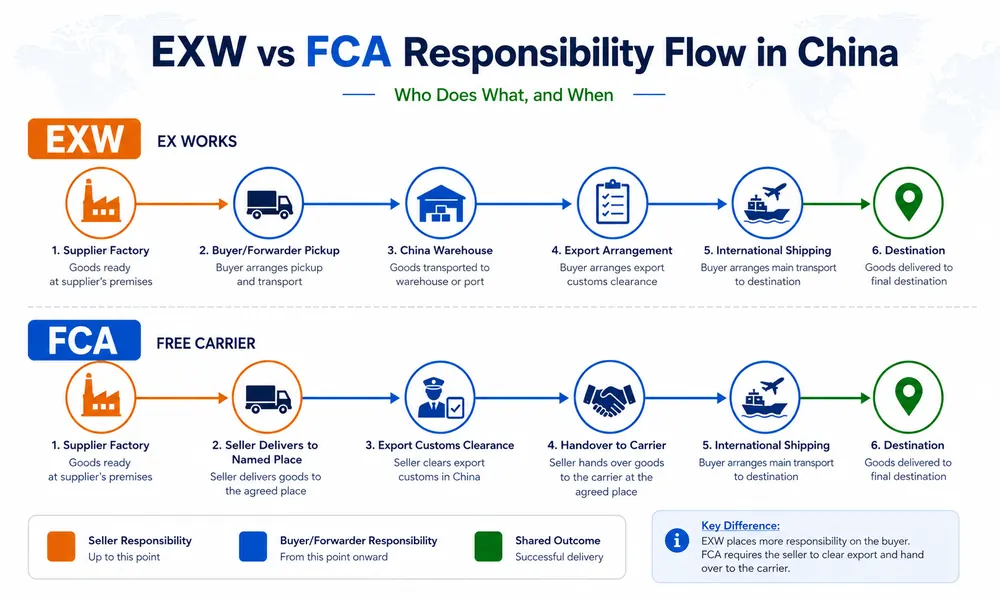
EXW vs FCA: Quick Comparison
EXW and FCA are both Incoterms® rules published by the International Chamber of Commerce. However, the practical difference for a China shipment appears before the international freight begins.
| Question | EXW | FCA |
|---|---|---|
| Where is delivery made? | Usually at the seller’s factory, warehouse or another agreed premises. | At the specifically agreed named place. |
| Who normally arranges factory pickup? | Buyer or buyer’s freight forwarder. | Depends on the FCA named place. |
| Who handles export clearance? | The seller does not clear the goods for export under EXW. The buyer must arrange the applicable export formalities. | The seller completes export clearance. |
| Who loads the collecting vehicle at seller premises? | EXW does not normally require the seller to load the buyer’s collecting vehicle. | If FCA delivery occurs at the seller’s premises, the seller loads the goods onto the buyer’s nominated collecting vehicle. |
| China local transport | Usually arranged by the buyer after the goods are made available at the EXW point. | If the agreed FCA delivery point is away from the seller’s premises, the seller is responsible for delivering the goods to that named place. Transport after the FCA delivery point is the buyer’s responsibility. |
| International freight | Buyer. | Buyer after FCA delivery. |
| Suitable for multiple suppliers? | Often useful when one forwarder collects and consolidates several EXW orders. | Possible, but each supplier needs a clearly defined FCA handover arrangement. |
| Suitable for an export-capable supplier? | Possible, but the buyer controls more of the origin process. | Often provides a cleaner export handover. |
The most important practical difference for China shipments is not the international freight. It is what happens between the supplier’s premises and the point where your freight forwarder receives the cargo under the agreed shipping arrangement.
What Does EXW Mean When Buying from China?
EXW means Ex Works. Under an EXW arrangement, the seller generally fulfils its delivery obligation by placing the goods at the buyer’s disposal at the agreed premises or other named location.
The seller does not normally have to load the goods onto the buyer’s collecting vehicle or clear them for export. Therefore, the buyer or its freight forwarder must plan the China-side movement carefully.
For an importer using a China freight forwarder, a typical operational flow may look like this:
Supplier Factory → Factory Pickup → Forwarder Warehouse → Export Arrangement → International Freight → Destination Delivery
This setup can work well when the importer wants one logistics company to arrange pickup directly from the supplier. It can also be useful when products from several factories must be collected and combined before international shipping.
However, an EXW price should not be compared with another supplier’s FCA or FOB quotation only by looking at the product invoice. Depending on the shipment, the buyer may also need to budget for local trucking, warehouse handling, export arrangements, documentation and other China-side services.
How EXW Factory Pickup Works in China
The supplier’s actual location matters because factory pickup can represent a meaningful part of the total origin cost.
For example, cargo purchased from a supplier in Yiwu but consolidated through a warehouse in South China may require significantly more domestic transport than cargo collected from a supplier close to the selected warehouse, airport or seaport.
Therefore, always provide the complete supplier address when requesting an EXW freight quotation. A city name alone is not enough for accurate pickup planning.
If your supplier is comparing a factory handover with a sea-freight port arrangement, read our detailed guide to EXW vs FOB shipping from China.
What Does FCA Mean When Shipping from China?
FCA means Free Carrier. Under FCA, the seller delivers the goods to the carrier or another person nominated by the buyer at the agreed named place. The seller also completes the applicable export clearance formalities.
This makes the FCA named place one of the most important parts of the agreement.
For example, these arrangements are not identical:
- FCA supplier factory
- FCA buyer’s freight forwarder warehouse
- FCA an agreed airport cargo facility
- FCA another specifically identified logistics point
If FCA delivery takes place at the seller’s own premises, the seller delivers the goods by loading them onto the means of transport arranged by the buyer.
If delivery takes place somewhere else, the seller transports the goods to the agreed named place and makes delivery there according to the FCA arrangement. Therefore, the actual handover location should be clearly identified in the commercial agreement.
Important: Do not treat “FCA China” as a complete logistics instruction. China is too broad. Even wording such as “FCA Shenzhen” may still create uncertainty if the parties have not identified the actual warehouse, terminal or other delivery point.
What Are the Biggest Differences Between EXW and FCA?
Who Picks Up the Cargo?
With a typical EXW factory quotation, the buyer asks its freight forwarder or another local carrier to collect the goods from the supplier. The pickup cost therefore sits outside the factory’s basic EXW product quotation.
With FCA, the answer depends on the agreed named place. If delivery is at the seller’s premises, the buyer may nominate the collecting carrier. If delivery is at another place, the seller must arrange the movement necessary to deliver the goods to that agreed point.
Who Loads the Goods?
Loading responsibility is one of the practical differences importers sometimes overlook.
Under EXW, the seller generally makes the cargo available rather than assuming responsibility for loading it onto the buyer’s collecting vehicle.
Under FCA at the seller’s premises, the seller loads the cargo onto the transport arranged by the buyer. For machinery, pallets, wooden crates, heavy cargo or shipments requiring a forklift or crane, this difference should be confirmed before pickup.
Who Handles China Export Customs?
This is usually the most important distinction for an international shipment.
Under FCA, the seller completes the export clearance requirement. Under EXW, the seller does not clear the goods for export, so the buyer must arrange the applicable export formalities.
In actual China logistics, however, the exporting entity, customs declaration arrangement, product classification and supplier’s ability to provide export documents still need to be checked.
Therefore, an importer should not assume that simply writing “EXW” or “FCA” on a purchase order automatically solves every China export issue.
Where Does Risk Transfer?
Risk transfer follows the agreed delivery point under the selected Incoterm.
With EXW, delivery generally takes place when the goods are placed at the buyer’s disposal at the agreed named premises.
With FCA, delivery occurs according to the agreed FCA delivery point and the applicable handover conditions. This is another reason why the precise named place matters.
Who Pays China-Side Charges?
An EXW supplier quotation commonly excludes most logistics costs after the goods are made available for collection. These additional costs may include pickup, domestic trucking, warehouse receiving and export-related services.
An FCA quotation may already include more seller-side work before handover. As a result, the FCA product quotation can appear higher even when its complete China-side logistics cost is competitive.
What If My Supplier Says EXW but Delivers to My Freight Forwarder’s Warehouse?
This situation is common in real China sourcing.
A supplier may tell the buyer that the commercial quotation is “EXW,” but then agree to send the cartons to the buyer’s nominated freight forwarder warehouse. That does not automatically mean the entire arrangement should still be treated as a strict factory-level EXW handover.
The parties should clarify exactly what the supplier is agreeing to do.
For example, confirm:
- Who pays the transport from the factory to the freight forwarder’s warehouse?
- Who bears the transport risk before the warehouse receives the cargo?
- Who loads the collecting vehicle?
- Who handles China export clearance?
- Is warehouse delivery included in the supplier’s price or billed separately?
If the supplier is responsible for delivering the goods to an agreed freight forwarder location and completing export clearance, an FCA arrangement may describe the actual handover more clearly than a simple EXW quotation.
However, changing the commercial term should be agreed between buyer and seller. The freight forwarder should not silently assume responsibilities that are not reflected in the commercial arrangement.
Practical takeaway: Do not focus only on the three letters shown on the supplier quotation. Confirm what the supplier will actually do before the cargo reaches your forwarder.
EXW vs FCA for China Export Customs Clearance
When shipping commercial goods internationally, China export declaration and documentation can be more important than many first-time importers expect.
A buyer may receive an EXW quotation because the factory focuses on manufacturing and does not normally arrange international export operations. Another supplier may offer FCA because it has an established exporting structure and can complete the required export formalities before handing the cargo to the buyer’s nominated freight forwarder.
When the Supplier Can Handle Export
If the supplier has the necessary export setup and can prepare compliant commercial documents, FCA can create a relatively clear handover.
The supplier clears the cargo for export and delivers according to the agreed FCA named place. The buyer’s freight forwarder then controls the next logistics stage after FCA delivery.
When the Supplier Cannot Normally Handle Export
If a factory tells you it does not normally handle export customs, do not immediately assume the goods cannot leave China.
The freight and export structure first needs to be reviewed, including the product, supplier setup, exporting entity, customs declaration method and whether the goods require any product-specific authorization.
It is also important to distinguish between a supplier that simply does not normally act as the exporting party and a product that is legally subject to a specific export license or export-control requirement. These are different situations.
If you are unsure about the China export side, review our China customs clearance guide before arranging pickup.
You can also review the Trade.gov guide to common export documents for general information about commercial invoices, packing lists and international shipping documents.
Practical rule: If the factory says “we cannot export,” ask what it actually means before changing the shipping term. The issue may be the supplier’s normal business setup, the customs declaration arrangement or a genuine product-specific regulatory requirement.
EXW vs FCA Cost: Which One Is Actually Cheaper?
EXW is not automatically cheaper than FCA. The EXW product quotation may be lower because the supplier has included fewer logistics responsibilities.
What matters to an importer is the complete cost required to move the same cargo to the same logistics handover point or final destination.
Example A: Supplier Quotes EXW
The supplier offers a lower unit price, but the importer may still need to pay for:
- Factory pickup
- China domestic trucking
- Forwarder warehouse receiving
- Carton checking or measurement
- Export-related arrangements
- International freight
- Destination customs and delivery according to the selected service
Example B: Supplier Quotes FCA an Agreed Freight Forwarder Warehouse
The supplier’s quotation may be slightly higher because the agreed FCA scope requires the seller to complete more work before handover.
For example, the supplier may need to complete export clearance and deliver the cargo to the agreed FCA location.
After FCA delivery, the buyer’s freight forwarder takes control of the next logistics stage. Depending on the real arrangement, this can reduce some China-side coordination for the importer.
The useful comparison is:
Supplier product cost + all China-side logistics required to reach the same handover point.
Do not compare only:
EXW unit price vs FCA unit price.
Instead, ask both suppliers exactly what is included before the freight forwarder receives the goods under the agreed commercial arrangement.
Why Does the FCA Named Place Matter?
The FCA named place determines where the seller must deliver the cargo and where the contractual handover to the buyer’s nominated carrier or person takes place.
This can materially change local trucking, loading, warehouse handling, risk and operational responsibility.
FCA at the Supplier’s Factory
If the named place is the supplier’s premises, the seller delivers the goods by loading them onto the collecting vehicle nominated by the buyer.
The buyer’s freight forwarder may then arrange trucking to a warehouse, airport, seaport or another logistics facility.
FCA at a Freight Forwarder’s Warehouse
The parties may instead agree that the supplier delivers the cargo to a specific freight forwarder warehouse.
This can be convenient when the buyer wants the forwarder to receive cartons, verify quantities, measure the shipment, consolidate orders or prepare cargo for international shipping.
Instead of writing only:
FCA Shenzhen
the commercial agreement should identify the actual agreed delivery point as clearly as practical.
FCA at Another Logistics Point
For selected shipments, the named place may be another agreed logistics location.
The important issue is not whether the location contains the word “port,” “airport” or “warehouse.” The important issue is that both parties understand exactly where delivery occurs and which costs and responsibilities apply before and after that point.
Before accepting an FCA quotation, ask:
- What is the exact named place?
- Who arranges transport to it?
- Who pays local handling charges before delivery?
- What documents will the supplier provide?
- Has export clearance been included?
- When does the freight forwarder take responsibility for the next transport stage?
EXW vs FCA for Air Freight, Sea Freight and DDP Shipping
EXW and FCA define the seller-to-buyer delivery arrangement at origin, while the international transport can still move by several different freight methods.
EXW with Air Freight
EXW can work well for air freight when the importer wants the freight forwarder to collect directly from the factory.
The forwarder can receive the goods, check actual weight and carton dimensions and then arrange air cargo after confirming chargeable weight and flight options.
This is particularly useful when the factory does not normally deliver to an airport cargo facility or when several supplier orders must first move to one warehouse.
For broader air-cargo planning, see our air freight from China service page.
FCA with Air Freight
With FCA, an export-capable supplier may deliver the shipment to the agreed named place and complete export clearance.
The buyer’s freight forwarder can then coordinate the main air freight after the FCA handover.
EXW with Sea Freight
EXW is commonly useful when the buyer wants the freight forwarder to control pickup, consolidation and ocean freight from China.
For LCL shipments, goods may first move from the factory to a consolidation warehouse. For FCL shipments, the forwarder can review whether the container should load at the factory or through another agreed arrangement.
Read our ocean freight from China service page for broader LCL and FCL planning.
FCA with Sea Freight
FCA can also work very well for sea freight, especially when the cargo is containerized and is handed to the carrier or terminal before it is loaded onto the vessel.
For containerized cargo handed to the carrier at a terminal before vessel loading, FCA may reflect the actual commercial handover more clearly than FOB.
Importers therefore should not automatically select FOB simply because the shipment moves by ocean. The correct choice depends on the transport mode, commercial agreement, handover point and how the seller and buyer want to divide China-side responsibilities.
EXW or FCA with DDP Delivery
Importers sometimes compare EXW and DDP as though they describe the same stage of transportation. They do not.
EXW or FCA defines the commercial delivery arrangement between seller and buyer at the origin side. A separately arranged DDP logistics service concerns a much broader shipment scope toward the destination, including the agreed customs, duty and final-delivery responsibilities.
If you want one freight plan from the Chinese supplier to the final overseas address, review our door-to-door shipping from China service.
EXW or FCA When Buying from Multiple Chinese Suppliers?
Buyers sourcing from several Chinese suppliers face a different logistics problem from buyers purchasing one shipment from one factory.
For example, an importer may purchase:
- Accessories from one supplier
- Electronic components from another supplier
- Packaging materials from a third supplier
If each factory sells EXW, the importer can nominate one China freight forwarder to coordinate pickup and send the different orders to one warehouse.
Supplier A + Supplier B + Supplier C → China Warehouse → Receiving and Checking → Consolidation → International Freight
The warehouse can identify each shipment, check carton quantity, measure the packages and consolidate the goods before export.
In this situation, EXW may give the buyer stronger control over the China-side consolidation process.
FCA can also work if each supplier has a clear export arrangement and the handover locations are coordinated properly.
The better option depends on the number of suppliers, pickup distances, cargo type, warehouse requirements and total domestic transport cost.
Common EXW and FCA Mistakes When Importing from China
1. Comparing Only the Supplier’s Unit Price
A lower EXW factory price does not necessarily create the lowest total logistics cost. Include pickup, origin handling and export-side expenses before comparing quotations.
2. Accepting an Unclear FCA Location
Terms such as “FCA China” or even “FCA Shenzhen” can be too vague for operational planning. Confirm the specific named place and the services included before signing the purchase agreement.
3. Assuming the Supplier Handles Export Customs Under EXW
Do not make this assumption. Under EXW, the seller does not normally clear the goods for export. Confirm the actual export arrangement before cargo pickup.
4. Ignoring Loading Conditions
If the cargo is machinery, pallets, wooden crates, extremely heavy cartons or oversized freight, confirm whether the factory has a forklift, loading dock or other equipment and which party is responsible for loading.
5. Ignoring the Pickup Distance
An EXW shipment collected close to the nominated warehouse and a shipment collected hundreds of kilometres away do not have the same China-side cost.
Always send the full supplier address when requesting a freight quotation.
6. Booking Before Final Carton Data Is Available
Air freight and express courier may use chargeable weight, while LCL sea freight is usually affected by volume and handling requirements.
Final dimensions and gross weight can therefore change the route recommendation and final freight cost.
7. Confusing FCA with FOB
FCA and FOB are not interchangeable labels.
If your main question concerns the difference between factory collection and FOB port responsibility, use our dedicated EXW vs FOB shipping from China guide.
8. Assuming DDP Fixes Every Origin Problem
A DDP freight quotation still depends on accurate product details, compliant documents and an executable China export process.
The destination service arrangement does not make restricted products, missing documents or incorrect export information disappear.
EXW vs FCA vs FOB: Which Shipping Term Should You Choose?
EXW, FCA and FOB can all appear in quotations from Chinese suppliers, but they serve different commercial situations.
Choose EXW When:
- You want your own freight forwarder to control factory pickup.
- You are consolidating cargo from several suppliers.
- You want goods sent first to a China warehouse.
- The supplier’s EXW price remains competitive after China-side logistics costs are added.
Consider FCA When:
- The supplier can complete export clearance.
- You can define a clear named handover place.
- You want the seller to take responsibility for more of the China-side process before handover.
- The supplier already works regularly with international shipments.
- Containerized cargo will be handed to the carrier before vessel loading.
Consider FOB When:
- The shipment moves by sea or inland waterway under an appropriate FOB arrangement.
- The seller handles the agreed origin responsibilities through vessel loading.
- You and the supplier have clearly agreed the named port and origin charges.
Do not choose by price alone. The lowest factory quotation is not automatically the lowest logistics cost.
Compare the same cargo, handover point and responsibility scope before making a purchasing decision.
For a deeper comparison between EXW and FOB, read EXW vs FOB Shipping from China: Costs, Responsibilities and the Best Choice.
Which Is Better: EXW or FCA When Importing from China?
There is no single Incoterm that is best for every China shipment.
EXW May Be Better When:
- You already work with a freight forwarder in China.
- You want pickup directly from the factory.
- You buy from several suppliers.
- You need warehouse receiving and consolidation.
- You want one forwarder to control the shipment from an early China-side stage.
- The supplier’s EXW quotation remains competitive after pickup and export-related costs are included.
FCA May Be Better When:
- You buy from one export-capable supplier.
- The supplier can complete export clearance properly.
- The FCA named place is clearly defined.
- You want fewer origin responsibilities before freight-forwarder handover.
- The supplier can deliver efficiently to your nominated logistics point.
- You want the commercial handover to match a carrier or terminal delivery more clearly.
For many first-time importers buying from one export-capable Chinese supplier, FCA can create a cleaner handover. For buyers consolidating cargo from several factories, EXW can still provide useful logistics control.
The final choice should be based on the supplier’s actual capability, cargo location, handover point and complete China-side cost rather than the Incoterm label alone.
What Information Does Your Freight Forwarder Need?
If you want to compare an EXW and FCA supplier quotation properly, your freight forwarder needs more than the Incoterm name.
Prepare the following information:
- Product name
- Product photos
- Supplier company and full pickup address
- Supplier’s EXW or FCA quotation
- Exact FCA named place if applicable
- Carton or pallet quantity
- Gross weight
- Carton dimensions
- Total CBM if available
- Cargo value and currency
- HS code if available
- Cargo-ready date
- Destination country
- Final postcode or delivery address
- Required delivery deadline
- Battery, liquid, powder, magnet or chemical information
- Brand or trademark information where relevant
- Special loading or handling requirements
With this information, the freight forwarder can compare the real China pickup cost, export arrangement, consolidation requirements and international shipping options instead of quoting from an incomplete supplier term.
Send VoltFreight Your EXW or FCA Supplier Quote
If your Chinese supplier has already quoted EXW or FCA, send VoltFreight the supplier quotation together with the pickup address, cargo details and destination postcode.
We can review the China-side responsibilities, check the practical handover arrangement and compare suitable air freight, sea freight, express or door-to-door options before you book the shipment.
Request an EXW or FCA freight quote from VoltFreight.
FAQ About EXW vs FCA Shipping from China
Is FCA Better Than EXW When Importing from China?
FCA can be easier when you buy from one Chinese supplier that can handle export clearance and deliver to a clearly agreed named place.
EXW may be more practical when you use your own China freight forwarder, require factory pickup or need to consolidate orders from several suppliers.
The better option depends on the complete China-side cost and logistics arrangement.
Who Handles Export Customs Under EXW and FCA?
Under FCA, the seller completes export clearance.
Under EXW, the seller does not normally clear the goods for export, so the buyer must arrange the applicable export formalities.
In practice, China export operations also depend on the actual supplier, exporting entity, product, customs declaration arrangement and regulatory requirements.
Is FCA Cheaper Than EXW?
Not necessarily.
An EXW supplier price often appears lower because fewer logistics responsibilities are included. FCA may include more seller-side work before handover.
Importers should compare the complete cost of getting the goods to the same logistics point rather than comparing only the product price.
Can My Freight Forwarder Pick Up EXW Goods from a Chinese Factory?
Yes. A freight forwarder can commonly coordinate pickup from an EXW supplier, provided the cargo, supplier address, pickup conditions and China export arrangement are confirmed.
Goods can also be delivered to a China warehouse for receiving, measurement, consolidation, repacking or other preparation before international transport.
What Does FCA Shenzhen Mean?
FCA Shenzhen indicates that the agreed FCA delivery point is in Shenzhen, but the wording may still be too broad for a commercial shipment.
The buyer and seller should identify the actual named place, such as an agreed warehouse or logistics facility, and confirm which local transport and handling costs apply before and after handover.
Conclusion: EXW vs FCA for Shipping from China
The practical difference between EXW and FCA is mainly about what happens before the cargo enters the international freight network.
EXW gives the buyer control from an earlier stage but can also require more China-side coordination. FCA can create a cleaner handover when the supplier completes export clearance and delivers according to a clearly defined named place.
For a buyer using several Chinese suppliers, EXW combined with warehouse consolidation may make sense. For one export-capable supplier, FCA may reduce origin-side coordination and make the commercial handover clearer.
Neither option should be selected only because the supplier’s unit price looks lower.
Before confirming the purchase order, compare the factory location, pickup cost, loading conditions, export capability, named delivery point, international freight requirements and final destination.
If you already have supplier quotations, send the EXW or FCA details to VoltFreight. We can review the shipment from China pickup through international transport and final delivery planning.
Official References
- International Chamber of Commerce — Incoterms® Rules
- Trade.gov — Common Export Documents
- General Administration of Customs of the People’s Republic of China
Important: Incoterms define commercial delivery responsibilities between buyer and seller, but they do not replace customs laws, product regulations, carrier requirements or a complete sales contract. The actual export and import arrangement should be confirmed for the specific product, parties and destination before shipment.