
If your freight forwarder says ETD Shanghai is August 10 and ETA Hamburg is September 12, those dates describe the planned movement of the shipment. If the vessel actually leaves on August 12, the ATD becomes August 12. When it finally reaches Hamburg, the actual arrival appears as the ATA.
That is the simplest way to understand the four terms:
ETD and ETA are estimated milestones. ATD and ATA record what actually happened.
These abbreviations frequently appear in ocean freight schedules, air cargo itineraries, carrier tracking systems, booking confirmations and freight-forwarder updates. Understanding them helps importers separate a planned schedule from an actual shipment event.
The same terminology can appear in both sea freight from China and air freight from China. However, always read each timestamp in the context of the specific route, location and transport stage shown by the carrier or tracking system.
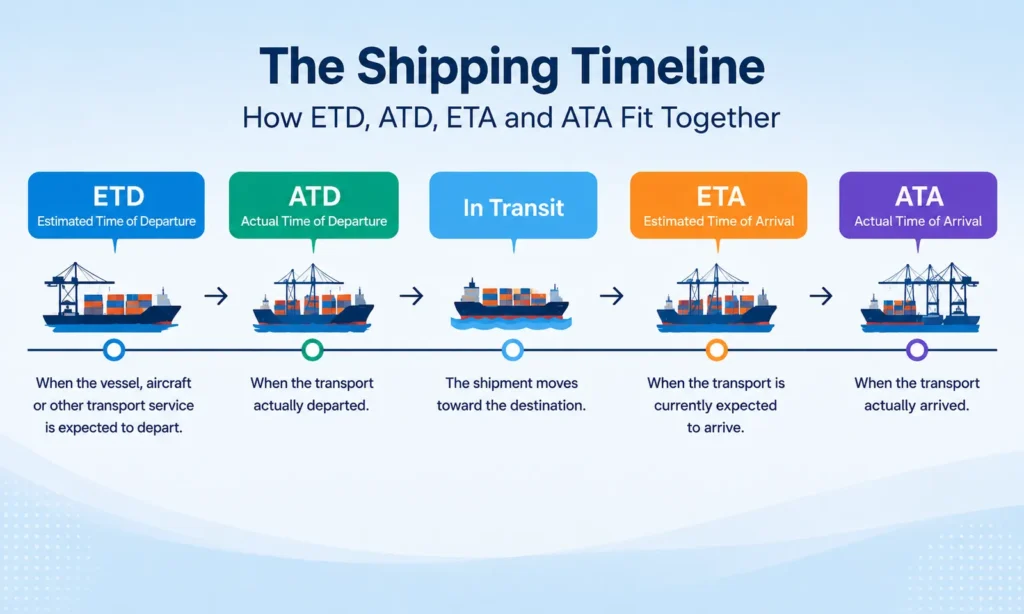
Quick Answer: ETA, ETD, ATD and ATA
| Term | Full Meaning | What It Tells You |
|---|---|---|
| ETD | Estimated Time of Departure | When the vessel, aircraft or other transport service is expected to depart |
| ATD | Actual Time of Departure | When the transport actually departed |
| ETA | Estimated Time of Arrival | When the transport is currently expected to arrive |
| ATA | Actual Time of Arrival | When the transport actually arrived |
The easiest distinction is:
ETD + ETA = planned or estimated milestones
ATD + ATA = actual milestones
An estimated date can change while the shipment is moving. An actual date records an event that has already occurred.
What Does ETD Mean in Shipping?
ETD means Estimated Time of Departure. It shows when a vessel, aircraft or other scheduled transport service is expected to leave a stated origin or intermediate point.
For example:
ETD Yantian: August 5
This means the current schedule expects the vessel to depart Yantian on August 5.
ETD is not the same as the date the supplier finishes production. It is also different from the day the cargo reaches the forwarder, airport or seaport.
Before the ETD, the shipment may still need warehouse receiving, documentation, export handling, security screening or terminal delivery, depending on the shipping method.
For air cargo, treat the cargo-ready date and airline departure schedule as separate milestones. Our air freight booking guide explains cargo-ready dates, airline space and booking preparation in more detail.
Because ETD is an estimate, the carrier may move it forward or backward when the schedule changes.
What Does ATD Mean in Shipping?
ATD means Actual Time of Departure. It records when the vessel, aircraft or transport movement actually departed.
Suppose the original schedule showed:
ETD: August 5
However, the vessel did not leave until August 7.
The shipment record may then show:
ATD: August 7
ETD tells you what the carrier expected. ATD tells you what actually happened.
The two dates may match when the service operates according to schedule. They may also differ because of weather, port or airport congestion, equipment issues, connection changes or other operational factors.
Once the actual departure occurs, the carrier or freight forwarder may update the expected arrival based on the remaining transport plan.
What Does ETA Mean in Shipping?
ETA means Estimated Time of Arrival. It shows when a vessel, aircraft or other transport service currently expects to reach a specified destination or transport point.
For example:
ETA Hamburg: September 9
This means the current transport schedule expects arrival in Hamburg around September 9.
Importers often use ETA to plan inventory, warehouse receiving and destination arrangements. However, ETA is an estimate, not a guaranteed delivery date.
The carrier may update the ETA while the shipment is in transit. For example, a vessel may depart later than planned, spend more time at a transshipment port or encounter another schedule change. As new schedule information becomes available, the tracking system may show a revised ETA.
Therefore, importers should follow the latest ETA instead of relying only on the date shown on the original booking confirmation.
What Does ATA Mean in Shipping?
ATA means Actual Time of Arrival. It records when the vessel, aircraft or transport movement actually reached the stated destination or transport point.
Suppose the latest schedule showed:
ETA: September 9
The vessel eventually arrives on September 10.
The shipment record may then show:
ATA: September 10
In this example, September 9 remains the estimated arrival date, while September 10 records the actual arrival.
One important detail often causes confusion:
ATA does not automatically mean the cargo is ready for collection or final delivery.
The vessel or aircraft may have arrived, while the shipment still needs destination processing before the importer can collect or receive it.
For this reason, importers should distinguish between the transport arrival milestone and the cargo-availability or delivery milestone.
ETA vs ETD: What Is the Difference?
ETD refers to expected departure, while ETA refers to expected arrival. In simple terms, ETD tells you when the vessel, aircraft or other transport service should leave a specified location. ETA tells you when it should reach the stated destination.
For example, a sea freight schedule may show:
- ETD Yantian: August 5
- ETA Hamburg: September 7
Both dates are estimates. After the vessel actually leaves, ATD confirms the departure. The carrier can then update the ETA as the shipment moves toward Hamburg.
Therefore, ETD answers “When is it expected to leave?”, while ETA answers “When is it expected to arrive?”.
ETA vs ATA: What Is the Difference?
The difference between ETA and ATA is estimated arrival versus actual arrival.
Before arrival, the shipment may show:
- ETA: September 9
- ATA: Not available yet
After the vessel or aircraft arrives, the shipment may show:
- ETA: September 9
- ATA: September 10
Importers use the ETA to plan around the expected arrival, while the ATA confirms when the arrival actually occurred.
A carrier may update the ETA several times during transportation. By contrast, the ATA records the actual arrival at the specific transport leg or location being monitored.
Therefore, if a tracking page changes from ETA September 7 to September 9 and then September 10, the cargo did not arrive three times. Instead, the carrier updated its expected arrival as new schedule information became available.
ETD vs ATD: What Is the Difference?
ETD and ATD follow the same logic on the departure side.
ETD tells you when departure is expected.
ATD tells you when departure actually happened.
For example:
- ETD Shanghai: August 10
- ATD Shanghai: August 12
The two-day difference means the actual departure occurred two days later than originally planned.
This does not automatically mean the final arrival will also be exactly two days late. The remaining route may recover some time, or additional changes may occur later.
For that reason, read ETD, ATD and the latest ETA together rather than simply adding the departure delay to the original ETA.
How Do ETD, ATD, ETA and ATA Work Together?
The four milestones form one simple shipment timeline:
ETD → ATD → International Transport → ETA → ATA
In practical terms:
- The carrier publishes an expected departure: ETD.
- The vessel or aircraft actually departs: ATD.
- The shipment moves toward the destination.
- The carrier shows the expected arrival and may update it: ETA.
- The transport actually arrives: ATA.
The estimated dates help importers plan. Actual dates confirm what happened.
For example, a booking may originally show:
- ETD Shenzhen: August 5
- ETA Hamburg: September 7
After departure, the carrier may update the shipment to:
- ATD Shenzhen: August 7
- Revised ETA Hamburg: September 9
When the vessel finally arrives:
- ATA Hamburg: September 10
This sequence allows the importer to see the difference between the original schedule, the actual departure and the final arrival.
Why Can ETA and ETD Change?
ETA and ETD are estimates because transportation schedules can change before or during the shipment.
Common causes include:
- Carrier schedule adjustments: A shipping line or airline changes the planned departure or connection.
- Weather: Severe weather may affect vessels, aircraft, ports or airports.
- Port or airport congestion: The transport may wait for a berth, handling position or available operational capacity.
- Transshipment or connection changes: A connecting vessel or flight may operate later than originally planned.
- Missed operational cutoff: Cargo that misses the required handover time may move on a later service.
- Operational disruption: Equipment, terminal or carrier-network issues may change the schedule.
The key point is simple: do not treat the first ETA or ETD as permanently fixed.
For time-sensitive shipments, importers should check the latest carrier or freight-forwarder status as the cargo moves through the route.
This article does not attempt to list every possible cause of shipping delays. ETA and ETD simply describe schedule milestones, while the reason behind a specific delay depends on the actual shipment and route.
ETA Does Not Mean the Cargo Is Ready for Pickup
This is one of the most important distinctions for importers.
If a vessel shows:
ETA Los Angeles: September 15
that does not necessarily mean the importer can collect the container on September 15.
Likewise, an ATA at the destination airport does not always mean air cargo can move immediately to collection.
These milestones describe different things:
- ETA: When the transport is expected to arrive.
- ATA: When the transport actually arrived.
- Cargo available: When the relevant destination facility or handling process allows the shipment to move toward collection.
- Delivery date: When the shipment actually reaches the consignee or final receiving point.
Arrival and cargo availability are therefore not interchangeable terms.
For example, a vessel may arrive on Tuesday, but the container may only become available after the required destination processing and release steps finish.
The exact process depends on the shipment and destination. For detailed information about import release procedures, use our separate customs clearance guidance rather than treating ETA as the expected customs-release date.
Where Do Importers See ETA, ETD, ATD and ATA?
Importers may see these abbreviations at several points during an international shipment.
Common sources include:
- Carrier tracking systems
- Freight-forwarder shipment updates
- Ocean booking confirmations
- Air cargo itineraries
- Vessel or flight schedules
- Pre-alert information
- Arrival information
Not every tracking system displays all four terms.
For example, one carrier may show ETD and ETA before departure and later add actual departure and arrival information. Another platform may continue displaying both the planned schedule and the latest actual timestamp.
Carriers and software platforms may also use slightly different wording. Therefore, check the location and transport leg beside each timestamp before interpreting the status.
An ETA at a transshipment port is not the same as the ETA at the final destination port. Similarly, an aircraft arriving at a connecting airport does not mean the shipment has reached its final cargo terminal.
Practical Example: Reading a Sea Freight Schedule
Consider a container shipment from Shenzhen to Hamburg.
The original booking confirmation shows:
- ETD Yantian: August 5
- ETA Hamburg: September 7
Before departure, the shipping line changes the schedule, and the vessel finally leaves Yantian on August 7.
The updated shipment status shows:
- ATD Yantian: August 7
- Revised ETA Hamburg: September 9
During the voyage, another schedule adjustment moves the expected arrival to September 10.
The vessel eventually arrives in Hamburg on September 10.
The final milestone sequence is therefore:
- ETD: August 5
- ATD: August 7
- Latest ETA: September 10
- ATA: September 10
The importer can now see that the vessel departed two days later than originally expected and that the ETA changed during transportation.
However, September 10 still represents the vessel-arrival milestone. It should not automatically be treated as the date the container reaches the importer’s warehouse.
Common Mistakes When Reading Shipping Milestones
Most confusion comes from treating estimated and actual events as if they mean the same thing.
Assuming ETA Is Guaranteed
ETA is a planning estimate. The carrier may change it as the route or schedule develops.
Confusing ETD with Cargo Ready Date
The factory may complete the cargo before the vessel or aircraft departs. These are separate operational milestones.
Ignoring an Updated ETA
The ETA on the original booking confirmation may no longer reflect the current schedule. Importers should check the latest shipment status.
Assuming ATA Means Immediate Pickup
Transport arrival and cargo availability are different events. A shipment can arrive before the terminal or warehouse makes it available for collection.
Comparing Timestamps Without Checking the Location
A shipment may pass through several ports or airports. Always confirm whether each timestamp refers to the origin, a transshipment point or the final destination.
FAQ About ETA, ETD, ATD and ATA
What is the difference between ETA and ETD?
ETD is the estimated time of departure, while ETA is the estimated time of arrival. ETD tells you when the transport should leave a stated location. ETA tells you when it should reach the stated destination.
What is the difference between ETA and ATA?
ETA is the estimated time of arrival, while ATA is the actual time of arrival. Importers use ETA for planning before arrival, while ATA confirms when the transport actually arrived.
What is the difference between ETD and ATD?
ETD is the estimated time of departure, while ATD is the actual time of departure. If a vessel is scheduled to leave on August 5 but actually leaves on August 7, the ETD is August 5 and the ATD is August 7.
Can ETA change after the shipment has departed?
Yes. The carrier may revise ETA after departure because of route changes, weather, congestion, transshipment connections or other operational factors.
Does ETA mean my cargo will be ready for pickup?
No. ETA describes the expected arrival of the transport movement. Cargo availability, release and final pickup can occur later.
Are ETA and ETD guaranteed dates?
No. They are estimated schedule milestones. ATD and ATA confirm the actual departure and arrival after those events occur.
Conclusion
ETA, ETD, ATD and ATA become much easier to understand once you separate estimated milestones from actual events.
- ETD: Estimated Time of Departure
- ATD: Actual Time of Departure
- ETA: Estimated Time of Arrival
- ATA: Actual Time of Arrival
Importers use ETD and ETA to plan around the expected schedule. ATD and ATA then confirm the actual departure and arrival.
The most important practical rule is to avoid treating ETA as a guaranteed delivery or cargo-pickup date. The transport may arrive before the shipment becomes available for collection or final delivery.
If you are shipping goods from China and need help understanding the latest freight schedule, send VoltFreight your origin, destination, cargo details and shipment information through our contact page. We can help coordinate the shipment and provide milestone updates based on the latest available carrier information.
Shipping schedules and timestamp terminology can vary slightly by carrier, route, terminal and tracking platform. Always confirm the location, transport leg and latest status shown in the actual shipment record.