Updated: August 2026.
Air freight from China to UK is a practical choice when commercial cargo is too urgent for ocean freight but too large, heavy or expensive for normal express-courier pricing. Electronics, machinery parts, fashion goods, replacement components, medical-related equipment, e-commerce replenishment and other time-sensitive inventory often move by commercial air cargo.
However, choosing air freight involves more than asking for a price per kilogram. Importers should compare the China departure airport, airline capacity, UK arrival airport, chargeable weight, transit plan, customs readiness, destination handling and airport pickup before booking.
For many shipments, London Heathrow (LHR) is the first UK airport to compare because of its international network and cargo scale. East Midlands (EMA) has become especially important for dedicated freighter and express cargo, including growing China-linked operations. Manchester (MAN) can be useful for northern England and selected regional distribution.
This page focuses specifically on commercial airport air freight. If you still need to compare air freight with sea freight, rail, truck, express, DDP or complete door-to-door delivery, use our broader shipping from China to the UK guide.
To keep the guide practical, we also include two anonymised VoltFreight shipment records. One explains why an exporter chose air freight for an urgent baby-products order with final delivery to Manchester. The other shows how VoltFreight planned a 1.5-tonne smart-home electronics shipment containing lithium batteries for London. We use these examples to explain route selection, time pressure, special-cargo review and customs preparation rather than to suggest that every shipment should use the same route.
Quick Answer: How Does Air Freight from China to UK Work?
A standard commercial air shipment begins by confirming the product, supplier city, cargo-ready date, package quantity, actual gross weight, outer dimensions and required UK airport. VoltFreight can then compare practical China gateways, available airline capacity and the most suitable UK arrival point.
For standard general cargo, a realistic planning window is often about 5–10 days from China-side receiving and export handling to UK airport availability. The aircraft movement itself can be shorter. Warehouse receiving, export customs, security screening, airline acceptance, waiting for booked capacity, flight routing and destination handling all add time around the flight.
After the shipment arrives, the UK importer or its customs agent normally completes the import declaration, arranges duty and VAT, pays destination handling charges and coordinates cargo release unless the written quotation already includes those services.
Importers that already have a GB EORI number, customs broker and local collection arrangement are often good candidates for airport-to-airport air freight from China.
Air Freight Cost from China to UK in 2026
The cost of air freight from China to UK changes according to chargeable weight, China origin, UK airport, airline space, fuel and security surcharges, cargo-ready date, product type, packaging dimensions and the service scope included in the quote.
The table below is a 2026 market-planning reference for ordinary, stackable general cargo. It is not a live VoltFreight quotation. Public market references vary widely because some quotes show only the international airline freight while others include origin handling, customs or final delivery.
| Chargeable Weight | 2026 Airport Freight Planning Range | Typical Airport Movement | Best Planning Use |
|---|---|---|---|
| 45–99 kg | Approx. USD 6.50–10.00/kg | About 3–8 business days | Urgent small commercial cargo; compare with express courier before booking. |
| 100–299 kg | Approx. USD 5.20–8.50/kg | About 3–8 business days | Commercial cartons, components, electronics and replenishment stock. |
| 300–499 kg | Approx. USD 4.50–7.50/kg | About 3–8 business days | Medium-size B2B shipments where air freight can beat courier economics. |
| 500–999 kg | Approx. USD 4.00–7.00/kg | About 4–9 business days | Denser commercial cargo with better airline weight breaks when space is available. |
| 1,000 kg+ | Approx. USD 3.80–6.50/kg | About 4–9 business days | Large general cargo; final price depends strongly on density, route and airline allocation. |
Last market review: August 2026. Use these figures only for early budgeting. Always request a dated quotation using final packed measurements before sending the cargo to the airport.
A low headline rate is not automatically the cheapest shipment. One quote may include security screening, airline terminal handling and Air Waybill fees, while another may show only the international freight line. Therefore, compare the same service boundary before choosing a forwarder.
For a broader explanation of airline pricing, surcharges and weight breaks, see our air freight rates from China guide.
Why Smaller Air Shipments Can Cost More per Kilogram
Airlines and handling agents often apply minimum charges. As a result, multiplying a 500 kg rate by 35 will not produce a reliable estimate for a 35 kg shipment. For small urgent cargo, compare commercial air freight with DHL, UPS, FedEx or another express service because integrated courier pricing may work better at low weights.
Why the Cheapest Airport Rate May Not Produce the Lowest Total Cost
A cheaper flight into a distant airport can create extra customs coordination, terminal fees or domestic trucking. For example, a Midlands importer should compare the complete cost of LHR plus road delivery with a suitable EMA option rather than comparing the airline rate alone.
What Does Airport-to-Airport Air Freight Include?
Airport-to-airport describes a transport boundary. It is not an Incoterm, and it does not automatically mean the same thing in every quotation.
China-Side Services That May Be Included
Depending on the written quote, VoltFreight can coordinate supplier pickup, warehouse receiving, consolidation, package counting, measurement, commercial-document review, China export customs, security screening, origin handling, airline booking, Air Waybill preparation, international air transportation and pre-alert documents.
UK Costs Normally Excluded Unless Added
Standard airport freight may exclude the UK customs broker, Customs Declaration Service entry, import duty, import VAT, airline or cargo-terminal handling, customs examination, storage, airport collection and domestic delivery.
These exclusions matter because a quote that looks inexpensive on departure can become costly after arrival if the importer has not planned customs release and pickup.
Airport-to-Airport vs Air DDP
Airport-to-airport air freight is normally better for established UK importers that want their own customs entry, VAT treatment and local delivery arrangement. A reviewed Air DDP service from China can provide a broader landed-delivery structure for eligible cargo, but DDP should remain a separate service model rather than being mixed into an airport freight rate.
Main China Airports for UK Air Cargo
The nearest airport to the factory is not always the best export gateway. A forwarder should compare inland trucking, available capacity, cargo acceptance, airline schedule, special-cargo restrictions and the UK destination before choosing the origin airport.
Shanghai Pudong — PVG
PVG is one of the main options for cargo from Shanghai, Suzhou, Kunshan, Hangzhou, Ningbo and the wider Yangtze River Delta. It is particularly useful for electronics, machinery components, industrial products and regular commercial cargo from eastern China.
Guangzhou Baiyun — CAN
CAN is a practical gateway for Guangzhou, Foshan, Zhongshan, Dongguan and other Pearl River Delta suppliers. Depending on capacity, cargo may move directly to the UK or through an international connecting hub.
Shenzhen Bao’an — SZX and Hong Kong — HKG
SZX is convenient for Shenzhen and Dongguan manufacturing, especially electronics and components. HKG provides a broader international cargo network and can support selected sensitive or special-cargo routings. However, mainland cargo must first move into Hong Kong, so include the trucking and handling cost when comparing the two gateways.
Beijing, Zhengzhou and Ezhou
VoltFreight may also compare PEK / PKX, Zhengzhou CGO and other Chinese gateways when supplier location or airline capacity supports the route. Ezhou Huahu Airport (EHU) has also become more relevant to UK freight as China-linked dedicated freighter services expand into East Midlands Airport.
LHR vs EMA vs MAN: Which UK Air Cargo Airport Should You Choose?
The best UK airport is not always the airport closest to the final customer. Importers should compare airline availability, destination handling, customs arrangements, road distance, warehouse receiving conditions and the total time from airport release to final delivery.
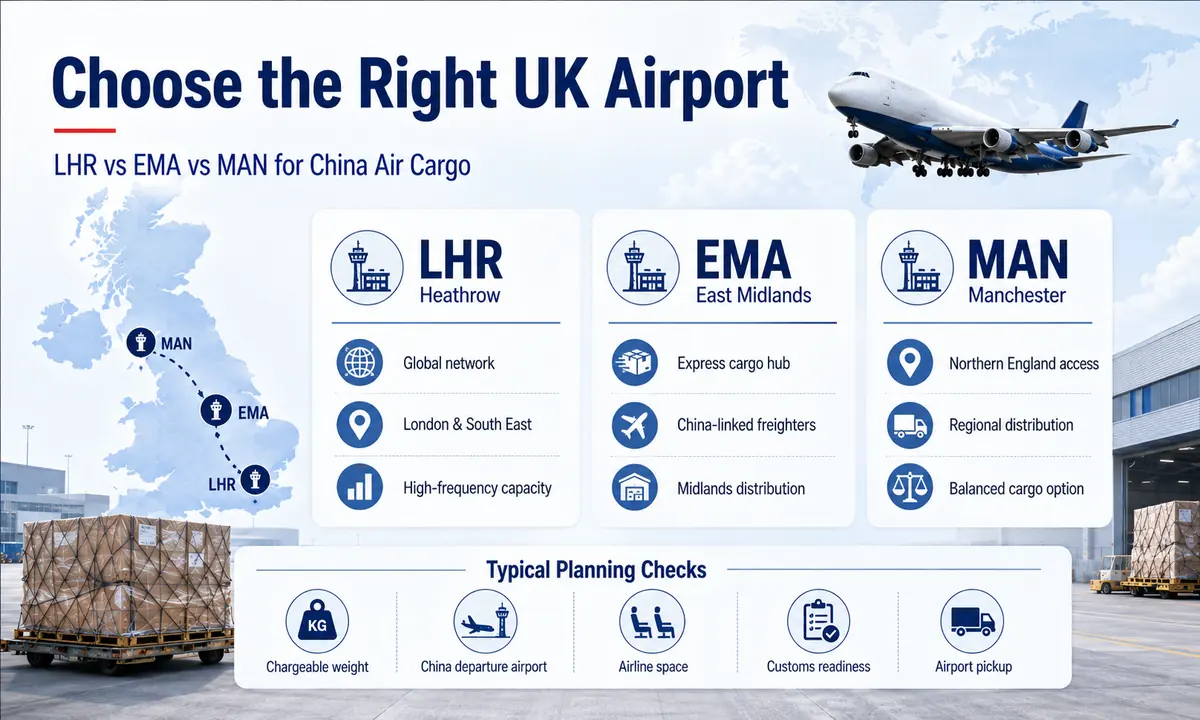
London Heathrow — LHR
Heathrow is normally the first UK gateway to compare for high-frequency international air cargo. Heathrow states that it is the UK’s largest port by value, with more than 230 destinations worldwide. In 2025, approximately 1.59 million tonnes of cargo passed through the airport and £293 billion worth of goods moved through its network.
LHR can work especially well for London, the South East, high-value cargo and shipments that benefit from a large passenger-airline network. Long-haul passenger services provide much of Heathrow’s cargo capacity, but VoltFreight still confirms the airline, aircraft and cargo acceptance for each booking.
Official reference: Heathrow Cargo.
East Midlands — EMA
EMA deserves much more attention than a simple secondary-airport mention. East Midlands Airport describes itself as the UK’s foremost express air-freight hub. It handled 413,664 tonnes during the 2025/26 financial year, up 12.5% from the previous year.
The airport is particularly interesting for China-linked cargo because dedicated freighter operations expanded significantly during 2025 and 2026. YunExpress and Central Airlines launched regular China-UK freighter services, while SF Express also developed Ezhou-to-East-Midlands operations. Schedules can change, but the expansion confirms that EMA is a genuine China-UK cargo gateway rather than only a domestic parcel hub.
EMA’s central location can also reduce the inland leg for cargo destined for the Midlands, Nottingham, Leicester, Derby, Birmingham-area distribution, selected northern warehouses and national e-commerce networks.
Official references: East Midlands Airport cargo growth and China-linked freighter operations at EMA.
Manchester — MAN
Manchester can be a practical choice for cargo destined for northern England. Manchester Airport states that it handles around 100,000 tonnes of import and export freight and mail annually and operates a 60,000-square-metre World Freight Terminal. The Far East is one of Manchester’s largest cargo markets.
For customers in Manchester, Liverpool, Leeds, Sheffield and other northern regions, a MAN routing can sometimes reduce the domestic trucking leg after customs release. However, the airline rate and available space should still be compared with LHR or EMA.
Official reference: Manchester Airport Cargo.
VoltFreight Case: Why a Baby-Products Exporter Chose Air Freight for Manchester Delivery
In one previous VoltFreight shipment, a China-based exporter had received an urgent order from a UK customer specialising in baby products. The buyer was satisfied with the supplier’s products but required faster replenishment, and the final delivery point was Manchester.
Before booking, our team first confirmed the cargo list, delivery requirement and the customer’s main concern: transit time. We then compared two practical transport plans. The first used air freight from South China with coordinated export preparation, international transport and final delivery to Manchester. By contrast, the ocean-freight alternative could reduce transport cost but could not match the required delivery speed.
After comparing both options, the exporter chose air freight because faster delivery had more commercial value than the lowest possible freight rate. VoltFreight then reviewed the available capacity and departure plan and coordinated the shipment from the China factory through the agreed UK delivery process.
Operational lesson: importers often choose air freight not because it is the cheapest mode, but because inventory urgency, customer commitments and sales timing make speed commercially valuable. The archived case record confirms Manchester as the final delivery city. Because the record does not preserve enough detail to verify the final UK arrival airport, we present this as a Manchester-delivery case rather than proof that every Manchester shipment should route through MAN.
Stansted, Birmingham, Gatwick and Other UK Airports
STN, BHX, LGW and other UK airports may support selected routings depending on airline capacity, charter activity, cargo type and final destination. Compare them case by case instead of assuming they offer the same space or price as LHR, EMA or MAN.
Air Freight Transit Time and Routing from China to UK
For commercial air cargo, the aircraft journey is only one part of the total timeline. A reliable plan should separate flight movement from cargo-ready-to-airport-availability time.
Under normal conditions, airport movement may take roughly 3–8 business days depending on the origin, UK airport, direct or connecting route and booked service. From China warehouse receiving through export handling and UK airport availability, a broader 5–10 day planning range is more realistic for many standard shipments.
Direct vs Connecting Air Freight
A direct or fewer-transfer service can reduce handling and may be preferable for urgent, fragile or high-value cargo. However, a connecting route can offer better capacity or price when direct space is tight.
Common international connections may use major hubs in the Middle East or Europe. Confirm the exact route with the booked airline instead of relying on an online schedule.
Passenger Belly Cargo vs Dedicated Freighter
This difference is especially useful when comparing UK airports. Heathrow benefits from a very large long-haul passenger network, which creates substantial belly-hold cargo capacity. East Midlands is strongly oriented toward dedicated freighter and express operations, including 24/7 cargo activity. Manchester handles both freight-only aircraft and cargo carried in passenger aircraft.
Neither model is automatically better. Dense pallets, oversized pieces, urgent e-commerce stock and special cargo may benefit from different aircraft and handling arrangements.
For airline booking preparation, cut-off and cargo-ready information, see our air freight booking from China guide.
Chargeable Weight: Actual Weight vs Volumetric Weight
Airlines normally charge according to the higher of actual gross weight and volumetric weight. Therefore, carton dimensions can be just as important as the scale weight.
A common commercial-air planning formula is:
Length × Width × Height in centimetres ÷ 6,000 = volumetric weight in kilograms
For total shipment volume, the same relationship is approximately:
1 CBM ≈ 166.7 kg volumetric weight
Example: 3.6 CBM Cargo with 480 kg Actual Weight
A shipment with a total volume of 3.6 CBM produces an estimated volumetric weight of about 600 kg:
3.6 × 166.7 ≈ 600 kg
If the actual gross weight is 480 kg, the planning chargeable weight is therefore approximately 600 kg, subject to final warehouse and airline measurements.
This is why furniture components, display equipment, lightweight machinery, plastic products and large retail cartons can cost more than expected when the importer looks only at actual kilograms.
Use our CBM and volumetric weight calculator before asking for a final quote.
UK Customs Preparation Before Your Air Cargo Arrives
Air freight moves quickly, so the UK importer should prepare the import arrangement before the cargo departs China. This section only covers customs items that directly affect an airport shipment; it does not attempt to replace a complete UK customs guide.
GB EORI and the UK Importer
HMRC states that a business importing goods into England, Wales or Scotland generally needs an EORI number beginning with GB. Northern Ireland movements can require an XI EORI under the applicable rules.
The importer should confirm the legal importer name, GB EORI, customs agent and responsibility for duty and VAT before departure. If those details remain unresolved when the flight arrives, customs may hold the cargo while the parties correct the entry.
Official reference: HMRC — UK import customs clearance.
Customs Declaration Service, Commodity Code and Documents
UK import declarations are made through the Customs Declaration Service (CDS). The importer or appointed customs agent should prepare the correct commodity code, customs value and declaration data before arrival.
A normal commercial air-freight file can include:
- Commercial invoice with accurate product description, quantity, value, currency and Incoterm
- Packing list with package count, gross weight and dimensions
- Master or House Air Waybill information
- GB EORI and importer details
- UK commodity code / HS classification
- Certificate of origin or product certificates when applicable
- Licences, UKCA / CE-related evidence or other product-compliance documents when applicable
- Battery, dangerous-goods or controlled-product documents when applicable
Import VAT and Postponed VAT Accounting
UK import VAT and Customs Duty depend on the commodity code, customs value and importer circumstances. VAT-registered UK businesses may be able to use Postponed VAT Accounting (PVA) to account for import VAT on the VAT Return rather than paying it immediately at import, provided the applicable HMRC conditions are met.
PVA is an importer tax-accounting decision, not a freight discount. The importer should confirm the intended VAT treatment with its customs agent or tax adviser before the customs agent submits the CDS declaration.
Official reference: HMRC — Postponed VAT Accounting.
UK Destination Charges, Cargo Release and Airport Pickup
After an airport-to-airport shipment lands, the consignee may still need to arrange customs brokerage, duty and VAT, airline or terminal handling, customs examination, storage, cargo release and truck collection.
Destination charges vary by airline, ground handler, airport, shipment size and time spent in the cargo facility. Therefore, the quotation should state exactly which UK charges it includes and which costs the importer still needs to pay.
Why Storage Risk Matters More with Air Freight
Air cargo reaches the UK quickly. That speed becomes a disadvantage when the importer is not ready. Missing EORI data, unclear commodity codes, compliance questions, unpaid duties or delayed broker instructions can leave cargo waiting at the terminal while storage charges increase.
Plan the Airport Pickup Before Departure
For palletised or heavy cargo, the consignee should confirm the collecting truck, vehicle size, warehouse opening hours, unloading equipment and delivery appointment before the flight arrives.
If the customer needs onward delivery after release, VoltFreight can review an airport-to-door structure instead of leaving the UK inland leg unplanned.
Batteries, Oversized Cargo and Other Special Air Freight
Standard general-cargo rates do not apply to every product. Tell the forwarder before booking if the shipment contains batteries, liquids, powders, magnets, chemicals, medical-related goods, high-value electronics, branded goods, temperature-sensitive products or oversized pieces.
Lithium Batteries
Lithium batteries can require UN38.3 information, SDS / MSDS, correct UN classification, compliant packaging, dangerous-goods documentation and airline approval. The cheapest general-cargo route may not accept the same battery shipment.
For a complete framework, see our guide to shipping batteries from China.
VoltFreight Case: 1.5-Tonne Smart Home Shipment with Lithium Batteries to London
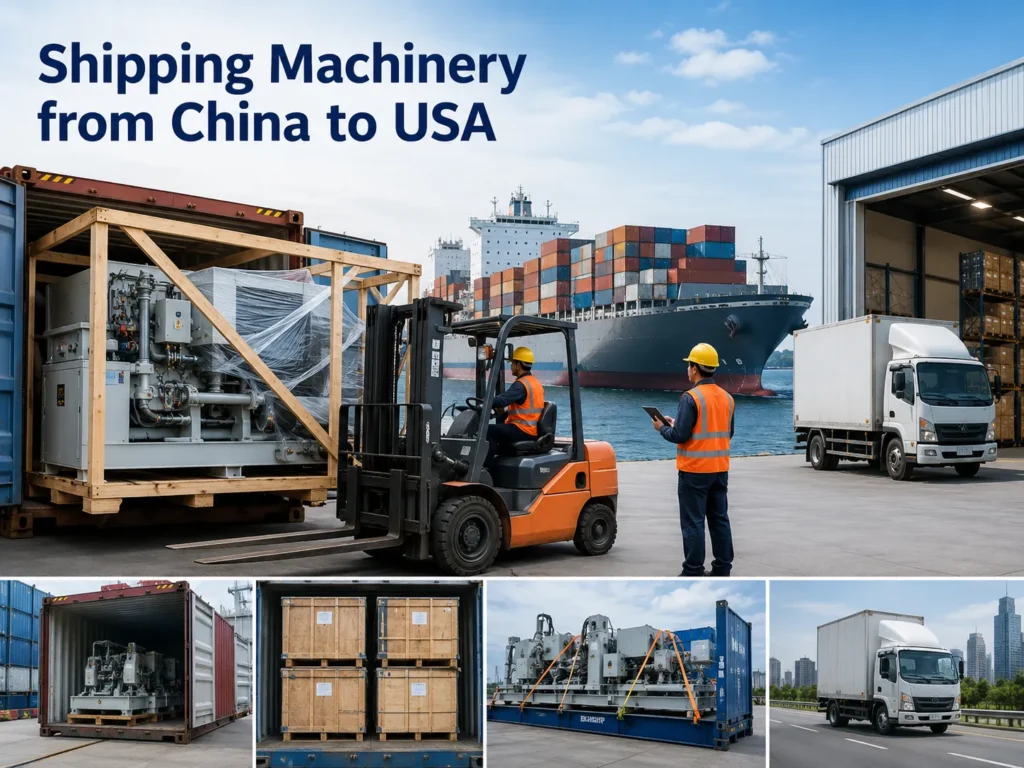
A Wuhan-based electronics company needed to move approximately 1.5 tonnes of smart-home equipment to a London warehouse for a time-sensitive product launch. Its cargo included smart locks, wireless thermostats and gateway devices, with lithium batteries contained in some products. The customer wanted factory-to-warehouse delivery within 10 days.
Battery Acceptance Review
Meeting that deadline was only part of the challenge. Battery-powered electronics require an acceptance review before they move as air cargo. Before airline booking, VoltFreight checked the battery configuration, available UN38.3 information, product and battery specifications, applicable dangerous-goods requirements and airline acceptance conditions.
The applicable IATA packing instruction depends on whether the shipper sends batteries alone, packs them with equipment or ships them contained in equipment. For that reason, VoltFreight reviewed the shipment according to its actual battery configuration instead of applying a generic battery rule.
Route, UK Customs and Delivery Result
According to the archived operating plan, the cargo moved from Wuhan through a China international gateway and onward to London Heathrow (LHR). We do not repeat the historical flight number because airline schedules, aircraft type, frequency and dangerous-goods acceptance can change. For every new shipment, VoltFreight checks the live route and available space again.
On the UK side, the importer and customs broker prepared the GB EORI, commodity-code information, commercial invoice, packing list, Air Waybill data and applicable product-compliance documents before arrival. For the smart products, the importer also reviewed the Great Britain conformity requirements relevant to the actual products, including technical documentation and CE / UKCA-related obligations where applicable.
According to the archived case record, the shipment reached the London warehouse in 8 days, two days ahead of the customer’s 10-day target. The same record notes that customs released the cargo in about six hours after the importer and broker submitted the prepared information. We do not use the historical freight rate or a fixed duty percentage as a current benchmark because air rates, commodity codes, duty treatment and service scope can change.
Operational lesson: shippers should review urgent battery-powered electronics before the cargo reaches the airline terminal. The right solution depends on the battery configuration, airline acceptance, chargeable weight, UK customs readiness and final-delivery deadline—not simply the lowest advertised price per kilogram.
Oversized, Non-Stackable and Heavy Pieces
Large machinery cases or non-stackable pallets can limit aircraft choice and create special handling charges. Before booking, provide the dimensions and weight of every piece rather than only the shipment total.
High-Value and Time-Critical Cargo
For high-value electronics, machinery parts or project-critical goods, compare freight cost with loss, damage and delay risk. A faster route can be worthwhile when a production line, launch date or customer deadline is at risk.
Review our freight insurance from China guide when appropriate.
Step-by-Step China to UK Airport Air Freight Process
- Collect the final cargo data. Confirm product name, quantity, value, package dimensions, gross weight and cargo-ready date.
- Review cargo acceptance. Identify batteries, dangerous goods, branded items, regulated products, oversized pieces or other special handling before booking.
- Confirm the UK importer. Check the GB EORI, customs agent, commodity code plan, VAT treatment and airport pickup responsibility.
- Compare the China airport and UK gateway. Review PVG, CAN, SZX/HKG or another origin against LHR, EMA, MAN or a suitable secondary UK airport.
- Receive and measure the cargo. Final warehouse data confirms actual and volumetric weight.
- Book airline space and complete China export handling. Arrange security screening, export customs, origin terminal handling and Air Waybill information.
- Send the pre-alert before arrival. The UK importer or customs agent receives the final invoice, packing list, AWB data and supporting documents.
- Complete UK customs and terminal release. The importer or broker submits the required CDS entry and arranges duty / VAT treatment.
- Collect or deliver the cargo. After customs and terminal release, the consignee collects the shipment from the airport or VoltFreight coordinates delivery under the agreed inland service.
Common Reasons China to UK Air Cargo Gets Delayed
The Final Dimensions Are Different from the Supplier Estimate
Airlines price air freight by chargeable weight. If the packed cartons are larger than the early quotation data, the airline cost can change before departure.
The Importer or GB EORI Is Not Ready
The cargo can arrive before the importer has a workable customs arrangement. Confirm the legal importer, EORI and customs agent before booking the flight.
Product Information Does Not Match the Documents
The invoice, packing list, Air Waybill and compliance documents should describe the product consistently. Vague descriptions such as “parts,” “accessories” or “samples” can create avoidable customs questions.
Special Cargo Is Identified Too Late
Review batteries, liquids, powders, magnets, oversized cases and controlled goods before requesting airline space. If the real product details appear later, the airline or forwarder may have to cancel or reroute a general-cargo booking.
The Quote Ends at the Airport but the Buyer Expected Door Delivery
Airport freight may exclude UK customs, terminal charges and final trucking. Confirm the service boundary in writing so the consignee knows who will release and collect the goods after arrival.
Why Choose VoltFreight for Air Freight from China to UK?
A useful China-to-UK air-freight forwarder should do more than send a rate sheet. The route should connect the supplier, final warehouse measurement, China export handling, airline booking, UK customs readiness and airport pickup plan before the goods fly.
The Manchester baby-products shipment and the 1.5-tonne London smart-home shipment above illustrate two different reasons air freight can be the right choice. Inventory urgency drove the first decision, while the second shipment required both speed and special-cargo planning for battery-powered electronics.
Depending on the shipment, VoltFreight can coordinate:
- Supplier pickup and China warehouse receiving
- Multi-supplier cargo consolidation
- Final weight and dimension verification
- Chargeable-weight calculation
- PVG, CAN, SZX, HKG and alternative China airport comparison
- LHR, EMA, MAN and secondary UK airport route review
- Direct and connecting airline option comparison
- General-cargo and special-cargo acceptance review
- China export customs and origin handling
- Air Waybill and pre-alert coordination
- Airport-to-airport air freight
- Reviewed airport-to-door or Air DDP alternatives when appropriate
What We Need for a Live UK Air Freight Quote
Send VoltFreight:
- Product name and clear product photos
- Supplier city or pickup address in China
- Number of cartons, pallets or cases
- Gross weight and outer dimensions of each package
- Total cargo value and currency
- Commodity / HS code if available
- Cargo-ready date
- Preferred UK airport or final delivery postcode
- Battery, liquid, powder, magnet, chemical, branded-goods or controlled-product information
- Required scope: airport-to-airport, airport-to-door, DAP or reviewed DDP
Contact VoltFreight for a current China-to-UK air freight quote.
FAQ About Air Freight from China to UK
How much does air freight from China to UK cost per kg?
For ordinary commercial airport freight, 2026 public market references commonly fall within a broad range of roughly USD 4–10/kg depending on chargeable weight, origin airport, UK gateway, airline capacity and booking date. Small shipments can cost more per kilogram, while dense cargo above 500 or 1,000 kg may receive better weight breaks. A live quotation should use final packed measurements.
How long does air freight from China to UK take?
Plan roughly 3–8 business days for airport movement in many standard cases. A broader 5–10 day range from China-side cargo receiving to UK airport availability is more realistic when origin handling and booking time are included. UK customs clearance and final delivery can require additional time.
Which UK airport is best for air cargo from China?
Heathrow LHR is normally the first gateway to compare because of its international network and cargo scale. East Midlands EMA is especially important for dedicated freighter and express cargo, including growing China-linked services. Manchester MAN can be useful for northern England. The best airport depends on airline space, destination handling and the final delivery region.
Is East Midlands Airport a real alternative to Heathrow for China cargo?
Yes. EMA is the UK’s leading express air-freight hub and has expanded regular China-linked freighter activity. It can be particularly useful for dedicated cargo aircraft, e-commerce freight and Midlands distribution. However, the final choice should still compare live airline capacity and total delivery cost.
How is air-freight chargeable weight calculated?
The airline normally compares actual gross weight with volumetric weight and charges the higher figure. A common planning formula is length × width × height in centimetres ÷ 6,000, or approximately 166.7 kg per CBM.
What does a UK importer need before airport cargo arrives?
For a standard commercial import into Great Britain, the importer should normally have the correct GB EORI, customs-agent arrangement, commodity code, invoice, packing list, Air Waybill data and duty / VAT plan ready before arrival. Product-specific certificates or licences may also apply.
Does airport-to-airport air freight include UK customs clearance?
Not automatically. Standard airport freight can exclude the UK customs entry, duty, VAT, terminal handling, storage, airport pickup and final delivery. The written quote should state the exact service boundary.
Can VoltFreight ship batteries or sensitive cargo by air to the UK?
VoltFreight can review selected batteries and sensitive products for approved air routes. Acceptance depends on the exact product, UN classification, documents, packing, airline restrictions, UK import requirements and the available service at the time of booking.
Important: Air-freight rates, airline schedules, cargo acceptance, UK customs requirements, duty, VAT treatment, airport handling and final delivery charges can change. This page is intended for freight planning. Confirm the live quotation, importer setup and product requirements before the goods leave China.