Most China–South Africa air cargo moves through Johannesburg’s O. R. Tambo International Airport, while Cape Town can be suitable for Western Cape deliveries. Durban may also be considered, although some shipments move more efficiently through Johannesburg before continuing by domestic transport.
This guide explains China to South Africa air freight rates, weight brackets, chargeable weight, transit times, departure airports, Johannesburg and Cape Town routing, customs documents, importer preparation, import VAT and airport-to-door delivery.
Need an air freight quote? Send your supplier city, product name, carton quantity, gross weight, individual carton dimensions, cargo-ready date and South African delivery city. Contact VoltFreight to compare airport-to-airport, airport-to-door and approved air DDP options.
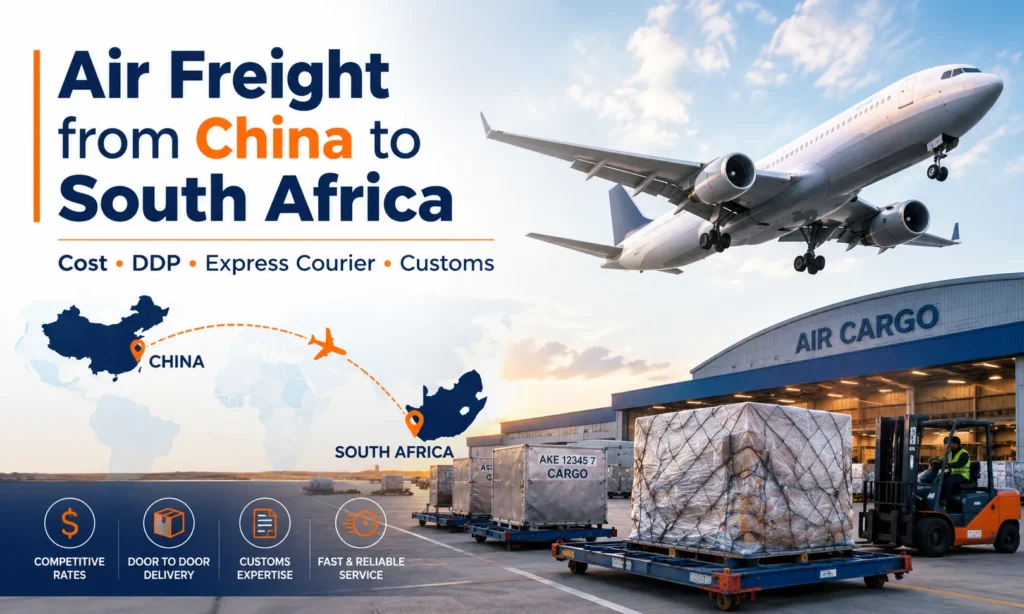
Quick Answer: How Does Air Freight from China to South Africa Work?
Air freight from China to South Africa normally begins with supplier pickup or delivery to a consolidation warehouse in China. The freight forwarder checks the cartons, calculates chargeable weight, reviews the product, confirms airline space and prepares the shipment for export.
After departure, the cargo may move on a direct flight or through an international transit hub. Once it arrives in South Africa, the importer or appointed customs broker completes customs clearance, pays the applicable duty and import VAT, and arranges collection or final delivery.
- Best suited to: Urgent commercial cargo, compact high-value goods, replenishment inventory, samples, parts and time-sensitive orders.
- Common minimum: Standard air freight often becomes practical from approximately 45 kg, although minimum airline and handling charges may apply.
- Main destination: Johannesburg O. R. Tambo International Airport, commonly identified by the airport code JNB.
- Other gateways: Cape Town CPT and selected routing through Durban DUR.
- Typical planning time: About 4–9 days airport-to-airport and approximately 7–14 days for many airport-to-door shipments.
- Pricing basis: The higher of actual gross weight and volumetric weight.
For a broader comparison of air, sea, express and door delivery, review our shipping from China to South Africa service page.
Contents
- Air freight service options
- Air cargo routes from China
- Johannesburg, Cape Town and Durban airports
- Air freight cost and weight brackets
- What an air freight quote includes
- Chargeable weight calculation
- Air freight transit time
- South Africa customs and importer preparation
- Import duty and VAT
- General and special cargo
- Air freight shipping process
- Ways to reduce air freight cost
- Why importers use VoltFreight
- Quote checklist
- Frequently asked questions
Air Freight Services from China to South Africa
Not every air freight quote covers the same steps. Therefore, importers should confirm where the service begins, where it ends, who handles customs clearance and whether final delivery is included.
Airport-to-Airport Air Freight
Airport-to-airport service covers air cargo movement from the selected Chinese departure airport to a South African destination airport. It works well for established importers that already have a South African customs broker and local delivery arrangement.
The quotation may include origin airport handling and the main air freight charge. However, South African terminal charges, customs brokerage, import duty, VAT, storage and final delivery may remain payable separately.
Airport-to-Door Air Freight
Airport-to-door service combines international air freight with destination customs coordination and local delivery. Depending on the agreed terms, the importer may still pay duty, VAT and customs-related charges directly.
This service is useful when the customer wants one logistics provider to coordinate the route but can still act as the importer and complete the required South African customs procedures.
Air DDP for Approved Cargo
Air DDP may be available for selected cargo after a product and route review. A confirmed DDP service may include China pickup, export handling, international air transport, customs coordination, duty and tax handling under the agreed service model, and delivery to the final address.
However, DDP is not automatically available for every shipment. Product classification, declared value, importer-of-record structure, customs risk, delivery city and product compliance can affect acceptance.
Batteries, liquids, powders, chemicals, cosmetics, food, supplements, branded products, high-duty goods and regulated equipment usually require additional review.
Express Courier for Small Parcels
DHL, FedEx, UPS, Aramex and other express networks can be more practical for documents, samples and small urgent parcels. Express courier usually provides integrated pickup, tracking, customs processing and delivery.
Nevertheless, courier pricing can become expensive when cartons are heavy or bulky. Once the shipment reaches approximately 45 kg, 100 kg or more, compare express rates with standard air freight instead of assuming courier will remain cheaper.
For small-parcel services, review our express freight from China page.
Main Air Freight Routes from China to South Africa
The best departure airport depends on the supplier’s location, cargo type, flight capacity, airline schedule and required delivery time. Moving cargo to the closest airport does not always produce the lowest total cost. In some cases, trucking the shipment to a larger gateway creates a better flight rate or a faster connection.
South China to South Africa
Guangzhou, Shenzhen and Hong Kong serve factories and trading companies across Guangdong. These gateways are especially useful for cargo collected from Shenzhen, Dongguan, Guangzhou, Foshan, Huizhou, Zhongshan and nearby manufacturing areas.
- Guangzhou Baiyun International Airport — CAN: A major option for general air cargo from South China.
- Shenzhen Bao’an International Airport — SZX: Convenient for Shenzhen, Dongguan and nearby suppliers.
- Hong Kong International Airport — HKG: Offers extensive international cargo capacity and can support selected sensitive or time-critical shipments after acceptance review.
VoltFreight can collect goods from multiple South China suppliers, consolidate them at a Shenzhen warehouse and compare CAN, SZX and HKG before booking.
East China to South Africa
Shanghai Pudong is the main air cargo gateway for many suppliers in Shanghai, Jiangsu, Zhejiang and the Yangtze River Delta. Cargo from Yiwu, Ningbo, Hangzhou, Suzhou, Wuxi and nearby cities may move through Shanghai or another regional airport depending on the shipment.
- Shanghai Pudong International Airport — PVG: A major international cargo hub with broad routing options.
- Hangzhou Xiaoshan International Airport — HGH: Can support selected Zhejiang and e-commerce cargo routes.
- Ningbo and Yiwu cargo: Often transferred by truck to PVG, HGH or another suitable gateway after comparing rates and schedules.
North China and Shandong
Beijing, Tianjin, Qingdao and surrounding manufacturing regions can use Beijing or Qingdao airport options. The selected route depends on the origin city, airline capacity and destination airport.
- Beijing Capital or Beijing Daxing — PEK/PKX: Suitable for Beijing, Hebei and selected North China cargo.
- Qingdao Jiaodong International Airport — TAO: Useful for cargo from Qingdao and other parts of Shandong.
- Tianjin cargo: May move through Beijing, Tianjin-area services or another gateway based on the available flight plan.
Fujian and Southeast China
Xiamen and Fuzhou can serve suppliers in Fujian, including factories in Xiamen, Quanzhou, Jinjiang and Fuzhou. Depending on the cargo, it may also be economical to transfer the shipment to Guangzhou, Shenzhen or Hong Kong.
- Xiamen Gaoqi International Airport — XMN
- Fuzhou Changle International Airport — FOC
Johannesburg, Cape Town or Durban: Which Airport Should You Use?
The lowest airport-to-airport rate does not always produce the lowest delivered cost. Importers should compare international air freight, destination handling, customs-broker availability and inland delivery before selecting a South African airport.
Johannesburg O. R. Tambo International Airport — JNB
Johannesburg is normally the first airport to compare for air cargo from China to South Africa. O. R. Tambo is South Africa’s principal international aviation hub and has substantial cargo-handling capacity.
JNB is particularly practical for:
- Johannesburg and the wider Gauteng region
- Pretoria and nearby industrial areas
- National distribution from a central inland hub
- Commercial cargo requiring broad airline and customs-broker options
- Shipments that will continue by domestic truck or air service
Even when the final destination is outside Gauteng, JNB may offer better international capacity than a smaller destination airport.
Cape Town International Airport — CPT
Cape Town can be suitable for importers, warehouses and businesses in the Western Cape. Routing cargo directly to CPT may reduce inland transport from Johannesburg, especially when the delivery address is in Cape Town or a nearby area.
However, direct or connecting capacity can vary. Therefore, compare the CPT air freight rate with the cost of flying to JNB and arranging domestic delivery.
King Shaka International Airport, Durban — DUR
Durban can support selected KwaZulu-Natal shipments. Nevertheless, not every China–South Africa air cargo route offers the same capacity or rate to DUR.
Depending on the airline and shipment, cargo for Durban may arrive through JNB before moving by domestic transport. Importers should compare the complete delivery plan rather than only the destination airport code.
Delivery to Other South African Cities
Airport-to-door delivery can be arranged to Pretoria, Durban, Port Elizabeth/Gqeberha, Bloemfontein, East London and other cities where service is available. Remote locations, farms, mines, construction sites and residential addresses may require additional delivery planning.
Air Freight Cost from China to South Africa
Air freight rates from China to South Africa change with airline capacity, fuel costs, season, cargo density, route, product acceptance and chargeable weight. As a result, no forwarder can provide a reliable final rate using only the destination country.
The following ranges are planning references for ordinary general cargo moving to Johannesburg. They are not fixed tariffs and may exclude China pickup, customs brokerage, duty, VAT, storage and final delivery.
Reference rate review: July 2026. Always request a current quotation before booking.
| Chargeable Weight | Indicative Standard Air Freight Range | Recommended Comparison | Planning Notes |
|---|---|---|---|
| Under 45 kg | Minimum charge or parcel quotation | Compare express courier and standard air freight | Airline, terminal and handling minimums can make small air cargo expensive. |
| 45–99 kg | Approximately USD 8.00–12.50/kg | Compare +45 kg air rate with express | Product type and carton dimensions have a strong effect on the quotation. |
| 100–299 kg | Approximately USD 7.00–11.50/kg | Standard consolidated air freight | This is a common range for commercial cartons and urgent stock. |
| 300–499 kg | Approximately USD 6.50–10.50/kg | Compare airlines and transit schedules | The unit rate may decrease, but volumetric weight still applies. |
| 500–999 kg | Approximately USD 6.00–10.00/kg | Air cargo spot quotation | Flight capacity, density and pallet configuration become increasingly important. |
| 1,000 kg or more | Request a live spot rate | Compare direct, transit and split-shipment options | Large shipments may qualify for a negotiated airline rate. |
The final air freight cost per kilogram may be higher for low-density cartons, hazardous cargo, batteries, liquids, powders, high-value goods, oversized pieces and shipments requiring temperature control or special handling.
Airport-to-door and air DDP prices also include additional service elements. Therefore, do not compare an airport-to-airport rate with a delivered DDP quotation as though they cover the same work.
What Is Included in an Air Freight Quote?
A very low air freight rate may cover only the airline charge between two airports. Before comparing quotations, ask each forwarder to identify included and excluded charges.
Possible Origin Charges in China
- Supplier pickup or domestic trucking
- China warehouse receiving
- Carton measurement and weight verification
- Consolidation from multiple suppliers
- Export customs declaration
- Security screening
- Airport terminal handling
- Air waybill preparation
- Palletizing, wooden packing or repacking
Main Air Freight Charges
- International airline freight
- Fuel surcharge
- Security surcharge
- Transit or transfer handling where applicable
- Dangerous-goods or special-handling surcharge where applicable
Possible Destination Charges in South Africa
- Airport terminal handling
- Document release charges
- Customs brokerage
- Import duty
- Import VAT
- Customs inspection or examination charges
- Storage caused by delayed clearance
- Airport collection
- Final delivery to the consignee
- Tail-lift, residential, remote-area or appointment delivery charges
Ask whether the quotation follows airport-to-airport, airport-to-door, DAP, DDU or DDP terms. In addition, confirm who acts as the importer, who appoints the customs broker and who pays duty and VAT.
How Is Air Freight Chargeable Weight Calculated?
Airlines compare actual gross weight with volumetric weight and normally charge the higher figure. Therefore, large lightweight cartons may cost more than expected even when their physical weight is low.
Common air freight volumetric-weight formula:
Length × Width × Height in centimetres ÷ 6,000
Example 1: Lightweight but Bulky Carton
A carton measures 60 × 50 × 40 cm and weighs 12 kg.
60 × 50 × 40 ÷ 6,000 = 20 kg volumetric weight
Because 20 kg is higher than the 12 kg actual weight, the chargeable weight is 20 kg.
Example 2: Compact Heavy Carton
A carton has the same dimensions but weighs 27 kg.
The volumetric weight remains 20 kg. However, the actual weight is higher, so the chargeable weight is 27 kg.
What Else Can Increase Chargeable Weight?
- Oversized cartons with unused internal space
- Pallets added after the first quotation
- Wooden cases or protective frames
- Non-stackable cargo
- Irregularly shaped pieces
- Minimum airline chargeable-weight rules
- Dimensions rounded according to carrier rules
Send the dimensions and gross weight of every carton rather than only the total CBM. This allows the forwarder to check chargeable weight, handling limits and packing efficiency correctly.
Air Freight Transit Time from China to South Africa
Flight time is only one part of the complete air freight schedule. Supplier pickup, warehouse receiving, booking, export customs, destination clearance and final delivery all affect the total transit time.
Typical Airport-to-Airport Planning Range
Standard air freight often requires approximately 4–9 days from cargo handover and booking to arrival and release readiness. A direct or faster connection may reduce the schedule, while a transit route can take longer.
Typical Airport-to-Door Planning Range
Many airport-to-door shipments require approximately 7–14 days. Customs questions, inspections, missing importer documents and remote delivery can extend the schedule.
Typical Timeline Breakdown
- Supplier pickup: Usually 1–2 working days, depending on the factory location.
- Warehouse receiving and measurement: Normally completed after all cartons arrive.
- Airline booking and export preparation: Often 1–3 working days.
- International flight and transit: Commonly around 3–5 days, depending on routing.
- South Africa customs clearance: Often 1–3 working days when documents are complete and customs does not inspect the shipment.
- Final delivery: Commonly 1–3 working days after release, depending on the city and delivery conditions.
What Can Delay Air Cargo?
- Peak-season flight capacity
- Public holidays in China or South Africa
- Incomplete commercial invoices
- Unconfirmed HS classification
- Missing importer registration or permit
- Customs inspection
- Airline rejection of sensitive cargo
- Incorrect battery, liquid or powder declarations
- Late duty and VAT payment
- Remote or appointment-based delivery
South Africa Customs Clearance and Importer Preparation
South African customs clearance falls under the South African Revenue Service, commonly known as SARS. Commercial importers should prepare the importer structure, product classification and supporting documents before the cargo departs China.
In general, local or foreign parties that import commercial goods into South Africa need the appropriate importer registration. A foreign importer also needs to nominate a qualifying registered agent located in South Africa.
Personal imports may follow different rules and exemptions. However, importers should not use personal-import procedures for regular commercial cargo without confirming eligibility.
Common Air Freight Documents
- Commercial invoice: Shows seller, buyer, product description, quantity, unit value, total value, currency, origin and transaction terms.
- Packing list: Shows carton quantity, contents, net weight, gross weight and dimensions.
- Air waybill: Identifies the shipper, consignee, airports, cargo and transport details.
- HS code: Supports duty calculation, VAT treatment and product-control checks.
- Importer information: Includes the importer’s registered details and appointed customs representative where required.
- Import permits: Required for certain controlled or regulated products.
- Product certificates: May apply to electronics, telecommunications equipment, medical-related goods, food, cosmetics, chemicals and other regulated products.
- Dangerous-goods documents: May include an MSDS, UN38.3 test summary, dangerous-goods declaration or product-specific transport report.
Use Specific Product Descriptions
Avoid vague invoice descriptions such as “accessories,” “parts,” “sample,” “gift” or “general goods.” Instead, describe the product, material and function clearly.
For example, “plastic accessories” may be too vague. A stronger description would be “injection-moulded ABS plastic protective covers for electronic control panels.”
Accurate descriptions help the customs broker review the HS code and reduce unnecessary questions.
Customs Clearance Is Not Automatically Included
Standard airport-to-airport air freight does not normally include South African customs clearance, duty, VAT or final delivery unless the quotation states otherwise.
Airport-to-door service may include customs-broker coordination but still require the importer to pay duty and VAT. Air DDP follows a different scope and needs approval before booking.
For broader document support, review our customs clearance services.
South Africa Import Duty and VAT
Import duty depends on the product’s tariff classification and cannot be calculated accurately from weight or cargo value alone. Two products with similar values may have different duty rates because they fall under different HS codes.
South Africa applies a standard VAT rate of 15% to imported goods. For many imports, SARS calculates VAT using an added tax value rather than applying 15% only to the supplier invoice.
For detailed SARS duty rates, 15% VAT and customs-value calculations, review our guide to import duties from China to South Africa.
General import VAT formula published by SARS:
[(Customs value + 10% of customs value) + non-rebated customs duty] × 15%
Illustrative VAT Calculation
Assume the customs value is ZAR 100,000 and non-rebated customs duty is ZAR 10,000.
- Customs value: ZAR 100,000
- 10% uplift: ZAR 10,000
- Non-rebated duty: ZAR 10,000
- Added tax value: ZAR 120,000
- VAT at 15%: ZAR 18,000
This example only illustrates the formula. The actual customs value, duty rate, rebates and VAT treatment depend on the product and import declaration.
Before shipping, confirm:
- The correct HS code
- The applicable customs duty
- Whether an import permit or certificate applies
- The customs value and Incoterm
- Who pays duty and VAT
- Whether the importer can claim input VAT
What Goods Are Suitable for Air Freight?
Air freight works best when delay costs more than the difference between air and sea transportation. It is especially useful for compact products with high value, urgent demand or limited inventory.
Common General Cargo
- Automotive spare parts
- Machine components
- Electronic parts and accessories
- Computer and telecommunications accessories
- Fashion items and seasonal inventory
- Product samples and prototypes
- E-commerce replenishment stock
- Promotional products
- Industrial tools
- Replacement parts needed to prevent production delays
- High-value compact commercial goods
Cargo Requiring Additional Review
Airlines apply stricter acceptance rules than ordinary road or sea transport. Therefore, tell the forwarder about sensitive characteristics before requesting a final quotation.
- Lithium batteries and power banks
- Battery-powered equipment
- Liquids, gels, creams and oils
- Powders and chemical materials
- Magnets and strongly magnetic goods
- Aerosols and compressed gas
- Flammable products
- Cosmetics and beauty products
- Food, supplements and medical-related products
- Branded or trademark-sensitive goods
- High-value cargo
- Oversized or non-stackable pieces
- Temperature-sensitive products
Lithium Batteries
Lithium batteries fall under air-transport dangerous-goods requirements. Acceptance depends on battery chemistry, watt-hour rating, lithium content, packing configuration and whether the battery ships separately, packed with equipment or installed in equipment.
The forwarder or airline may request:
- Battery model and specification
- UN number
- UN38.3 test summary
- MSDS or safety data
- Battery quantity per package
- Watt-hour rating
- Packaging photos
- Dangerous-goods declaration where applicable
Do not describe battery-powered products as ordinary general cargo. Undeclared batteries can lead to airline rejection, return costs and serious compliance problems.
Liquids, Powders and Chemicals
Liquids and powders are not automatically dangerous goods, but airlines need enough information to classify them. Provide an MSDS, ingredient details, product photos, packaging method and intended use.
Some products can move through an approved air cargo route. Others may need a dangerous-goods service or sea freight instead.
China to South Africa Air Freight Process
Step 1: Send Cargo and Delivery Information
Provide the product name, photos, supplier city, number of cartons, dimensions, gross weight, declared value, cargo-ready date and destination. Disclose batteries, liquids, powders, magnets, chemicals and brands.
Step 2: Select the Route and Service Scope
VoltFreight compares the suitable Chinese departure airport, South African destination airport, airline schedule and delivery model. At this stage, we also clarify whether the quote is airport-to-airport, airport-to-door or an approved DDP service.
Step 3: Collect or Receive the Cargo
The supplier can deliver the goods to our China warehouse, or we can arrange pickup. When several suppliers are involved, we can receive and consolidate their cartons before export.
Step 4: Check Weight, Dimensions and Packing
Our warehouse checks the shipment data and calculates chargeable weight. We can also review carton condition, shipping marks and packing suitability.
If the cartons contain excessive empty space, repacking may reduce volumetric weight. Fragile, heavy or irregular cargo may need a pallet, wooden case or stronger protection.
Step 5: Prepare Export Documents and Book the Airline
The shipper prepares the commercial invoice and packing list. Meanwhile, the forwarder arranges export declaration, security screening, terminal handling and airline booking.
Sensitive cargo only moves after document and airline-acceptance review.
Step 6: Air Transport to South Africa
The shipment departs on the confirmed route and may travel directly or through a transit hub. Tracking milestones vary between consolidated air freight, direct air waybill shipments and courier services.
Step 7: South Africa Customs Clearance
The importer or appointed broker submits the declaration, responds to customs questions and arranges payment of duty, VAT and other charges. If customs selects the cargo for inspection, clearance will take longer.
Step 8: Collection or Final Delivery
After customs releases the shipment, the consignee can collect it from the agreed facility or arrange delivery to the final address. Delivery requirements should be confirmed before booking, particularly for residential, remote, mine-site or appointment deliveries.
How to Reduce Air Freight Cost from China to South Africa
Reduce Empty Carton Space
Air freight charges large lightweight cartons by volumetric weight. Ask the supplier to use cartons that fit the products properly and avoid unnecessary empty space.
Compare Several China Departure Airports
The nearest airport is not always the cheapest. For example, cargo from Dongguan may use SZX, CAN or HKG depending on the product and flight rate. Likewise, Yiwu cargo may move through PVG or HGH.
Consolidate Multiple Suppliers
Combining small shipments can reduce repeated pickup, handling and minimum-charge costs. However, the forwarder should verify all products before mixing them into one export shipment.
Provide Accurate Carton Data Before Booking
An estimate based only on total weight can change after warehouse measurement. Obtain the final carton quantity, dimensions and gross weight before confirming the freight budget.
Separate Urgent and Non-Urgent Inventory
You do not need to ship every product by air. Send urgent or high-margin stock by air while moving bulk replenishment by sea.
This split-shipment strategy can protect sales while controlling the overall logistics cost. For larger non-urgent cargo, compare our sea freight from China to South Africa via Durban options.
Avoid Customs and Document Errors
Incorrect invoices, vague descriptions and missing importer documents can create airport storage charges. Preparing the customs information before departure is often cheaper than correcting it after arrival.
Book Before the Deadline Becomes Critical
Emergency bookings reduce routing flexibility. When possible, allow the forwarder to compare direct and transit services instead of requiring the first available flight at any cost.
Why Choose VoltFreight for China–South Africa Air Cargo?
VoltFreight supports international importers that buy from factories, trading companies, wholesale markets and multiple suppliers across China.
Supplier Pickup Across China
We can collect cargo from Shenzhen, Dongguan, Guangzhou, Foshan, Yiwu, Ningbo, Shanghai, Suzhou, Qingdao, Xiamen and other supplier locations.
Shenzhen Warehouse Consolidation
Customers purchasing from several suppliers can send goods to our warehouse for receiving, carton checking, consolidation and export preparation.
Chargeable-Weight Verification
We check actual weight, carton dimensions and total volume before finalizing the shipment. This helps identify differences between supplier data and warehouse measurements.
Route and Airline Comparison
Instead of using one fixed route, we compare departure airport, airline capacity, transit schedule, product acceptance and destination requirements.
Airport-to-Airport and Airport-to-Door Options
We can coordinate standard air cargo for importers with their own customs broker or provide a broader airport-to-door solution where available.
DDP Review for Suitable Cargo
For approved general cargo, we can review whether an air DDP route is available. Confirmation depends on the product, declared value, customs structure and final delivery address.
Commercial Invoice and Packing-List Review
We can identify missing product descriptions, carton discrepancies and other obvious document issues before departure. However, the shipper and importer remain responsible for accurate commercial information and legal compliance.
Sensitive-Cargo Screening
Before booking, we review whether batteries, liquids, powders, chemicals, magnets, cosmetics, branded goods and other special products require additional documentation or a different route.
Cargo Insurance Options
Air freight moves quickly, but loss and damage risks still exist. Cargo insurance can be reviewed based on shipment value, product type and coverage requirements.
Information Needed for an Accurate Air Freight Quote
Send the following information to avoid an inaccurate estimate:
- Supplier city and pickup address in China
- Product name in English
- Product material and intended use
- Clear product photos
- HS code, if available
- Number of cartons
- Dimensions of each carton
- Gross weight of each carton
- Total gross weight and total CBM
- Whether cartons can be stacked
- Whether the cargo uses pallets or wooden cases
- Commercial invoice value and currency
- Incoterm with the supplier, such as EXW or FOB
- Cargo-ready date
- Preferred destination airport
- Final delivery city, postcode and address type
- Whether the consignee has South African importer registration
- Whether a customs broker has already been appointed
- Required delivery deadline
- Battery, liquid, powder, chemical, magnet or dangerous-goods details
- Brand and trademark information
- Any required permits or product certificates
Send these details through our freight quotation form. We will compare the available air freight route and explain what the quotation includes.
FAQ About Air Freight from China to South Africa
How much is air freight from China to South Africa per kilogram?
As a broad planning reference, standard general air cargo above 45 kg may cost approximately USD 6.00–12.50 per chargeable kilogram. Smaller shipments, special cargo and urgent services can cost more. The rate depends on the weight bracket, dimensions, departure airport, destination airport, airline capacity and product type.
This range normally does not represent an all-inclusive DDP price. Customs brokerage, duty, VAT and final delivery may be separate.
How long does air freight from China to South Africa take?
Standard airport-to-airport air freight commonly requires about 4–9 days, while many airport-to-door shipments require approximately 7–14 days. These ranges include planning time beyond the flight itself but cannot guarantee customs-clearance speed.
Should I ship to Johannesburg or Cape Town?
Johannesburg JNB is usually the first option to compare because it is South Africa’s main international cargo gateway and supports inland distribution. Cape Town CPT can be better for Western Cape deliveries when the direct or connecting air rate is competitive.
The correct choice depends on the combined international freight, terminal, customs and final delivery cost.
What is the minimum weight for standard air freight?
Airlines and handlers may apply minimum charges rather than one universal minimum weight. In commercial freight planning, importers often begin comparing standard air cargo with courier services at approximately 45 kg.
For shipments below 45 kg, DHL, FedEx, UPS, Aramex or another express channel may be simpler. Nevertheless, bulky cartons can still make a standard air quotation worth checking.
Does air freight include customs clearance, duty and delivery?
Not automatically. Airport-to-airport air freight usually ends at the destination airport and does not include import duty, VAT or final delivery.
Airport-to-door service can include customs coordination and delivery, but the importer may still pay taxes and official charges. Approved air DDP service follows a different scope and must be confirmed before booking.
Conclusion: Plan the Complete Air Freight Route
Air freight from China to South Africa provides a useful balance between speed and cost for urgent commercial shipments. It is particularly suitable for replacement parts, electronics, e-commerce inventory, samples, seasonal products and compact high-value goods.
However, the cheapest rate per kilogram does not always produce the lowest final cost. Importers should compare chargeable weight, Chinese departure airport, destination airport, customs scope, duty, VAT and final delivery.
Johannesburg JNB is normally the main gateway to compare, while Cape Town CPT can work well for Western Cape deliveries. Durban and other cities may require connecting transport after the international flight.
Before booking, prepare accurate carton dimensions, product descriptions, invoice values and importer information. In addition, disclose batteries, liquids, powders, chemicals and branded goods so the forwarder can confirm cargo acceptance.
For an air freight quote from China to South Africa, contact VoltFreight with your cargo and delivery information. We will compare standard air freight, airport-to-door delivery, express courier and approved air DDP options based on the actual shipment.
Official Information Sources
- South African Revenue Service — Importer Registration
- South African Revenue Service — Duties and Taxes for Importers
- South African Revenue Service — Customs Tariff Information
- Airports Company South Africa — O. R. Tambo International Airport
- IATA — Dangerous Goods Guidance Documents
Important: Freight rates and transit times are planning references only. Airline capacity, fuel surcharges, customs requirements, cargo acceptance and delivery conditions can change. Confirm the final rate, route and service scope before dispatching the goods.