Import duties from China to South Africa do not follow one universal percentage. The customs duty rate depends on the South African tariff classification, customs value, country of origin and any additional measures that apply to the product. In addition, SARS calculates most commercial imports with South Africa’s 15% import VAT by using an Added Tax Value rather than only the supplier invoice.
What Should You Confirm Before Importing?
For goods originating in China, the import VAT calculation normally includes the customs value, a 10% customs-value uplift and any non-rebated duties. Moreover, certain products may attract ad valorem excise duty, anti-dumping duty, countervailing duty, safeguard duty or an import-permit requirement. Therefore, confirm the HS code, customs value and importer arrangement before paying a supplier or booking freight.
This guide focuses specifically on South Africa customs duty, import VAT, customs valuation, importer registration, permits and landed-cost planning. Meanwhile, the main route page and the dedicated shipping-time and lowest-cost guides cover transport selection in more detail. For a full comparison of sea freight, air freight, express and door delivery, review our shipping from China to South Africa service page.
Need a shipping and landed-cost review? First, send VoltFreight the product name, material, function, HS code if available, invoice value, supplier city, package details and South African delivery address. Then contact VoltFreight so we can review the logistics information required for a practical quotation.
Quick Answer: How Much Import Duty Will You Pay?
In practice, there is no single import-duty rate for all goods shipped from China to South Africa. Some tariff lines are duty-free, while others use an ad valorem percentage, a specific duty based on quantity or weight, or another tariff structure. The correct rate comes from the product’s South African tariff code and the current Customs and Excise Tariff.
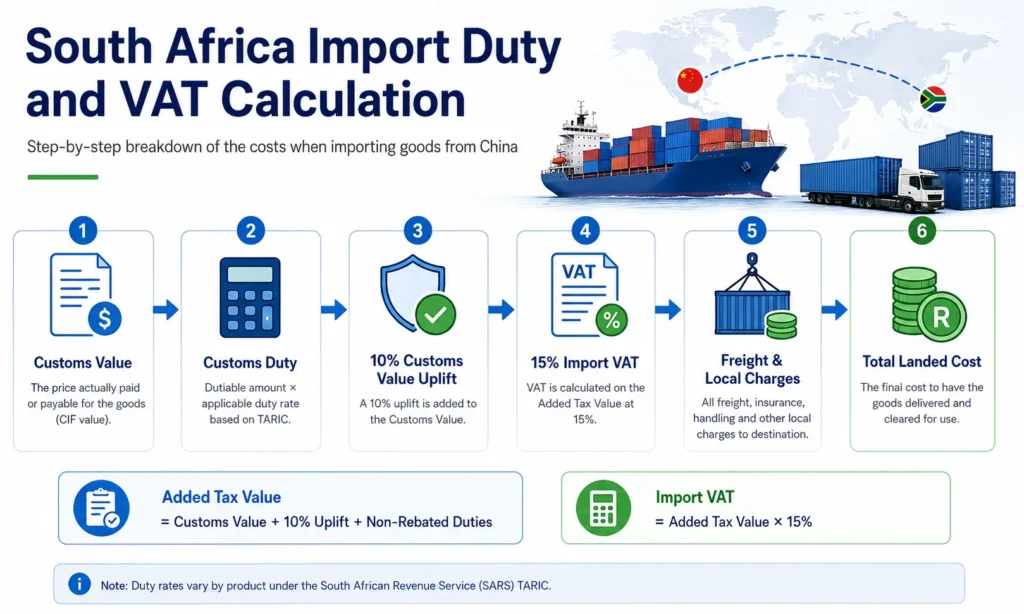
Therefore, use the following order for a basic calculation:
- Determine the product’s South African tariff classification.
- Confirm the customs value under South Africa’s valuation rules.
- Apply the customs-duty rate and any additional non-rebated duties.
- Calculate the Added Tax Value.
- Apply the 15% VAT rate to the Added Tax Value.
- Add freight, insurance, broker fees, destination charges and final delivery to calculate landed cost.
For goods from China, the simplified import VAT formula is:
[(Customs Value + 10% of Customs Value) + Non-Rebated Duties] × 15% = Import VAT
The 10% uplift normally applies because China is outside the Southern African Customs Union. However, the final calculation still depends on the accepted customs value, applicable duties, rebates and the declaration entered with South African Customs.
What Charges Can Apply When Importing into South Africa?
Import duty and VAT are not the only possible costs. Therefore, separate customs taxes from commercial clearance and delivery charges. This distinction shows what you pay to the government and what service providers charge.
| Charge or Requirement | What Triggers It | How to Check It | Planning Treatment |
|---|---|---|---|
| Customs Duty | The product’s tariff heading, origin and applicable rate | SARS Schedule 1 and the final South African tariff classification | Normally part of the permanent landed cost |
| Import VAT | Importation of goods, subject to exemptions and VAT rules | SARS Added Tax Value formula and customs declaration | A qualifying VAT vendor may be able to deduct it as input tax |
| Ad Valorem Excise Duty | Selected products listed in the tariff schedules | SARS Schedule 1, including the relevant excise or ad valorem part | Usually a non-recoverable import cost |
| Anti-Dumping, Countervailing or Safeguard Duty | Specific products, origins, exporters or trade-remedy measures | SARS Schedule 2 and current ITAC measures | Can materially increase landed cost |
| Import Permit | Controlled goods, including many used or second-hand goods | ITAC import-control lists and product-specific authorities | Secure it before import when the rules require it |
| Broker and Destination Charges | Customs entry, terminal handling, inspection, storage and delivery | Customs broker, terminal, carrier and final-delivery quotation | Commercial charges rather than customs taxes |
A product with a zero ordinary duty rate may still create import VAT, broker charges, permit costs or trade-remedy exposure. By contrast, a product with a high duty rate can become unprofitable even when the international freight cost is low. Therefore, compare the full landed cost instead of only the supplier price or freight rate.
How Is South Africa Import VAT Calculated?
South Africa’s standard VAT rate is 15%. For imported goods, SARS applies the rate to the Added Tax Value, commonly shortened to ATV.
For goods imported from outside the Customs Union, SARS presents the calculation as:
Customs Value + 10% of Customs Value + Non-Rebated Duties = Added Tax Value
Added Tax Value × 15% = Import VAT Payable
SARS uses the 10% amount as an uplift for the VAT calculation. It is not a second customs-duty rate. In addition, SARS calculates the uplift on the customs value, not on the final selling price in South Africa.
“Non-rebated duties” means duties that remain payable after any valid rebate or relief. Depending on the goods, this amount may include ordinary customs duty and other duties included in the customs assessment.
Importers sometimes apply 15% directly to the Chinese commercial invoice. That shortcut can understate the VAT because it ignores the customs value adjustment and duty component. Conversely, using the full door-to-door cost as the VAT base without reviewing the customs valuation can also produce an inaccurate estimate.
For the official formula and current guidance, refer to the SARS duties and taxes for importers page and the SARS import VAT FAQ.
Worked Example: Duty, VAT and Landed Cost in South African Rand
The following example is for planning only. It assumes that the customs broker has already confirmed the customs value and duty rate. It does not suggest that every product has a 10% customs-duty rate.
Example assumptions:
- Accepted customs value on an FOB basis: R100,000
- Illustrative customs-duty rate: 10%
- International freight and insurance: R20,000
- Broker and destination handling: R5,000
- Final delivery: R7,000
Step 1: Calculate Customs Duty
R100,000 × 10% = R10,000 customs duty
Step 2: Calculate the 10% Customs-Value Uplift
R100,000 × 10% = R10,000 uplift
Step 3: Calculate the Added Tax Value
R100,000 customs value + R10,000 uplift + R10,000 non-rebated duty = R120,000 ATV
Step 4: Calculate Import VAT
R120,000 × 15% = R18,000 import VAT
Step 5: Calculate Customs Duty and VAT Payable at Import
R10,000 customs duty + R18,000 import VAT = R28,000
Step 6: Estimate the Total Landed Cost
R100,000 customs value
+ R20,000 international freight and insurance
+ R10,000 customs duty
+ R18,000 import VAT
+ R5,000 broker and destination handling
+ R7,000 final delivery
= R160,000 estimated landed cost
As a result, this example separates the FOB customs value from international freight and avoids counting the same cost twice. Furthermore, a VAT-registered importer that qualifies to deduct the R18,000 as input tax may analyse its net commercial cost differently. However, a South African tax professional should confirm that VAT treatment, while the importer should keep the required customs documents.
How Does SARS Determine Customs Value?
Customs value is not automatically the same as the number printed on a supplier invoice. South Africa applies a hierarchy of valuation methods, with transaction value as the primary method when its conditions are satisfied.
Under the transaction-value method, the starting point is the price actually paid or payable for the imported goods. Nevertheless, customs may adjust the declared value to include costs, charges or items required by the valuation rules.
South Africa retains an FOB basis for customs valuation. In practical terms, costs up to the port or place of export can form part of the customs value. For example, under EXW terms, the importer may need to add inland transport, export packing and other costs that move the cargo to the Chinese port or place of export.
By contrast, do not add international freight from the Chinese export point to South Africa to customs value as a blanket rule. The customs broker must review the Incoterm, invoice, freight breakdown and actual transaction documents.
The following factors can require additional attention:
- EXW, FOB, CIF or other Incoterms used on the purchase;
- China inland freight and export handling;
- Packing costs and packing materials;
- Assists supplied by the buyer;
- Royalties or licence fees connected to the goods;
- Buying or selling commissions;
- Related-party transactions;
- Discounts that customs may ask the importer to substantiate;
- Proceeds of later resale that return to the seller.
If the transaction does not qualify for the transaction-value method, customs may move through the other valuation methods in the required order. For official guidance, see the SARS customs valuation page.
How Do You Find the Correct HS Code and Duty Rate?
Importantly, the HS code determines far more than the ordinary customs-duty rate. It can also affect VAT treatment, import permits, trade-remedy duties, statistical reporting, rebates and product compliance.
A Chinese supplier’s export code can be a useful starting point. However, it is not automatically the final South African tariff classification. South Africa may require a more detailed tariff subheading or interpret the product differently based on its material, construction, principal function and intended use.
Use the following process before a large order:
- Identify the product precisely. Avoid descriptions such as “parts,” “accessories” or “equipment.”
- Confirm the material and composition. Plastic, steel, aluminium, textile and electrical products may enter different chapters.
- Explain the function and user. A component can be classified differently according to the machine or system it serves.
- Review technical documents. Product photos, specifications, catalogues and manuals help support classification.
- Check the current South African tariff. Use the latest Schedule 1 rather than an old blog or supplier rate.
- Obtain professional confirmation. For repeated, high-value or uncertain imports, ask a licensed customs broker or consider a formal tariff determination.
The SARS Tariff Book separates normal customs duties, excise duties, ad valorem duties, anti-dumping duties and countervailing duties into different schedules. Therefore, checking only the first six HS digits may not reveal the complete South African import treatment.
Use the SARS tariff page and the current Schedules to the Customs and Excise Act when reviewing the rate.
Can a VAT-Registered Importer Claim Import VAT Back?
A South African VAT vendor may be entitled to deduct VAT paid on imported goods as input tax when the goods are imported in the course of making taxable supplies and the statutory requirements are satisfied.
This does not mean every importer receives an automatic cash refund. Instead, a qualifying vendor can generally include the import VAT as input tax in the relevant VAT return, subject to the importer’s business activity, timing and documentary evidence.
SARS links the deduction to the tax period when customs releases the goods under the Customs and Excise Act. The vendor must also hold the required supporting documentation, including the relevant customs release message and a valid bill of entry or prescribed customs document.
However, the importer may lose part or all of the deduction when:
- The importer does not hold VAT registration;
- The business uses the goods for exempt supplies;
- The business uses the goods privately or outside taxable activities;
- The customs documents name a different importer from the vendor claiming the deduction;
- The importer lacks the required customs release or entry documents;
- The DDP structure does not provide the buyer with acceptable import evidence;
- Apportionment rules limit the deductible portion.
This point is especially important for VAT-registered companies comparing DDP with importer-controlled clearance. A quote may include VAT, yet the buyer may be unable to deduct that VAT if another party imports the goods under its own customs registration.
For detailed tax requirements, consult the SARS VAT 404 Guide for Vendors and a South African tax adviser.
Do You Need a South African Importer Code?
Commercial importers should confirm their customs registration before the goods leave China. SARS states that local and foreign persons importing goods into South Africa must register as importers, subject to limited exceptions such as qualifying personal imports.
A South African company importing in its own name normally uses its own customs importer registration. It then declares the customs entry, tariff classification, customs value, duty and VAT under its own responsibility.
A foreign importer can also register. However, SARS requires a foreign importer to nominate a registered agent located in South Africa before SARS completes the foreign importer registration.
A registered agent and a licensed clearing agent are not necessarily the same role:
- Registered agent: A South African person or entity that acts for a foreign principal under the customs-registration framework.
- Licensed clearing agent: A customs service provider that prepares and submits clearance declarations.
- Importer of record: The party legally identified as the importer and responsible for the customs declaration.
Before booking, confirm:
- Whose importer code will appear on the declaration;
- Whose VAT number will be connected to the import;
- Who accepts tariff-classification and valuation responsibility;
- Who receives the release message and customs declaration;
- Who pays duty, VAT and customs-related charges;
- Whether a foreign importer needs a registered agent;
- Whether the appointed broker has all supporting documents.
For registration information, see the SARS importer-registration page and the SARS registered-agent page.
Which Goods Need Import Permits or Additional Duties?
Not every product requires an ITAC import permit. However, importers must check controlled goods before shipment, while import-control measures broadly cover used or second-hand goods.
Examples that deserve early review include:
- Used or second-hand machinery, electronics, vehicles and equipment;
- Waste, scrap and certain recyclable materials;
- Selected chemicals and industrial substances;
- Tyres and automotive-related products;
- Steel, aluminium and other metal products;
- Textiles, footwear and clothing categories under specific measures;
- Agricultural, food, animal or plant products regulated by other authorities;
- Medical, wireless, electrical or safety-regulated products;
- Goods subject to anti-dumping, countervailing or safeguard duties.
Nevertheless, a category appearing in this list does not mean every item in that category needs a permit or additional duty. Instead, the exact tariff code, product condition, origin, manufacturer and current measure must be checked.
Anti-dumping duties can be particularly significant because they may apply only to a defined product scope, country, manufacturer or exporter. Consequently, importers should not rely on a generic percentage from an old article.
Check the ITAC import-control page, the current SARS tariff schedules and any product-specific regulator before the supplier dispatches the goods.
What Documents Are Needed Before Shipping from China?
Consequently, customs planning should begin before cargo pickup. Once the goods arrive in South Africa, missing permits, weak product descriptions or mismatched values can cause storage, examination and amendment costs.
Prepare the following information:
- Commercial invoice: Seller, buyer, product name, material, function, quantity, unit value, total value, currency, origin and Incoterm.
- Packing list: Carton or pallet quantity, dimensions, net weight, gross weight, CBM and shipping marks.
- Bill of lading or air waybill: Transport details that match the commercial shipment.
- HS code support: Product specifications, photos, catalogue, material details and intended use.
- Importer information: Importer code, VAT number, registered address and customs representative details.
- Proof of transaction: Purchase order, contract, proof of payment or other value evidence when requested.
- Freight and insurance breakdown: Useful for confirming the valuation point and avoiding duplicated costs.
- Import permit: ITAC or another authority’s approval where the product is controlled.
- Product compliance documents: Test reports, certificates, registrations or approvals where applicable.
- MSDS and transport documents: Required for certain batteries, liquids, powders and chemicals.
- Certificate of origin: Where required for customs, trade measures or another regulatory purpose.
Invoice descriptions should state the goods’ materials and functions clearly. For example, “aluminium control-panel housing for industrial machinery” is more useful than “metal parts.”
For practical document coordination, review our customs clearance support page.
DDP vs Importer-Controlled Customs Clearance
A DDP quotation can simplify budgeting because the seller or logistics provider coordinates a broader delivered scope. Nevertheless, the importer should not judge DDP only by whether the quotation says “tax included.”
Before accepting a DDP service, ask:
- Who will act as the importer of record?
- Whose importer code and VAT number will appear on the customs declaration?
- Are ordinary customs duty and 15% import VAT included?
- Are anti-dumping, excise or safeguard duties included if they apply?
- Who obtains an ITAC or product permit?
- Will the South African buyer receive the customs release and entry documents?
- Can a VAT-registered buyer use the import VAT as input tax?
- Are customs examinations, storage and document amendments excluded?
- Does the quotation include final delivery, appointment and unloading?
By contrast, importer-controlled clearance may be better when the South African buyer has an importer code, VAT registration, customs broker and established compliance process. In that structure, the buyer usually has clearer control over tariff classification, valuation, customs evidence and VAT treatment.
DDP may be practical for eligible cargo when the buyer wants one coordinated delivery plan. However, importers should not use DDP to underdeclare goods, bypass permits or hide the importer arrangement.
The best option depends on the product, buyer’s tax position, shipment value and required customs documents.
How Does Shipping Cost Affect Landed Cost?
At the same time, shipping cost remains part of the commercial landed cost even when customs value excludes part of it. Air freight, sea freight, express and door-to-door services create different freight, handling, broker and delivery costs.
Therefore, this article does not attempt to rank those transport methods because that search intent belongs to other pages. Use the following guides for route decisions:
- Complete shipping options from China to South Africa
- China-to-South-Africa shipping time
- Cheapest shipping from China to South Africa
For this duty page, the important point is to separate:
Customs value used for duty
Import VAT calculated through the ATV formula
Freight, broker, destination and delivery charges used for total landed cost
Without this separation, an importer may count freight twice, omit local charges or compare a port-to-port quote with a tax-inclusive door-to-door quote as though they were equivalent.
Pre-Order Duty and VAT Checklist
Before paying the deposit to a Chinese supplier, use the following checklist:
- Complete product description
- Materials and components
- Principal function and intended use
- Proposed South African tariff code
- Current ordinary customs-duty rate
- Ad valorem excise applicability
- Schedule 2 anti-dumping, countervailing or safeguard measures
- ITAC or other import-permit requirement
- Confirmed importer of record
- Valid SARS customs registration
- Declared customs value and Incoterm
- Separate China inland and international freight costs
- Estimated 15% import VAT under the ATV formula
- Buyer’s eligibility to claim input tax
- Documents supporting the VAT deduction
- Broker, terminal and local delivery charges
- Exclusions in the DDP or door-to-door quotation
- Total landed cost per unit
Therefore, this checklist is more useful than asking only, “What percentage tax will I pay?” The final decision depends on classification, customs value, VAT position, freight and local operating cost together.
How VoltFreight Helps with South Africa Import Planning
VoltFreight is a freight forwarder rather than a South African tax adviser. Nevertheless, we can help importers prepare the logistics and product information that the customs broker needs before completing the final declaration.
For example, our support may include:
- Collecting goods from factories and trading companies in China;
- Receiving and consolidating cargo from multiple suppliers;
- Checking carton quantity, outer packaging, dimensions and gross weight;
- Reviewing whether the commercial invoice and packing list are consistent;
- Requesting clearer product names, materials and intended-use descriptions;
- Comparing the supplier’s proposed HS code with available product information;
- Separating China pickup, export handling, freight and destination charges;
- Coordinating air freight, sea freight, express or door-to-door quotations;
- Clarifying DDP and importer-controlled customs responsibilities;
- Identifying batteries, liquids, powders, brands and controlled products that need additional review;
- Coordinating with the importer or customs broker before cargo departure;
- Planning final delivery to Johannesburg, Pretoria, Durban, Cape Town and other South African destinations.
To receive a useful review, send:
- Product photos and specifications;
- Product name, material and function;
- HS code if available;
- Commercial value and Incoterm;
- Supplier city and pickup address;
- Carton or pallet quantity;
- Dimensions, gross weight and total CBM;
- Battery, liquid, powder, chemical or brand information;
- South African city, postcode and full delivery address;
- Importer code and VAT status when relevant;
- Preferred customs and delivery arrangement.
Request a China-to-South-Africa shipping and landed-cost review.
FAQ About Import Duties from China to South Africa
How much is import duty from China to South Africa?
There is no single rate for every Chinese product. The duty depends on the South African tariff code, customs value, origin and any additional measures. Some tariff lines are duty-free, while others use percentage or specific rates. Check the current SARS tariff before shipment.
How is the 15% import VAT calculated?
For goods from China, the simplified formula is: customs value plus 10% of customs value plus non-rebated duties. SARS then applies the 15% VAT rate to that Added Tax Value.
Is international freight included in South Africa customs value?
South Africa uses an FOB basis for customs valuation. Customs may include costs up to the port or place of export. By contrast, do not automatically add international freight after that point without reviewing the Incoterm and valuation documents. Ask the customs broker to confirm the final treatment.
Can a VAT-registered importer claim import VAT?
A qualifying VAT vendor may deduct import VAT as input tax when the goods support taxable supplies and the vendor satisfies the timing and documentary requirements. The importer should hold the relevant customs release and entry documents, and the customs declaration should support the vendor making the claim.
Do I need an importer code in South Africa?
Commercial importers generally need SARS customs registration. A foreign importer must register and nominate a registered agent located in South Africa. Limited exceptions can apply to qualifying personal imports, but businesses should confirm registration before shipping.
Does DDP include customs duty and VAT?
It depends on the written quotation. A DDP-style offer should list each included item, including ordinary duty, import VAT, additional duties, permits, customs examination, storage and final delivery. The buyer should also confirm who acts as importer and whether the buyer receives documents needed for VAT treatment.
Final Thoughts
Importers should calculate duties from China to South Africa before making a purchase decision, not after the cargo arrives. The importer first needs the correct South African tariff classification and a defensible customs value. Next, the importer must calculate duty, the 10% customs-value uplift and 15% import VAT. Finally, add freight, broker charges, destination costs and delivery to reach the true landed cost.
A low supplier price does not guarantee a profitable import. Similarly, a low freight quotation does not guarantee a low landed cost. Permits, anti-dumping duties, VAT documentation and importer registration can be more important than the headline shipping rate.
Before booking, confirm the HS code, customs value, importer of record, VAT position, permit status and DDP scope with the relevant South African professionals. VoltFreight can then help organise the China-side pickup, freight data, document coordination and delivery quotation around that confirmed customs plan.
Official Information Sources
- South African Revenue Service: Duties and Taxes for Importers
- South African Revenue Service: How VAT Is Calculated on Imported Goods
- South African Revenue Service: Customs Valuation
- South African Revenue Service: Customs Tariff
- South African Revenue Service: Schedules to the Customs and Excise Act
- South African Revenue Service: Importer Registration
- South African Revenue Service: Registered Agents
- South African Revenue Service: VAT 404 Guide for Vendors
- International Trade Administration Commission: Import Control
Important note: This guide is for logistics and import-planning information only. It is not legal, customs or tax advice. Duty rates, VAT treatment, customs valuation, importer registration, permits, trade-remedy measures, rebates and documentary requirements can change. Always confirm the final tariff code, customs value and tax treatment with SARS, ITAC, a licensed South African customs broker and a qualified tax adviser before shipment.