Updated: August 30, 2026.
Air freight from China to Nigeria is one of the fastest practical options for urgent commercial cargo, electronics, spare parts, machinery components, fashion goods, samples and time-sensitive inventory that cannot wait for ocean freight.
However, the airline rate per kilogram is only one part of the shipment. Importers should also compare chargeable weight, departure airport, airline routing, Nigerian arrival airport, destination handling and the exact service scope. Accordingly, importers should prepare customs documents and product approvals before departure because air cargo can reach Lagos faster than they can correct missing import information.
For most commercial cargo, Lagos Murtala Muhammed International Airport (LOS) is the first Nigerian gateway to compare. In addition, importers can consider Abuja (ABV), Port Harcourt (PHC) and Kano (KAN) when the final destination, airline capacity and customs plan support the route.
This page focuses specifically on commercial air cargo from China to Nigeria. If you still need to compare air freight with sea freight, express, DAP, DDP or complete door-to-door shipping, use our broader shipping from China to Nigeria guide.
Quick Answer: How Does Air Freight from China to Nigeria Work?
August 2026 planning answer: Importers can generally budget approximately USD 4.80–9.00/kg for standard commercial air freight from China to Nigeria, depending on chargeable weight, origin airport, airline capacity and cargo type. Allow approximately 5–10 days from China-side handling to Nigerian airport availability under normal conditions. Lagos LOS is normally the first gateway to compare.
A standard commercial air shipment starts by confirming the final cargo weight, package dimensions, product type, supplier location, Nigerian destination and importer readiness. VoltFreight can then compare suitable China airports, airline capacity and the Nigerian arrival airport before the airline confirms space.
For China to Lagos air freight, cargo may depart from Guangzhou CAN, Shenzhen SZX, Hong Kong HKG, Shanghai PVG or another suitable Chinese gateway. The airline may offer a direct flight when capacity allows; however, one-stop services through major transit hubs are also common.
After arrival, the Nigerian importer or appointed clearing agent normally handles customs entry, duty and tax, regulatory approvals, terminal charges and cargo release unless the written quotation clearly includes these services.
For the broader service structure, review our air freight services from China.
Air Freight Cost from China to Nigeria
The cost of air freight from China to Nigeria depends on chargeable weight, China departure airport, Nigerian destination airport, airline capacity, cargo-ready date, package dimensions, product type and the service scope.
The table below provides an August 2026 market-planning reference for standard general cargo. VoltFreight compiled the ranges from recent market checks and general-cargo spot enquiries. Accordingly, use them for planning rather than as a live quotation. The figures exclude Nigerian customs clearance, duties, terminal charges and final delivery unless the table specifically states otherwise.
| Route / Shipment Size | August 2026 Planning Rate | Planning Time to Airport Availability | Planning Notes |
|---|---|---|---|
| Guangzhou CAN → Lagos LOS, 45 kg+ | Approx. USD 6.30–8.50/kg | About 5–8 days | Common South China route for standard commercial cargo. |
| Shanghai PVG → Lagos LOS, 100 kg+ | Approx. USD 6.20–8.00/kg | About 5–8 days | Useful for Shanghai, Jiangsu, Zhejiang and eastern China cargo. |
| Shenzhen / Hong Kong → Lagos LOS, 45–100 kg+ | Approx. USD 6.50–9.00/kg | About 5–9 days | Often reviewed for South China electronics and special-cargo options. |
| Large general cargo, 500 kg+ | Approx. USD 4.80–7.00/kg | About 5–9 days | Final rate depends heavily on airline allocation, density and booking date. |
Timing note: These planning times cover China-side handling through Nigerian airport availability. Supplier pickup, Nigerian customs clearance, terminal release and final delivery can add additional time.
What Does the Published Air Freight Rate Include?
These figures describe the main airport freight market. For this reason, do not compare them directly with quotations that include Nigerian customs clearance, duties, airport handling or Lagos door delivery.
For example, a local Nigeria service may quote a much higher USD/kg figure because its rate also includes clearance or local delivery. Accordingly, the important question is not simply “What is your rate per kg?” but “What exactly does this rate include?”
For airline pricing, surcharges and weight breaks, see our air freight rates from China guide.
Need a dated airline rate? Send the product name, package quantity, gross weight, dimensions, supplier city, cargo-ready date and Nigerian destination. Request a live China-to-Nigeria air freight quote.
What About Small Shipments Below 45–100 kg?
Small commercial shipments can be expensive per kilogram because airlines, terminals and forwarders may apply minimum charges. As a result, do not estimate a 30 kg shipment by multiplying a 500 kg airline rate by 30.
For small urgent cargo, compare commercial air freight with DHL, UPS, FedEx or another express service before booking.
Airport-to-Airport vs Air + Clearance vs Air DDP
Nigeria air-freight quotations can look very different because the service boundaries are not always the same.
Airport-to-Airport Air Freight
Established Nigerian importers can use this model when they already have importer records, a customs broker or clearing agent and a local airport pickup arrangement.
The quotation may include China export handling and the international air movement to the agreed Nigerian airport. Nigerian import clearance, duty, tax, terminal charges, storage and delivery normally remain with the importer unless included in writing.
For a detailed explanation, see our airport-to-airport air freight service.
Air Freight Plus Nigerian Clearance Support
Some importers want the international freight together with destination customs coordination. In this structure, the quotation should separate or clearly identify the airline freight, Nigerian clearance charges, government or airport charges and delivery scope.
Air DDP or Door-to-Door
For eligible cargo, a reviewed Air DDP route can combine pickup, export handling, international air freight, agreed customs and tax handling and final delivery. However, DDP does not remove Nigerian import requirements. Consequently, the forwarder and importer should still review the product type, HS code, Form M status, PAAR, SONCAP, controlled-product approvals and final delivery location before booking.
For the wider landed-service structure, see Air Freight DDP from China.
Main China Airports for Nigeria Air Cargo
The nearest airport to the factory is not always the best airport. VoltFreight compares supplier location, domestic trucking, cargo acceptance, available airline space and Nigerian destination before selecting the export gateway.
Guangzhou Baiyun Airport — CAN
CAN is often a practical gateway for cargo from Guangzhou, Foshan, Dongguan, Zhongshan and the wider Pearl River Delta. As a result, importers commonly consider CAN for general commercial cargo moving to Lagos.
Shenzhen Bao’an Airport — SZX
SZX can be convenient for electronics, components and industrial goods produced in Shenzhen and Dongguan. Nevertheless, compare its rate and capacity with Guangzhou and Hong Kong before booking.
Hong Kong International Airport — HKG
HKG can provide additional international airline and special-cargo options. However, mainland cargo must first move into Hong Kong, so importers should compare the total trucking, handling and airline cost.
Shanghai Pudong Airport — PVG
PVG can serve suppliers in Shanghai, Suzhou, Kunshan, Hangzhou, Ningbo and other eastern China manufacturing regions.
Other Chinese Gateways
In addition, VoltFreight can review Beijing PEK / PKX, Zhengzhou CGO, Ezhou EHU and other airports when the cargo, airline schedule and destination support the route.
LOS vs ABV vs PHC vs KAN: Which Nigerian Airport Should You Choose?
Choose the Nigerian airport according to the complete logistics route, not simply the airport nearest to the customer.
Lagos — Murtala Muhammed International Airport (LOS)
LOS is normally the first airport to compare for air freight to Lagos Nigeria. The Federal Airports Authority of Nigeria identifies Murtala Muhammed International Airport as Nigeria’s busiest airport. FAAN also confirms that MMIA has dedicated cargo facilities with separate access and cargo-handling operations.
For many importers in Lagos and southwestern Nigeria, LOS provides the clearest combination of international cargo connectivity, clearing-agent availability and inland distribution.
Official references: FAAN — Murtala Muhammed International Airport and FAAN — MMIA Cargo Operations FAQ.
Abuja — Nnamdi Azikiwe International Airport (ABV)
ABV serves Nigeria’s federal capital. For this reason, importers can consider it for cargo destined for Abuja and central Nigeria. Compare an ABV route with LOS plus inland trucking before deciding.
Official reference: FAAN — Nnamdi Azikiwe International Airport.
Port Harcourt — PHC
PHC can be commercially important for cargo supporting Rivers State, the energy industry and industrial projects. Urgent valves, controls, electrical parts, machinery components and project spares may justify comparing a PHC route with LOS plus road delivery.
Official reference: FAAN — Port Harcourt International Airport.
Kano — Mallam Aminu Kano International Airport (KAN)
Importers can consider KAN for northern Nigeria. However, Lagos may offer more international cargo capacity and routing options. Accordingly, confirm KAN space and handling before the supplier dispatches the goods.
Official reference: FAAN — Mallam Aminu Kano International Airport.
Air Freight Transit Time and Routing from China to Nigeria
Under normal conditions, importers can often plan approximately 5–10 days from China-side handling through Nigerian airport availability for standard commercial airport-to-airport cargo.
The actual aircraft movement may be shorter. The 5–10 day planning range allows for warehouse receiving, export customs, airline acceptance, space confirmation, flight routing and arrival handling. Nigerian customs clearance and final delivery can add additional time.
Typical Transit Hubs
China-to-Nigeria air cargo does not always move on a nonstop flight. Depending on the airline and available capacity, common transit hubs can include:
- DXB — Dubai
- DOH — Doha
- ADD — Addis Ababa
- IST — Istanbul
Forwarders commonly consider Emirates SkyCargo, Qatar Airways Cargo, Ethiopian Airlines Cargo and Turkish Cargo on this trade lane. However, routes and cargo acceptance change. Consequently, a quotation should show the planned service and name a carrier only after the airline confirms space.
Direct vs Connecting Service
A faster or lower-handling route may be preferable for urgent, fragile or high-value cargo. A connecting service can offer better capacity or pricing but introduces another transfer stage.
For airline space, cut-off and booking preparation, see our air freight booking from China guide.
Chargeable Weight: Actual Weight vs Volumetric Weight
Airlines normally charge the higher of actual gross weight and volumetric weight.
A common planning formula is:
Length × Width × Height in cm ÷ 6,000 = volumetric weight in kg
For total volume, the same relationship is approximately:
1 CBM ≈ 166.7 kg volumetric weight
For example, 7 CBM of air cargo produces an estimated volumetric weight of approximately 1,167 kg. If the actual gross weight is only 800 kg, the airline may still charge near the higher volumetric figure after the warehouse and airline complete their final measurements.
This is why large but relatively light equipment can cost much more than an importer expects when looking only at the actual kilograms.
Use our CBM and volumetric weight calculator when preparing the quotation.
Nigeria Customs Preparation Before Your Air Cargo Arrives
Nigerian air cargo can arrive quickly. For this reason, the importer should prepare the import transaction and clearance file before the goods leave China. This section does not replace a full Nigeria customs guide; instead, it highlights the documents that most directly affect an air-freight shipment after arrival.
The Nigeria Trade Portal currently provides digital access to CBN Form M, PAAR Consignment, Single Goods Declaration, tariff search and other trade services. The importer and licensed clearing agent should follow the current Nigeria Customs / National Single Window process applicable to the shipment.
Official reference: Nigeria Trade Portal.
Form M, Bank Processing and PAAR
For many commercial imports, the Nigerian importer opens Form M through its Authorized Dealer Bank and the applicable trade-processing system before shipment. The bank and trade platform may generate transaction references that connect the named importer, declared import transaction, commercial documents and later PAAR / customs records.
The exact name, format and workflow of any bank or transaction reference can vary. Accordingly, the importer should confirm the current requirements directly with its Authorized Dealer Bank and licensed clearing agent instead of treating one reference term as universally applicable.
PAAR forms part of the pre-arrival customs process. Therefore, the importer or broker should have the commercial and shipping information ready before the cargo reaches LOS or another Nigerian airport.
Depending on the shipment, the air-cargo clearance file can include:
- Final commercial invoice
- Packing list
- Air Waybill
- Form M and applicable bank / transaction references
- Importer TIN and company information
- Correct HS code and detailed product description
- SONCAP, NAFDAC or another agency approval where applicable
- End-User Certificate or other controlled-product documentation where applicable
SONCAP for Regulated Products
Products within the Standards Organisation of Nigeria’s regulated scope can require SONCAP conformity documentation. SON explains that the Product Certificate supports the Form M process, while Nigerian customs uses the SONCAP Certificate for PAAR and clearance of regulated goods.
From March 27, 2026, SON requires importers to complete relevant SONCAP and Import Permit activation for Form M, PAAR and cargo clearance through Nigeria’s National Single Window framework. Accordingly, confirm the exact requirement by product and HS classification before the cargo flies.
Official references: SONCAP Service and SON 2026 National Single Window Notice.
Security Equipment: Metal Detectors, Security Doors and Scanners
Some security products need an additional end-user review before shipment. The Office of the National Security Adviser lists items such as metal detectors, security doors, explosive detectors, narcotic detectors, mail and baggage scanners among controlled products that can require an End-User Certificate.
For private security equipment, supporting records can include product specifications, company information and other applicant documents. For security doors, explosive detectors, metal detectors, narcotic detectors, bar lights and mail or baggage scanners, ONSA also states that a beneficiary letter and local purchase order should accompany the application.
This requirement directly affects air freight. Consequently, the forwarder and importer should check controlled equipment before airline booking. If the importer has not resolved the end-user or approval path, the cargo can arrive in Lagos long before the importer can clear it.
Official references: ONSA — Private Security Gadget Guidelines and ONSA — General EUC Guidelines.
Destination Charges, FAAN Cargo Fees and Lagos Airport Pickup
After a standard airport-to-airport shipment reaches Nigeria, the importer may still need to pay or arrange customs brokerage, duty, tax, terminal handling, government charges, storage and local truck pickup.
Accordingly, the written quotation should list the Nigeria-side costs that it includes and the costs that the consignee must pay separately.
2026 FAAN Cargo Tariff Adjustment
FAAN announced a cargo tariff adjustment in 2026 that increased its cargo port charge from ₦7 to ₦20. FAAN also explains that this port charge is different from a private cargo-warehouse or concessionaire handling fee.
In practical terms, an importer can see more than one destination charge without those charges necessarily being duplicates. One fee may relate to common airport infrastructure, while another relates to cargo handling, storage or documentation by a warehouse operator.
Official reference: FAAN — 2026 Cargo Tariff Adjustment FAQ.
Why Pre-Arrival Preparation Matters
Air cargo can reach LOS before an unprepared importer finishes correcting documents. Consequently, customs delays can quickly increase storage and handling costs.
Before departure, the importer and broker should have the final invoice, packing list, importer references, product approvals and a clear clearance plan.
Batteries, High-Value Goods and Other Special Air Cargo
Not every product can move under a standard general-cargo rate. Tell the forwarder before booking if the shipment contains batteries, liquids, powders, magnets, chemicals, medical-related goods, high-value electronics, branded products or oversized pieces.
Lithium Batteries
Battery cargo can require UN38.3 information, SDS / MSDS, correct UN classification, compliant packing and airline approval. The route for ordinary goods may not accept the same battery shipment.
For the full battery framework, see our guide to shipping batteries from China.
Food, Cosmetics, Pharmaceuticals and Medical-Related Goods
These products may require NAFDAC or another Nigerian agency review in addition to airline acceptance. Transport approval does not replace product-import approval.
High-Value or Project-Critical Cargo
For high-value electronics, machinery parts and urgent project cargo, consider the effect of loss or damage as well as freight cost. Review our freight insurance from China guide when appropriate.
How VoltFreight Handles Air Freight from China to Nigeria
- Collect final cargo data. Confirm product, quantity, package dimensions, gross weight, value and cargo-ready date.
- Review cargo acceptance and Nigeria import status. Check general cargo, dangerous goods, SONCAP, NAFDAC or controlled-product requirements.
- Confirm the importer and transaction references. The Nigerian customer prepares the applicable Form M, bank / transaction references, TIN and broker arrangement.
- For controlled security goods, confirm the end-user path. Check EUC, beneficiary letter, local purchase order and applicable NSCDC / ONSA requirements before booking.
- Compare the air route. Review China origin airport, airline space, transit hub and Nigerian arrival airport.
- Receive and measure the cargo. The final warehouse dimensions determine chargeable weight.
- Complete export handling and airline booking. Prepare China export documents, cargo acceptance and Air Waybill information.
- Send the pre-alert before arrival. The Nigerian importer / broker receives the final shipping documents for PAAR and clearance preparation.
- Complete Nigeria clearance and pickup. After customs and terminal release, the importer, clearing agent or delivery provider collects or delivers the cargo under the agreed service.
Real VoltFreight Case: About 800 kg / 7 CBM of Walk-Through Security Gates to Lagos
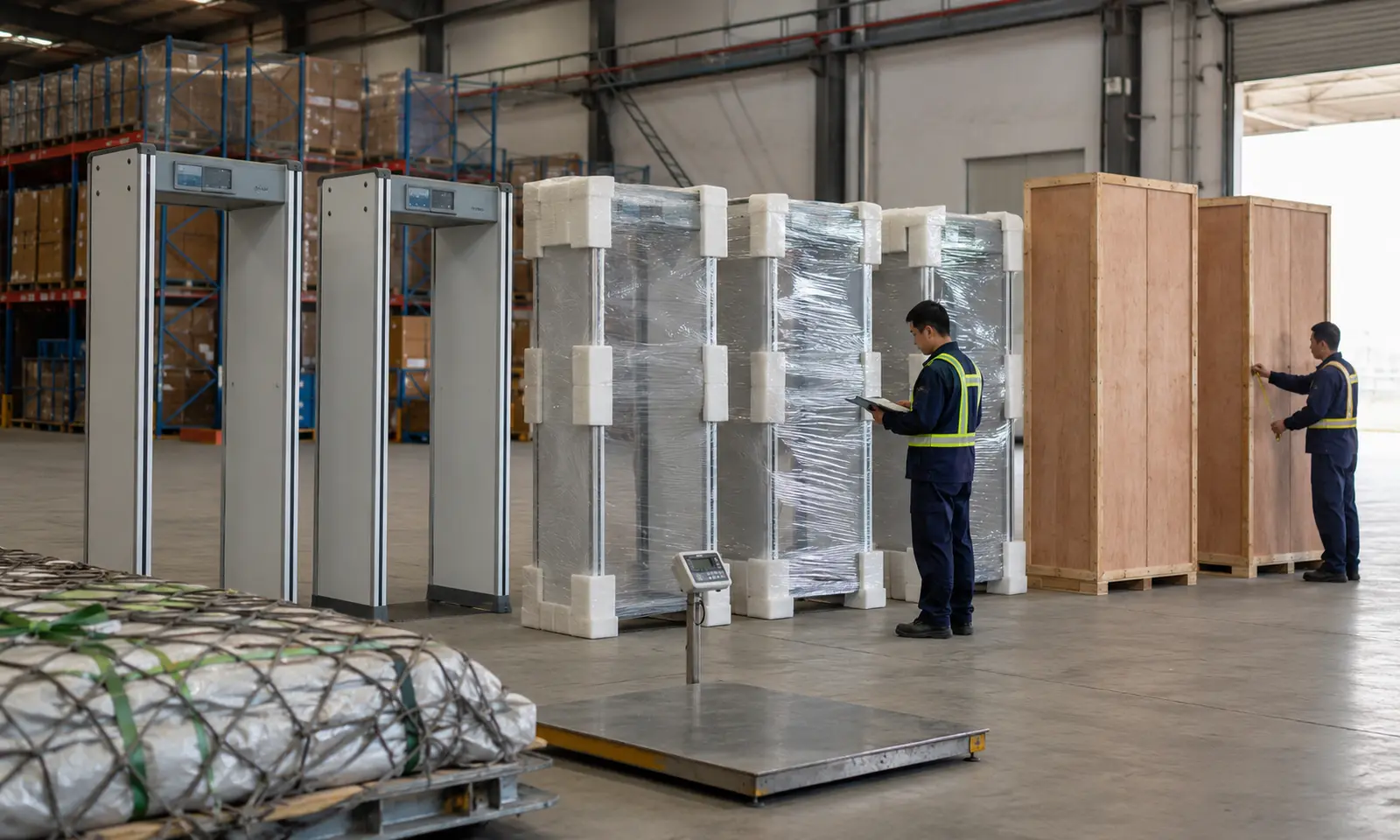
One of our previous Nigeria air-freight shipments involved 7 packages of walk-through security screening gates / metal-detector equipment moving by air from China to Lagos Airport.
- Product: Walk-through security screening gates / metal detectors
- Packages: 7
- Actual gross weight: approximately 800 kg
- Total volume: approximately 7 CBM
- Estimated volumetric weight: approximately 1,167 kg using the /6000 air-freight formula
- Destination: Lagos Airport (LOS)
- Service: Commercial air freight to airport with Nigerian importer handling the required import-clearance process
This shipment illustrates two Nigeria-specific issues that are easy to miss.
First, actual weight was not the only pricing factor. Seven cubic metres produces a much higher volumetric weight than 800 kg. As a result, we had to check the chargeable-weight calculation before booking.
Second, the customer needed the Nigerian import and end-user paperwork before the cargo reached Lagos. For commercial import processing, the importer needed the applicable Form M, bank / transaction references and final commercial shipping documents. In addition, because the cargo was security screening equipment, we had to review the end-user / beneficiary documentation and the relevant Nigerian security-equipment approval path.
For this type of shipment, the important documents can include the importer’s company and TIN information, Form M and applicable bank / transaction references, commercial invoice, packing list, final Air Waybill information, detailed equipment specifications, beneficiary letter, local purchase order and the applicable ONSA End-User Certificate. In addition, the product’s HS classification may trigger SONCAP documentation requirements.
The operational lesson is simple: do not fly controlled equipment to Nigeria first and try to identify the importer, end user or approvals after arrival. Instead, the importer should make sure that the importer, transaction and end-use records match the shipment before the cargo departs China.
Common Reasons Nigeria Air Cargo Gets Delayed
Import Documents Are Not Ready Before Arrival
If the importer has not completed the applicable Form M, bank processing, PAAR or broker preparation, air cargo can reach Nigeria before the import transaction is ready for clearance. As a result, airport storage can begin while the importer still corrects the documents.
Product or Regulatory Information Does Not Match
The invoice, packing list, Air Waybill and applicable regulatory records should describe the cargo consistently. A vague description such as “equipment” can create unnecessary questions when the shipment is actually a regulated security device, battery product or other controlled cargo.
Airline Booking or Special-Cargo Approval Is Delayed
Batteries, liquids, powders, magnets, oversized pieces and some controlled products may require a different airline, additional documents or special acceptance. Declaring these details only after the goods reach the export warehouse can cause rejection, rebooking and extra handling time.
Destination Charges or Airport Pickup Were Not Planned
An airport freight rate can exclude Nigerian customs clearance, terminal handling, storage and local delivery. The consignee should know who will clear and collect the cargo before departure instead of arranging the destination side only after the shipment reaches LOS.
Why Choose VoltFreight for Air Freight from China to Nigeria?
VoltFreight has handled China-to-Nigeria cargo across a wide range of product types, from ordinary commercial cartons to machinery, electronics, batteries and shipments requiring additional document review.
Our role is not only to find an airline rate. We help connect the supplier, final cargo measurements, China export handling, airline booking and the Nigerian importer’s clearance plan before departure.
Depending on the shipment, we can coordinate:
- Supplier pickup and China warehouse receiving
- Multi-supplier cargo consolidation
- Final measurement and chargeable-weight calculation
- CAN, SZX, HKG, PVG and alternative China airport comparison
- LOS, ABV, PHC and KAN route review
- Direct and connecting airline options
- General cargo and special-cargo acceptance review
- China export handling
- Air Waybill and pre-alert coordination
- Airport-to-airport air freight
- Reviewed customs and delivery support under the agreed service scope
What We Need for a Live Quote
Send VoltFreight:
- Product name and clear photos
- Supplier city / pickup address
- Carton, pallet or case quantity
- Gross weight and outer dimensions
- Total cargo value
- HS code if available
- Cargo-ready date
- Nigerian airport or final delivery city
- Battery, liquid, powder, magnet, security-equipment or other controlled-product information
- Whether you need airport-to-airport, airport-to-door, DAP or a reviewed DDP solution
Contact VoltFreight for a current China-to-Nigeria air freight quote.
FAQ About Air Freight from China to Nigeria
How much does air freight from China to Nigeria cost per kg?
For standard airport cargo, current 2026 market planning references can range roughly from the mid-USD 4/kg level for larger general cargo to around USD 8–9/kg or more for smaller shipments and certain routes. However, live pricing depends on weight, volume, China airport, Nigerian airport, airline capacity and cargo-ready date. Therefore, ask the forwarder to quote clearance, duty and delivery separately unless the written rate includes them.
How long does air freight from China to Nigeria take?
Under normal conditions, importers can often plan about 5–10 days from China-side handling to Nigerian airport availability. However, the aircraft movement itself may take less time, while Nigerian customs clearance and final delivery can extend the complete schedule.
Which Nigerian airport is best for air cargo from China?
Lagos LOS is normally the first gateway to compare for commercial cargo. However, importers can also consider Abuja ABV, Port Harcourt PHC and Kano KAN according to airline capacity, destination handling and the final delivery region.
Does air freight from China to Nigeria usually fly direct?
Not always. One-stop routings through hubs such as Dubai, Doha, Addis Ababa or Istanbul are common. Therefore, confirm the planned route and airline when the carrier confirms space.
How is air-freight chargeable weight calculated?
The airline compares actual gross weight with volumetric weight and normally charges the higher number. A common planning formula is length × width × height in centimetres ÷ 6,000. For total volume, 1 CBM is approximately 166.7 kg of volumetric weight.
What documents should be ready before air cargo arrives in Nigeria?
Common records include the commercial invoice, packing list, Air Waybill, importer and TIN information, HS code, Form M, applicable bank / transaction references and PAAR information. Regulated products can also require SONCAP, NAFDAC, End-User Certificate or other agency documentation. The exact file depends on the product and importer.
Does airport-to-airport air freight include Nigerian customs clearance?
Not automatically. Standard airport-to-airport freight can exclude Nigerian customs clearance, duties, taxes, terminal handling, storage and local delivery. The quotation should state the service boundary clearly before booking.
Can batteries, security equipment or other sensitive cargo be shipped by air to Nigeria?
A forwarder can review selected batteries and sensitive cargo for approved air routes. Lithium batteries require airline special-cargo or dangerous-goods review, while certain security products can require a Nigerian End-User Certificate or other controlled-product documentation. Therefore, send the exact product details before the supplier dispatches the cargo.
Important: Nigerian customs, banking, SONCAP, EUC and product-approval requirements can change and differ by HS code, importer and end use. This guide is for freight and import-planning purposes. The Nigerian importer should confirm the final clearance requirements with its Authorized Dealer Bank, licensed clearing agent and the relevant Nigerian authority before the goods leave China.