Updated: August 2026.
Air freight from China to Germany is a practical option for urgent commercial cargo, production parts, electronics, machinery components, samples, replacement goods, seasonal inventory and other shipments that cannot wait for railway or ocean freight.
However, choosing air freight involves more than comparing a price per kilogram. The importer should confirm the China departure airport, German destination airport, chargeable weight, airline routing, cargo acceptance, customs responsibility, destination-terminal charges and final pickup or delivery plan before booking.
For experienced German importers with their own EORI number, customs broker and local trucker, traditional airport-to-airport air freight can provide a clear and flexible service structure. Meanwhile, buyers that want customs and final delivery coordinated under one reviewed route may also compare Air DDP or airport-to-door service.
This page focuses specifically on commercial airline cargo moving from China to Germany. If you still need to compare air freight with railway, truck, express, LCL, FCL or DDP, use our broader shipping from China to Germany guide.
For the wider difference between airport-to-airport, airport-to-door, booking, DDP and special-cargo air services, review our main air freight services from China page.
Quick Answer: How Does Air Freight from China to Germany Work?
Commercial air freight normally starts after the supplier completes production and provides the final packed cargo information. VoltFreight can arrange supplier pickup, China warehouse receiving, final measurement, export document review, customs declaration, cargo security procedures, airline booking and Air Waybill preparation before the shipment enters the international air network.
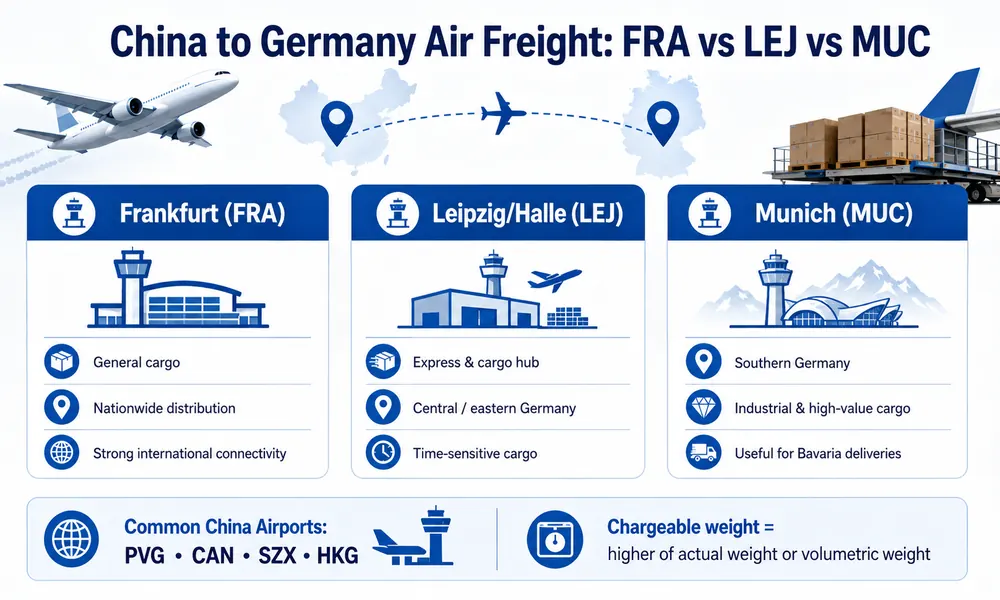
The route may use Shanghai PVG, Guangzhou CAN, Shenzhen SZX, Hong Kong HKG or another suitable Chinese gateway. In Germany, Frankfurt FRA is often reviewed first for general international air cargo, while Leipzig/Halle LEJ and Munich MUC can be useful for particular routings, cargo types and final delivery regions.
The nearest airport is not automatically the best airport. For example, a lower air rate into one German airport may be offset by higher terminal handling or a longer truck move to the consignee. Therefore, the route should be selected according to the complete airport and inland-delivery plan, not only the first airline rate.
For a standard airport-to-airport shipment, the German importer or its appointed customs broker normally handles import customs clearance, duty, import VAT, terminal release and pickup unless the written quotation includes these services.
Air Freight Cost from China to Germany
The air freight cost from China to Germany changes according to chargeable weight, airport pair, airline capacity, cargo-ready date, service level, package dimensions and product type.
Commercial airline cargo commonly uses weight breaks such as +45 kg, +100 kg, +300 kg, +500 kg and +1,000 kg. Larger, dense and stackable shipments can often reach a lower rate per chargeable kilogram, while small, bulky, non-stackable or sensitive cargo may cost more.
August 2026 Air Freight Rate Reference
The following VoltFreight ranges are planning references for ordinary, stackable general cargo. They are designed for commercial airport-to-airport air freight and reflect the competitive buying levels we can review through direct airline and consolidation relationships. They are not fixed tariffs and must be reconfirmed against the actual cargo-ready date, weight break, airline space and commodity.
| Route | Planning Rate | Typical Airport Transit | Best Used For |
|---|---|---|---|
| Shanghai PVG → Frankfurt FRA | USD 2.90–5.00/kg | About 3–6 days | Yangtze River Delta general cargo |
| Shenzhen SZX → Frankfurt FRA | USD 3.10–5.30/kg | About 3–6 days | Shenzhen and Dongguan commercial cargo |
| Guangzhou CAN → Munich MUC | USD 3.30–5.60/kg | About 4–7 days | South China cargo for Bavaria and southern Germany |
| Beijing PEK → Frankfurt FRA | USD 3.00–5.10/kg | About 3–6 days | North China general cargo |
Rate note: Updated August 2026. The ranges above are for planning only and normally refer to ordinary general cargo before German destination customs, duty, import VAT, terminal storage and final delivery. Small shipments, dangerous goods, lithium batteries, oversized pieces, non-stackable cargo, peak-season bookings and priority capacity can price above these ranges. Larger dense cargo above 500 or 1,000 kg may reach the lower end when suitable capacity is available.
What About Air Freight Below 45 kg or 100 kg?
Very small commercial shipments should not be priced by multiplying a large-shipment rate by 20 or 30 kilograms. Airlines, terminals and forwarders can apply minimum charges, and origin handling can become a large part of the total cost.
For small urgent cartons, compare standard air freight with DHL, UPS or FedEx express courier. Once the shipment becomes heavier or consists of several commercial cartons, airport air freight may become more economical.
How the Air Freight Cost Is Calculated
A basic freight calculation can be expressed as:
Chargeable Weight × Current Air Freight Rate = Main Air Freight Cost
However, the complete quotation may also include or exclude supplier pickup, China warehouse handling, export customs, security screening, origin terminal charges, Air Waybill fees, German terminal handling, customs brokerage, duty, import VAT, storage and final trucking.
Therefore, two quotations showing the same rate per kilogram can still produce very different final invoices. Compare the written service boundary, not only the headline air rate.
For a deeper explanation of airline weight breaks, pricing factors and surcharges, review our air freight rates from China guide.
Why Online Air Freight Rates Should Be Treated as Planning References
Airline capacity can change quickly. Rates may rise before Chinese holidays, major sales seasons, production peaks or other periods when export demand increases. Direct and connecting space can also price differently.
For this reason, a reliable quotation needs the actual cargo-ready date. VoltFreight reconfirms the rate, weight break and available routing before space is booked.
Air Freight Transit Time from China to Germany
The total air freight transit time from China to Germany should not be confused with aircraft flying time or a published flight schedule.
Under normal planning conditions, standard commercial air freight can often be planned at approximately 5–10 days from China-side cargo handover to German airport availability or release planning. The actual flight or airport-to-airport movement may be shorter, but the complete operational window also includes pickup or warehouse handover, final measurement, export customs, security screening, airline acceptance, flight routing and destination-terminal availability.
Priority or fewer-transfer services may be faster when suitable space is available. Connecting routes, peak periods, dangerous goods, special cargo or customs problems can take longer.
What Happens Before the Flight?
Before airline departure, the shipment may require supplier pickup, warehouse receiving, final weighing and measurement, packaging review, security screening, export customs preparation, airline booking and cargo-terminal acceptance.
Therefore, a supplier that says “the goods are ready today” does not necessarily mean the cargo can depart on tonight’s flight.
What Happens After Arrival in Germany?
After arrival, the importer or broker may still need to complete customs entry, duty and VAT processing, terminal payment and cargo release. Afterwards, the consignee or its trucker collects the shipment.
If final delivery is included in the quotation, the cargo can instead move from the airport or transfer warehouse to the agreed German postcode after release.
Consequently, importers should compare cargo-ready-to-release or cargo-ready-to-delivery time, not only the aircraft schedule.
Main Air Freight Departure Airports in China
The best China departure airport depends on supplier location, domestic pickup cost, airline space, product acceptance and the German destination.
Shanghai Pudong Airport — PVG
PVG is commonly reviewed for cargo originating from Shanghai, Suzhou, Kunshan, Hangzhou, Ningbo and the wider Yangtze River Delta.
It can be useful for electronics, machinery components, industrial goods, e-commerce stock and other commercial cargo when suitable Germany-bound capacity is available.
Guangzhou Baiyun Airport — CAN
CAN can serve factories across Guangzhou, Foshan, Dongguan, Zhongshan and other parts of the Pearl River Delta. It is often compared with Shenzhen and Hong Kong rather than selected automatically.
Shenzhen Bao’an Airport — SZX
SZX can be convenient for Shenzhen and Dongguan suppliers, particularly when the cargo can use available South China airline capacity without first trucking to another province.
Hong Kong International Airport — HKG
HKG can provide additional international airline and special-cargo routing options. However, using Hong Kong also requires a mainland-to-Hong-Kong transfer plan when the goods originate in mainland China.
Therefore, a lower HKG airline rate does not automatically mean a lower total shipment cost.
Other China Airports: CGO, PEK and PKX
Zhengzhou Xinzheng Airport (CGO), Beijing Capital Airport (PEK), Beijing Daxing Airport (PKX) and other Chinese gateways may also support selected Germany-bound cargo. Route availability changes according to airline schedules, cargo type, transfer plan and booking period.
VoltFreight therefore compares supplier location and available airline capacity instead of forcing every shipment through the same China gateway.
Frankfurt, Leipzig or Munich: Which German Airport Should You Choose?
Germany has several important cargo gateways. The correct destination should match the airline route, customs setup, destination handler and final delivery region.
Frankfurt Airport — FRA
Frankfurt is Germany’s main conventional international air-cargo gateway and is often the first airport to compare for general commercial freight. Its cargo ecosystem includes airline capacity, handling facilities, customs services, warehouses and strong road connections.
Importers can review official airport information through the Fraport operations and cargo information.
FRA can work well when the consignee is located in Frankfurt, the Rhine-Main region or another German destination that can be served efficiently by road after customs release.
Leipzig/Halle Airport — LEJ
Leipzig/Halle has a strong cargo and express role and can be useful for central and eastern Germany, time-sensitive freight and selected freighter routings.
More information about the express operation is available from the official DHL Hub Leipzig cargo page.
For a traditional forwarder shipment, however, a large express hub does not mean every shipment should automatically use LEJ. The airline product, cargo terminal, AWB destination, customs plan and pickup arrangement must still match the shipment.
Munich Airport — MUC
Munich can be particularly useful for Bavaria and southern German industrial destinations. Its cargo catchment area is closely connected with automotive, machinery, technology and other high-value manufacturing sectors.
Official cargo information is available from Munich Airport Cargo.
For cargo ultimately moving to Munich, Nuremberg, Augsburg or another southern German location, MUC may reduce inland trucking compared with routing everything through Frankfurt. Nevertheless, compare the complete airline and trucking quotation first.
Other German Air Cargo Options: DUS, CGN, BER and HAM
Düsseldorf (DUS), Cologne/Bonn (CGN), Berlin Brandenburg (BER) and Hamburg (HAM) can also be considered when airline schedules, transfer services, destination handling or final delivery geography make them practical.
DUS can be useful for the Rhine-Ruhr market, while CGN has strong express and integrator activity. BER and HAM may support selected commercial cargo depending on the airline and route. These airports should normally be treated as alternatives rather than automatic replacements for FRA, LEJ or MUC.
The main rule is simple: choose the German airport according to the complete air-freight and inland-delivery plan, not the airport name alone.
Direct vs Connecting Air Freight to Germany
A China-to-Germany air-freight quotation may use a direct flight, a connecting flight or an air-and-road combination. These options can have different costs, schedules and handling risks.
Direct or Fewer-Transfer Routing
A direct or fewer-transfer route may be preferable when:
- The delivery deadline is tight
- The cargo has high commercial value
- The shipment contains fragile equipment
- Production downtime depends on the replacement parts
- The buyer wants fewer handling stages
However, the fastest flight is not always available at the best price or from the airport closest to the supplier.
Connecting Air Freight
A connecting route may provide more space or a lower freight rate. Nevertheless, every transfer introduces another operational stage.
Possible effects include:
- Longer transit time
- Additional terminal handling
- Missed connections
- More handling of cartons, pallets or crates
- Greater sensitivity to irregular flight schedules
Connecting routes can still be an excellent option for flexible commercial cargo. The forwarder should explain the planned routing and service level before booking.
Road Feeder Service After the Flight
Some air-freight networks use a scheduled truck connection after the international flight. Therefore, the physical aircraft may land at one European gateway before the cargo moves by road to another terminal or destination.
Importers should confirm the airport shown on the Air Waybill, where customs release will occur and where the cargo will actually become available for collection.
For more details about airline booking, cargo cut-offs and route selection, read our air freight booking from China guide.
Chargeable Weight: Actual Weight vs Volumetric Weight
Airlines calculate air freight from China to Germany according to chargeable weight. They compare actual gross weight with volumetric weight and use the higher value for pricing.
A common planning formula is:
Length × Width × Height in centimeters ÷ 6,000 = Volumetric Weight in kilograms
Chargeable Weight Example
Assume one export carton measures:
- 100 cm long
- 80 cm wide
- 75 cm high
- Actual gross weight: 72 kg
The volumetric calculation is:
100 × 80 × 75 ÷ 6,000 = 100 kg
The actual weight is 72 kg, while the volumetric weight is 100 kg.
Therefore, the estimated chargeable weight is 100 kg.
If the shipment contains five identical cartons:
100 kg × 5 cartons = 500 kg estimated chargeable weight
This is why a quotation based only on “the goods weigh 360 kg” can be inaccurate. The carton dimensions may produce a much higher billable weight.
You can use our CBM and chargeable-weight calculator before requesting a quotation.
How to Reduce Unnecessary Volumetric Weight
Importers can ask the supplier to:
- Remove excessive empty space
- Use export cartons sized closer to the actual product
- Combine small packages where product protection allows
- Avoid unnecessarily tall pallets
- Provide final packed dimensions before airline booking
However, reducing carton size should not weaken the packaging. Air cargo may pass through warehouses, security screening, forklifts, terminals and transfer points before final collection.
What Does a Germany Airport-to-Airport Air Freight Quote Include?
“Airport-to-airport” describes the main transport boundary, but every quotation should still identify what is included on the China side and what the German importer must arrange after arrival.
China-Side Services That May Be Included
- Supplier pickup or China warehouse receiving
- Final weighing, measurement and chargeable-weight confirmation
- Export-document review, security screening and China customs declaration
- Airline booking and origin-terminal handling
- Air Waybill preparation and shipment pre-alert
- International air freight to FRA, LEJ, MUC, DUS or the agreed German airport
German Destination Costs Normally Need Separate Confirmation
- German customs broker and import clearance
- Customs duty and import VAT
- Destination-terminal handling and storage
- Customs examination or regulatory inspection
- Airport collection
- Final truck delivery to the German consignee
These services can be added when the importer requests airport-to-door, DAP or another confirmed delivery scope.
For a broader explanation of service boundaries, review our airport-to-airport air freight guide.
Why Storage Costs Matter
Air cargo can arrive before an unprepared importer is ready to clear it. If the broker receives documents late, or if customs information is incomplete, terminal storage may begin accumulating according to the handler’s rules.
Therefore, the German broker, EORI details and customs documents should be prepared before departure whenever possible.
Germany Customs Clearance, EORI, TARIC, Duty and Import VAT
Air freight reaching Germany still requires normal EU and German import procedures. Fast transportation does not remove customs, taxation or product-compliance requirements.
EORI Number
Economic operators involved in EU customs activities generally need an EORI number. German Customs explains that the EORI number identifies economic operators in their dealings with customs authorities and is used in customs declarations.
Official information is available from German Customs — EORI Number.
For a traditional importer-cleared air shipment, the buyer should confirm the EORI number and customs-broker arrangement before the cargo leaves China.
HS Code, TARIC and Customs Duty
Customs duty depends on the product classification, origin, customs value and any applicable EU measures.
The importer or customs professional should confirm the correct commodity classification rather than choosing an HS code only because another supplier used it for a similar product.
German Customs provides access to the EU TARIC information system through its TARIC information page.
German Import VAT
Germany’s standard import VAT rate is generally 19%. A reduced rate of 7% applies to certain qualifying goods.
Import VAT should not be estimated simply by multiplying the supplier’s invoice value by 19%. Customs valuation, customs duty and certain transport costs can affect the taxable basis.
German Customs provides examples through its official import VAT calculation guidance.
For general freight-customs support, you can also review our customs clearance service.
Standard Air Freight vs Air DDP
Traditional airport-to-airport air freight normally gives the German importer more direct control over customs entry, broker selection and import records.
Air DDP follows a different service model. For eligible cargo, a reviewed Air DDP route can combine international air transport, customs coordination, agreed duty and tax handling and final delivery.
However, DDP does not necessarily mean the shipment clears customs directly at FRA, LEJ or MUC under the German buyer’s own import entry. Some DDP structures may use another EU gateway before final delivery into Germany.
Therefore, companies that require customs records under their own EORI or accounting structure should confirm the customs model before selecting DDP.
For the broader landed-service explanation, review Air Freight DDP from China.
Documents, Special Cargo and Representative Cases for China-to-Germany Air Freight
Basic Commercial Documents
Common commercial air-freight documents include:
- Commercial invoice
- Packing list
- Air Waybill
- HS or TARIC classification information
- Importer and EORI details
- Country-of-origin information
- Product certificates or permits when required
The invoice, packing list and physical cargo should agree on the product, quantity, package count, weight and commercial information.
Descriptions such as “parts,” “accessories,” “samples” or “goods” may be too vague when a more accurate description is available.
Lithium Batteries and Battery-Powered Goods
Lithium battery cargo must be classified before an air-freight rate is confirmed. The correct requirements depend on whether the batteries move by themselves, packed with equipment or contained in equipment.
For example, fully regulated standalone lithium-ion batteries normally move under UN3480 as Class 9 dangerous goods. They require cargo-aircraft and airline acceptance, and current IATA requirements restrict standalone lithium-ion batteries to a state of charge not exceeding 30% of rated capacity unless an applicable approval allows otherwise.
Depending on the exact configuration and packing instruction, the shipper may need:
- UN38.3 test summary matching the actual battery model
- Battery specification showing voltage, capacity and Watt-hour rating
- SDS or additional technical information when requested by the airline or operator
- Approved packaging and package quantity limits
- Correct Class 9 lithium battery hazard label
- Correct UN number marking or applicable battery mark
- Cargo Aircraft Only label when required by the packing instruction
- Shipper’s Declaration for Dangerous Goods when required
- Overpack markings and labels when an overpack is used
Labels and marks must match the actual UN number and packing method. A package should not be relabeled simply because another battery shipment used the same artwork.
IATA’s 2026 Battery Shipping Regulations include updated state-of-charge, marking, labelling and documentation requirements. Current official guidance is available from the IATA battery guidance page. For the complete UN3480, UN3481, UN3090, UN3091, UN38.3 and air-versus-sea framework, use our dedicated guide to shipping batteries from China.
Oversized and Non-Stackable Cargo
Air cargo cannot be priced only by total kilograms when the shipment contains long, tall, oversized or non-stackable pieces.
Provide the dimensions and weight of every large package before booking. The forwarder may need to confirm:
- Aircraft door limitations
- ULD compatibility
- Forklift requirements
- Center of gravity
- Stackability
- Special terminal handling
Machinery, industrial equipment and heavy crates should also have clear lifting or forklift points where appropriate.
Liquids, Powders, Chemicals, Magnets and Regulated Products
These goods require product-specific review before the forwarder confirms ordinary air-freight space.
In addition, medical-related products, food, cosmetics, electronics, wireless devices, toys and other regulated products may require separate EU or German compliance documentation even when the airline accepts them for transportation.
Transport acceptance and product-market compliance are two separate checks.
The examples below show how the air-freight decision changes when the cargo moves from ordinary general freight to regulated dangerous goods. The battery example reflects the type of recurring lithium-battery projects VoltFreight handles; final airline approval always depends on the actual battery model, packing instruction and booking date.
Case 1: 5,000 kg Lithium-Ion Battery Cargo to Frankfurt
Cargo: Approximately 5,000 kg of standalone lithium-ion batteries for commercial distribution in Germany.
Classification: The project was planned as fully regulated Class 9 dangerous goods under UN3480 rather than ordinary general cargo. This meant the shipment required a dedicated dangerous-goods review before airline space could be confirmed.
China-side preparation: The battery model, UN38.3 test summary, specification data, state of charge, packing method and supporting dangerous-goods documents were checked before warehouse handover. The packages required the correct Class 9 lithium battery hazard label, UN3480 marking and other marks or labels required by the applicable packing instruction. Cargo Aircraft Only labelling and a Shipper’s Declaration were also reviewed where required.
Route planning: For a shipment of this size, the important question was not simply whether one airline published a low rate. VoltFreight had to compare approved dangerous-goods capacity, cargo-aircraft routing, pallet and package limits, transit points and Frankfurt destination handling.
Operational lesson: A 5,000 kg battery shipment should receive DG approval before it enters the airline terminal. Incorrect UN information, missing Class 9 labels, mismatched UN38.3 documents or an unapproved packing configuration can trigger rejection, relabelling, warehouse charges and rebooking.
For battery-specific packing, labels, UN numbers and documentation, see our shipping batteries from China guide.
Case 2: Urgent General Cargo for a Southern Germany Factory
Consider an urgent shipment of industrial spare parts moving from South China to a factory in Bavaria. The goods are ordinary general cargo, but the cartons are moderately bulky and the final consignee needs the parts quickly to avoid production disruption.
Instead of automatically routing the shipment to Frankfurt, the forwarder should compare CAN or SZX departure capacity with both FRA and MUC. If a suitable MUC routing is available, the higher or similar air rate can still produce a better total result by reducing the final truck distance to Bavaria.
The decision should therefore compare chargeable weight + airline routing + destination-terminal cost + final trucking. This is exactly why the cheapest airport-to-airport linehaul is not always the lowest landed logistics cost.
Step-by-Step Air Freight Process from China to Germany
- Send the cargo data. Provide product details, photos, package count, weight, dimensions, supplier city, cargo-ready date and German destination.
- Review cargo acceptance. Confirm whether the shipment is general cargo, battery cargo, dangerous goods, oversized or non-stackable freight.
- Select the airport route. Compare the China departure airport, FRA/LEJ/MUC or another German gateway, direct versus connecting space and inland delivery.
- Prepare the German import setup. For standard airport-to-airport freight, confirm EORI, customs broker, product classification and destination pickup plan before departure.
- Receive and measure the cargo in China. Confirm final package count, gross weight, dimensions and chargeable weight before the airline booking is finalized.
- Book space and complete China export handling. Arrange security screening, export customs, terminal delivery and Air Waybill preparation.
- Complete German customs and terminal release. The importer or broker handles customs entry, duty, import VAT and destination-terminal requirements under the agreed service scope.
- Collect or deliver the cargo. The consignee’s trucker collects the freight, or VoltFreight arranges final delivery when included in the quotation.
Air freight arrives quickly, so customs and pickup preparation should begin before departure rather than after the shipment lands.
When Should You Use Air Freight Instead of Express, Rail or Sea Freight?
Air freight works best when transportation speed has real commercial value.
Choose Commercial Air Freight When
- The shipment is too large or expensive for normal express courier
- Production will stop without replacement parts
- Inventory is running low
- The goods have high value relative to freight cost
- A launch or sales deadline is approaching
- The importer has a German customs broker and airport pickup plan
- The cargo needs a faster route than rail, truck or sea freight
Compare Express Courier When
DHL, UPS or FedEx may be simpler for documents, samples and small urgent parcels because one courier can manage most of the transport and final delivery process.
However, volumetric weight can make express expensive when cartons become larger or heavier.
Compare Rail, Truck or Sea Freight When
For heavy, bulky or planned inventory, slower services may provide a significantly lower unit transportation cost.
Railway or truck freight may offer a middle-speed option for suitable China-Europe cargo, while LCL and FCL sea freight generally become more attractive when urgency decreases and volume increases.
Because these methods have different customs and delivery structures, use our main China-to-Germany shipping page when you have not yet chosen the transportation mode.
Consider Air DDP When You Need a Landed Delivery Structure
Air DDP may suit eligible commercial cartons when the buyer wants one reviewed transportation, customs and delivery structure rather than managing German airport recovery separately.
Nevertheless, standard airport-to-airport freight and Air DDP solve different problems. They should not be compared only by the first per-kilogram rate.
What Information Is Needed for a China-to-Germany Air Freight Quote?
For an accurate air-freight quotation, send the information that changes airline pricing and cargo acceptance:
- Product name and clear photos
- Supplier city or pickup address in China
- Cargo-ready date
- Carton, pallet or crate quantity
- Final dimensions and gross weight of each package type
- Total gross weight and declared commercial value
- Preferred German airport, if already known
- Final German city and postcode if delivery is required
- Battery, dangerous-goods, liquid, powder, chemical or magnet status
- Oversized, non-stackable, fragile or temperature-sensitive status
If the final dimensions are not ready, VoltFreight can prepare an initial estimate. However, airline space and final pricing should use the actual packed cargo data.
A good quotation should clearly state the airport pair, chargeable weight, service level, estimated transit range, included China charges, excluded German charges, rate validity and any special-cargo conditions.
Why Choose VoltFreight for Air Freight from China to Germany?
China-to-Germany air freight should connect airline pricing with the real cargo, airport route, customs responsibility and final German delivery plan.
VoltFreight can coordinate:
- Direct airline and consolidation-rate comparison for selected China-Europe routes
- PVG, CAN, SZX, HKG, PEK/PKX and other China airport planning
- FRA, LEJ, MUC, DUS and alternative German airport review
- Chargeable-weight calculation and final warehouse measurement
- Direct, connecting and road-feeder route comparison
- China export customs, airline booking and Air Waybill preparation
- Lithium-battery and other special-cargo acceptance review
- Airport-to-airport, airport-to-door, DAP and reviewed Air DDP options
- Final delivery to German warehouses, factories, distributors, 3PLs and commercial addresses
Most importantly, the quotation should explain the service boundary before cargo moves. A low headline air rate is useful only when the importer also understands the destination charges, customs responsibility and final delivery cost.
If you need a live rate, send the cargo details through our contact page. VoltFreight can compare the available China-to-Germany air routes after reviewing the actual shipment.
FAQ About Air Freight from China to Germany
How long does air freight from China to Germany take?
Standard commercial air freight can often be planned at approximately 5–10 days from China-side cargo handover to German airport availability or release under normal conditions. The flight segment itself may be shorter, but the planning range also includes export handling, airline acceptance, routing and destination-terminal availability.
How much does air freight from China to Germany cost?
The cost depends on chargeable weight, airport pair, cargo-ready date, airline capacity, product type, package dimensions and service level. Our August 2026 general-cargo planning references are roughly USD 2.90–5.60/kg on the example China-to-Germany airport pairs shown above, while dangerous goods, small shipments, priority space and non-stackable cargo can cost more. A live quotation is required before booking.
Which German airport is best for air freight from China?
Frankfurt FRA is often the first gateway to compare for conventional international air cargo. Leipzig/Halle LEJ can work well for selected cargo and central or eastern Germany, while Munich MUC can be useful for Bavaria and southern Germany. The correct airport depends on the actual airline route, terminal charges, customs arrangement and final delivery postcode.
Is Frankfurt always cheaper than Leipzig or Munich?
No. The lowest airline rate does not necessarily produce the lowest total logistics cost. Importers should also compare China pickup, flight routing, German terminal charges, customs setup and final trucking.
What is the minimum weight for air freight from China to Germany?
There is no single universal minimum for every route. Commercial air tariffs commonly use weight breaks beginning around +45 kg, but airline and terminal minimum charges can make very small shipments uneconomical. For lightweight urgent cargo, compare DHL, UPS or FedEx with standard airport air freight before booking.
How is air freight chargeable weight calculated?
Airlines compare actual gross weight with volumetric weight and normally charge whichever is higher. A common planning formula is length × width × height in centimeters ÷ 6,000. Final warehouse and airline measurements control the billable weight.
Does a German importer need an EORI number?
Businesses participating in EU customs procedures generally need an EORI number. The importer should confirm its EORI and customs-broker setup before arranging traditional airport-to-airport commercial air freight.
Does airport-to-airport freight include German customs clearance?
Not automatically. Unless the written quotation specifically includes German clearance, duties, VAT and destination services, the importer and its customs broker normally handle customs entry, terminal charges, cargo release and pickup after arrival.
Can lithium batteries be shipped by air from China to Germany?
Selected lithium batteries and battery-powered products can move by approved air-freight routes when the battery classification, UN38.3 documentation, packing and airline acceptance meet the applicable requirements. Approval is shipment-specific, so the forwarder must review the actual battery and packing before booking.
Can VoltFreight deliver the cargo from the German airport to my warehouse?
Yes, final delivery can be reviewed separately from standard airport-to-airport freight. Depending on the shipment, the route may be arranged as airport-to-door, DAP or another confirmed delivery service. Provide the German postcode, address type, unloading conditions and cargo dimensions so the final trucking cost can be checked.