Truck freight from China to Russia is suitable for commercial cargo that needs flexible factory pickup, LTL or FTL capacity and delivery to a Russian warehouse or business address.
As a planning range, FTL truck freight may take approximately 15–25 days, while LTL and Truck DDP commonly require about 18–35 days after cargo receiving and route confirmation. Actual timing depends on the Horgos or Manzhouli corridor, consolidation, border conditions, customs clearance and the final Russian postcode.
LTL is usually priced according to weight, CBM, pallet space and cargo density. FTL is quoted according to the truck type, loading city, border route, destination and required vehicle capacity. Therefore, there is no reliable universal price per kilogram for every China-to-Russia road shipment.
This guide explains the Horgos and Manzhouli corridors, LTL and FTL trucking, DDP and DAP delivery, customs documents, pricing factors and the cargo information required for an accurate quotation.
For a broader comparison of rail, air, sea, express and multimodal routes, review our complete China-to-Russia freight service overview.
Russian-speaking importers can also review our Russian-language guide to shipping from China to Russia for truck, rail, air, sea and DDP delivery information.
For commercial road freight services covering Russia, Europe and Central Asia, visit our truck freight services from China page.
Need a truck freight quotation? Send the pickup city in China, Russian destination city and postcode, product name, carton or pallet quantity, gross weight, dimensions, CBM, cargo value and preferred delivery terms.
Request a China-to-Russia truck freight quote
Quick Answer: How Does Truck Freight from China to Russia Work?
China-to-Russia road freight normally begins with cargo pickup from a factory, trading company or warehouse in China. The goods may first be delivered to a consolidation warehouse, where the cartons are counted, measured, weighed and prepared for the selected truck route.
After export preparation, the cargo moves toward the confirmed border corridor. Depending on the origin, destination and customs arrangement, the shipment may travel through Horgos and Kazakhstan or through Manzhouli and the China–Russia border.
Border transport does not always mean one truck travels from the supplier directly to the final consignee. In practice, a shipment may involve domestic pickup trucks, consolidation vehicles, cross-border carriers, customs-controlled transport and a separate Russian delivery vehicle. Therefore, the forwarder should explain the route structure before booking.
The main service options include:
- LTL truck freight: The cargo shares vehicle capacity with other compatible shipments.
- FTL truck freight: The importer uses dedicated truck capacity for one large shipment.
- Truck DDP: Road transport, customs coordination, agreed tax scope and final delivery are combined under one quotation.
- DAP truck freight: The cargo is transported to the agreed destination, while the Russian importer handles import clearance, duty and VAT.
Truck freight is usually considered when a shipment needs more delivery flexibility than a terminal-based service. Nevertheless, cargo type, documentation, route availability and the final Russian postcode must be reviewed before the service is confirmed.
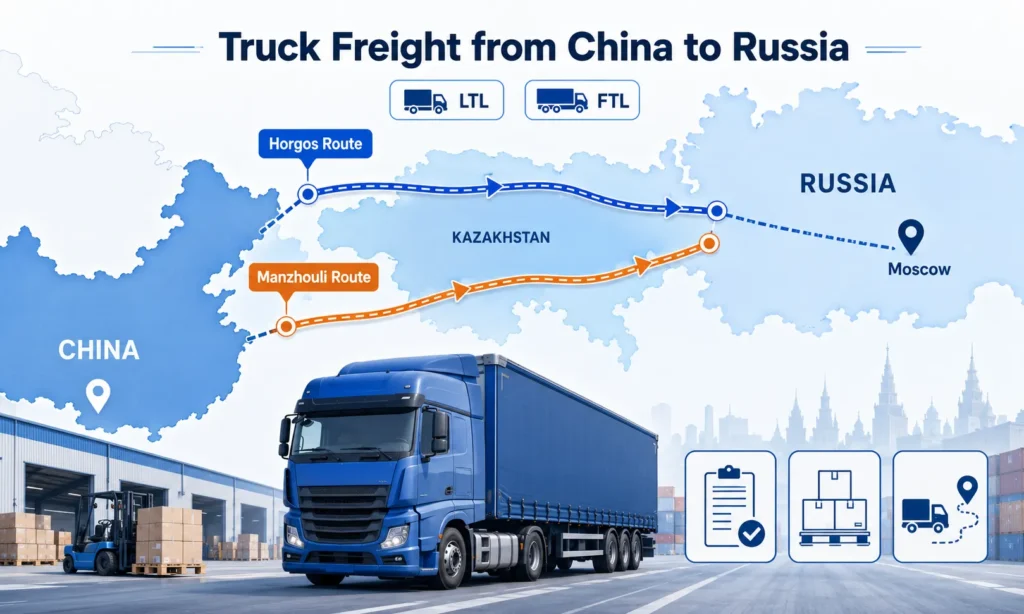
Main Truck Routes from China to Russia
There is no single road corridor that is automatically suitable for every shipment. Route selection depends on the supplier location, Russian destination, cargo dimensions, customs arrangement, truck availability and current border conditions.
For many commercial shipments, two route directions deserve the closest comparison.
China–Horgos–Kazakhstan–Russia Route
The Horgos route is commonly reviewed for cargo collected in southern, central, eastern or western China. Goods from Shenzhen, Guangzhou, Dongguan, Foshan, Yiwu, Shanghai, Ningbo, Chengdu, Chongqing, Zhengzhou and nearby manufacturing regions may first move by domestic truck to a consolidation point or toward Xinjiang.
After export preparation, the shipment moves toward the Horgos border area. It may then travel through Kazakhstan before entering Russia and continuing to Moscow or another western Russian destination.
A typical route structure may include:
- Pickup from one or several Chinese suppliers;
- Delivery to a China consolidation warehouse;
- Carton, pallet, weight and dimension confirmation;
- Domestic movement toward Xinjiang;
- China export and border handling at or near Horgos;
- Transit transport through Kazakhstan;
- Entry into Russia under the confirmed customs plan;
- Russian customs clearance and final delivery.
The Horgos direction can be practical for cargo moving toward Moscow and western Russia. However, it should not be promised solely on the basis of the Chinese pickup city. Vehicle supply, transit arrangements, border queues and the customs structure can change the most suitable plan.
China–Manzhouli–Russia Route
The Manzhouli route connects China with Russia through Inner Mongolia and the Manzhouli–Zabaikalsk border area. It may be reviewed for goods collected in northern, northeastern, eastern or coastal Chinese manufacturing regions.
Cargo from Tianjin, Beijing, Qingdao, Dalian, Shanghai, Ningbo, Suzhou, Shandong, Hebei and other regions can be moved toward a consolidation hub before joining the international road route. Cargo originating in southern China can also use this direction, although the longer Chinese domestic leg must be included in the quotation.
After crossing into Russia, the shipment may continue toward Siberian destinations, the Ural region, Moscow or another inland city. Consequently, the final Russian address is essential when comparing Manzhouli with Horgos.
This corridor may be considered when:
- The Chinese pickup location gives it a practical domestic transport advantage;
- The Russian destination is suitable for an eastern or Siberian entry direction;
- The required vehicle and border capacity are available;
- The customs and product-compliance plan supports the route;
- The cargo can meet the selected carrier’s acceptance requirements.
How Is the Route Selected?
A route should be selected after the forwarder reviews the entire shipment, not just the destination country.
The most important factors include:
- Supplier location: Domestic transport from Shenzhen is different from pickup in Tianjin or Harbin.
- Russian destination: Moscow, Novosibirsk, Yekaterinburg and Vladivostok need different inland plans.
- Cargo volume: Small LTL cargo and dedicated FTL cargo may use different schedules.
- Product category: Batteries, electronics, machinery and regulated goods require additional review.
- Customs arrangement: Formal importer clearance and reviewed DDP routes may use different operating structures.
- Vehicle availability: Truck type, border capacity and compatible consolidation space affect departure timing.
- Delivery deadline: A lower-priced route may not be suitable when the cargo is needed for urgent production.
LTL, FTL and Truck DDP Options
Importers should choose the service according to cargo size, delivery control and customs responsibility. LTL is not automatically better because the shipment is small, while FTL is not determined by CBM alone.
| Service | Best Suited For | Pricing Basis | Main Considerations |
|---|---|---|---|
| LTL Truck Freight | Small and medium commercial shipments, spare parts, e-commerce replenishment and multi-supplier cargo | Weight, CBM, pallet space, cargo density and destination | Consolidation time, transfer handling, minimum charges and compatible cargo availability |
| FTL Truck Freight | Large orders, palletized cargo, machinery, factory shipments and goods requiring dedicated capacity | Truck type, loading location, route, destination and required capacity | Loading method, payload, cubic capacity, unloading conditions and delivery appointment |
| Truck DDP | Eligible cargo requiring a coordinated customs and final-delivery scope | Freight, customs plan, declared value, product classification and delivery address | Included taxes, importer structure, compliance documents, inspection charges and service exclusions |
| DAP Truck Freight | Importers with their own Russian customs broker and importer arrangement | Transport to the agreed location, excluding Russian duty and VAT | Importer readiness, customs broker coordination and responsibility after arrival |
When to Use LTL Truck Freight
LTL means Less Than Truckload. The cargo occupies part of a shared truck or consolidated road-freight movement instead of using an entire vehicle.
This option may work for:
- A few cartons or pallets of industrial parts;
- E-commerce inventory and warehouse replenishment;
- Goods collected from several Chinese suppliers;
- Seasonal stock that is not large enough for a full truck;
- General commercial cargo that can be safely consolidated;
- Shipments where air freight is too expensive but rail is less flexible.
Because LTL requires consolidation, the goods may wait for compatible cargo before departure. In addition, the shipment may be unloaded and transferred during the journey. Strong packaging, clear carton marks and accurate packing-list data are therefore important.
When to Use FTL Truck Freight
FTL means Full Truckload. It is suitable when the cargo uses dedicated vehicle capacity or when the importer needs stronger control over loading, handling and delivery.
FTL may be appropriate for:
- Large palletized factory orders;
- Machinery and industrial equipment;
- High-volume commercial inventory;
- Goods requiring a specific loading method;
- Cargo that should not be mixed with other shipments;
- Deliveries requiring a confirmed warehouse appointment.
Dedicated capacity can reduce some consolidation delays and handling. Even so, the forwarder still needs to confirm the truck type, usable dimensions, payload, border route, customs method and unloading requirements.
Truck Freight Transit Time from China to Russia
Truck freight transit time should be calculated from supplier pickup to final delivery, rather than only from the border departure date.
A shipment normally passes through several stages:
- Supplier pickup and domestic transport in China;
- Warehouse receiving and cargo consolidation;
- Export-document preparation;
- Movement toward Horgos or Manzhouli;
- Border processing and possible vehicle transfer;
- Transit through Kazakhstan when the Horgos corridor is used;
- Russian import clearance;
- Final road delivery to the consignee.
After cargo receiving and route confirmation, the following ranges may be used for initial planning:
- FTL truck freight: Often approximately 15–25 days, depending on route, customs and destination.
- LTL truck freight: Often approximately 18–35 days because consolidation may add waiting time.
- Truck DDP: Often approximately 20–35 days, depending on the customs structure and final delivery city.
These are not guaranteed schedules. The final timing can change because of border congestion, vehicle shortages, weather, customs inspection, document corrections, holidays, road restrictions or delivery appointments.
These ranges normally begin after the cargo has been received, measured, reviewed and assigned to a confirmed route. Supplier production time, China pickup and waiting for missing documents may fall outside the quoted transit period.
Moreover, the first day should be defined clearly. Some quotations calculate transit time from warehouse departure, while the buyer may assume it starts when the supplier says the goods are ready.
For urgent industrial parts, compare road freight with air freight before booking. By contrast, if a large shipment can use a stable containerized route, rail freight may offer a better cost-and-capacity balance.
How China-to-Russia Road Freight Is Priced
There is no reliable universal rate per kilogram or per CBM for every road shipment. The quotation depends on the service type and the space, weight, handling and customs requirements created by the cargo.
LTL Truck Freight Pricing
LTL quotations may consider:
- Total gross weight;
- Total CBM;
- Carton or pallet dimensions;
- Cargo density;
- Whether pallets can be stacked;
- Minimum charge for the selected route;
- Pickup cost from the supplier;
- Warehouse handling and consolidation;
- Russian destination city and postcode;
- Final delivery access and unloading conditions.
For example, two shipments may both weigh 500 kg. However, the first may occupy two compact pallets, while the second uses oversized cartons that cannot be stacked. Their road-freight costs will not be the same.
FTL Truck Freight Pricing
FTL rates are normally based on the required truck capacity and complete route.
The quotation may depend on:
- Truck body type and internal dimensions;
- Maximum payload;
- Loading city in China;
- Selected border corridor;
- Russian destination;
- Loading and unloading method;
- Waiting time at the factory or warehouse;
- Special equipment, securing or protective requirements;
- Customs and transit arrangements;
- Current vehicle supply.
As a result, importers should not request an FTL quote using only the total CBM. The cargo list must also show dimensions, weight distribution, pallet details and loading conditions.
Charges That May Be Outside the Basic Freight Rate
A low road-freight rate may exclude important costs. Before booking, ask whether the quotation includes:
- Pickup from the Chinese supplier;
- China warehouse receiving;
- Export declaration;
- Border handling;
- Customs brokerage;
- Russian import duty and VAT;
- Customs inspection;
- Storage caused by delayed documents;
- Remote-area delivery;
- Delivery appointment;
- Forklift or unloading labor;
- Redelivery after a failed delivery attempt.
Therefore, compare the total delivered scope instead of comparing only the international truck rate.
Cargo Suitable for China-to-Russia Trucking
Road freight can handle many types of commercial cargo. Nevertheless, acceptance should be confirmed before goods are collected from the supplier.
General Commercial Cargo
Common examples include:
- Auto parts and mechanical components;
- Industrial spare parts;
- Tools and hardware;
- Packaging materials;
- Furniture and home products;
- Textiles, shoes and retail goods;
- Non-hazardous machinery;
- General electronics without restricted components;
- Commercial display equipment;
- Warehouse and e-commerce inventory.
E-commerce and Multi-Supplier Cargo
LTL trucking can be useful when a buyer purchases from several factories. The goods can first be collected at a China warehouse and combined into one shipment.
Warehouse preparation may include:
- Receiving cartons from several suppliers;
- Checking carton quantity;
- Comparing the received goods with packing lists;
- Measuring final dimensions and gross weight;
- Replacing damaged outer cartons;
- Applying shipping marks;
- Consolidating compatible goods;
- Preparing one clearer export shipment record.
This process can reduce repeated minimum charges. More importantly, it allows the importer to confirm the final cargo details before the road-freight quotation is finalized.
Cargo Requiring Additional Review
The following products may require additional transport, customs or compliance review:
- Lithium batteries and battery-powered products;
- Liquids, powders and chemicals;
- Magnetic products;
- Cosmetics and personal-care products;
- Food and food-contact products;
- Medical-related goods;
- Wireless and telecommunications equipment;
- Branded products;
- Automotive products subject to technical requirements;
- Machinery requiring conformity documentation;
- Dangerous goods;
- Dual-use or sanctions-sensitive products.
These products are not automatically accepted or rejected. Route availability depends on the exact model, material, function, HS or TN VED classification, safety documents, brand status, declared value and current carrier policy.
VoltFreight does not arrange cargo that violates customs law, sanctions requirements, export controls or carrier restrictions.
Russia Customs and Road-Freight Documents
Document preparation should begin before the truck leaves the Chinese warehouse. Once the cargo reaches the border, correcting product descriptions or missing compliance files can become slower and more expensive.
Commercial Invoice
The commercial invoice should clearly identify:
- Seller and buyer;
- Product name;
- Material and function;
- Quantity and unit;
- Unit price and total value;
- Currency;
- Country of origin;
- Incoterm or delivery term;
- HS code or TN VED code when available.
Descriptions such as “parts,” “accessories,” “sample” or “gift” may be too vague for customs classification. A stronger description would identify the product, material and intended function.
Packing List
The packing list should match the physical shipment. It normally includes:
- Carton or pallet quantity;
- Net and gross weight;
- Dimensions;
- CBM;
- Product quantity in each package;
- Shipping marks;
- Package type.
If the warehouse repacks or consolidates the cargo, the final packing list should be updated before export.
HS Code and TN VED Code
The international HS system and the EAEU TN VED classification are closely related, but the final Russian code may require more detailed digits and local classification review.
The classification can affect:
- Customs duty;
- VAT treatment;
- Import restrictions;
- EAC requirements;
- Product certificates;
- Customs inspection risk;
- Whether the selected DDP route is available.
The Russian importer or licensed customs broker should confirm the final classification for formal import clearance.
CMR Consignment Note
The CMR consignment note is used in international road transport to record important information about the consignor, consignee, carrier, cargo and delivery.
Depending on the actual route structure, more than one transport document may be involved. Therefore, importers should not assume that preparing a commercial invoice alone is enough for international trucking.
TIR Customs Transit
TIR is an international customs-transit framework for qualifying cross-border road and multimodal movements. It can support sealed transport across participating customs territories under an internationally recognized system.
However, TIR is not automatically used for every China-to-Russia shipment. Its use depends on the carrier, vehicle, route, customs arrangement and cargo eligibility. The freight forwarder should confirm whether the shipment will move under TIR or another customs-transit procedure.
EAC Certificate or Declaration
Some products placed on the EAEU market may require an EAC certificate, EAC declaration or another conformity document.
Requirements depend on the product and applicable technical regulation. Electronics, machinery, children’s goods, light-industry products, packaging, cosmetics and other regulated categories may require additional checks.
Importers should confirm:
- Whether the product falls under an EAEU technical regulation;
- Whether certification or declaration is required;
- Who can act as the applicant;
- Whether product testing is required;
- Whether labels and manuals must meet local requirements;
- Whether the document is valid for the specific model.
For more general support, review our customs-clearance service.
DDP vs DAP Truck Freight to Russia
Importers often request Truck DDP because they want one delivered price. Nevertheless, the term should not be accepted without a written description of the customs and tax scope.
Truck DDP
A reviewed DDP quotation may include:
- Supplier pickup in China;
- Warehouse receiving and consolidation;
- China export handling;
- International truck transport;
- Customs coordination under the confirmed arrangement;
- Import duty and VAT within the agreed scope;
- Final delivery to the Russian address.
However, the quotation must also explain what is not included. Customs inspection, storage, product testing, certification, unloading, remote-area delivery or declaration changes may create additional costs.
DDP availability depends on product type, value, documents, importer structure and destination. Therefore, a forwarder should not confirm DDP after receiving only a product name and total weight.
DAP Truck Freight
DAP may be more suitable when the buyer has a Russian importer, customs broker and compliance arrangement.
Under a typical DAP structure:
- The forwarder arranges transport to the agreed Russian destination;
- The importer handles import clearance;
- The importer pays customs duty and VAT;
- The Russian broker submits the local declaration;
- The parties coordinate delivery after customs release.
Some customers still use the older expression “DDU” informally. However, the current Incoterms term generally used for delivery without the seller paying import duty is DAP.
For a general explanation of coordinated delivery services, visit our door-to-door shipping page.
Step-by-Step Truck Freight Process
A successful road shipment should follow a clear process.
1. Collect Cargo Information
The importer provides the product name, photos, material, use, carton quantity, dimensions, weight, value, supplier address and Russian delivery address.
At this stage, any batteries, liquids, powders, magnets, brands or regulated functions should be disclosed.
2. Review Cargo and Route Availability
The forwarder checks whether the cargo is suitable for LTL, FTL, DDP or DAP road freight.
The review also considers Horgos, Manzhouli and alternative transport modes when relevant.
3. Confirm Documents and Customs Responsibility
The parties clarify who provides the commercial invoice, packing list, classification, EAC documents, Russian importer details and customs-broker instructions.
DDP or DAP responsibility should be confirmed before pickup.
4. Pick Up the Goods in China
Goods can be collected from one factory or several suppliers. Alternatively, suppliers may deliver the cargo to the appointed China warehouse.
Each supplier should use the correct warehouse mark and shipping reference.
5. Receive and Prepare Cargo
The warehouse confirms the received carton quantity and outer condition. When arranged, the team can also measure the goods, take photos, consolidate shipments or replace damaged outer packaging.
The final weight and dimensions are then used to confirm the quotation.
6. Arrange Export and International Road Transport
The cargo is prepared for the confirmed route and departure schedule. LTL goods may wait for compatible consolidation, while FTL cargo uses dedicated capacity.
Export and transit documents are prepared according to the selected operating structure.
7. Complete Border and Customs Procedures
The shipment passes through border handling, customs transit and the Russian import-clearance process.
Customs may request clarification, supporting documents, certificates or a physical inspection.
8. Deliver to the Russian Consignee
After customs release, the cargo moves to the final warehouse, business address or distribution point.
The consignee should confirm:
- Business hours;
- Delivery appointment requirements;
- Truck-access restrictions;
- Forklift availability;
- Unloading responsibility;
- Contact person and phone number.
Truck Freight vs Rail and Air Freight
This page focuses on road transport, so rail and air should only be compared when they affect the trucking decision.
Choose Truck Freight When
Truck freight may be preferable when:
- The cargo needs flexible pickup and warehouse delivery;
- The shipment is suitable for LTL consolidation;
- The buyer wants dedicated FTL capacity;
- The final address is not close to a railway terminal;
- Multiple Chinese suppliers need consolidation;
- Door delivery is more important than terminal-to-terminal movement.
Compare Rail Freight When
Rail may deserve comparison when:
- The shipment is large or containerized;
- The cargo can use Rail LCL or Rail FCL;
- The destination is supported by a practical rail and final-delivery plan;
- The importer wants a cost balance between road and slower sea-related transport.
Read our dedicated guide to rail freight from China to Russia for a deeper railway-route explanation.
Compare Air Freight When
Air freight may be better when production, repair or sales would be seriously affected by a road-freight delay.
This is especially relevant for compact, urgent and higher-value industrial parts. Nevertheless, volumetric weight can make air freight expensive when the cartons are large.
Planning Case: 189 kg of Industrial Parts by LTL Truck Freight
A buyer requested a road-freight quotation for two pieces of industrial cargo weighing approximately 189 kg in total.
The shipment was not large enough to require a dedicated truck. Therefore, the initial route review focused on LTL truck freight rather than FTL.
Before preparing a final quotation, the following points needed confirmation:
- Exact dimensions of both pieces;
- Whether the cargo was packed in cartons, wooden cases or pallets;
- Whether the items could be stacked;
- Product name, material and industrial use;
- HS or TN VED classification;
- Declared commercial value;
- China pickup address;
- Russian destination postcode;
- Whether the buyer had a Russian importer;
- Whether delivery was required under DAP or a reviewed DDP structure.
The actual weight alone could not determine the price. If the two pieces occupied a large amount of truck space, the quotation would need to consider chargeable volume or pallet space.
In addition, air freight remained worth comparing if the parts were urgently required for production or equipment repair. This illustrates why the cheapest rate per kilogram should not be the only selection criterion.
The correct decision depends on cargo dimensions, urgency, customs readiness and the cost of a late delivery.
Common Mistakes That Delay Road Freight
Many delays can be avoided before cargo pickup.
Booking Before Checking Product Acceptance
A forwarder should review batteries, liquids, powders, brands, machinery functions and regulated products before the goods enter the export route.
Booking first and checking later may lead to rejection, repacking or additional storage.
Providing Only Total Weight
Road freight also depends on dimensions, CBM, pallet size and stackability. Therefore, a message saying “500 kg to Moscow” is not enough for a reliable quote.
Using Vague Product Descriptions
“Parts” and “accessories” do not explain the material, function or customs classification.
A better description may be “steel motor mounting brackets for industrial machinery” or “aluminum housings for electronic control equipment.”
Assuming DDP Includes Every Possible Cost
Customs inspection, certification, storage, delivery appointments and unloading may be excluded.
The buyer should request a written list of inclusions and exclusions.
Ignoring Final Delivery Conditions
A Moscow business address may be easier to serve than a remote industrial site. Moreover, some warehouses require appointments, vehicle registration or specific unloading equipment.
Using Old Transit Times and Freight Rates
Border capacity, fuel costs, vehicle supply and customs conditions change. Consequently, an old quotation should not be used as a fixed benchmark for a new shipment.
Truck Freight Quotation Checklist
Send the following information to obtain a more accurate quotation:
- Supplier company and pickup address in China;
- Russian destination city and postcode;
- Complete delivery address when available;
- Product name;
- Product material and intended use;
- Product photos;
- HS code or TN VED code when available;
- Carton, pallet or wooden-case quantity;
- Dimensions of each package;
- Gross weight of each package;
- Total gross weight;
- Total CBM;
- Whether the cargo can be stacked;
- Commercial value and currency;
- Whether the goods contain batteries, liquids, powders, magnets or chemicals;
- Whether the products carry a brand;
- Available EAC or product-compliance documents;
- Preferred LTL or FTL service;
- DDP or DAP requirement;
- Required delivery date;
- Unloading and appointment requirements.
If the final dimensions are not ready, ask the supplier for a preliminary packing list. The quotation can then be updated after the China warehouse receives and measures the cargo.
Why Use VoltFreight for China-to-Russia Truck Freight?
VoltFreight helps importers coordinate the practical steps before road cargo leaves China.
Our support may include:
- Supplier pickup: Collect cargo from factories, trading companies and warehouses in different Chinese cities.
- Multi-supplier consolidation: Receive compatible goods from several suppliers under one shipping plan.
- Warehouse checking: Confirm carton quantity, outer packaging, dimensions and gross weight.
- LTL and FTL comparison: Review shared capacity and dedicated truck options according to cargo volume.
- Route review: Compare Horgos, Manzhouli and alternative options using the actual pickup and delivery addresses.
- Document preparation support: Review commercial-invoice descriptions, packing-list details and classification information.
- Compliance screening: Identify cargo that may require EAC, safety, brand or controlled-goods documentation.
- Delivery-term clarification: Define DDP, DAP, customs and tax responsibility before booking.
- Final delivery planning: Confirm Russian postcode, address access, appointment and unloading requirements.
- Transport-mode comparison: Compare road freight with rail or air when another method may better fit the shipment.
Our goal is not to select truck freight for every shipment. Instead, the route should match the real cargo, customs structure, deadline and Russian destination.
Send your cargo details for an LTL, FTL or Truck DDP review
FAQ About Truck Freight from China to Russia
How long does truck freight from China to Russia take?
FTL truck freight may often require approximately 15–25 days, while LTL may require approximately 18–35 days. Truck DDP may need around 20–35 days because customs and final delivery are included in the process. These are planning ranges rather than guaranteed schedules.
Is Horgos or Manzhouli better for Russia truck freight?
Neither route is always better. Horgos may be reviewed for cargo moving through Kazakhstan toward Moscow and western Russia. Manzhouli may be practical for certain northern, eastern, Siberian or inland directions. The correct route depends on the Chinese pickup city, Russian postcode, cargo type, customs arrangement and current border conditions.
What is the difference between LTL and FTL trucking?
LTL uses shared truck capacity and is suitable for smaller commercial shipments. FTL uses dedicated capacity and is generally better for larger cargo, special loading requirements or shipments needing stronger delivery control. Dimensions, payload and stackability must be checked before deciding.
Can you arrange Truck DDP delivery to Moscow?
Truck DDP may be available for eligible cargo after product, customs and compliance review. The quotation should clearly explain pickup, freight, customs, duty, VAT, final delivery and excluded charges. DDP cannot be confirmed reliably from weight and destination alone.
What documents are required for road freight to Russia?
Common documents may include a commercial invoice, packing list, sales contract, transport document, HS or TN VED classification, Russian importer information and product-compliance documents. Depending on the route, CMR, TIR or other transit documents may also be involved. Regulated products may require EAC certification or declaration.
Final Thoughts
Truck freight from China to Russia can provide flexible LTL, FTL, DDP and DAP delivery for commercial cargo. However, successful road transport depends on much more than choosing a truck.
The importer should confirm the Horgos or Manzhouli direction, cargo dimensions, packaging, customs classification, Russian importer structure, EAC requirements and final delivery conditions before departure.
LTL can reduce transport cost for smaller shipments, although consolidation may add time and handling. By contrast, FTL provides dedicated capacity and stronger loading control for larger commercial orders.
DDP can simplify delivery planning for eligible goods, but the tax, customs and compliance scope must be explained in writing. When the cargo is urgent or highly sensitive to delay, air freight should also be compared. Similarly, large containerized cargo may benefit from a rail-freight review.
To receive a practical quotation, send VoltFreight the product details, photos, package dimensions, total weight, supplier address, Russian postcode, cargo value and preferred delivery terms.
Contact VoltFreight for a China-to-Russia road freight quotation
Official Information Sources
- UNECE: TIR customs transit system
- UNECE: CMR and electronic road consignment notes
- Eurasian Economic Commission: Technical regulation
- Eurasian Economic Commission: Technical regulation and conformity documents
- China Customs: TIR road transport through Khorgos
Important note: Road-freight routes, transit times, truck capacity, border conditions, customs procedures, duties, VAT, DDP availability, product acceptance, EAC requirements and final delivery arrangements can change. Confirm the final plan with the freight forwarder, Russian importer, customs broker and compliance adviser before cargo pickup.