VoltFreight vs Freightos is not simply a comparison between two freight quotations. It is a choice between working directly with a China-based freight forwarder and booking through an online marketplace that connects shippers with third-party logistics providers. Freightos can be useful when an importer wants to compare standardized spot quotes quickly. VoltFreight is usually the stronger fit when a shipment needs supplier communication, pickup in China, warehouse consolidation, cargo review, customs coordination, DDP delivery or Amazon FBA preparation.
This comparison builds on our March 2026 research into China-to-USA ocean and air freight quotations. The original rate ranges, transit-time findings and operational observations have been retained. Because freight markets and available marketplace services change, the figures should be read as a researched comparison sample rather than a permanent rate guarantee.
VoltFreight vs Freightos: Head-to-Head Comparison
The most important difference is who takes responsibility for building and coordinating the shipment. Freightos provides a digital environment for comparing and booking services sold by participating logistics providers. VoltFreight works directly with the customer and China suppliers to design and execute the freight plan.
| Comparison Point | VoltFreight | Freightos |
|---|---|---|
| Business model | Direct China freight forwarder and shipment coordinator | Digital freight marketplace connecting shippers with third-party Sellers |
| Quotation method | Cargo-specific quote reviewed by a freight coordinator | Automated comparison of quotes published by marketplace providers |
| China supplier communication | Direct coordination of cargo-ready dates, pickup and packing data | Depends on the selected Seller and booked service scope |
| Price basis | Written quote based on confirmed cargo and delivery requirements | Displayed Seller quote; adjustments may apply if shipment data or services change |
| Account contact | Dedicated coordinator familiar with the cargo and shipment history | Marketplace support plus communication with the selected Seller |
| Customs and DDP | Customs responsibility and DDP or DDU scope reviewed before booking | Availability and inclusions depend on the Seller, route and selected quotation |
| China warehouse services | Receiving, measuring, consolidation, photos, repacking and labeling | Not a direct platform operation; depends on the booked provider |
| FBA door-to-door service | Factory pickup, preparation and delivery coordination available | May be available through selected providers but was not consistently included in our tested routes |
| Special cargo review | Manual review of batteries, liquids, magnets, food and sensitive cargo | Subject to marketplace restrictions and individual Seller acceptance |
| Best fit | Customized, recurring or operationally complex China-origin shipments | Standardized spot shipments where rapid rate comparison is the priority |
This does not mean that every VoltFreight quotation will be cheaper or that every Freightos booking will be incomplete. It means the two models solve different problems. A marketplace is designed to make rates searchable and comparable. A direct forwarder is designed to investigate the actual cargo, coordinate the parties and manage exceptions throughout the shipment.
Is Freightos a Freight Forwarder?
Freightos is primarily an online freight marketplace, not the freight forwarder that physically executes every shipment displayed on its platform. A shipper enters the origin, destination, cargo type, weight and dimensions, then compares quotations from participating freight forwarders, carriers and other logistics providers.
Freightos explains in its terms for shippers that a booking creates a direct agreement between the shipper and the selected Seller. Freightos facilitates the platform, payment and communication process, while the selected Seller performs the freight service. This is an important distinction when an importer evaluates responsibility for pickup, documentation, customs, delivery or a shipment problem.
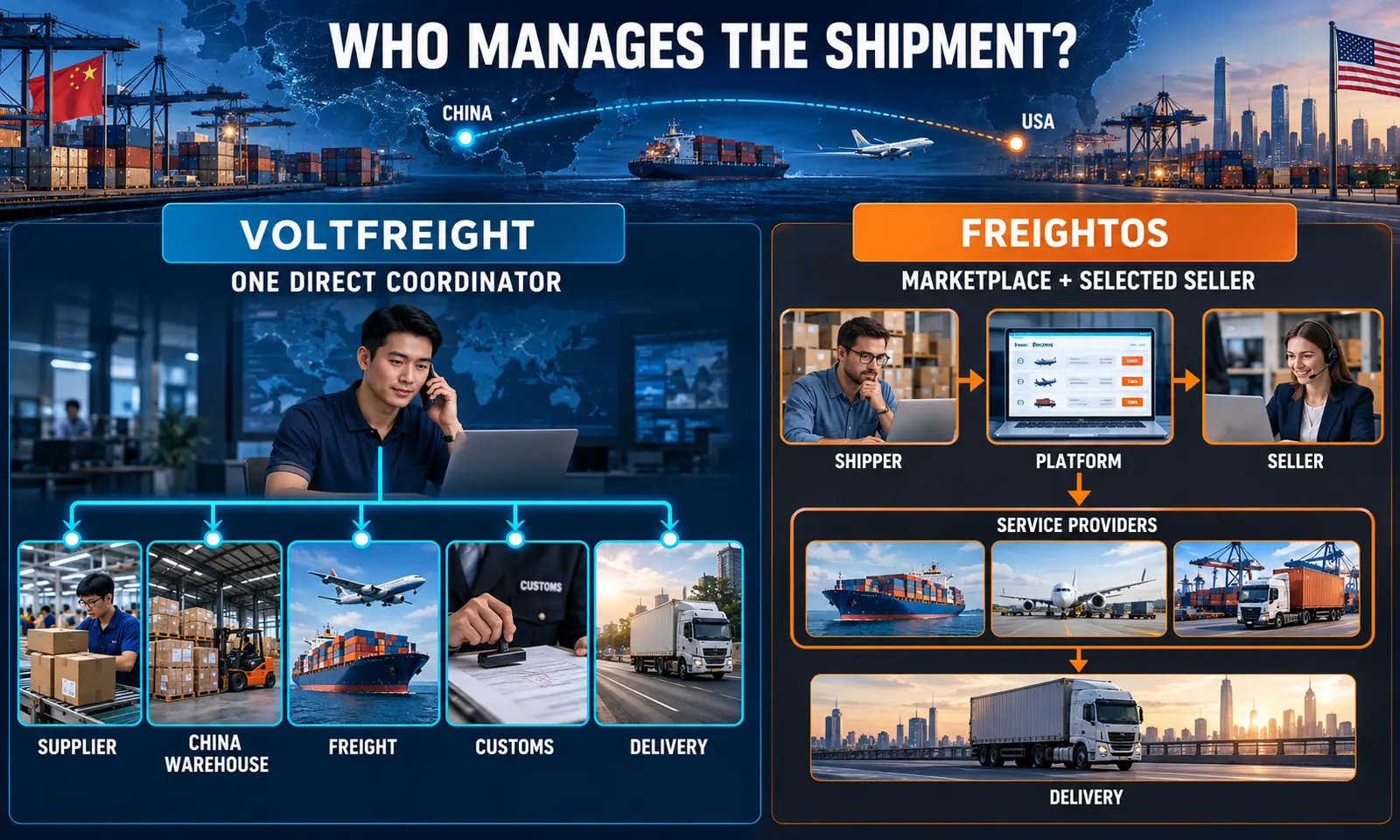
Freightos can provide a useful dashboard, online comparison, tracking tools and platform assistance. However, the VoltFreight vs Freightos difference is that platform support is not the same operating model as appointing one freight forwarder before booking and asking that company to contact suppliers, verify packing information and construct the entire route.
With VoltFreight, the working relationship starts before a rate is accepted. We can communicate with the factory, determine whether the dimensions are final, check whether the cargo contains batteries or liquids, decide whether consolidation is practical and clarify who handles customs and final delivery. For an importer with several Chinese suppliers, these steps may matter more than the speed of receiving the first quotation.
What Our Freightos Research Found
Freightos currently advertises port-to-port, port-to-door and door-to-door options. Our earlier research did not conclude that its software was technically incapable of producing a door-to-door quote. The finding was more practical: on the China-to-USA searches and quotation samples reviewed in March 2026, the most consistently usable results were port-to-port or required destination services to be selected and coordinated separately.
Port-to-Port and Door-to-Door Availability
A complete door-to-door quotation requires compatible rates for China pickup, origin handling, international freight, destination charges and final delivery. If a participating Seller has not published every required element for a route, the result may be unavailable, incomplete or dependent on additional coordination.
VoltFreight handles the route in the opposite direction. We begin with the factory address and final destination, then build the required pickup, warehouse, main freight, customs and delivery steps. For customers that only need port-to-port shipping, unnecessary services can be removed. For customers that need door-to-door shipping from China, the quotation can define every included and excluded stage.
Customs Clearance and Duties
Our tested Freightos quotations did not consistently include customs clearance as one complete, automatically bundled service. Brokerage could be selected, added or arranged through the chosen provider, but the responsibility and cost had to be checked separately. Import duty and tax were also not automatically included unless the quotation specifically used a DDP service scope.
This distinction matters because customs brokerage, import duty and DDP are not interchangeable. A broker may file an entry while the importer remains responsible for duty, bond and product compliance. A properly scoped DDP shipment from China to USA must state who coordinates customs, which costs are included and what information the consignee must provide.
Support and Shipment Ownership
Freightos provides platform support and messaging with the selected Seller. What our comparison did not find was the same type of permanent, China-based account contact who already knew the supplier, cargo history, packaging requirements and destination plan before the booking.
When everything matches the original booking, platform communication may be sufficient. When the supplier changes the carton count, the factory misses the cutoff, customs requests a product document or the delivery warehouse changes its appointment, the value of one coordinator becomes more visible. The question is not whether support exists. The question is how many parties the importer must contact to obtain a decision.
Why Some Importers Hesitate to Use a Direct Freight Forwarder
Freight marketplaces are attractive because they display choices immediately. Some companies avoid contacting a forwarder because they expect a slow quotation process, hidden markups or a service designed only for large importers. Those concerns are understandable, but they do not always reflect how a specialized China forwarder works.
Concern 1: Losing Visibility or Control
Some importers assume that giving a forwarder responsibility means losing control of the shipment. In practice, control depends on the quality of the information and communication, not whether a rate was generated by a platform. A direct coordinator can explain the booking status, cargo cutoff, sailing or flight, customs position and delivery plan while also contacting the supplier when data changes.
Concern 2: Hidden Fees
An online rate looks transparent because the customer sees an immediate price. However, any freight quote—marketplace or direct—can change when the declared dimensions, weight, address type or service request is inaccurate. The right comparison is not “online price versus manual price.” It is a comparison between two quotations with the same Incoterm, cargo measurements, customs scope and delivery conditions.
VoltFreight quotations identify the service basis and known inclusions before booking. Additional costs can still arise from customs inspection, storage, demurrage, consignee delay or changes made after confirmation, but these risks should be explained rather than hidden behind the base freight rate.
Concern 3: Small Shipments Are Not Worth a Forwarder’s Time
Some companies believe freight forwarders only handle full containers or large air shipments. VoltFreight can also coordinate LCL cargo, consolidated supplier orders, express shipments and smaller DDP consignments. A small shipment may need more planning, not less, because minimum charges and destination fees have a larger effect on the final cost.
For example, a 2–3 CBM commercial shipment may fit LCL sea freight from China, while a light urgent order may be better by air or express. A direct review prevents an importer from choosing sea freight merely because the base rate appears lower.
How Does Freightos Make Money?
Freightos earns revenue from transactions and digital services connected with its marketplace and logistics technology. Sellers pay marketplace fees when shipments are booked, while other Freightos products generate revenue from software, payment, data and market-intelligence services.
In our earlier marketplace research, the effective commission or marketplace-related cost built into comparable quotations was estimated at approximately 8%–15%, depending on the shipment mode, provider and transaction structure. This figure was not always displayed to the shipper as one separate commission line. It represents the effective marketplace-related cost found in that research, not a claim that Freightos publishes one universal 8%–15% fee for every shipment.
The commercial structure affects accountability. Freightos earns revenue when a transaction takes place through the marketplace, while the selected Seller performs the actual freight service. Freightos may assist with communication and disputes, but the freight contract remains with the Seller.
VoltFreight’s relationship with a customer depends more directly on shipment execution, repeat bookings and long-term retention. If a supplier misses a ready date, packaging is unsuitable or customs requires more information, VoltFreight must help solve the problem if it expects the customer to return. This does not mean that a marketplace has no interest in successful shipments. It means the two models distribute responsibility and commercial incentives differently.
Why VoltFreight Provides More Control for China-Origin Shipments
VoltFreight’s main advantage is not simply access to an ocean or air rate. It is the ability to manage the China side of the shipment before the cargo enters the international network.
Depending on the shipment, our work can include:
- contacting one or more suppliers and confirming cargo-ready dates;
- arranging EXW pickup from Chinese factories;
- receiving cargo at a China warehouse and checking package quantities;
- measuring cartons, pallets or wooden cases before final quotation;
- taking warehouse photos and reporting visible packaging problems;
- combining orders from multiple suppliers into one shipment;
- repacking, labeling, palletizing or preparing cargo for Amazon FBA;
- reviewing batteries, liquids, magnetic products, food and other sensitive cargo;
- comparing ocean, air, express and DDP routes;
- coordinating export documents, customs arrangements and final delivery.
This manual work is difficult to represent in a standard quote form. A marketplace search depends on the information entered by the user. If the supplier provides estimated dimensions that later increase, the displayed rate may no longer apply. VoltFreight can obtain and verify the packing information before the customer commits to the final route.
Direct coordination is also useful for sensitive or regulated products. A battery shipment may need an SDS, UN38.3 test information or different airline routing. Cosmetics, food, supplements and branded products may require destination-specific documents. Oversized machinery may need a wooden case, forklift plan or non-standard delivery. These details cannot be solved by selecting the cheapest visible price.
For standard cargo with complete data, Freightos may provide a fast way to discover market options. For cargo that still requires decisions at the supplier or warehouse, VoltFreight offers more practical control.
Cost, Transit Time and Real Client Results
The following figures come from the researched VoltFreight vs Freightos comparison used for the original article. They should not be treated as live September 2026 quotations. Ocean and air rates change with capacity, fuel, season, routing and cargo data. Their value is to show how service scope and booking structure can affect the result.
40ft Ocean Freight: Shanghai to Los Angeles
The researched direct-forwarder range was USD 1,800–2,200, compared with a Freightos marketplace range of USD 2,100–2,900, subject to the selected sailing and quote conditions. In that sample, the direct arrangement was approximately 15%–25% lower. On a USD 2,500 shipment, that represented a potential difference of approximately USD 375–625 per container.
This comparison is only valid when both offers cover the same origin, destination and charges. An ocean rate excluding destination handling cannot be compared with a port-to-door price. Importers should use our container cost from China to USA guide to identify the components that may sit outside the headline rate.
100 kg Air Freight: Shanghai to Los Angeles
The original research recorded a direct-forwarder range of USD 2.50–3.20/kg and a Freightos marketplace range of USD 3.10–4.50/kg. Actual air freight pricing depends on chargeable weight, cargo dimensions, product restrictions, departure airport and final delivery scope. The comparison therefore assumes that both quotations use the same 100 kg cargo data and equivalent service boundaries.
Ocean LCL Transit and Los Angeles Warehousing
The researched direct LCL plan averaged approximately 18–22 days door to door, while the marketplace samples showed approximately 20–28 days, varying by provider and route. The Los Angeles warehouse range used in the earlier research was USD 18–25 per CBM per month.
Transit time should never be evaluated without its definition. Port-to-port, CFS-to-CFS and door-to-door times start and finish at different points. LCL also requires consolidation in China and deconsolidation in the United States, so a shorter advertised sailing does not always create an earlier delivery.
Operational Results Retained from the Original Research
The earlier operational dataset recorded the following outcomes:
- Amazon FBA sellers reported approximately 20% faster inventory rotation when using a coordinated FBA door-to-door process instead of separately managing freight, customs and delivery.
- Recurring B2B importers moving 5–15 pallets per month recorded an average 18% cost reduction after moving from shipment-by-shipment marketplace shopping to planned rate and routing arrangements.
- First-time importers reported a 95% reduction in logistics-related stress when documentation, brokerage and shipment follow-up were coordinated through one operating contact.
These figures describe the researched client sample and are not guaranteed outcomes for every VoltFreight customer. Shipment frequency, cargo profile, season and destination all affect the result. The operational lesson remains useful: recurring shipments can benefit from accumulated cargo knowledge and route planning that a new spot booking must rebuild each time.
When Freightos Might Work—and When It May Not
Freightos May Be a Good Fit When
- the cargo is ordinary commercial freight with no special restrictions;
- the shipper already has accurate final dimensions and weight;
- one supplier is shipping from a standard port or warehouse location;
- the importer understands Incoterms, customs and destination charges;
- the primary goal is to compare several spot quotes quickly;
- the customer is comfortable selecting and managing the Seller through a platform;
- the required route and additional services are available in the search results.
For this type of shipment, Freightos can reduce the time needed to gather initial market quotations. Its online comparison and booking workflow can be convenient for an importer that already knows exactly what service to purchase.
VoltFreight Is Usually the Better Fit When
- several Chinese suppliers must deliver cargo to one warehouse;
- the factory has not confirmed final packing data;
- the goods need photos, inspection of outer packaging, consolidation or repacking;
- the shipment contains batteries, liquids, magnets, food, cosmetics or sensitive products;
- the customer needs a clearly defined DDP or door-to-door plan;
- Amazon FBA labeling, pallet preparation or appointment delivery is required;
- the importer ships repeatedly and wants one team to retain shipment history;
- a problem requires direct coordination with both the supplier and destination provider.
The difference becomes especially important when the cargo changes after quotation. A marketplace may need the customer to update the booking and wait for the selected Seller’s response. VoltFreight can speak directly with the supplier, recalculate the shipment and explain the available alternatives before the cargo misses its planned schedule.
VoltFreight or Freightos: Final Quote Checklist and Verdict
Before deciding which quotation is lower, compare the following points line by line:
- Origin: Does the price start at the factory, a China warehouse or the port?
- Incoterm: Is the supplier selling under EXW, FOB or another term?
- Cargo data: Are the dimensions, gross weight and CBM final?
- Origin charges: Are pickup, export declaration, terminal or CFS charges included?
- Main freight: Is the carrier service direct or transshipped, and how long is the rate valid?
- Customs: Who appoints the broker, importer of record and bond?
- Duties and taxes: Are they excluded, estimated or included under a genuine DDP scope?
- Destination charges: Are terminal, CFS, chassis, drayage and release fees included?
- Delivery: Does the price cover the exact ZIP code, appointment, liftgate or residential conditions?
- Operational contact: Who will contact the supplier and solve changes after booking?
The final VoltFreight vs Freightos decision depends on the cargo and the amount of coordination required. Freightos is useful as a rate-discovery and booking marketplace. It can be a reasonable choice for a standardized shipment when the importer has complete information and the required route appears with a suitable provider. Its strongest advantage is speed of comparison.
VoltFreight is the better choice when the customer needs more than an online rate. Supplier pickup, multiple-factory consolidation, warehouse handling, special-cargo review, DDP, FBA preparation and destination coordination require an operating plan as well as a booking. Our advantage is one team that can understand the shipment before departure and remain involved until the agreed delivery scope is complete.
Freightos helps you compare providers. VoltFreight becomes the provider responsible for coordinating your shipment.
To compare an actual shipment, send VoltFreight the product name, supplier address, Incoterm, carton or pallet count, packed dimensions, gross weight, cargo-ready date and final destination. We will prepare a clearly scoped quotation so you can compare the total delivered service—not only the first rate displayed on the screen.