- What Is EU VAT in Import Logistics?
- Why VAT-Air Freight Mismatch Happens
- Understanding EU VAT and Air Freight Clearance
- Common Scenarios Leading to Double Taxation
- Matching Solutions to Avoid Double Taxation
- Prepaid VAT vs VAT Deferred Clearance
- Frequently Asked Questions (EU VAT & Air Freight Clearance)
What Is EU VAT in Import Logistics?
EU VAT (Value-Added Tax) is a consumption tax. Goods entering an EU member state from outside the EU can attract import VAT; a later sale has its own VAT treatment. The two amounts belong in different parts of the shipment and sales records.
Two key stages:
- Import VAT (at customs)
Paid at import or accounted for under a permitted national procedure during air freight clearance. - Sales VAT (after sale)
Reported for the applicable VAT period when the subsequent sale is taxable.
The business can deduct eligible import VAT when its activities give it that right and it holds the required evidence. The European Commission’s deduction guidance calls for an import document naming the claimant as consignee or importer and showing the VAT due, or enough information to calculate it. A freight invoice or a supplier’s commercial invoice does not replace that import record.
Why VAT-Air Freight Mismatch Happens
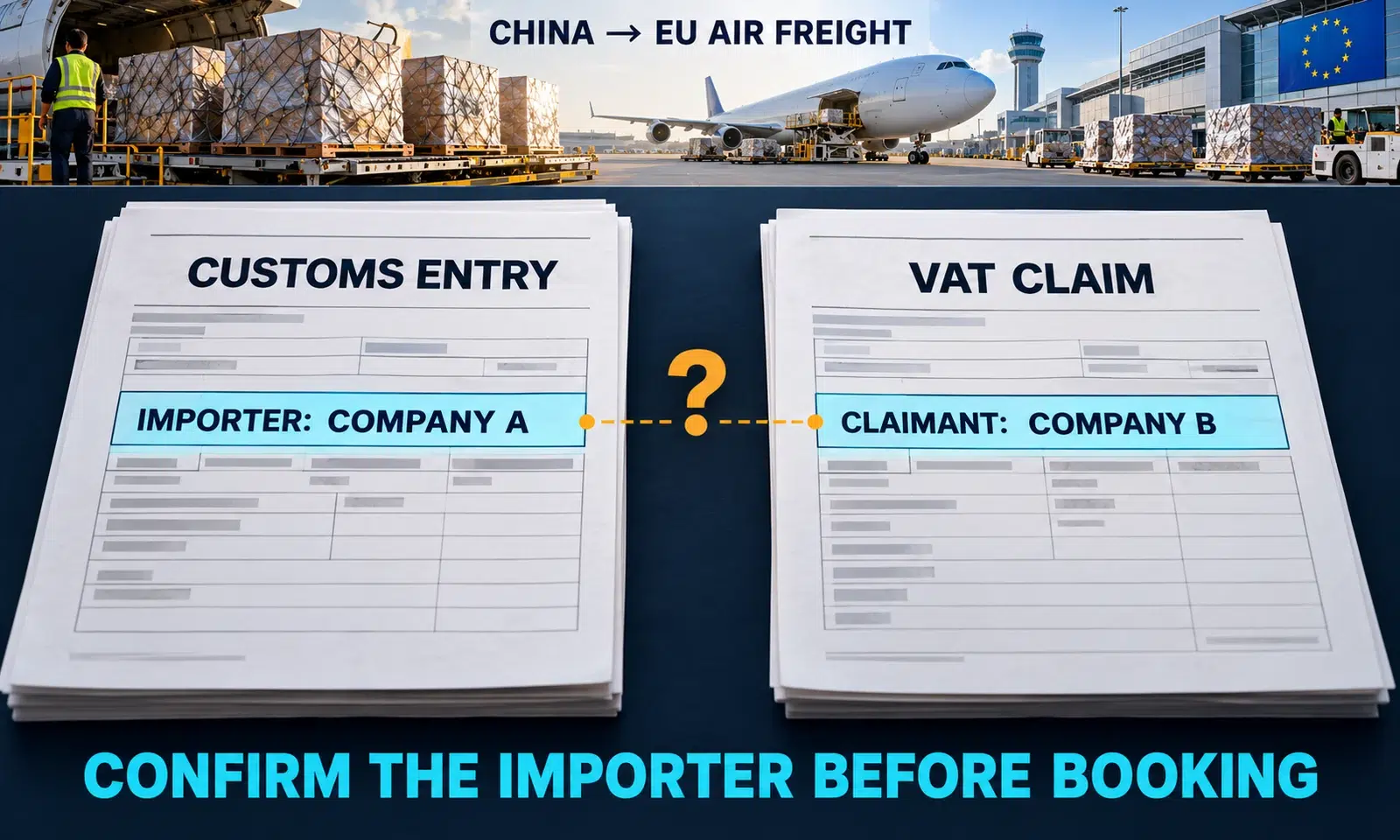
Here is where a shipment falls apart: the cargo arrives, the broker files the entry, and only then does the seller discover that another company is named as importer. Finance asks for the import VAT evidence in the seller’s name; the forwarder sends an air waybill and commercial invoice. Neither resolves who made the import. Settle the importer and VAT claimant before the goods leave China.
Common causes include:
- A forwarder or warehouse uses its own importer details without explaining whose VAT claim the entry will support.
- The seller pays import VAT upfront but receives no official import record or payment evidence for its files.
- The invoice, air waybill and customs entry describe different parties without a documented reason.
Pain Point: Paying VAT at import is not the mistake. The mistake is paying it and then discovering that the business cannot support its intended deduction. The import VAT remains a cost while VAT on the later taxable sale still has to be reported.
Understanding EU VAT and Air Freight Clearance
| Term | Definition | Key Impact |
|---|---|---|
| EU VAT (Value-Added Tax) | Tax that can arise when goods enter an EU member state. | To claim eligible import VAT, the business needs the correct importer record and must meet the deduction rules. |
| Air Freight Clearance | The import declaration, customs review, duty assessment and VAT treatment of cargo arriving by air. | Confirm who is importer before the broker submits the entry. |
| C88 Import Document | C88 is a UK customs declaration form, not an EU-wide VAT certificate. | For an EU import, request the destination country’s import declaration and VAT evidence. UK importers may need a C79 certificate or postponed import VAT statement, depending on the procedure. |
Insight: Read the importer or consignee field on the actual customs entry. Then reconcile it with the invoice, air waybill, broker instructions and VAT records. Fix a wrong identity before filing the return. EU rules do not require every transport document to carry an identical VAT number.
Common Scenarios Leading to Double Taxation
| Scenario | Cause | Result |
|---|---|---|
| Third-party VAT usage | The forwarder clears goods under its own importer details without defining the seller’s role. | The seller may have no import record supporting its own VAT claim, even though it later accounts for VAT on the sale. |
| Missing VAT deferral | Neither party checks whether the destination offers a suitable postponed-accounting procedure. | The importer pays VAT upfront and ties up cash. Prepayment itself does not remove a valid deduction. |
| Ownership mismatch | The invoice, air waybill and customs entry identify different parties. | The claimant must show how its transaction connects to the official import record. |
One missing link between clearance and accounting records can make an otherwise deductible VAT amount hard to recover. These three situations show where to look first:
1 Inconsistent VAT Subjects Between Clearance and Declaration
A seller asks a forwarder or overseas warehouse to arrange clearance. The customs entry names that third party, but the seller later claims the import VAT in its own return. The accountant asks for an import document naming the seller and receives only the supplier invoice. That invoice cannot establish who imported the goods. The seller may be unable to support the claim while it still has to report VAT on a later taxable sale.
What to do: Before the flight is booked, tell the broker which company will act as importer and which company expects to claim import VAT. Get that arrangement confirmed against the commercial invoice and proposed customs entry. If another entity must import, have the broker and VAT adviser explain the consequence before the seller relies on a deduction.
2 Unused VAT Deferral Policy & Incomplete Tax Vouchers
A seller pays import VAT at clearance and expects to recover it in the next VAT return. Months later, its finance team cannot find the import entry or evidence of the VAT charged. The payment has created a cash-flow burden; the missing records create a separate deduction problem. Paying upfront does not remove a qualifying business’s right to deduct. Ask for the destination country’s import and VAT records as soon as the broker completes clearance. If cash flow is tight, check the local postponed-accounting option before shipping.
3 Mismatched Goods Ownership and VAT Holder Information
Consolidated air cargo may travel under one master air waybill and several house air waybills. The supplier invoice names the buyer, while the master waybill names the consolidator. That can be normal. The problem is an import entry that cannot be tied to the business claiming VAT on its goods. Ask the broker how each batch maps to the customs declaration and which entity the import record identifies. Sharing an aircraft or consolidation does not, by itself, make VAT irrecoverable.
Pro Tip: Approve the importer and consignee details before the broker finalizes the customs instructions. Match the legal entities across the documents; do not try to solve a wrong importer by adding the same VAT number to every page.
Matching Solutions to Avoid Double Taxation
The choice is practical: clear under the correct importing business and pay VAT at entry, or use an available national procedure that changes when the import VAT is accounted for. Neither route fixes a wrong importer. The destination broker checks the required EORI, any VAT registration and the country-specific filing method.
Before booking the flight: Send the broker the destination country, intended importer’s legal name, goods owner, invoice and product description. Ask two direct questions: “Whose name will appear on the import entry?” and “What import VAT evidence will that business receive?” VoltFreight can pass the answers through to the supplier and air freight team so the shipping documents reflect the agreed clearance plan.
Solution 1: Clearance with Your Own VAT Number
If the buyer will import the goods and claim import VAT, put that business at the center of the clearance instructions. The broker confirms its EORI and any VAT registration needed for the transaction. Do this before cargo arrives, not when the accountant asks for records weeks later.
Operation Standard: Give the supplier, VoltFreight and the destination broker the agreed importer’s legal name and shipment details. Review the commercial invoice, air waybill and draft customs instructions for conflicting identities.
Compliance Logic: After clearance, collect the destination country’s import declaration and VAT evidence. Verify that the record identifies the relevant importer or consignee and establishes the VAT charged.
Deduction Effect: The business can claim the import VAT to which it is entitled when it has the required records. The amount may be fully deductible, partly deductible or non-deductible according to the use of the goods and applicable rules. Matching paperwork supports a valid claim; it does not create one by itself.
Advantages:
- The import evidence goes to the business that needs it for an eligible VAT claim.
- Finance can trace the customs entry back to the shipment and invoice.
- Discrepancies surface before the VAT return is filed.
Solution 2: VAT Deferred Clearance
For regular imports, paying VAT upfront on every shipment can tie up working capital. Where the destination country permits postponed accounting for this importer, it can account for import VAT through its VAT return instead. A deferred-payment arrangement may work differently, so the broker must name the actual procedure before quoting its benefit.
Core Advantages: An eligible importer can avoid financing import VAT at clearance under a postponed-accounting procedure. Customs duty and other charges can still be due.
Operation Requirements: Have the destination broker check eligibility, registration or approval, and the customs declaration instructions before the shipment departs. Name the correct importer and retain the resulting VAT statement or import record.
Applicable Value: This route addresses cash flow. It does not fix a declaration under the wrong company or automatically make VAT deductible.
Requirements:
- Confirm that the importer qualifies under the destination country’s procedure.
- Instruct the broker which approved method to use in the declaration.
- Send the final import and VAT records to the same business’s finance team.
| Benefit | Description |
|---|---|
| Cash Flow Optimization | Eligible postponed accounting moves import VAT into the return instead of an upfront payment at clearance. |
| Compliance Assurance | The declaration and VAT statement show how the importer accounted for the shipment; eligibility to deduct is checked separately. |
| Financial Flexibility | Less cash tied up in import VAT on qualifying repeat shipments. |
After Air Freight Clearance: Match the Import Record to the Shipment
Do not close the shipment file when the cargo is delivered. Ask for the import entry reference, importer or consignee details, VAT amount and the relevant payment evidence or accounting statement. Keep them with the invoice, packing list and air waybill. If the entry names the wrong business, contact the broker before filing the VAT return; changing the invoice alone does not change the customs entry.
Prepaid VAT vs VAT Deferred Clearance
The key difference is when the importer finances the VAT. Neither method excuses a missing import record or changes who has the right to deduct:
| Comparison Dimension | Prepaid VAT Clearance | VAT Deferred Clearance |
|---|---|---|
| Double Taxation Risk | Missing import evidence can block a valid claim; paying upfront is not the cause by itself. | A wrong importer can still cause a VAT problem even when no VAT is paid upfront. |
| Capital Occupation | Import VAT is paid at clearance. | Under eligible postponed accounting, import VAT is accounted for in the return. |
| Qualification Threshold | Follow the destination’s ordinary import-payment rules. | Meet the country’s registration, eligibility and any approval requirements. |
| VAT Deduction Difficulty | Keep the import entry and proof of VAT paid; entitlement is checked separately. | Keep the import entry and VAT statement; normal deduction rules still apply. |
| Suitable Business | Irregular shipments where paying VAT at import is practical. | Qualifying importers with repeat shipments and a need to manage cash flow. |
Frequently Asked Questions (EU VAT & Air Freight Clearance)
Can I use a forwarder’s VAT number for long-term EU air freight clearance?
Do not borrow a forwarder’s VAT number to get the goods cleared. First decide who will be importer and who expects to claim import VAT. If the entry names the forwarder, your supplier invoice does not automatically give you evidence for your own deduction. Get the broker to explain the arrangement before departure.
Will consolidated air freight cause VAT double taxation?
No. Sharing an air shipment does not itself cause a VAT problem. The risk is that your goods enter under another company’s import record and you cannot support your intended claim. Ask the broker which entry will cover your goods and who it will name as importer or consignee.
Which EU countries support air freight VAT deferral policies?
Germany, France, Italy, Spain and the Netherlands do not use one identical procedure. Tell the broker where the goods will be imported and ask which postponed-accounting or deferred-payment option, if any, this importer can use. Get that answer before the customs declaration is filed.
VoltFreight can coordinate air freight from China, collect the supplier’s shipment details and pass the agreed importer instructions to the air freight and clearance teams. Send us the product, supplier location, weight, dimensions, destination and intended importer. We can help keep the shipping file consistent; your destination broker confirms the entry and your VAT adviser confirms the deduction.
Recommended Industry Resources