Where should your inventory live? Keep every proven product in China, and buyers may face slow delivery and repeated international parcel charges. Move untested stock overseas too early, and storage fees can consume cash while the goods sit unsold. For businesses sourcing from China, the choice between a China warehouse and an overseas warehouse directly affects freight cost, delivery speed, inventory turnover and customer experience.
Here, a China origin warehouse holds goods near suppliers before export. China-based exporters may call it a “domestic warehouse”; for an overseas importer, China is the origin, not the home market. An overseas warehouse holds imported stock in a destination market such as the US, UK or Europe. Keep trial products and scattered demand at origin; consider destination stock for reliable repeat orders. Use both when different SKUs need different treatment.
A B2B buyer may take cartons or pallets on a planned schedule; an ecommerce customer may need one parcel tomorrow. These are different order profiles, so compare their freight, storage and delivery costs separately.
From a freight-forwarding perspective, the key is to compare the whole route and the cash committed to stock before choosing either warehouse. The following sections show where each model earns its place.
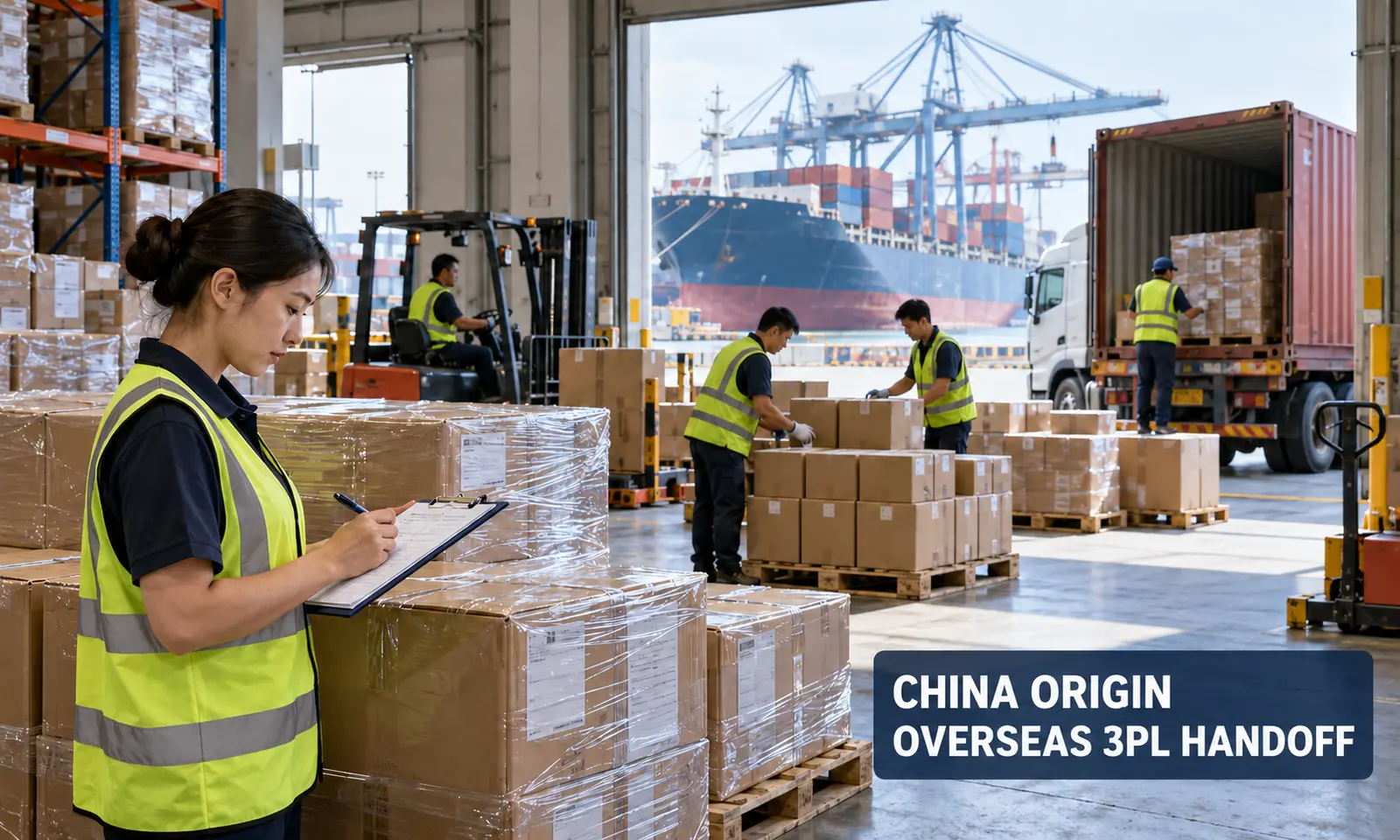
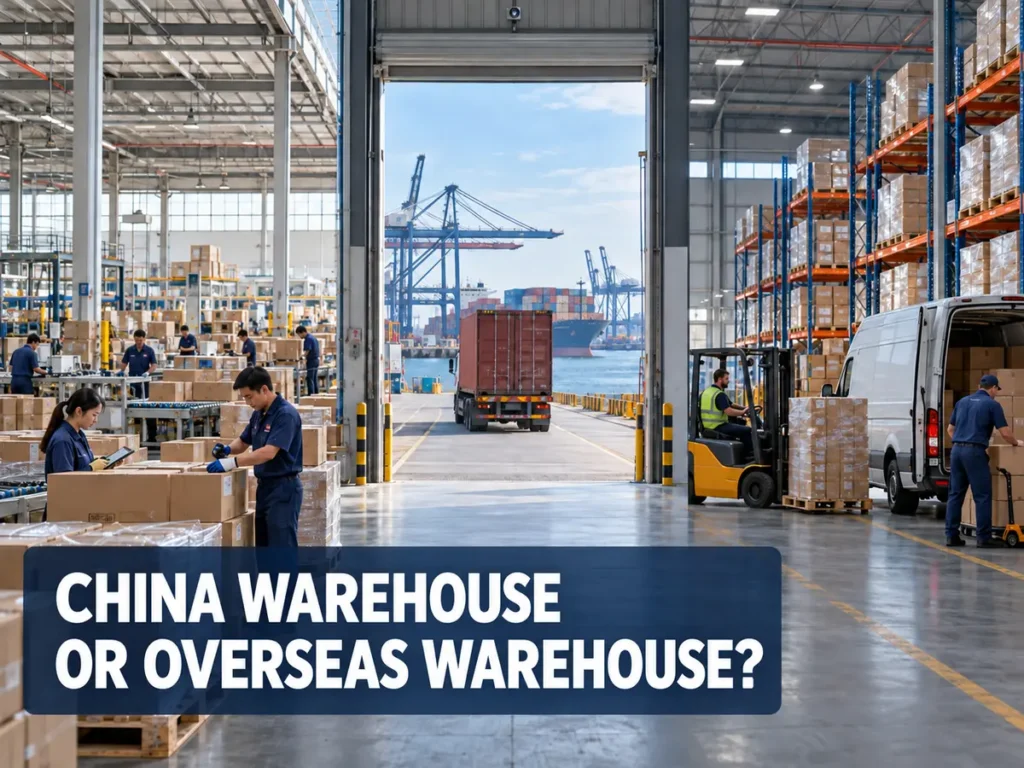
Distribution centers: A China hub receives and prepares goods before export; a destination hub holds imported stock for local orders. Each solves a different problem.
Part 1: China Origin Warehousing Before Export
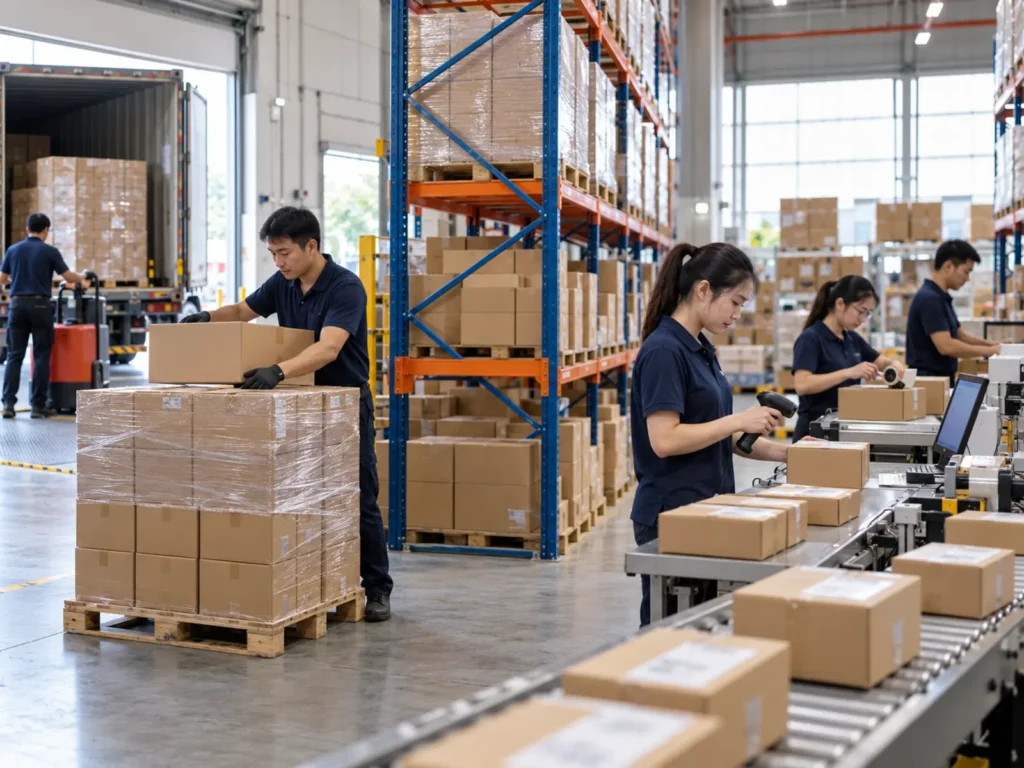
A China origin warehouse sits near the country of manufacture and serves as the first stage of global fulfillment. Suppliers deliver products to one hub, which may use a warehouse management system (WMS) to track inventory and orders. Goods stay in China until a bulk shipment or an individual international order is ready to dispatch. This is the “domestic” option only from the China-side supply-chain perspective.
This keeps packaging and inventory decisions close to the factory. The trade-off is clear: every subsequent export still needs freight and customs arrangements.
Which China Warehouse Setup Fits Your Cargo?
The original four warehouse types describe two different choices. Public versus private describes who operates the facility. Bonded versus non-bonded describes its customs status. These categories can overlap where the facility holds the required authorization.
Operating model
- Public warehouses: Third-party, multi-tenant facilities charge for agreed pallet positions, shelves, floor space and handling. Seasonal businesses and growing brands gain flexible space without buying a warehouse, although minimum fees and contract terms still apply.
- Private warehouses: A brand owns or leases its own facility and controls the layout, operations and WMS. That control brings rent or property costs, staff and equipment commitments, so it fits very high, stable volumes better than uncertain demand.
Customs status
- Bonded warehouses: Customs-supervised facilities can hold eligible goods under the applicable bonded regime. Depending on the location and authorization, storage, handling or kitting may occur before duties and taxes become payable on release into the domestic market. Duty deferral can improve cash flow for the right import or re-export flow; it is not a blanket benefit for every China-made product.
- Non-bonded warehouses: Standard facilities outside a bonded customs regime. They may suit ordinary China-side consolidation, direct export preparation or domestic distribution. The tax position depends on where the goods came from and how they are sold; it should not be assumed that every item in a non-bonded warehouse has already incurred import duty.
For ordinary China-made goods waiting to ship abroad, a non-bonded origin warehouse may be enough. Bonded status matters when a shipment actually enters an eligible customs-supervised flow.
What Does a China Origin Warehouse Do Better?
An origin hub gives cross-border brands three practical advantages:
- Centralized inventory control: Keep the full catalog in one China hub instead of splitting it prematurely across countries. Allocate stock after you see which market is actually ordering.
- Packaging and kitting flexibility: Perform quality checks, custom kitting, subscription-box assembly and branded packing near the manufacturer, where supplier feedback and packing materials are easier to coordinate. Confirm the warehouse’s handling price for the specific work.
- Minimized capital risk: If a SKU fails in one market, goods still in China are not trapped in an overseas 3PL. Eligible stock can be redirected, repacked or held for another channel, though production and China storage costs remain.
Part 2: Moving Closer to Buyers: Overseas Warehousing
Overseas warehousing moves a bulk shipment by ocean or air into the target market, such as the US, UK or an EU country. After import clearance, a regional distribution center holds the goods and ships local orders. You pay to place inventory there before every unit has sold, but you no longer arrange an international shipment for each order.
What Are Some Common Types of Overseas Warehouses?
- Overseas 3PL hubs (shared distribution centers): Multi-tenant facilities receive stock, then pick, pack and ship local orders or prepare B2B carton and pallet releases. Some connect to Shopify or marketplace systems. Check receiving, integration, returns and B2B delivery capabilities before sending cargo.
- FBA and other platform warehouses: Marketplace facilities such as Amazon FBA may give eligible products faster platform delivery, but enforce their own receiving, labeling, capacity and seasonal or aged-stock charges. They do not automatically suit wholesale orders from other channels.
What Are the Advantages and Disadvantages of Overseas Warehousing Services?
The advantages
- Faster last-mile delivery: Stock already in the destination country can reach eligible local addresses in one to three days with the right warehouse and courier. Confirm warehouse cutoff times and postcode coverage before promising that speed.
- Lower international shipping cost per order: Bulk ocean freight can spread international transport across many units instead of paying to fly each small order abroad. The saving holds only after destination receiving, storage, picking, taxes and local delivery are included.
- Simpler domestic returns: A 3PL with returns service can receive, grade and restock eligible goods locally instead of sending individual returns to China. Damaged or restricted products may still need another remedy.
The disadvantages
- Higher warehousing carrying costs: Destination storage, labor, receiving and pick-and-pack fees can exceed China-side costs. Ask for the full fee schedule, not just the quoted storage rate.
- Overstock and dead-stock risk: Send too much of a slow-moving SKU abroad and storage, aging fees or liquidation can erase the savings from local shipping.
Comparison: China Origin vs. Overseas Warehouse
China origin warehouse vs. overseas warehouse: do not compare only the two storage bills. Origin stock can create repeated international freight charges; overseas stock commits freight and inventory before orders arrive. Compare the entire flow for the same SKU, market and order type.
| Operational Metric | China Origin Warehouse | Overseas Warehouses (Destination Hub) |
|---|---|---|
| Upfront Capital Risk | Lower: Commit less stock to any one foreign market; scale warehouse space under the agreed terms. | Higher: Pay bulk freight and place inventory abroad before all units sell. |
| Last-Mile Shipping Speed | Slower: Often 7 to 14 business days for an illustrative cross-border parcel route, depending on service and customs. | Faster: An illustrative 1 to 3 days for eligible addresses served by a local courier and stocked warehouse. |
| Per-Unit Storage Overhead | Often lower monthly pallet or bin storage costs at origin. | Often higher storage and local labor costs; check the actual market. |
| Custom Kitting & Quality Control | Easier to inspect, repackage and adjust goods close to the factory. | Possible, but complex rework and kitting may cost more locally. |
| Best Suited For | High-SKU catalogs, lighter goods and new-market tests. | High-volume bestsellers, heavier goods and brands with stable local demand. |
These time ranges are examples, not guarantees. A B2B pallet delivery, an Amazon transfer and a consumer parcel have different timing and charges.
Calculate both models for the same SKU and sales period. China stock: receiving, storage, preparation, international freight, clearance and returns. Overseas stock: bulk freight, import costs, receiving, storage, picking, local delivery, returns and unsold inventory. Compare cost per fulfilled order for parcels, or per delivered unit or pallet for wholesale. Use realistic sales, not every unit you hope to sell.
Which Warehouse Fits Your Orders: China, Overseas or Both?
Choose a China Origin Warehouse If You:
- Are testing new products or entering overseas markets before committing to destination inventory.
- Sell fast-changing or trending products with unstable demand.
- Have limited cash flow and want to avoid placing too much stock overseas.
- Receive a low or scattered volume of cross-border orders that does not yet justify regular bulk replenishment.
Choose an Overseas Warehouse If You:
- Have stable best-selling products and continuous repeat orders in a defined destination market.
- For ecommerce orders, need faster local delivery to improve customer satisfaction and marketplace service performance.
- For repeated single-piece orders, want to reduce international parcel costs after accounting for all destination fees.
- Are building a long-term local brand presence and can forecast replenishment with reasonable confidence.
For B2B wholesale, the stronger reason to hold overseas stock is repeated local carton or pallet replenishment with a defined delivery window. For ecommerce, it is local picking and parcel delivery. Confirm that the chosen 3PL supports the order profile you actually sell.
Best Advanced Solution: Hybrid China + Overseas Fulfillment
Keep new, trial and low-volume products in a suitable China bonded or non-bonded warehouse; move proven bestsellers to an overseas distribution center. You avoid trapping uncertain SKUs abroad while giving repeat buyers faster access to reliable stock. Whether this improves cost and competitiveness depends on accurate replenishment and inventory records.
We recommend evaluating a hybrid warehouse match for 90% of scaling B2B brands before committing the whole catalog to one location. This is a screening recommendation, not a claim that 90% should actually split stock. Let SKU demand and total cost decide the final placement.
How VoltFreight Helps Businesses Choose the Right Model
VoltFreight connects the two sides of this decision. If inventory stays in China, we can collect from suppliers, receive and prepare the goods, and dispatch the agreed international shipment. If proven stock moves overseas, we can coordinate China pickup, export, ocean or air freight, customs handover and delivery to the nominated 3PL or platform warehouse. The overseas provider handles its own storage and local orders under a separate agreed scope.
Flexible Warehousing Network
Our Shenzhen warehouse can receive goods from multiple suppliers, check the outer cartons, record quantities, arrange repacking or labeling when requested and consolidate suitable cargo. For overseas inventory, we arrange delivery to the customer’s nominated or agreed destination 3PL. You can keep uncertain SKUs in China and replenish the overseas facility with proven products.
Customs Clearance Expertise
Before booking, we review the invoice, packing list, importer and warehouse destination, then coordinate China export and destination clearance with qualified parties. Bonded and non-bonded movements need the correct customs procedure. That check prevents a warehouse handover from being mistaken for import release.
Real-Time Inventory Management
At origin, receiving records and carton details show which supplier goods arrived and what is ready to ship. At destination, the 3PL’s WMS may report receipts, dispatches, returns and remaining stock. We coordinate the freight handover and confirm the records each side can share; a single live dashboard depends on the actual systems involved.
Cost Optimization
We quote China handling and international freight from the real carton, weight, volume and route data. Add the 3PL’s receiving, storage, pick-and-pack and local-delivery fees to see whether overseas placement actually saves money. The cheapest freight rate alone cannot answer where inventory should live.
To compare the two models, share your SKUs, cartons, weight, dimensions, China supplier locations, target markets, monthly order volume and delivery requirement. Include the overseas 3PL or Amazon facility if one is already selected. Contact VoltFreight for the matching freight and handover scope.
Frequently Asked Questions (FAQs)
Are Bonded Warehouses Always Better Than Non-Bonded Warehouses?
No. Bonded storage may defer duty for eligible goods or support re-export, but adds customs controls. Non-bonded storage is simpler for ordinary China-side operations or a standard bulk import. Choose based on the product, customs regime and planned movement rather than assuming bonded always saves tax.
Should We Invest in Private Warehouses or Rely on Public Warehouses and 3PLs?
Public warehouses and 3PLs let growing brands scale without owning a facility. Private warehouses suit very high, stable volume or specialized handling. VoltFreight can receive and consolidate eligible cargo in Shenzhen, then coordinate freight to the agreed destination warehouse.
Can One Provider Manage Both Domestic and Overseas Warehouses for Us?
Yes. One coordinator can link China receiving, export, freight and overseas-warehouse delivery. A single operational contact does not guarantee that one company owns both warehouses or provides a unified inventory screen. Check the two facilities’ data integration if you need one stock view.
Do I Need to Register for VAT/GST If I Use an Overseas Warehouse?
Possibly. Local inventory can create VAT or GST obligations, depending on the country, owner, importer and sales model. The UK has rules for overseas sellers holding UK stock; US state sales tax works differently. A 3PL can help coordinate records or introduce a tax adviser, but does not automatically register or file for you.
EU IOSS applies to eligible low-value distance sales imported into the EU; it is not a general registration route for bulk stock already held there. Check EU IOSS, UK VAT or US sales tax with a qualified adviser before transfer. See EU IOSS guidance and UK overseas-seller guidance.
What Happens If My Overseas Warehouse Runs Out of Stock?
Set a safety-stock buffer and WMS reorder alert where available. Two to three weeks is only a starting example; use actual demand, production, freight and customs lead times to set the level. If stock runs short, emergency air freight for eligible goods can bridge the gap before the next regular replenishment.
Recommended Industry Resources
- Shopify: International Warehouse — What It Is and Its Benefits, for additional context on international warehouses.
- Shopify: Global Fulfillment — Services, Costs and Solutions, for an ecommerce fulfillment perspective.