Confused about B2B fulfillment vs. DTC fulfillment? Learn the key differences, warehouse strategies, shipping methods, inventory management, and hybrid fulfillment best practices for international growth.
Understanding the differences between B2B fulfillment and DTC fulfillment is critical for brands scaling internationally. This article explores the operational contrasts, pain points, and solutions in dual-channel fulfillment, offering insights into inventory management, warehouse workflows, and shipping strategies. Learn how hybrid fulfillment models can optimize efficiency, reduce costs, and improve customer experience.
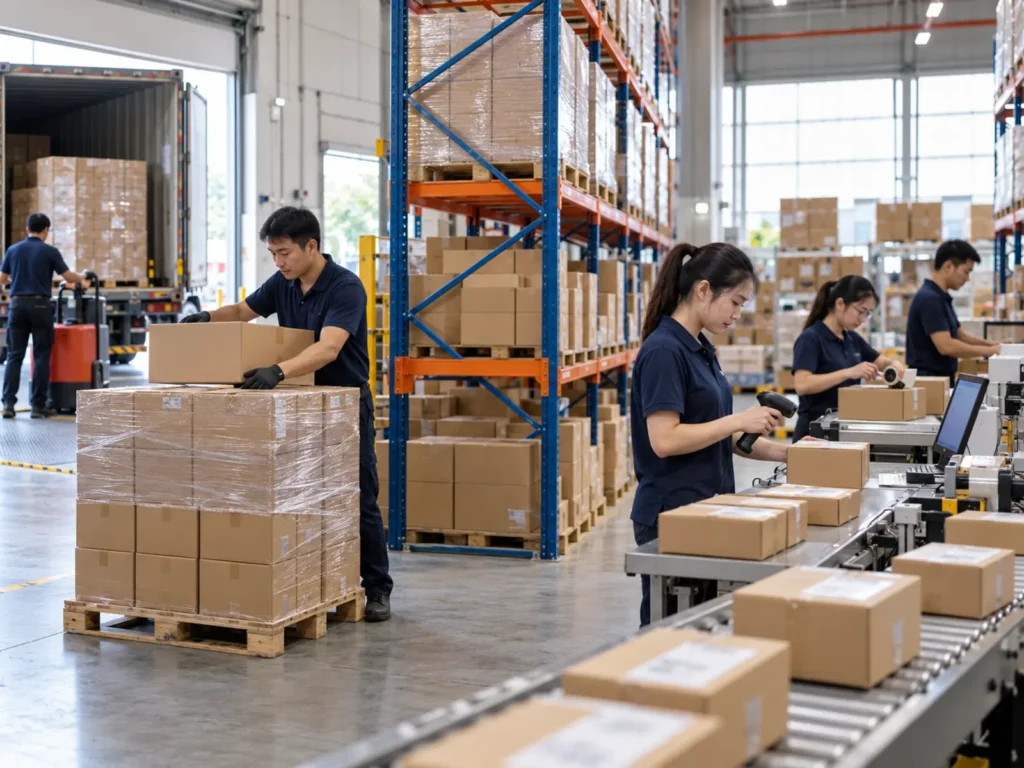
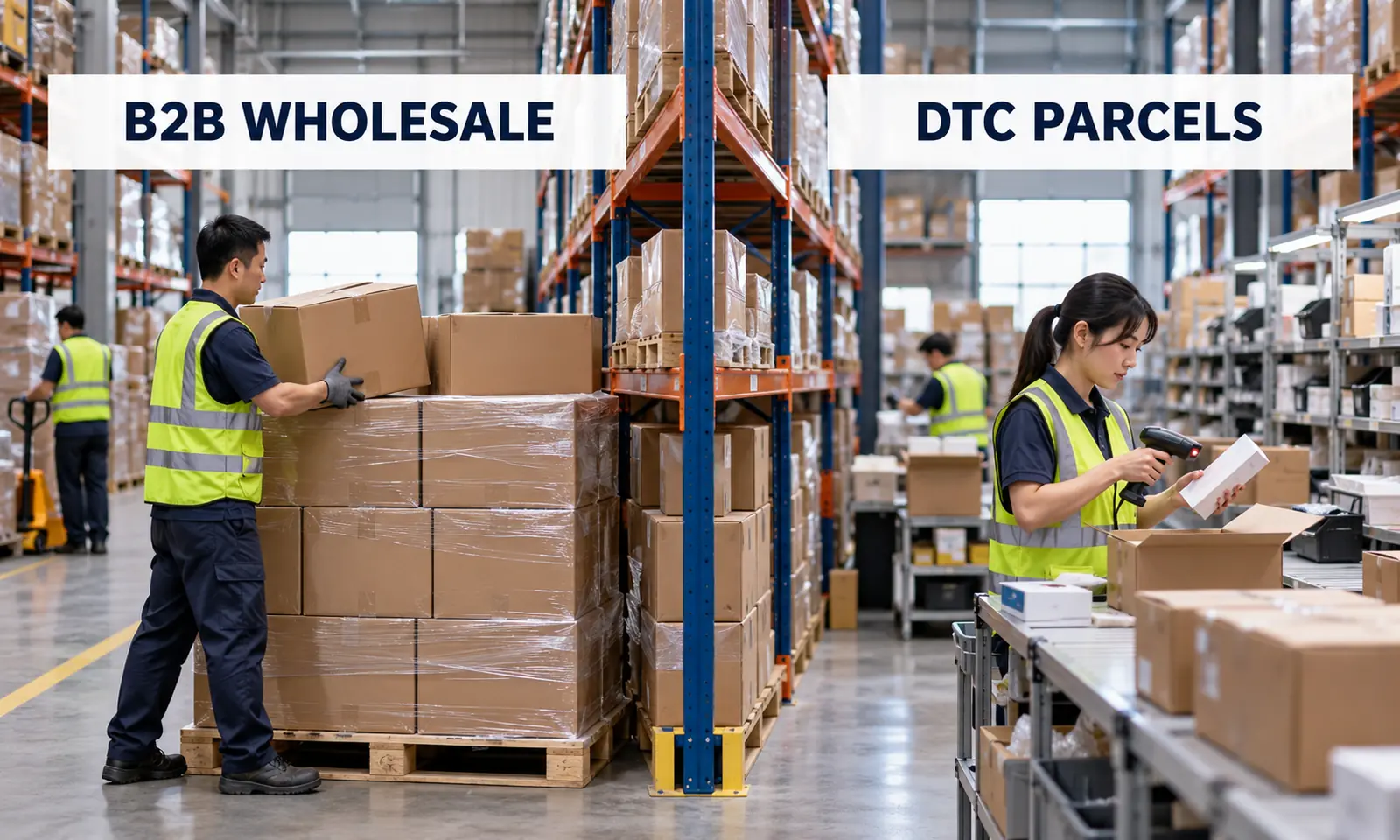
In practice, B2B logistics and DTC logistics can draw from the same inventory pool but require different preparation and delivery workflows. A wholesale order for a retailer, a pallet shipment to a distributor, an Amazon replenishment order and a single parcel for a consumer each place different demands on warehouse staff, packaging, shipping methods and service standards. The sections below connect these differences to a practical China-side fulfillment operation.
The Pain Point of Dual-Channel Complexity
The rise of e-commerce has blurred the lines between direct-to-consumer fulfillment and business-to-business fulfillment. Brands are no longer choosing one channel; they must master both. A company may sell wholesale to retailers, replenish Amazon inventory, operate a Shopify store and ship individual orders from TikTok Shop within the same sales cycle.
B2B logistics and DTC logistics use different order, packaging and delivery workflows even when the products come from the same inventory pool.
- DTC pain points: unpredictable order spikes, costly returns, high parcel volume, individual picking requirements and customer expectations for speed, tracking and delivery transparency.
- B2B pain points: compliance-heavy requirements, bulk shipping, pallet or case picking, purchase-order accuracy, retailer routing rules and the need for predictable, scalable operations.
Without a clear strategy, companies risk inefficiency, rising costs and poor customer satisfaction. A DTC promotion can consume stock reserved for a retailer, while a B2B shipment can occupy warehouse labor and equipment needed for daily parcel dispatch. Separate spreadsheets and disconnected logistics providers make these conflicts harder to see until a backorder, missed delivery appointment or customer complaint has already occurred.
The challenge is therefore operational rather than simply commercial. The brand needs one view of inventory, but it also needs channel-specific rules for allocation, picking, packaging, shipping, delivery confirmation and returns. That is the foundation of an effective dual-channel fulfillment model.
B2B Fulfillment vs. DTC Fulfillment: What’s the Difference?
B2B fulfillment and DTC fulfillment serve different customers and operate under different service expectations. B2B orders usually move in larger quantities to retailers, distributors or commercial partners. DTC orders move in individual parcels directly to consumers. The same SKU can appear in both channels, but the warehouse must handle the order according to its destination and delivery requirement.
| Feature | B2B Fulfillment | DTC Fulfillment |
|---|---|---|
| Customers | Retailers & distributors | Individual consumers |
| Average Order Size | Large bulk orders | Single-item or multi-item parcels |
| Picking Method | Case & pallet picking | Piece picking |
| Packaging | Standard cartons & pallets | Branded packaging, inserts, gift wrapping |
| Shipping Method | LTL, FTL, sea freight, air freight | Small parcel carriers, express shipping |
| Delivery Schedule | Appointment-based | Customer-selected delivery |
| Compliance | ASN, pallet labels, retailer routing guides | Customer communication & tracking |
| Returns | Low frequency | High return volume |
| Main KPI | Cost efficiency & compliance | Speed & customer experience |
For B2B fulfillment, an incorrect carton count, missing pallet label or missed receiving appointment can delay an entire purchase order. For DTC fulfillment, a wrong item, damaged parcel or missing tracking update affects one customer at a time but can create a large number of support cases when order volume increases. The warehouse must therefore use the right process for each channel instead of applying one general packing and shipping rule to every order.
Shipping methods also differ. B2B inventory may move by LTL, FTL, sea freight or air freight after case and pallet preparation. DTC orders usually rely on small parcel carriers or express shipping, with individual tracking and customer-selected delivery options. A strong fulfillment plan connects both methods to the same inventory records while keeping their operational steps separate.
Why Many Brands Need Hybrid Fulfillment Instead of Choosing One
Many businesses believe they must choose between wholesale and direct sales. In reality, most growing brands eventually operate both. A business may begin with one channel and then add marketplaces, retail distribution, subscription services or corporate orders as its customer base develops.
For example, a growing brand may:
- Sell wholesale to distributors.
- Operate a Shopify store.
- Supply Amazon FBA.
- Ship TikTok Shop orders.
- Fulfill subscription boxes.
- Support B2B corporate gifting.
This is known as hybrid fulfillment or dual-channel fulfillment. Rather than separating inventory into multiple warehouses, hybrid fulfillment allows brands to use one inventory pool while serving multiple sales channels. The model can connect China supplier receiving, inventory control, wholesale preparation, consumer parcel dispatch and international freight planning through one coordinated operation.
The benefits include:
- Lower storage costs.
- Better inventory utilization.
- Faster replenishment.
- Simplified forecasting.
- Reduced stockouts.
- Lower operational overhead.
Operating a unified inventory pool gives you maximum flexibility, preventing your capital from being locked up in one underperforming channel. However, without absolute, real-time inventory visibility, a sudden viral surge in DTC sales could accidentally drain the safety stock reserved for a critical B2B retailer order, leading to severe contract penalties. Transitioning to a high-tier, cloud-based WMS provides cross-channel visibility, protecting buffer stocks and preventing split shipments or unexpected backorders.
For day-to-day planning, allocation rules can reserve agreed quantities for B2B purchase orders while available inventory continues to support DTC demand. The operation can then distinguish stock that is available, committed, in transit or awaiting preparation, improving replenishment decisions across both channels.
A Practical Hybrid Fulfillment Workflow
A practical hybrid fulfillment workflow normally follows the same basic logic:
- Receive goods from one or more suppliers and identify each SKU.
- Record quantity, packaging condition and final inventory data.
- Allocate available stock between wholesale, marketplace and DTC requirements.
- Use case or pallet picking for B2B orders and piece picking for DTC orders.
- Apply the packaging, label and transport rule required by each channel.
- Reconcile shipped, returned, damaged and reserved inventory in one system.
This approach allows the brand to operate several sales channels without building an entirely separate inventory operation for each one.
When Should You Outsource B2B and DTC Fulfillment?
A third-party logistics partner can coordinate warehouse workflows for both B2B orders and DTC parcels.
Outsourcing becomes increasingly valuable when your business experiences:
- Rapid international expansion.
- Seasonal demand spikes.
- Multi-channel sales growth.
- Rising warehouse labor costs.
- Inventory management challenges.
- Increasing shipping complexity.
Rather than investing heavily in warehouse space, equipment, software and staffing, many brands partner with a third-party logistics (3PL) provider to gain scalable infrastructure and expertise. A capable 3PL can receive products from Chinese suppliers, prepare wholesale cartons, process individual DTC parcels, coordinate international freight and provide the operational records needed for inventory decisions.
Outsourcing is particularly useful when a brand has outgrown supplier-direct shipping but is not ready to establish warehouses in every destination market. A China-based fulfillment partner can consolidate products before export, prepare different order types and match each shipment to the correct freight channel. This can reduce repeated origin handling while giving the brand more control over packaging, labels and shipment data.
Why Global Brands Choose VoltFreight for Hybrid Fulfillment
As an experienced international order fulfillment and warehousing provider based in China, VoltFreight helps brands manage both business-to-business fulfillment and direct-to-consumer fulfillment through one integrated logistics platform. The service connects China supplier coordination, warehouse receiving, inventory preparation, international freight and final delivery.
Our services include:
- Global order fulfillment.
- International warehousing.
- Inventory management.
- Pick & pack services.
- Kitting and assembly.
- Product inspection.
- Amazon FBA preparation.
- B2B wholesale distribution.
- Cross-border DTC fulfillment.
- Returns management.
- Custom packaging and branding.
- Worldwide shipping with multiple carrier options.
Whether you’re shipping B2B orders to retailers or shipping DTC orders directly to customers, our warehouse management system provides real-time inventory visibility and flexible workflows designed for modern omnichannel commerce. Supplier pickup, warehouse receiving, carton checking, consolidation, packing, labeling and freight booking are coordinated before the goods leave China.
With strategically located fulfillment operations in China, brands can reduce shipping costs, shorten delivery times, and simplify global expansion while maintaining excellent customer experiences. A single China-side logistics partner can coordinate wholesale cargo, consumer parcels, Amazon inventory and other channel-specific shipments within one broader fulfillment plan.
How VoltFreight Solves the B2B + DTC Fulfillment Challenge
Unified International Warehousing with Channel-Specific Workflows
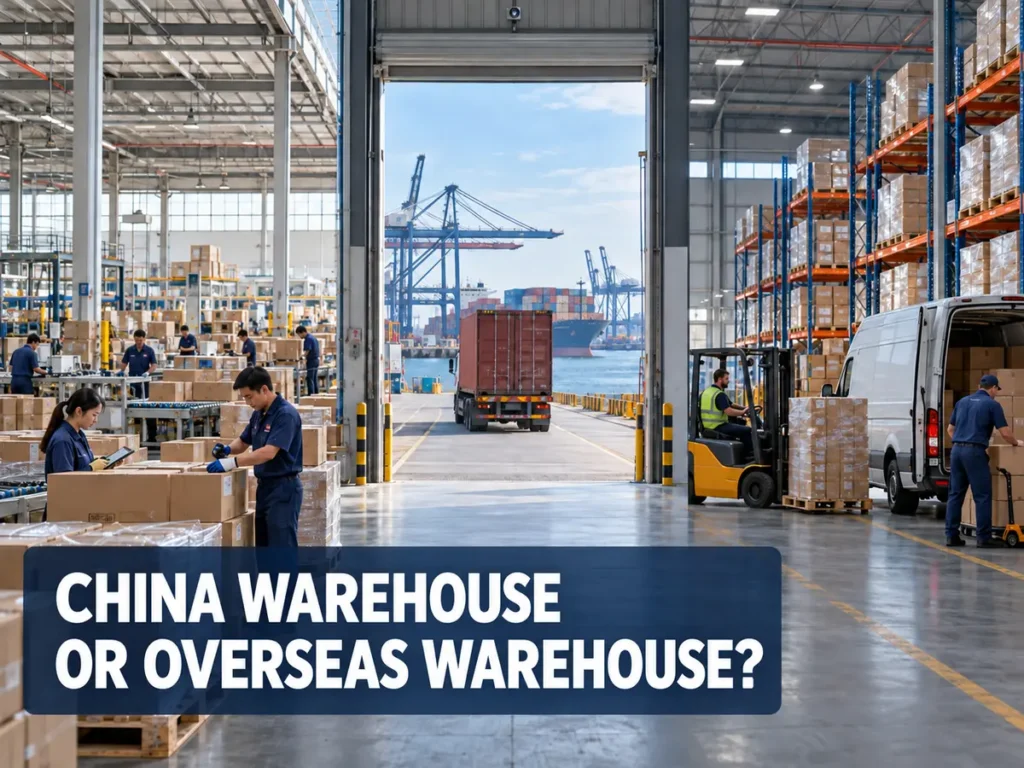
Unified international warehousing with channel-specific workflows. Our facilities in China are configured with dedicated DTC zones (optimized for piece-picking, branded packaging, and same-day parcel dispatch) and B2B zones (equipped for pallet building, ASN generation, and LCL/FTL freight staging).
This separation allows both channels to use one inventory pool while maintaining different preparation rules. Wholesale orders can be grouped by purchase order, retailer instruction or pallet requirement. DTC orders can be picked by individual unit, packed with approved inserts or gift wrapping and released through the selected parcel or express network.
Real-Time Inventory Visibility
Real-time inventory visibility. Our WMS integrates with Shopify, Amazon, WooCommerce, and major ERP systems, giving you a single dashboard view of stock across both channels. Automated allocation rules prevent channel conflict and stockouts.
Accurate records should distinguish available stock from committed B2B inventory, DTC orders awaiting dispatch, returned items, damaged units, goods under inspection and cargo already in transit. This information supports better replenishment decisions and helps the brand decide when to use air freight, sea freight, express shipping or a split shipment.
Flexible Labor Scaling
Flexible labor scaling. DTC peak season? We surge piece-picking teams. B2B purchase order due? We allocate certified pallet builders and forklift operators.
This flexibility helps brands handle seasonal demand spikes without permanently carrying the full cost of warehouse labor and equipment. It also allows the business to respond when the order mix changes quickly between consumer parcels, wholesale cartons, FBA inventory and other commercial shipments.
International Freight Expertise
International freight expertise. From LCL consolidation for B2B wholesale shipments to express parcel networks for DTC orders, we manage the entire international logistics chain—customs documentation, duty optimization, and cross-border compliance included.
When several suppliers are involved, suitable products can be received at the China warehouse, checked against the supplied information, packed according to the selected route and consolidated before export. B2B cargo may move by LCL, FCL, air freight or another commercial method, while urgent DTC replenishment or individual orders may use express or air services. VoltFreight’s multi-supplier consolidation service explains how supplier receiving, carton checks, measurement, repacking and shipping planning can be connected in one workflow.
The correct method still depends on the product, final package data, destination, deadline, customs responsibility and delivery scope. A lower freight rate does not automatically produce the lowest total fulfillment cost if it causes stockouts, missed retail appointments, additional handling or delayed consumer orders.
Frequently Asked Questions (FAQ)
What is the difference between B2B fulfillment and DTC fulfillment?
B2B fulfillment focuses on shipping bulk orders to businesses such as retailers and distributors, emphasizing compliance, palletized shipments and operational efficiency. DTC fulfillment ships individual orders directly to consumers, prioritizing speed, accurate picking, branded packaging and a seamless delivery experience. Many growing brands need both models and therefore require separate workflows connected to one accurate inventory system.
Can one warehouse handle both B2B and DTC orders?
Yes. A professionally managed fulfillment center can support dual-channel fulfillment by using separate picking processes, storage zones, packaging rules and shipping methods while maintaining a unified inventory system. The warehouse must receive clear channel instructions, maintain accurate SKU records and protect stock reserved for confirmed B2B orders while processing DTC demand.
How can businesses reduce shipping costs for international orders?
Consolidating inventory, using strategically located warehouses, selecting the right shipping method (air, sea, express, or postal), optimizing packaging dimensions, and partnering with an experienced international 3PL can significantly reduce transportation costs. B2B cargo may benefit from LCL or FCL planning, while DTC orders may require parcel, postal or express networks. Combining suitable supplier orders, measuring final cartons and comparing the complete delivery scope can also reduce repeated origin and handling charges.
Recommended Industry Resources
The following resources provide additional background on freight and parcel decisions, international warehousing and hybrid fulfillment:
- Flexport Logistics – Freight vs. Parcel
- DHL Supply Chain Insights (international warehousing)
- Shopify: Hybrid Fulfillment – A Solution for Fast Ecommerce Growth
Build Your B2B and DTC Fulfillment Plan with VoltFreight
If your brand sells through wholesale, marketplaces and direct online channels, send VoltFreight the information needed to review the full workflow:
- Product names, SKU count and supplier locations in China.
- Expected B2B order profile, DTC parcel volume and seasonal demand peaks.
- Carton quantity, dimensions, gross weight and total inventory volume.
- Required inspection, labeling, kitting, repacking or branded packaging work.
- Wholesale delivery requirements, DTC destination markets and Amazon or marketplace instructions.
- Preferred air, sea, express, postal, LCL, FCL or split-shipment plan.
VoltFreight can review the warehouse requirements and international freight plan together, then help determine how supplier receiving, inventory preparation, B2B fulfillment, DTC fulfillment and final delivery should be coordinated. Send your fulfillment and shipping details to VoltFreight for a practical plan.