The United States originally scheduled higher port service fees on Chinese-linked vessels for April 17, 2026. However, the Section 301 maritime measures were later suspended for one year beginning November 10, 2025. This means the April 2026 fee escalation should now be understood as part of the original USTR schedule, not as an active charge during the suspension period.
For importers, freight forwarders, Amazon sellers and companies shipping from China to the United States, the immediate risk is lower than the original April 2026 schedule suggested. Still, the issue has not disappeared. The suspension is temporary, carrier surcharge language may remain in contracts, and China–U.S. ocean freight costs can still be affected by capacity planning, routing decisions, blank sailings, fuel cost, tariff exposure and port congestion.
This guide explains the current status of U.S.–China port fees, the original USTR fee schedule, China’s countermeasures, what changed after the one-year suspension, and what shippers should check before booking China to USA ocean freight, DDP delivery, Amazon FBA shipments or time-sensitive replenishment cargo.
Quick Update: Are U.S. Port Fees on Chinese Vessels Active Now?
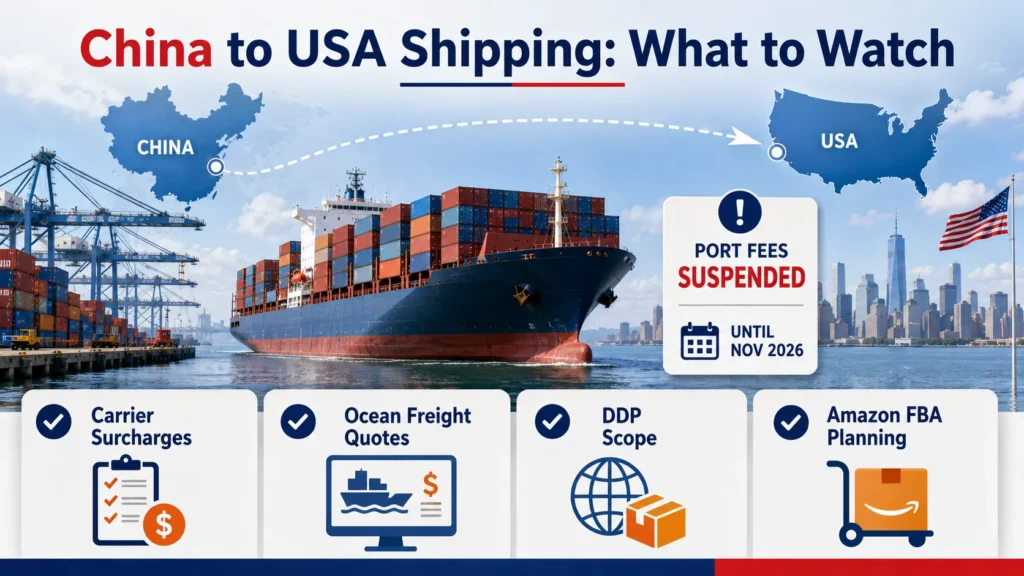
As of the current suspension period, the U.S. Section 301 maritime service fees targeting Chinese-owned, Chinese-operated and Chinese-built vessels are not active. The U.S. Trade Representative suspended the relevant actions for one year from November 10, 2025, through November 9, 2026.
This is the most important correction for shippers. The April 17, 2026 increase was part of the original phase-in schedule. However, because of the later suspension, the fee escalation should not be presented as an active April 2026 cost increase during the suspension period.
At the same time, the suspension does not mean the policy has been permanently cancelled. Importers should still watch carrier notices, contract clauses and freight quotations, especially if they are booking long-term ocean freight from China to the United States.
Original USTR Fee Schedule Before the One-Year Suspension
The USTR’s original Section 301 action targeted China’s maritime, logistics and shipbuilding sectors. Before the one-year suspension, the schedule included phased port service fees for Chinese-owned or operated vessels and Chinese-built vessels calling at U.S. ports.
| Category | Original Oct. 14, 2025 Level | Original Apr. 17, 2026 Level | Original Apr. 17, 2028 Peak Level |
|---|---|---|---|
| Chinese-owned or Chinese-operated vessels | $50 per net ton | $80 per net ton | $140 per net ton |
| Chinese-built vessels, tonnage basis | $18 per net ton | $23 per net ton | $33 per net ton |
| Chinese-built vessels, container basis | $120 per container | $153 per container | $250 per container |
Important note: This was the original schedule before the suspension. During the one-year suspension period, shippers should not treat the April 17, 2026 figures as automatically active charges. Instead, they should treat them as a policy risk that may return, change or be renegotiated after the suspension period.
What Changed After the U.S.–China Suspension Agreement?
After the original USTR action, the United States and China moved toward a temporary pause. The USTR later modified the action and suspended the Section 301 maritime measures for one year beginning November 10, 2025.
For importers, this changed the practical meaning of the April 2026 escalation. The original cost schedule still matters because it shows the scale of potential fees if the policy returns. However, current freight planning should clearly separate the original schedule from the suspended status.
This distinction is important for three reasons. First, shippers should avoid overestimating immediate April 2026 ocean freight cost increases. Second, they should still review contract language because carriers may include surcharge clauses for future regulatory costs. Third, long-term China to USA shipping budgets should leave room for policy changes after the suspension period ends.
What About China’s Countermeasures?
China also introduced special port charges on U.S.-linked vessels in response to the U.S. maritime measures. However, China later announced a one-year suspension of its corresponding port fees after the U.S. suspension.
This means the immediate risk of reciprocal port fee escalation is reduced on both sides during the pause. Nevertheless, the broader trade tension remains relevant for ocean carriers, vessel deployment, long-term contracts and shipbuilding-related policy discussions.
For businesses shipping from China, the main takeaway is not panic. The better response is to watch policy updates, confirm freight quote scope, avoid unclear surcharge clauses and keep flexible shipping options available.
How This Could Affect China to USA Shipping Costs
Even when the specific port fees are suspended, China to USA shipping costs can still be affected indirectly. Ocean freight prices are shaped by more than one government fee. Carriers also adjust prices based on demand, blank sailings, fuel cost, port congestion, vessel deployment, equipment availability and trade policy risk.
If the port fee policy returns after the suspension period, carriers may try to recover additional costs through surcharges, rate increases, routing changes or service adjustments. Some carriers may also continue using fleet swaps or non-Chinese-built vessels on selected U.S. services to reduce future exposure.
For shippers, this means a low spot rate is not the only thing to compare. A China to USA freight quote should be checked for origin charges, ocean freight, destination port charges, customs clearance, duties, tariffs, delivery cost, appointment fees, warehouse transfer, demurrage, detention and any possible regulatory surcharge language.
For broader cost planning, read our China to USA Shipping Cost guide. If you need a door-to-door landed solution, review DDP Shipping from China to USA.
What Importers Should Check Before Booking China to USA Ocean Freight
The best way to manage policy risk is not to wait until cargo is already on the water. Importers should confirm the quote scope and routing details before booking, especially for FCL, LCL, DDP, Amazon FBA and time-sensitive replenishment shipments.
1. Check whether the quote includes possible surcharge language
Ask whether the ocean freight quote includes or excludes future carrier surcharges, port service fees, regulatory charges or emergency cost adjustments. If the quote is valid for only a short period, confirm the validity date in writing.
2. Confirm the carrier and service route
For FCL shipments, the actual carrier and vessel service can matter when policy risk is linked to vessel ownership, operation or build origin. Importers do not need to manage fleet compliance themselves, but they should ask their freight forwarder whether the route has any known surcharge risk.
3. Compare West Coast, East Coast and Gulf routing
China to U.S. West Coast routes may be faster for many shipments, while East Coast or Gulf routes can make sense for cargo delivered inland or to eastern warehouses. The best option depends on destination ZIP code, cargo volume, delivery deadline, port congestion and final trucking cost.
4. Check whether destination charges are included
A low ocean rate can become expensive if destination charges are unclear. Ask whether the quote includes destination port charges, customs brokerage, ISF filing, terminal handling, warehouse transfer, devanning, palletization, LTL delivery, FTL delivery and appointment handling where needed.
5. Plan earlier for Amazon FBA shipments
Amazon FBA cargo needs more than ocean freight. Sellers should confirm FBA warehouse code, shipment ID, carton labels, box content information, pallet requirements, final delivery appointment and receiving timeline. If inventory is urgent, a split shipment may be safer: send part of the cargo by air and move the main replenishment by sea.
For FBA planning, read our Shipping from China to Amazon FBA USA guide.
Practical Shipping Options for China to USA Importers
Shippers should not choose a shipping method only because of a policy headline. The right solution depends on cargo size, urgency, product value, duty exposure, destination, Amazon requirements and cash flow.
Ocean FCL for container-level cargo
FCL is usually the better option when the cargo volume is large enough for a full container. It gives the importer more control over container loading, transit planning and final delivery. However, FCL quotes should clearly show origin charges, ocean freight, destination charges, customs clearance and inland trucking.
Ocean LCL for smaller commercial shipments
LCL can work when the shipment does not fill a container. It is useful for small-to-medium replenishment cargo, but shippers should check consolidation time, destination warehouse handling, CBM calculation and final delivery cost.
Air freight for urgent inventory
Air freight is not the cheapest method, but it can protect sales when inventory is close to stockout. It is often useful for product launches, seasonal goods, high-value products, Amazon replenishment and urgent commercial cargo.
DDP door-to-door shipping
DDP can simplify landed delivery when the shipper wants one coordinated price from China to the final address. However, the quote must clearly explain customs scope, duties, tariffs, Importer of Record responsibility, final delivery and exclusions.
Split shipment strategy
When inventory is urgent but the full shipment is too expensive by air, split shipping can help. Send a smaller urgent quantity by air and ship the main replenishment by ocean. This strategy is common for Amazon sellers and importers who need to balance speed and cost.
Should Importers Use Canada or Mexico as Alternative Routes?
Some shippers may consider Canadian or Mexican ports if U.S. port fees return or if U.S. port congestion becomes severe. This can work in selected cases, but it should not be treated as a simple shortcut.
Alternative routing can create extra trucking, customs, bonded transfer, documentation and timing issues. It may also increase total landed cost if the final destination is far from the alternative port. Before using this option, importers should compare the full landed cost, not only the ocean freight rate.
For most China to USA shipments, the first step should still be comparing normal U.S. routing options, checking surcharge exposure and confirming the full quote scope with the freight forwarder.
How VoltFreight Helps Importers Manage China-USA Freight Risk
VoltFreight helps importers, wholesalers, e-commerce sellers and Amazon sellers plan shipping from China to the United States by ocean freight, air freight, express courier, DDP and door-to-door delivery.
For China to USA shipments, our team can help you compare:
- FCL and LCL ocean freight: Compare container shipping and consolidated cargo options based on volume, destination and deadline.
- Air freight and express: Use faster options for urgent replenishment, samples, high-value products or stockout recovery.
- DDP and non-DDP solutions: Review customs scope, duties, taxes, Importer of Record responsibility and final delivery terms.
- Amazon FBA delivery: Plan shipment ID, FBA warehouse code, labels, carton data, LTL/FTL delivery and appointment requirements.
- Customs document review: Check invoice, packing list, HTS code, declared value and product compliance risk before shipping.
- Route and cost comparison: Compare West Coast, East Coast, inland delivery and split shipment options when needed.
If you are worried about China to USA shipping cost changes, port fee risk, carrier surcharge language or Amazon FBA delivery timing, send your product name, supplier city, carton quantity, weight, dimensions, cargo value, destination ZIP code and delivery deadline. Then contact VoltFreight for a practical shipping comparison.
Related China to USA Shipping Guides
- China to USA Shipping Cost
- Shipping from China to the USA
- DDP Shipping from China to USA
- Customs Clearance Service
- Shipping from China to Amazon FBA USA
- Shipping from Alibaba to USA
FAQ: U.S.–China Port Fees and Shipping from China to the USA
Are U.S. port fees on Chinese vessels active now?
The U.S. Section 301 maritime fees were suspended for one year beginning November 10, 2025, through November 9, 2026. During the suspension period, shippers should not treat the original April 2026 escalation as an active charge.
What was supposed to happen on April 17, 2026?
Under the original USTR schedule, port service fees on Chinese-owned, Chinese-operated and Chinese-built vessels were scheduled to increase on April 17, 2026. However, that schedule was later affected by the one-year suspension.
Did China also suspend its countermeasures?
Yes. China announced a one-year suspension of special port fees on U.S.-linked vessels after the U.S. moved to suspend its Section 301 maritime measures.
Will China to USA shipping costs still increase?
Not necessarily because of these suspended fees alone. However, China to USA freight costs can still change because of carrier capacity, blank sailings, fuel cost, demand, port congestion, tariff risk and contract surcharge language.
Should importers still worry about port fee surcharges?
Importers should not panic, but they should check quote validity, surcharge clauses and carrier notices before booking. This is especially important for long-term contracts, FCL shipments, DDP quotes and Amazon FBA replenishment planning.
What should I send for a China to USA freight quote?
Prepare product name, supplier city, carton quantity, gross weight, dimensions, cargo value, destination ZIP code, delivery deadline, preferred shipping method and whether you need customs clearance, DDP or Amazon FBA delivery.
Final Takeaway
The April 2026 U.S. port fee escalation on Chinese-linked vessels should no longer be described as the current active policy. The original USTR schedule still matters, but the later one-year suspension changed the immediate cost outlook for China to USA shippers.
For importers, the right strategy is to stay flexible. Review carrier surcharge language, confirm quote scope, compare ocean and air options, plan Amazon FBA shipments earlier and calculate total landed cost before booking. If you need help comparing China to USA ocean freight, air freight, DDP or Amazon FBA delivery, contact VoltFreight with your shipment details.
Sources Referenced
- USTR — Section 301: China Targeting the Maritime, Logistics, and Shipbuilding Sectors for Dominance
- Federal Register — Notice of Modification of Section 301 Action
- Reuters — China suspends port fees on U.S.-linked ships for a year
- Watson Farley & Williams — Suspension and amendments to U.S. and China port fees
- FreightWaves — Carrier response and routing adjustments