Shipping instant noodles and herbal tea from China to the USA requires more than choosing an air or sea freight rate. The importer should first review the product formula, manufacturer, English label, FDA information, U.S. importer responsibilities, packaging and intended sales channel.
Instant noodles can create extra questions when the seasoning contains beef, chicken, pork, egg, milk, seafood or other animal-derived ingredients. Herbal tea and canned beverages can create a different set of risks, including botanical ingredients, product claims, liquid leakage, dented cans, heavy cartons and pallet instability.
This guide focuses specifically on instant noodles, herbal tea drinks, canned beverages and similar packaged Asian grocery products. It does not replace the broader food-import guide. For candy, biscuits, spices, dried snacks, sauces, supplements and other food categories, read our main guide to shipping food from China to the USA.
Need a product-specific shipping review? Send VoltFreight the ingredient list, English label, manufacturer information, carton dimensions, weight, total CBM and U.S. destination. We can review the logistics route, packaging plan and documents required before the supplier dispatches the cargo.
Can You Ship Instant Noodles and Herbal Tea from China to the USA?
Yes, many commercially packaged instant noodles, herbal tea drinks and shelf-stable beverages can be imported and shipped from China to the United States. However, approval cannot be assumed from the product name alone. The exact ingredients, processing method, manufacturer, label, importer and packaging determine which checks are needed.
Plain noodles with vegetable seasoning may follow a different review process from noodles containing real meat powder or poultry extract. Similarly, a shelf-stable canned herbal drink is different from loose dried herbs, products making medical claims or beverages containing ingredients that require additional agricultural review.
The safest process is to review the product before requesting a final freight booking. A low shipping price does not solve FDA, FSVP, labeling, USDA, APHIS or packaging problems.
| Product | Main Import Concern | Information to Check First |
|---|---|---|
| Vegetable-flavor instant noodles | FDA, labeling and allergen compliance | Complete formula, English label, manufacturer and Prior Notice data |
| Beef, chicken or pork-flavor noodles | Possible meat, poultry or animal-product review | Actual ingredient source, percentage, processing method and country eligibility |
| Herbal tea bags or dry tea products | FDA plus possible plant-product questions | Botanical name, processing, claims, packaging and plant material |
| Canned herbal tea and beverages | FDA, labeling, liquid packaging and damage risk | Formula, can specification, carton strength, pallet plan and shelf life |
| Mixed grocery shipment | Different requirements for each product | Separate SKU list, labels, ingredients, manufacturers and quantities |
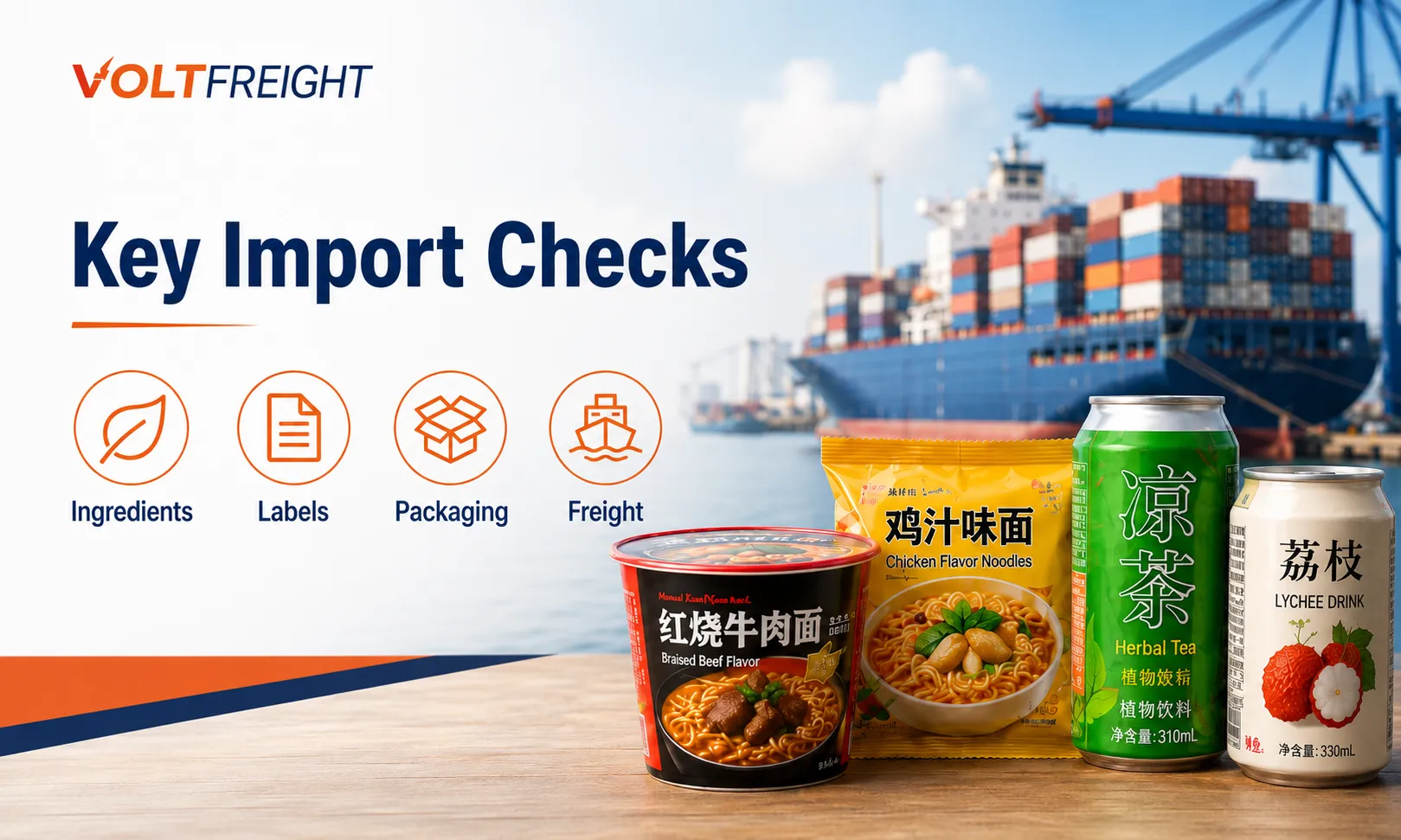
Instant noodles and herbal tea shipments require product-specific ingredient, compliance, packaging and freight checks.
Why These Products Need a Separate Import Review
Instant noodles and herbal beverages may look like simple grocery products, but one small ingredient can change the import process. For example, a seasoning packet may contain dehydrated vegetables, egg powder, milk powder, seafood flavor, beef extract or chicken fat. The front label may only say “beef flavor,” which does not reveal whether the flavor is artificial or derived from actual meat.
Herbal tea also covers a wide range of products. It may mean a conventional canned drink, dried tea bags, a powdered beverage, loose botanical material or a product marketed with health-related claims. Each format can raise different questions about product classification, labeling, ingredients, plant material and transport conditions.
For this reason, the commercial invoice should never describe the shipment only as “food,” “tea,” “snacks” or “noodles.” The product name, brand, flavor, packaging format and intended use should be clear and consistent across the invoice, packing list, label and import filing.
Instant Noodle Ingredient Checks Before Shipping
The ingredient list is the most important starting point for an instant noodle shipment. Importers should collect the full formula for the noodle cake, seasoning powder, oil packet, sauce packet and any separate garnish.
Do not review only the main noodle ingredients. The highest import risk often appears in a small seasoning sachet. A vegetable noodle can still contain egg, milk, seafood, animal fat or meat extract in the flavor packet.
Information to request from the supplier
- Complete ingredient list for every packet inside the retail package
- Percentage or concentration of animal-derived ingredients when relevant
- Common and scientific names for unusual botanical ingredients
- Product specification sheet and processing method
- Manufacturer name and production address
- Brand owner and authorization information when applicable
- English label artwork
- Allergen declaration
- Nutrition Facts panel
- Country of origin statement
- Shelf life and storage conditions
- FDA food facility registration information when applicable
The product name used for customs should be specific. “Instant wheat noodles with vegetable seasoning” is more useful than “noodles.” If the product contains separate sauce or oil packets, the declaration and supporting documents should still describe the complete retail product accurately.
Beef, Chicken, Pork and Egg Flavor: When USDA Review May Matter
Instant noodles containing meat, poultry or egg ingredients may involve more than FDA review. USDA agencies can have authority over animal products and meat, poultry or processed egg products. The exact agency and entry requirement depend on the ingredient, source, processing, percentage, exporting country and final product.
A flavor name alone is not enough. “Chicken flavor” may be artificial, plant-based or made with actual poultry material. “Beef flavor” may contain real beef extract, animal fat or no meat ingredient at all. Importers should obtain the actual formula rather than relying on the retail flavor name.
Commercial imports of regulated meat, poultry and egg products can be subject to country eligibility, establishment eligibility, certification and inspection requirements. Therefore, noodles containing real animal-derived ingredients should be reviewed by the U.S. importer, customs broker and appropriate compliance specialist before production is finalized or cargo is collected.
Questions to answer before booking
- Does the seasoning contain real meat, poultry, egg or animal fat?
- What animal species is involved?
- Where was the animal-derived ingredient produced?
- How was the ingredient processed or heat-treated?
- What percentage of the finished product is animal-derived?
- Does the exporting establishment meet the applicable eligibility requirements?
- Is an official certificate, permit or additional entry document required?
- Does the label accurately declare the ingredient and allergen source?
VoltFreight can help organize the product details and logistics documents, but the freight forwarder should not make unsupported promises that every meat-flavor noodle can enter the United States. Eligibility must be confirmed for the actual product.
Herbal Tea, Tea Bags and Botanical Ingredients
Herbal tea products should be divided into clear categories. A ready-to-drink canned beverage, a sealed tea bag made from processed ingredients and loose dried plant material do not have the same risk profile.
For conventional packaged beverages, the main issues usually include FDA import data, facility registration when applicable, FSVP, labeling, allergens, product claims and packaging. Products containing raw or minimally processed plant materials may also require review under APHIS plant-product rules.
The supplier should provide the common English name and botanical name of each herbal ingredient. Vague descriptions such as “Chinese herbs” or “natural plant extract” are not sufficient for a reliable import review.
Claims can change the product risk
Marketing language also matters. A product presented as a normal beverage is different from a product claiming to diagnose, treat, cure or prevent a disease. Importers should review front-label claims, website claims, product inserts and distributor advertising before the goods are sold in the United States.
For canned or bottled drinks, confirm the product is shelf-stable and suitable for normal transport. Products requiring refrigeration or temperature control need a separate cold-chain plan and should not be booked as ordinary dry cargo.
FDA Prior Notice for Noodles and Herbal Beverages
FDA requires Prior Notice for food imported or offered for import into the United States unless a specific exemption applies. Prior Notice provides advance shipment and product information so FDA can decide whether the shipment should be examined when it arrives.
Prior Notice is not an FDA product approval. It does not confirm that the label, formula, manufacturer, FSVP program or shipment is compliant. The submitted data must match the actual cargo and supporting documents.
Common Prior Notice data
- Food article and product description
- Manufacturer and production facility
- Country of production
- Shipper and importer information
- Quantity and packaging
- Carrier and mode of transport
- Port or place of arrival
- Estimated arrival information
- Submitter and transmitter details
Mixed shipments need special attention. If a container holds several noodle flavors, multiple beverage SKUs or products made by different factories, the importer and filing party need a complete SKU-level list early enough to prepare the entry data correctly.
Food Facility Registration and FSVP
Facilities that manufacture, process, pack or hold food for consumption in the United States may be required to register with FDA unless an exemption applies. A foreign facility registration also involves a U.S. agent.
Registration is not the same as FDA approval. FDA does not pre-approve an individual imported food product simply because the facility has a registration number.
The Foreign Supplier Verification Program places responsibility on covered U.S. food importers to perform risk-based supplier verification activities. In general, an importer may need an FSVP for each food and each foreign supplier, although exemptions and modified requirements exist for certain situations.
Clarify these parties before shipment
- U.S. importer of record
- FSVP importer
- Customs broker
- Prior Notice filing party
- Foreign manufacturer
- FDA-registered facility when required
- U.S. agent for the foreign facility
- Final consignee or warehouse
A DDP quotation does not automatically solve FSVP responsibility. The importer should know which U.S. party will be named for the food compliance obligations before cargo departure.
English Labels, Allergens and Product Claims
Food offered for import must comply with applicable U.S. labeling requirements. FDA can examine imported products and collect samples to check labeling and other compliance issues.
For instant noodles, common labeling concerns include wheat, soy, milk, egg, fish, crustacean shellfish, sesame and other major allergens. The complete contents of seasoning, sauce and oil packets should be reflected in the label.
For herbal beverages, check the statement of identity, ingredient list, net quantity, manufacturer or distributor details, Nutrition Facts information, allergen declaration and any claims. Imported labels should not rely only on Chinese text or a small sticker that conflicts with the original package.
Label review checklist
- Accurate English product identity
- Ingredients listed in descending order when required
- Major allergen sources declared correctly
- Nutrition Facts format reviewed
- Net quantity stated in an appropriate format
- Manufacturer, packer or distributor details
- Country of origin information
- Storage instructions and shelf life
- No unsupported medical or disease claims
- Label information consistent with the invoice and entry data
Documents for Importing Instant Noodles and Herbal Tea
Prepare product and shipping documents before pickup. Waiting until the cargo reaches the port or airport creates unnecessary storage, amendment and inspection risk.
Commercial and logistics documents
- Commercial invoice with specific product descriptions
- Packing list with SKU, carton, weight and dimension details
- Bill of lading or air waybill
- Sales contract or purchase order when requested
- HS code information reviewed with the broker
- Brand authorization when applicable
Product and compliance information
- Complete ingredient list
- English retail label
- Nutrition Facts and allergen declaration
- Manufacturer name and production address
- Food facility registration information when applicable
- FSVP importer details
- Prior Notice data
- Product specification and processing description
- Animal-origin ingredient details when relevant
- Botanical names and plant-material information when relevant
- Permit, certificate or agency documentation when required
All documents should describe the same product. A label showing “Beef Flavor Instant Noodles” should not be supported by an invoice that only says “dry food.”
Sea Freight, Air Freight or Express Courier?
The best method depends on cargo size, shelf life, packaging, urgency, product value and import readiness.
Sea freight
Sea freight is normally the most practical option for commercial quantities of noodles, canned drinks and shelf-stable grocery stock. LCL works for smaller volumes, while FCL gives the importer more control over loading and mixed-product planning. Sea freight requires good moisture protection, strong cartons and enough remaining shelf life for the complete door-to-door journey.
Air freight
Air freight can work for urgent replenishment, product launches and higher-value shipments. Chargeable weight can make lightweight noodle cartons expensive because they occupy a large volume. Liquids also require carrier acceptance and leak-resistant packaging.
Express courier
Courier service may be suitable for documents or small product samples, but it should not be treated as a way to avoid food-import requirements. Prior Notice and other regulatory obligations may still apply to food shipments.
For broader route planning, compare sea freight from China, air freight from China and express freight from China.
Packaging Noodles, Cans and Beverage Cartons
Instant noodles and canned beverages create opposite loading problems. Noodle cartons are light but easy to crush. Beverage cartons are heavy and can damage lighter cartons if the pallet is stacked incorrectly.
Instant noodle packaging
- Use export-strength outer cartons
- Avoid excessive empty space inside cartons
- Protect retail cups or bowls from compression
- Do not place heavy beverage cartons on top
- Use pallets when multiple handling steps are expected
- Keep cartons dry and away from container condensation
Canned and bottled beverage packaging
- Confirm cans and closures are suitable for export transport
- Use strong cartons with internal dividers where needed
- Place heavy cartons on the lower pallet layers
- Use corner protectors, stretch film and pallet straps
- Check pallet weight and receiving-warehouse limits
- Separate leaking or damaged cartons before loading
- Protect nearby dry products from liquid damage
If the shipment combines noodles and drinks, the loading plan should be prepared before cargo enters the container. Heavy liquid cargo should not be allowed to crush the noodle cartons during transit or final delivery.
Can These Products Use DDP or Door-to-Door Shipping?
DDP or customs-inclusive door-to-door service may be possible for selected packaged food products, but it should never be confirmed from the product name alone. The forwarder needs the formula, label, manufacturer, value, quantity, importer structure and final address.
The quotation should state clearly who is responsible for the importer of record, FSVP, Prior Notice, duties, FDA entry data, examinations, storage and final delivery. A vague “tax included” quote is not enough for food cargo.
Importers should avoid routes that depend on incorrect descriptions, undervaluation or hiding regulated ingredients. A shipment can become much more expensive if it is held, refused, returned or destroyed.
For general delivery-term differences, see our guide to door-to-door shipping from China.
Example: Noodles and Canned Herbal Tea for a U.S. Grocery Importer
Consider a California grocery importer buying three noodle flavors and one canned herbal tea product from two Chinese suppliers.
First, each noodle flavor should be reviewed separately. The vegetable flavor may contain no animal ingredients, while the chicken flavor may contain poultry powder and the beef flavor may contain only artificial flavor. The importer should not assume all three products follow the same agency review.
Second, the herbal tea supplier should provide the full formula, botanical names, label, processing information and can specification. The importer should confirm whether the beverage is a conventional shelf-stable food and whether any plant material or claims require extra review.
Third, the forwarder should consolidate the cargo only after the document list is complete. During loading, beverage cartons should be placed below the lighter noodle cartons, with separate pallet protection where possible.
Finally, the importer, broker and FSVP party should confirm the entry plan before departure. The freight route comes after product eligibility and document readiness, not before them.
Information Needed for an Accurate Shipping Quote
A useful quote requires both cargo data and product data. Send the following information together:
- Product name, brand and flavor
- Complete ingredient list
- English label photos or artwork
- Manufacturer name and address
- FDA facility registration information when applicable
- U.S. importer and FSVP information if available
- Animal-derived ingredient details
- Botanical ingredient names for herbal products
- Packaging type: bag, cup, can, bottle, tea bag or carton
- Shelf life and storage conditions
- Carton quantity
- Carton dimensions
- Gross weight per carton and total weight
- Total CBM
- Pallet quantity and dimensions
- Supplier pickup city in China
- U.S. ZIP code and full delivery address
- Sales channel: wholesale, retail, restaurant supply, Amazon or e-commerce
- Cargo ready date
- Preferred method: sea, air, express or door-to-door
Contact VoltFreight for a product-specific shipping review and quotation.
How VoltFreight Supports Noodle and Beverage Shipments
VoltFreight helps importers coordinate the logistics side of packaged food shipments from China. Our role is to collect complete cargo information, compare practical routes and reduce avoidable packaging and document problems before departure.
- Supplier pickup in China
- Warehouse receiving and consolidation
- Carton counting, weighing and measurement
- Label and ingredient-document collection
- Packaging inspection and photo support when arranged
- Palletization and loading planning
- Air, sea, express and door-to-door route comparison
- Commercial invoice and packing list review
- Coordination with the importer and customs broker
- Final delivery planning to U.S. warehouses and business addresses
VoltFreight is a logistics provider, not FDA, USDA or legal counsel. Product eligibility and compliance responsibility should be confirmed by the U.S. importer and qualified specialists for the actual formula and transaction.
Frequently Asked Questions
Can I ship instant noodles from China to the USA?
Many instant noodle products can be shipped, but the importer should review the complete ingredient list, manufacturer, English label, FDA Prior Notice, FSVP responsibility and any animal-derived ingredients before booking.
Can beef or chicken flavor noodles enter the United States?
It depends on the actual formula. Artificial flavor and real meat or poultry ingredients are not the same. Products containing regulated animal ingredients may require USDA, APHIS or FSIS review, country and establishment eligibility, certificates or other entry conditions.
Can herbal tea and canned drinks be shipped from China?
Many conventional shelf-stable beverages can be shipped when the formula, label, manufacturer, FDA information and packaging are acceptable. Loose or minimally processed botanical material and products making medical claims may need additional review.
Is Prior Notice required for noodle and tea shipments?
FDA generally requires Prior Notice for food imported or offered for import into the United States unless a specific exemption applies. Prior Notice is an advance filing and is not the same as product approval.
Is sea freight or air freight better?
Sea freight is usually more economical for commercial quantities of shelf-stable noodles and beverages. Air freight is useful for urgent replenishment, but volumetric weight can make noodle cartons expensive and liquids require carrier acceptance and stronger packaging.
Conclusion
Shipping instant noodles and herbal tea from China to the USA is possible, but these products should not be treated as ordinary general cargo. The ingredient list, label, manufacturer, FSVP party, Prior Notice data, animal or plant ingredients, packaging and final delivery plan should be reviewed before cargo collection.
Instant noodles need special attention to every seasoning and sauce packet. Herbal tea products need clear botanical ingredients, product claims and packaging information. Canned drinks need strong cartons and a loading plan that protects lighter products.
Once the product and importer responsibilities are clear, VoltFreight can compare sea freight, air freight, express and door-to-door options based on the actual weight, volume, pickup city and U.S. destination.
Send us your product information and request a China-to-USA shipping quotation.
Official Sources and References
- U.S. FDA — Importing Human Foods
- U.S. FDA — Filing Prior Notice of Imported Foods
- U.S. FDA — FSVP Final Rule for Food Importers
- U.S. FDA — Registration of Food Facilities
- U.S. FDA — Food Allergen Labeling Guidance
- USDA FSIS — Import Guidance
- USDA APHIS — Animal Product Imports
- USDA APHIS — Importing Plants and Plant Products
Important: This article is for logistics planning and general informational purposes. FDA, USDA, APHIS, FSIS, customs, labeling, FSVP, facility registration, Prior Notice, permit and product eligibility requirements depend on the actual product, ingredients, processing, manufacturer, importer and shipment. Confirm current requirements with the U.S. importer, customs broker and qualified compliance professionals before shipping.