Quick answer: The best way to ship luggage from China depends on the number of bags, contents, packed dimensions, destination and deadline. Compare airline excess baggage with courier delivery for one or two suitcases. Air or sea freight usually becomes worth checking only for several cartons or a larger relocation shipment.
Once a suitcase leaves the airline baggage system and enters a courier or freight network, it is handled as cargo. The carrier needs to know what is inside, the shipment must be packed for repeated handling, and customs normally requires an itemised description and a reasonable value.
This guide is for used clothes, shoes, books and other eligible personal belongings leaving China. It is not a guide to importing wholesale suitcases as merchandise, and it does not replace the destination country’s customs rules.
Before You Ship Luggage from China, Compare It with Extra Baggage
If you are flying to the same destination as your belongings, shipping is not automatically the cheaper choice. Airline excess baggage, courier delivery and freight services calculate charges differently, so compare the complete cost rather than a headline price per kilogram.
Start with three real quotations:
- Your airline’s fee for an additional checked bag on the exact ticket and route.
- A courier or door-to-door quote based on the suitcase after it has been packed in an outer carton.
- An air or sea freight quote only when you have enough cartons or volume to justify freight minimum charges.
Taking an extra bag on your flight often deserves serious consideration when you have only one suitcase, can carry it through the airport and the contents are permitted as passenger baggage. Shipping becomes more useful when you cannot travel with the items, have several cartons, need collection from China, or want the belongings delivered separately.
Identify Everything Inside the Suitcase Before Requesting a Quote
Before you ship luggage from China, prepare more detail than “one suitcase of personal items.” A mixed bag may contain ordinary clothing together with a power bank, perfume, medicine or food. Those items do not follow the same transport or import rules.
Empty the suitcase and group the contents before booking:
- Ordinary personal effects: used clothes, shoes, books and simple household items.
- Electronics: laptops, tablets, cameras, wireless devices and anything with an installed battery.
- Loose batteries and power banks: these require separate review and can face tighter air and courier restrictions.
- Liquids and aerosols: perfume, sprays, nail products, toiletries and cleaning products may be restricted or treated as dangerous goods.
- Controlled or destination-sensitive items: medicines, food, seeds, plant or animal products, alcohol and tobacco.
- High-value or irreplaceable property: jewellery, cash, passports, original certificates and sentimental items should normally stay with you rather than enter a general cargo network.
Send the inventory to the forwarder before collection. Removing a restricted item at the China warehouse is easier than dealing with a carrier rejection or customs hold after dispatch.
Which Method Should You Use to Ship Luggage from China?
There is no universal best shipping method. Use the shipment profile—not a fixed weight rule—to narrow the choice.
| Option | Usually worth comparing when | How the charge is built | Main limitation |
|---|---|---|---|
| Airline extra baggage | You are travelling on the same route with one or two additional bags | Airline allowance, bag count, route and oversize or overweight fees | You must handle the bag and comply with passenger-baggage rules |
| Express courier | You have a few properly packed cartons and need tracked address delivery | The higher of actual or volumetric weight, plus applicable surcharges | Large, light cartons and remote addresses can increase the price |
| Air freight | You have several cartons or a larger urgent shipment that justifies freight handling | Chargeable weight, origin handling, air transport and the selected destination scope | Airport, clearance and final-delivery costs must be defined in the quote |
| Sea freight | You have multiple bulky cartons, flexible timing and enough volume to absorb minimum charges | Volume or minimum shipment charge, origin handling, ocean freight and destination services | A single suitcase can cost more than expected once fixed charges are included |
For a small shipment, start by comparing express freight from China with the airline option. For a larger shipment, compare the complete scope of air freight, ocean freight and door-to-door shipping from China.
Why a Small Suitcase Can Have a High Cost per Kilogram
Travellers are often surprised by the cost to ship luggage from China when a small courier quote looks expensive compared with a freight rate seen online. The two prices may describe completely different shipment sizes and service scopes.
A small shipment can be affected by:
- a carrier or forwarder minimum charge;
- volumetric weight if the outer carton is large relative to its weight;
- China pickup and warehouse handling;
- special-product screening for batteries, liquids or other restricted contents;
- customs processing and destination delivery;
- remote-area, residential, oversize or additional-handling surcharges; and
- destination terminal and clearance fees on freight services.
This is why a rate offered for a larger commercial shipment should not be multiplied by the weight of a three-kilogram parcel. Weight-break pricing and minimum charges can produce a much higher effective rate per kilogram for a small bag.
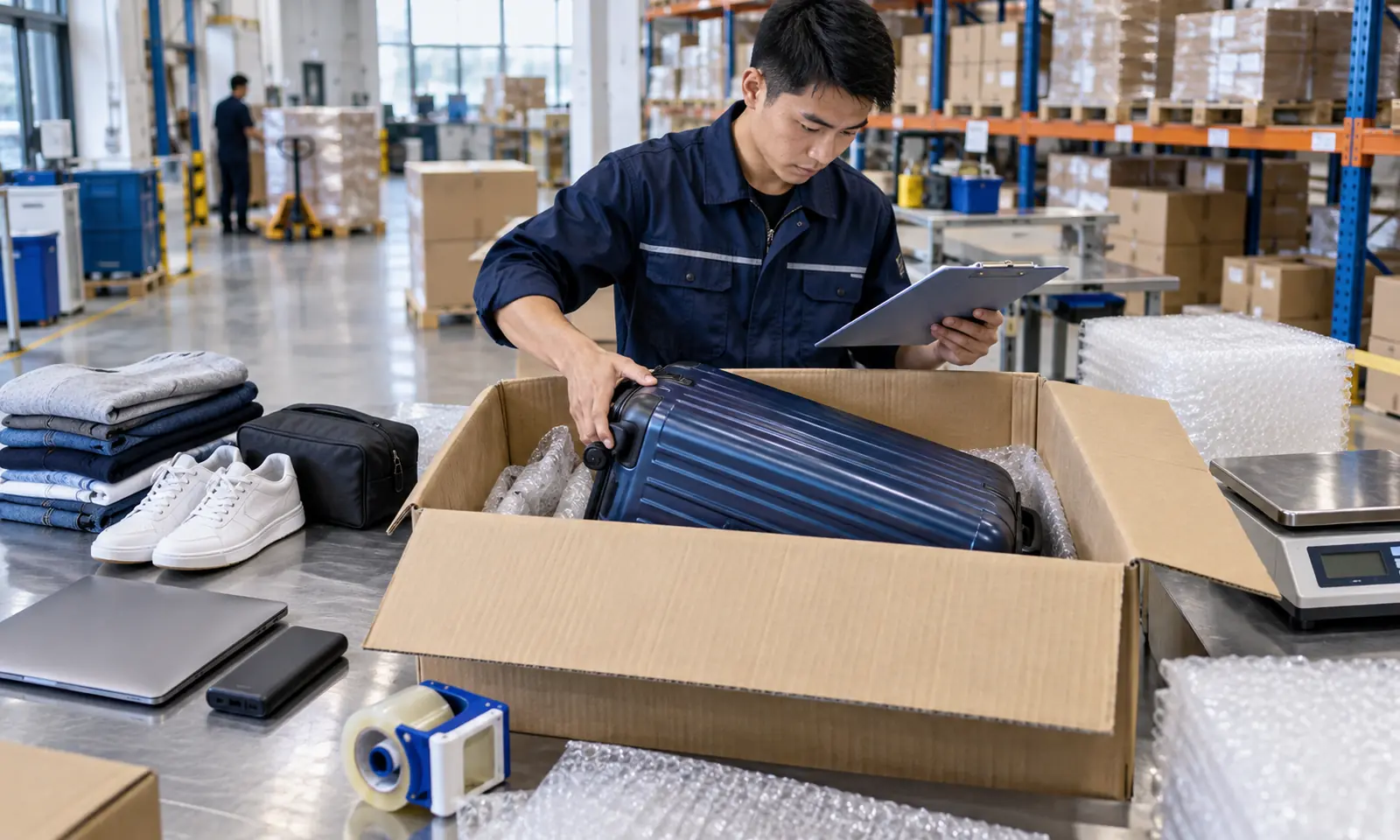
Pack the Suitcase Inside a Strong Outer Carton
A suitcase is designed for travel, but exposed wheels, handles, straps and zippers are vulnerable in a parcel or freight network. Do not assume that wrapping a label around the handle provides adequate protection.
FedEx’s luggage packaging guidance follows the same basic protection principle: inspect the bag, remove restricted contents, place it in a strong outer box and fill empty space with cushioning.
- Inspect the shell, handle, wheels and zippers, then remove old airline tags.
- Place clothing in sealed inner bags to protect it from moisture.
- Cushion fragile eligible items individually and prevent movement inside the suitcase.
- Close the suitcase, but do not rely on the suitcase lock as the outer security layer because customs or the carrier may need access.
- Place the complete suitcase in a close-fitting, strong corrugated carton with cushioning around all sides.
- Seal every opening with reinforced parcel tape and protect the carton from rain during pickup.
- Put the sender and receiver details inside the carton as well as on the outer label.
- Photograph the contents, closed suitcase, packing process and final carton before handover.
The final quote should use the weight and dimensions after this packing is complete. Estimating from an unpacked suitcase can lead to a price adjustment.
Prepare an Itemised Customs Inventory for Used Personal Effects
Customs does not inspect a suitcase as one item. It considers the goods inside it. Avoid vague descriptions such as “personal stuff,” “clothes” or “no commercial value.” Used belongings can have a low current value, but they do not automatically have zero value.
A practical inventory describes the quantity, item, material or use, condition and estimated current value. For example:
- 8 used cotton T-shirts for personal use — estimated current value USD 40;
- 2 pairs of used sports shoes for personal use — estimated current value USD 30;
- 12 used paperback books — estimated current value USD 24; and
- 1 used laptop, brand and model stated, with installed lithium-ion battery — estimated current value stated and subject to carrier review.
The receiving country may ask for identification, proof of travel or relocation, a detailed packing list, proof of ownership, residence documents or another customs form. Some countries offer relief for qualifying personal effects when a person changes residence, but the conditions, timing and required evidence vary. Do not assume that marking a shipment “personal effects” makes it duty-free.
Which Items Need Review Before You Ship Luggage from China?
Every destination and carrier has its own acceptance rules, so the final decision must be made against the actual inventory. The following items require particular attention:
Lithium Batteries and Electronics
Loose batteries and power banks can face stricter controls than a battery correctly installed in equipment. Do not hide them among clothes. Provide the product name, battery type, model, capacity and photos for review. For a more detailed explanation, see the VoltFreight battery shipping guide.
Perfume, Aerosols and Other Liquids
Perfume, hairspray, nail polish, lighters and some toiletries may be flammable or otherwise regulated. Ordinary travel use does not make them ordinary cargo. Declare them before packing and remove them if the selected service cannot accept them.
Food, Medicine and Biological Products
Food, seeds, plants, animal products and medicines can trigger health, quarantine or import controls. The rules depend on the destination and the exact product. A sealed retail package is not automatic permission to import it.
Documents, Cash and Valuables
Keep passports, residence documents, cash, jewellery, keys and irreplaceable records with you. Carrier liability or cargo insurance may exclude or strictly limit these items, and a financial payment cannot replace an original document or sentimental object.
When Sea Freight Makes Sense—and When It Does Not
Sea freight can be economical for a genuine relocation shipment with several cartons or meaningful cubic volume. It is rarely enough to compare only the ocean rate. LCL shipments can include origin receiving, consolidation, documentation, port or CFS handling, customs clearance, destination handling and final delivery.
For one suitcase, those fixed charges may outweigh the lower line-haul cost. For several boxes, sea freight may become reasonable if the shipment is non-urgent and the quote clearly states both origin and destination charges.
Ask these questions before accepting a sea freight quotation:
- Is the service port-to-port, warehouse-to-port or door-to-door?
- Which origin and destination charges are included?
- Who acts as the importer and arranges customs clearance?
- Is final delivery included, and are there address restrictions?
- What minimum volume or minimum charge applies?
- What happens if customs examines the shipment or documents are incomplete?
DDP Is Not a Shipping Method for Personal Luggage
Courier, air freight and sea freight describe how cargo moves. DDP is an Incoterm used to allocate delivery, customs and cost responsibilities between a seller and buyer in a sales transaction. It should not appear as a separate transport mode in a comparison.
When you send your own used belongings, there may be no seller-to-buyer transaction. Some providers still use “DDP” informally to describe a duties-paid door service, but the label alone does not explain who will act as importer, which charges are included or whether personal effects qualify for that route. Ask for the actual service scope in writing.
A duties-paid quotation does not make prohibited contents acceptable, eliminate customs inspections or guarantee that every mixed personal-effects shipment is eligible. If the receiver must complete clearance or pay import charges, that responsibility should be stated before dispatch.
Document the Condition and Value Before Buying Insurance
Used belongings can be difficult to value after loss or damage. Before shipping, photograph the contents and record brand, model, serial number, condition and estimated current value where relevant. Keep purchase records for higher-value items if they are available.
Ask the insurer or carrier what is covered, what evidence is needed for a claim, whether used goods are valued at replacement cost or depreciated value, and which items are excluded. A declared value on a customs inventory is not automatically the same as insured value, and carrier liability is not the same as cargo insurance.
What Is the Process to Ship Luggage from China?
- Send the inventory first. Include every item that may affect carrier or customs acceptance.
- Confirm the route and service scope. Compare extra baggage, courier, air and sea using the same packed shipment data.
- Remove non-accepted contents. Do this before pickup or warehouse delivery.
- Pack and measure the final cartons. Confirm gross weight and all three dimensions for every carton.
- Approve the customs documents and cost responsibility. Check item descriptions, values, importer details, duty responsibility and final delivery.
- Dispatch only after written confirmation. Keep the packing photos, inventory, quotation and tracking or freight documents together.
Do not send an unreviewed suitcase to a China warehouse and assume a route will be available afterward. The contents determine the route as much as the destination does.
What VoltFreight Needs to Check Your Luggage Shipment
For an initial review, send:
- pickup city and address in China;
- destination country, city and postal code;
- the number of suitcases or cartons;
- final packed dimensions and gross weight of each carton;
- an itemised contents list with quantity, condition and estimated value;
- photos of the contents and final packing;
- details of batteries, electronics, liquids, powders, food, medicine or branded goods;
- your required delivery date;
- whether you are travelling or relocating to the destination; and
- whether you need airport or port delivery, or a reviewed door-to-door service.
VoltFreight can then review eligible courier or freight options from China and explain the proposed route, chargeable basis, customs responsibility and included delivery scope. Final acceptance, price and timing depend on the actual contents, packing, destination and carrier approval.
Get a Plan to Ship Luggage from China
The right question is not simply, “Which carrier has the lowest price per kilogram?” First decide whether shipping beats extra baggage, remove contents that cannot enter the chosen network, and prepare a customs-ready inventory. Then compare complete quotations using the same final carton data.
Send VoltFreight your shipment details before collection. We will check whether the luggage is suitable for an available service and confirm what the quotation includes before dispatch.