The EU ETS shipping surcharge has become a regular cost consideration for importers and exporters using ocean freight between China and Europe. However, it is not a fixed European tax charged at the same amount for every container.
Shipping companies must purchase and surrender emission allowances for maritime emissions that fall within the EU Emissions Trading System. Carriers may recover part of this compliance cost through an emissions surcharge, an environmental charge or an adjustment included in the base ocean freight.
The amount can vary according to the shipping line, destination region, container type, trade direction, vessel route and quotation period. In addition, some carriers combine EU ETS and FuelEU Maritime costs under one environmental surcharge, while others use separate pricing structures.
This guide explains how EU ETS applies to China–Europe ocean freight, how it can affect FCL and LCL costs, why carrier charges differ and how to check whether an emissions-related fee is separate, included or potentially duplicated in a freight quotation.
Last updated: July 31, 2026. The regulatory explanation is intended for long-term reference. Carrier surcharge examples are reviewed quarterly and must be reconfirmed before booking.
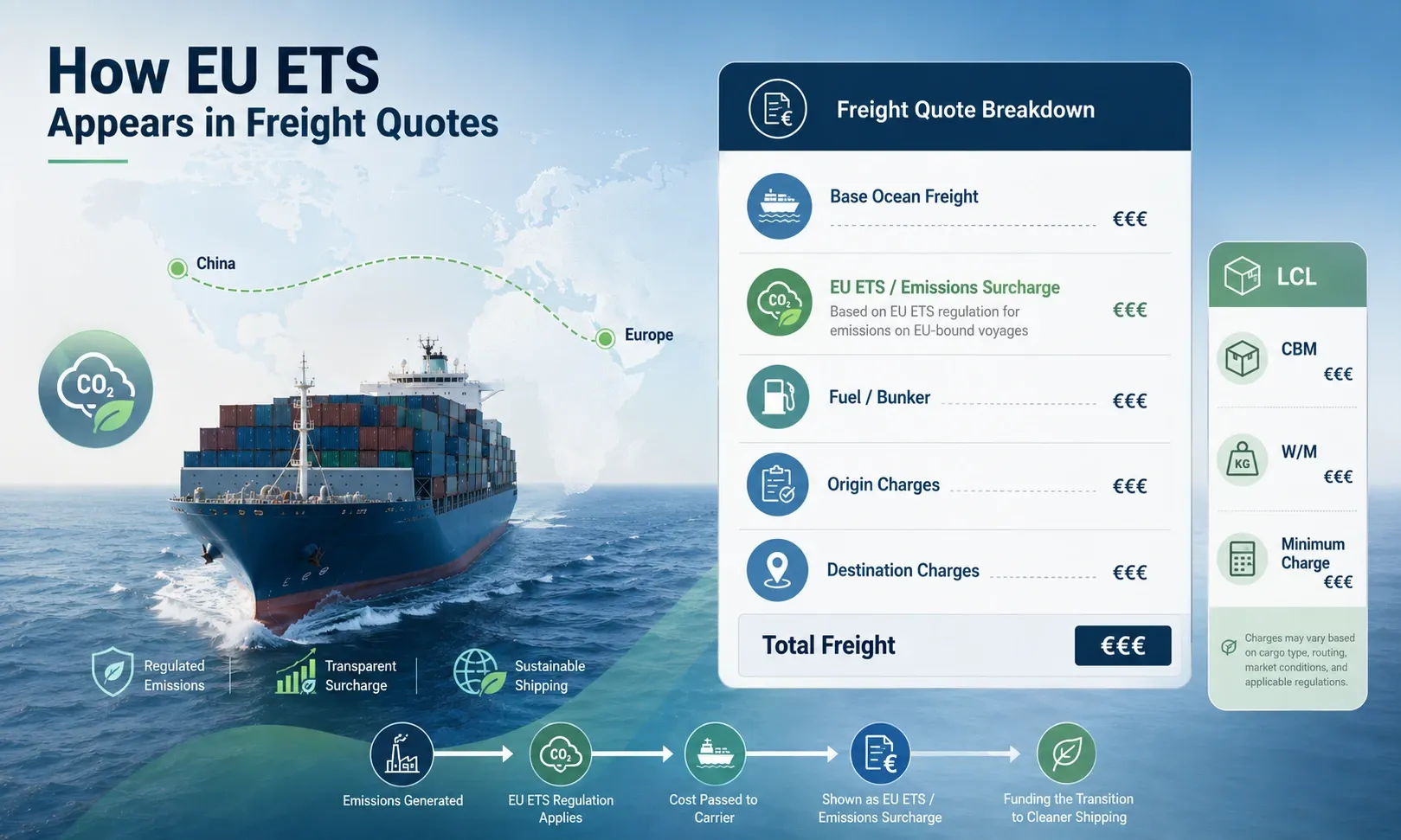
EU ETS Shipping Surcharge: Quick Answer
EU ETS affects covered vessels calling at EU and EEA ports. For most international container voyages between China and an EU port, the system generally covers 50% of the emissions from the international voyage.
By comparison, EU ETS covers 100% of emissions from voyages between two EU ports. It also covers 100% of covered emissions released while a vessel is within an EU port, including emissions at berth and during movements inside the port.
The shipping company carries the legal obligation to monitor covered emissions and surrender the required allowances. Nevertheless, carriers often recover part of that cost through freight pricing.
For customers, the cost may appear in several ways:
- As a separate EU ETS surcharge
- As an emissions or environmental surcharge
- Under a carrier-specific name such as EMS, ESS or EES
- Combined with FuelEU Maritime compliance costs
- Included directly in the base ocean freight
- Allocated across LCL cargo by CBM, revenue ton or minimum shipment charge
There is no universal cost per container. Current carrier benchmarks for China–Europe trades range from tens of US dollars for a 20ft dry container to more than USD 200 for some 40ft dry-container tariffs. Reefer examples can be substantially higher.
However, a lower environmental surcharge does not automatically mean a lower total freight cost. Importers should compare the base ocean freight, fuel charges, China origin costs, European destination charges, customs clearance and final delivery together.
How EU ETS Applies to China–Europe Ocean Freight
The European Union extended its Emissions Trading System to maritime transport in January 2024. The system is route-based and flag-neutral, which means covered ships can fall within scope regardless of the country in which the vessel is registered.
Voyages Between China and an EU Port
For a voyage that begins outside the EU and ends at an EU port, or begins at an EU port and ends outside the EU, 50% of the voyage emissions generally fall within the EU ETS scope.
This rule is relevant to routes such as:
- Shanghai to Rotterdam
- Ningbo to Hamburg
- Yantian to Antwerp
- Qingdao to Piraeus
- Xiamen to Valencia
- Shenzhen to Genoa
The remaining 50% of the extra-EU voyage emissions falls outside the EU ETS scope. However, the carrier’s customer surcharge is still determined by its own tariff and should not be interpreted as a simple mathematical charge on exactly half of the voyage.
Voyages Between EU Ports
The system covers 100% of emissions from voyages between two EU ports.
For example, if a vessel moves from Piraeus to another EU port as part of a container service, the emissions from that intra-European stage generally fall fully within the EU ETS scope.
Emissions Within EU Ports
The system also covers 100% of covered emissions released while a vessel is inside an EU port. This includes relevant emissions while the vessel is at berth and during movements within the port area.
Transshipment Does Not Automatically Remove EU ETS
Some China–Europe services call at a non-EU transshipment port before entering the European Union. However, a transshipment stop does not automatically reset or remove the EU ETS calculation.
The EU has anti-avoidance provisions covering certain neighbouring container transshipment ports. Consequently, importers should not assume that an indirect route eliminates the environmental cost.
How the Maritime EU ETS Phase-In Works
The maritime system was introduced in stages. Shipping companies did not need to surrender allowances for the full amount of covered emissions during the first reporting years.
- 2024 emissions: Allowances cover 40% of the applicable reported emissions.
- 2025 emissions: Allowances cover 70% of the applicable reported emissions.
- Emissions from 2026 onward: Allowances cover 100% of the applicable reported emissions.
The surrender deadline falls in the year after the emissions are reported. Therefore, shipping companies surrendered allowances for 40% of their 2024 emissions in 2025 and for 70% of their 2025 emissions in 2026. Allowances covering 100% of the applicable 2026 emissions fall within the following compliance cycle.
Greenhouse Gases Included
The EU ETS initially accounted for carbon dioxide from maritime transport. From 2026, methane and nitrous oxide also fall within the ETS scope.
This broader coverage matters because different marine fuels can have different carbon dioxide, methane and nitrous-oxide profiles. Fuel choice, vessel efficiency, loading and operating conditions can therefore influence a carrier’s compliance-cost calculation.
EU ETS Is Not a Fixed Tax per Container
The European Union defines the emissions that shipping companies must cover. However, it does not prescribe one retail surcharge that every carrier must charge for a 20GP, 40GP or 40HQ container.
Each carrier develops its own commercial method for recovering regulatory costs. This is why two shipping lines can publish different environmental benchmarks for similar China–Europe routes.
Current EU ETS Surcharge Examples
Data update policy: VoltFreight reviews the carrier examples in this section quarterly. The figures below are based on official Maersk and ONE notices effective from July 1 to September 30, 2026.
These figures are published carrier benchmarks rather than permanent market prices or fixed VoltFreight tariffs. They illustrate the size and variation of the environmental component, but the actual China-export quotation may incorporate that component into the base ocean freight.
| Shipment Type | North Europe Q3 Benchmarks | Mediterranean Q3 Benchmarks | China-Export Quote Check |
|---|---|---|---|
| 20ft dry container | Maersk: USD 78 ONE: USD 102 |
Maersk: USD 59 ONE: USD 43 |
Confirm whether the environmental component is separate or incorporated into base freight. |
| 40ft or 40HQ dry container | Maersk: USD 155 ONE: USD 204 |
Maersk: USD 117 ONE: USD 86 |
Check carrier, destination trade, quotation period and freight-inclusion method. |
| 20ft reefer container | Maersk: USD 116 ONE: USD 196 |
Maersk: USD 89 ONE: USD 78 |
Confirm whether the equipment is an operating reefer and which reefer tariff applies. |
| 40ft reefer container | Maersk: USD 231 ONE: USD 392 |
Maersk: USD 177 ONE: USD 156 |
Check reefer equipment, route, operating status and related electricity charges. |
| LCL cargo | No universal carrier-to-customer rate | No universal carrier-to-customer rate | Confirm CBM, W/M, revenue ton, minimum shipment charge or inclusion in the all-in rate. |
Important for China exports: Maersk states that, for bookings from China excluding Hong Kong and Taiwan, its emissions surcharge is added to the base freight rate for regulatory reasons. ONE advisories similarly state that the EES portion for export cargo from China may be incorporated into freight rather than invoiced as a separate surcharge.
Therefore, the amounts in the table should be treated as carrier pricing benchmarks. A China-origin quotation may not reproduce the same amount as a separate line item.
The table also shows why a universal statement such as “EU ETS costs USD 100 per container” would be inaccurate.
For example, the Q3 2026 benchmark for a 40ft dry container from Asia to North Europe is USD 155 under the Maersk schedule and USD 204 under the ONE schedule. The difference is USD 49 before any comparison of base freight or other charges.
Meanwhile, the same carriers publish different benchmarks for Mediterranean trades. A shipment to Piraeus, Valencia or Genoa should not automatically use the amount associated with Rotterdam, Hamburg or Antwerp.
For information about container routing to Greece, review our sea freight from China to Piraeus guide.
Next data review: Replace the table values when the relevant Q4 carrier notices are published or when the planned sailing falls outside the current July–September validity period.
Why Carrier EU ETS Charges Differ
Shipping lines may publish different charges even when they serve similar origin and destination regions. Several commercial and operational factors explain the difference.
Carrier Calculation Method
Carriers operate different fleets and may use different vessel, fuel, route and loading data when estimating compliance costs.
They can also use different:
- European Union Allowance reference periods
- Currency-conversion methods
- Trade-lane definitions
- Contract-validity rules
- Fleet-emissions assumptions
- Commercial adjustment policies
North Europe or Mediterranean Trade
Carriers commonly separate North Europe and Mediterranean services because the voyage patterns, distances, port rotations and emissions profiles differ.
North Europe may include ports such as Rotterdam, Hamburg, Antwerp-Bruges, Bremerhaven and Le Havre. Mediterranean trades may include Piraeus, Valencia, Barcelona, Genoa and La Spezia.
However, carriers can define their trade regions differently. The applicable carrier tariff should therefore control the quotation rather than a general geographic assumption.
Container and Equipment Type
Shipping lines may publish separate amounts for:
- 20ft dry containers
- 40ft dry containers
- 40HQ containers
- 20ft reefer containers
- 40ft reefer containers
- Special equipment
Reefer benchmarks are often higher because refrigerated equipment requires additional energy during the voyage.
European Union Allowance Prices
EU emission allowances trade in a market, so their price changes over time. A carrier may calculate the next quarter’s surcharge using the average allowance price from a defined reference period.
For its Q3 2026 calculation, Maersk used an average EUA price of EUR 71.07 based on its stated February-to-May reference period.
Consequently, the environmental component may rise or fall even when the route and container type remain unchanged.
Route and Regulatory Treatment
Longer vessel routings, security diversions, transshipment changes, congestion and schedule adjustments can affect fuel consumption and emissions.
In addition, EU ETS and FuelEU Maritime are separate regulations, but some carriers recover the related costs through one combined environmental surcharge. Two carrier amounts may therefore cover different combinations of compliance costs.
How the Charge Appears on a Freight Quote
A China–Europe freight quotation may use several names for environmental costs.
Common descriptions include:
- EU ETS
- ETS Surcharge
- Emission Allowance Surcharge
- Emissions Surcharge
- Emission Management Surcharge or EMS
- Emission Surcharge System or ESS
- Europe Environment Surcharge or EES
- Energy Transition Surcharge
- Environmental Surcharge
- Carbon Surcharge
The name alone does not explain exactly what the customer is paying. Importers should ask the carrier or freight forwarder whether the line covers EU ETS only, several environmental regulations or a wider freight adjustment.
The Charge May Be Shown Separately
A quotation may display the environmental cost as an individual line:
Base ocean freight: USD 2,400
EU ETS or emissions surcharge: USD 155
Fuel or bunker surcharge: USD 280
China origin charges: USD 430
European destination charges: Quoted separately
This structure makes the environmental component easy to identify and compare.
The Charge May Be Included in Base Freight
Some China-export quotations include the emissions cost within the base ocean freight instead of showing it separately.
A missing surcharge line does not automatically mean that no EU ETS-related cost applies. At the same time, a cost already incorporated into base freight should not be added again as a separate charge.
When comparing quotations, ask the forwarder to state one of the following clearly:
- EU ETS is shown separately
- EU ETS is included in base ocean freight
- EU ETS is included in a combined environmental surcharge
- No separate EU ETS line applies under the carrier’s China-export tariff structure
The Charge May Include FuelEU Maritime
EU ETS and FuelEU Maritime regulate different aspects of maritime emissions.
EU ETS requires shipping companies to account for covered emissions through emission allowances. FuelEU Maritime focuses on reducing the greenhouse-gas intensity of the energy used on board covered ships.
Nevertheless, carriers may combine the costs connected with both regulations. Maersk states that its Q3 2026 EMS and ESS include EU ETS and FuelEU Maritime compliance costs.
Before accepting two separate environmental fees, confirm that they do not recover the same underlying cost twice.
How EU ETS Works for FCL Freight
For FCL shipments, the carrier normally publishes an equipment-based tariff or benchmark. The amount can depend on the container size, equipment type, trade lane, direction and quotation period.
20GP Containers
A 20GP generally follows the carrier’s published 20ft dry-container amount.
Importers should confirm whether the figure uses USD, EUR or another currency and whether the tariff applies to the correct direction.
40GP and 40HQ Containers
A 40ft container is commonly treated as two TEU for capacity purposes. However, customers should use the carrier’s published 40ft or 40HQ amount whenever it is available.
Do not always double the 20ft amount manually because the carrier may:
- Round the 40ft amount
- Use the same benchmark for 40GP and 40HQ
- Apply different equipment rules
- Use a separate trade or contract calculation
Reefer Containers
Reefer environmental benchmarks can be considerably higher than dry-container amounts.
The quotation should confirm:
- Container size
- Operating or non-operating reefer status
- Required temperature
- Carrier equipment code
- Electricity and monitoring charges
- Applicable environmental benchmark
FCL Cost Example
Assume an importer books one 40HQ from Yantian to Rotterdam. For illustration, the quotation identifies an environmental component separately:
- Base ocean freight: USD 2,350
- Carrier emissions component: USD 155
- Fuel or bunker surcharge: USD 280
- China origin charges: USD 430
- European destination charges: USD 520
- Customs clearance and final delivery: Quoted separately
The cost before customs clearance and final delivery would be:
USD 2,350 + USD 155 + USD 280 + USD 430 + USD 520 = USD 3,735
The USD 155 environmental component represents approximately 4.1% of this example total before customs and delivery.
However, a real China-export quotation may include that component within the base freight rather than show it separately. The example explains the cost structure; it is not a current VoltFreight rate.
How EU ETS Works for LCL Freight
LCL pricing works differently because several customers share one container.
The ocean carrier normally charges the master-booking party or consolidator at container level. The consolidator then allocates the environmental cost among the individual LCL shipments inside the container.
There Is No Universal LCL EU ETS Rate
A consolidator may allocate the cost using:
- Chargeable CBM
- Weight or measurement, also called W/M
- Revenue ton
- Gross weight
- A minimum amount per shipment
- A percentage included in the LCL ocean freight
- An all-in freight rate that already includes environmental costs
Therefore, two LCL providers using the same trade lane may quote different environmental charges.
Example of CBM and Minimum Charging
Suppose an LCL quotation states:
- Environmental surcharge: USD 4 per CBM
- Minimum charge: USD 20 per shipment
For a shipment of 3 CBM:
3 CBM × USD 4 = USD 12
Because the minimum charge is USD 20, the customer would pay USD 20.
This is only an example of a possible LCL charging method. It is not a standard EU requirement or a fixed VoltFreight tariff.
Check Whether the Cost Is Already Included
Some LCL quotations include the carrier’s environmental cost in the all-in ocean freight rate.
Before approving a quote, ask:
- Is the environmental cost already included in the LCL ocean freight?
- If separate, is it charged by CBM, W/M, weight or shipment?
- Does a minimum amount apply?
- Which carrier operates the master container?
- Does the charge include FuelEU Maritime?
- Will the amount change if the consolidator changes carrier?
Check for Duplicate Environmental Charges
A quotation may contain several descriptions such as EU ETS, environmental surcharge, energy-transition fee or carbon surcharge.
These lines may represent separate costs, but they may also overlap. Ask the freight forwarder to identify the carrier tariff or regulatory cost behind each item.
How to Check an EU ETS Freight Quote
A customer does not need to calculate the vessel’s emissions independently. Instead, use the following checks to determine whether the freight quotation is transparent and commercially reasonable.
- Confirm the carrier: Ask which shipping line will issue the master bill of lading.
- Confirm the route: Check the actual China origin port, European discharge port and final delivery location.
- Confirm the trade region: Identify whether the carrier classifies the booking as North Europe, Mediterranean or another trade.
- Confirm the direction: Make sure the amount applies from Asia to Europe rather than Europe to Asia.
- Confirm the equipment: Check whether the quote covers 20GP, 40GP, 40HQ, reefer, special equipment or LCL cargo.
- Confirm the effective period: Carrier environmental pricing can change quarterly.
- Confirm FuelEU treatment: Ask whether the charge covers EU ETS only or combines several compliance costs.
- Confirm base-freight treatment: Determine whether the environmental component is separate or already incorporated into base freight.
- Confirm LCL allocation: For LCL, ask whether the amount uses CBM, W/M, revenue ton or a minimum charge.
- Compare the total freight cost: Do not select a carrier using only the environmental line.
Use the complete cost structure:
Base ocean freight
+ emissions or environmental cost
+ fuel or bunker surcharge
+ peak-season surcharge, when applicable
+ China origin charges
+ European destination charges
+ customs clearance
+ final delivery
= total logistics cost
A carrier with a lower EU ETS benchmark can still produce a more expensive total shipment.
How VoltFreight Quotes China–Europe Ocean Freight
VoltFreight helps importers compare China–Europe ocean freight based on the complete shipment cost rather than one surcharge line.
Depending on the service, our quotation can identify:
- Supplier pickup in China
- China origin port
- FCL or LCL service
- 20GP, 40GP, 40HQ or reefer equipment
- Ocean carrier and sailing schedule
- Base ocean freight
- EU ETS or carrier environmental cost
- Whether FuelEU-related costs are included
- China origin charges
- European destination charges
- Customs-clearance coordination
- Final delivery to the confirmed postcode
When a carrier incorporates the environmental cost into the base freight, we can identify it as included instead of adding a duplicate charge.
For general service details, review our ocean freight from China page.
To receive an accurate quotation, send:
- Supplier city or pickup address in China
- Preferred China origin port, if known
- European destination port
- Final delivery country and postcode
- FCL or LCL requirement
- Container type or total cargo CBM
- Gross weight
- Product name
- HS code, if available
- Cargo-ready date
- Supplier Incoterm
- Required transit time
- Customs-clearance and delivery requirements
Request a China–Europe freight quote with the EU ETS or environmental cost shown separately or clearly marked as included.
FAQ About EU ETS Shipping Surcharges
What is the EU ETS shipping surcharge?
The EU ETS shipping surcharge is a carrier pricing mechanism used to recover part of the cost of complying with the maritime EU Emissions Trading System. Shipping companies must purchase and surrender emission allowances for covered emissions, while customers may see the cost reflected in the ocean freight tariff.
How much does EU ETS add to a 40ft container?
There is no universal amount. The cost depends on the carrier, destination region, direction, equipment type and effective period.
For example, Q3 2026 carrier benchmarks range from USD 155 to USD 204 for selected Asia-to-North-Europe 40ft dry-container trades. Mediterranean benchmarks range from USD 86 to USD 117.
These figures may be incorporated into base freight for China exports and must be updated when carrier tariffs change.
Is EU ETS included in China export ocean freight?
It depends on the carrier and quotation structure. Some freight offers show an environmental charge separately, while others incorporate it into the base ocean freight.
Maersk and ONE both publish China-export treatment under which the emissions-related component may be included within freight rather than invoiced as a separate surcharge.
How is EU ETS charged on LCL shipments?
LCL consolidators may allocate the container-level cost by CBM, W/M, revenue ton, gross weight or a minimum amount per shipment. Some providers include the cost in an all-in LCL rate.
There is no universal LCL EU ETS price.
Does the surcharge include FuelEU Maritime?
Sometimes. EU ETS and FuelEU Maritime are separate regulations, but some shipping lines combine their related compliance costs in one emissions or energy-transition surcharge.
Ask the carrier or freight forwarder to explain what the quoted environmental cost includes.
Final Advice
The EU ETS shipping surcharge has become part of the long-term cost structure for China–Europe ocean freight. However, it should not be treated as a fixed tax or reviewed separately from the rest of the freight quotation.
Before approving a shipment, confirm the carrier, route, trade region, equipment, effective period and FuelEU treatment. For LCL cargo, also confirm the allocation method and minimum shipment charge.
Most importantly, determine whether the environmental component is listed separately or already incorporated into the base freight. This helps prevent duplicate charges and makes competing quotations easier to compare.
For a transparent China–Europe ocean freight quotation, contact VoltFreight with your cargo, route and delivery details.
Official Sources
- European Commission — Reducing Emissions from the Shipping Sector
- European Commission — Maritime Transport in the EU ETS FAQ
- Maersk — Q3 2026 Emissions Surcharge EMS/ESS
- ONE — Q3 2026 Europe Environment Surcharge
- European Commission — FuelEU Maritime
Important: Carrier tariffs, currencies, quotation conditions and environmental charges can change. Always confirm the current amount, carrier treatment and service scope before booking.