Quick answer: VAT is the European Union’s value-added tax system. IOSS is a simplified VAT reporting mechanism for eligible B2C distance sales of imported goods with an intrinsic value of no more than €150. IOSS does not replace VAT, EORI or customs clearance, and it is not the correct mechanism for B2B freight, Amazon FBA replenishment or warehouse inventory transfers.
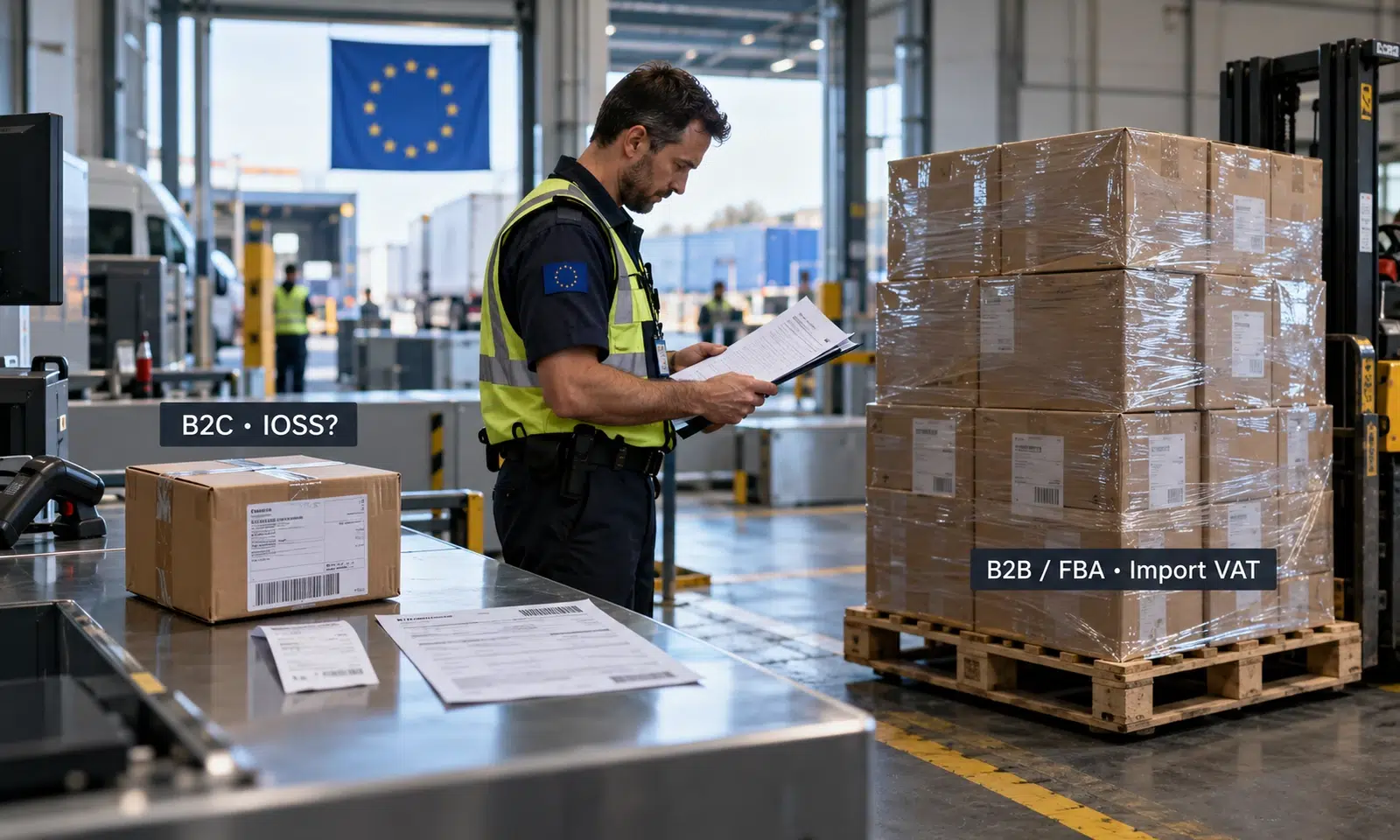
Choosing between VAT and IOSS starts with the transaction, not the freight method. The seller must confirm who buys the goods, who imports them, where the inventory will be stored and whether the shipment represents a direct sale to an EU consumer. A low shipment value alone does not make an import eligible for IOSS.
Contents
- What is the difference between VAT and IOSS?
- When can IOSS be used for EU imports from China?
- Why does IOSS not apply to B2B, FBA or warehouse replenishment?
- How do VAT, IOSS and EORI work together?
- What changed for shipments valued at €150 or less in 2026?
- How should intrinsic value and shipping documents be checked?
- Which VAT or IOSS route fits your shipment?
- VAT and IOSS questions
- How VoltFreight reviews EU-bound shipments before booking
What Is the Difference Between VAT and IOSS?
VAT is the wider tax system for goods and services in the EU. IOSS, or Import One-Stop Shop, is one method for collecting and declaring VAT on a limited category of imported B2C sales. Businesses should not treat them as competing tax numbers.
| Item | VAT | IOSS |
|---|---|---|
| What is it? | The EU value-added tax system | Import One-Stop Shop scheme |
| Main purpose | Taxation of goods, services and imports | Simplified VAT collection for eligible imported B2C sales |
| Main users | Businesses and other taxable persons with VAT obligations | Sellers or deemed suppliers making eligible B2C distance sales |
| B2B bulk shipment | Potentially applicable | Not the appropriate scheme |
| FBA inventory replenishment | Potentially applicable | Not the appropriate scheme |
| B2C direct-to-consumer sale | Applicable under the relevant VAT rules | Can apply when all IOSS conditions are met |
| Value condition | No general €150 VAT threshold | Intrinsic value must not exceed €150 |
| Customs role | Separate from customs identification | The valid IOSS number must be transmitted in the customs declaration |
| Can it replace EORI? | No | No |
The European Commission explains that IOSS simplifies VAT declaration and payment for eligible distance sales of imported goods not exceeding €150. Imported goods remain subject to VAT, so an IOSS shipment is not “tax-free.” The seller collects VAT at checkout and reports it through IOSS. When the valid IOSS number and correct transaction data reach customs, the buyer should not pay the same import VAT again at delivery. The European Commission’s VAT One-Stop Shop guidance provides the official framework.
When Can IOSS Be Used for EU Imports From China?
IOSS can apply when a business sells goods from outside the EU directly to an EU consumer and the intrinsic value of the consignment does not exceed €150. The goods must not be subject to excise duties, and the seller or deemed supplier must use a valid IOSS arrangement.
The transaction normally needs to satisfy all four conditions:
- The goods are dispatched from China or another territory outside the EU.
- The transaction is a distance sale from a business to an EU consumer.
- The intrinsic value of the consignment does not exceed €150.
- The goods are not subject to excise duties.
The valid IOSS VAT identification number must reach customs through the proper declaration process. A missing, invalid or mismatched number may prevent the intended IOSS treatment.
These examples show why transaction structure matters:
- €100 B2C direct-to-consumer order: potentially eligible for IOSS if every other condition is met.
- €100 B2B shipment: IOSS is not the applicable scheme because the buyer is a business rather than the final consumer.
- €100 Amazon FBA inventory shipment: IOSS is not the applicable scheme because the cargo represents inventory replenishment.
- €200 B2C order: outside the €150 intrinsic-value condition for IOSS.
Does the freight method affect IOSS eligibility?
Air freight, express courier and postal delivery can carry eligible B2C orders, but the transport method does not create IOSS eligibility. DDP and DAP also define commercial responsibilities rather than tax eligibility. Several wholesale cartons on one air waybill remain B2B cargo, while small cartons sent to FBA remain inventory replenishment. Businesses planning urgent delivery can review VoltFreight’s air freight services from China after confirming the import structure.
Why Does IOSS Not Apply to B2B, FBA or Warehouse Replenishment?
IOSS covers eligible distance sales to final consumers. B2B cargo, Amazon FBA replenishment and stock transfers to a 3PL do not represent that transaction, even when each carton has a low value.
B2B commercial freight
A wholesaler, distributor or retailer importing goods for resale follows the applicable commercial import VAT and customs procedure. The destination, business setup and Incoterm determine the importer and customs arrangement. A value below €150 does not make the shipment eligible for IOSS.
Amazon FBA replenishment
When a seller sends inventory from China to an Amazon fulfillment centre, the shipment moves stock into a fulfillment network before the final consumer sale. The seller therefore needs the appropriate importer, customs and VAT structure for inbound inventory rather than an IOSS number for each carton.
VAT registration may also be required where inventory is stored or sold. Sellers using Pan-European FBA should review the VAT obligations in every country where they enable storage. For the logistics side, VoltFreight’s guide to shipping from China to Amazon FBA Europe explains freight, customs, labeling and final warehouse delivery in more detail.
3PL and overseas warehouse replenishment
A shipment to an EU warehouse also represents inventory movement. Later B2C fulfillment does not convert the original bulk import into an IOSS shipment. The freight forwarder needs the transaction connected to the current customs declaration, rather than a possible sale after the goods enter inventory.
How Do VAT, IOSS and EORI Work Together?
VAT, IOSS and EORI support different functions. A company may use more than one of them, but possession of all three does not automatically make a shipment compliant. Each identifier must belong to the correct party and match the transaction and customs declaration.
VAT number
A VAT number identifies a business for VAT purposes. Registration depends on the importer, country, transaction, place of supply, inventory location and sales arrangement. Sellers should check the countries where they import, store and sell goods.
IOSS number
An IOSS number supports qualifying B2C distance sales of imported goods with an intrinsic value of no more than €150. It must correspond to the relevant seller, intermediary or deemed supplier and pass securely through customs. Sellers should not publish it or allow unrelated businesses to use it.
EORI number
An EORI number identifies an economic operator during EU customs procedures. The European Commission states that EORI is mandatory for import, export and transit operations. The operator or representative carrying out the customs activity provides it; VAT and IOSS cannot replace it. See the European Commission’s EORI guidance.
Can one IOSS registration cover sales to several EU countries?
Yes. IOSS provides one reporting mechanism for qualifying imported B2C distance sales across EU member states. The seller still applies the correct destination VAT rate, keeps the required records and sends the correct IOSS number with each qualifying transaction.
The practical relationship can be summarized as follows:
- VAT: the wider tax obligation.
- IOSS: a simplified mechanism for a defined category of low-value B2C imports.
- EORI: customs identification for the operator involved in customs procedures.
What Changed for Shipments Valued at €150 or Less in 2026?
The €150 figure now answers two separate questions. It remains the intrinsic-value ceiling for IOSS, but it no longer provides a general customs-duty exemption for the affected low-value e-commerce imports.
From 1 July 2026, the EU applies a temporary €3 customs duty per item to low-value distance-sale consignments up to €150 that are imported from outside the EU. The temporary measure replaced the previous duty exemption and is scheduled to apply until 1 July 2028. Normal customs tariffs are expected to apply after that transition.
The €3 duty is calculated per item based on tariff classification rather than simply per parcel. A consignment with products under several tariff classifications can attract more than one €3 charge. The declaration, classification and any preferential treatment still affect the result.
The temporary duty applies whether the affected distance sale uses IOSS, special arrangements or standard VAT. IOSS and customs duty therefore answer different questions. See the Commission’s 2026 guidance on the temporary €3 customs duty.
Before sending a low-value order, businesses should answer two questions separately:
- Does the transaction qualify for IOSS? Check the B2C sale, origin, intrinsic value, product and IOSS conditions.
- What customs duty applies? Check the 2026 low-value rule, tariff classification, origin and current customs treatment.
Calling every consignment below €150 “duty-free” or “IOSS tax-free” is therefore inaccurate in 2026.
How Should Intrinsic Value and Shipping Documents Be Checked?
The €150 IOSS test uses the intrinsic value of the goods. The invoice and order records should separate product value from freight, insurance and other charges so the seller, carrier and customs representative can apply the correct valuation rules.
For an order with several products, confirm whether customs treats them as one consignment and whether the total intrinsic value exceeds €150. Artificial splitting or undervaluation can trigger reassessment, extra tax, penalties or delays.
Information to reconcile before departure
The seller, shipper and logistics provider should check the following information before EU-bound cargo leaves the China warehouse:
- Shipper: confirm the legal entity and complete address.
- Consignee: identify the actual consumer, business, fulfillment centre or warehouse receiving the goods.
- Importer: confirm who takes responsibility for the EU import entry.
- EORI: verify the customs operator and the number used for the declaration.
- VAT: confirm the VAT registration connected to the import or inventory arrangement where applicable.
- IOSS: include it only when the specific transaction qualifies.
- Product description: use a commercially accurate description rather than a vague term such as “sample,” “gift” or “accessory.”
- HS code: check the classification against the product’s material, function and composition.
- Quantity: make sure the invoice, packing list and physical cargo agree.
- Unit and total value: use commercially supportable figures that match the sales records.
- Incoterm: state the named place and ensure the import responsibilities match the commercial agreement.
- Air waybill or other transport document: align shipper, consignee, packages, weight and routing data.
- Customs declaration: reconcile it with the invoice, packing list, transport record and tax information.
Shipment data may pass through the seller, China warehouse, freight forwarder, carrier, customs representative and delivery network. One inconsistent name, value or tax number can create a later query.
A freight forwarder can check document consistency. The seller, importer and qualified adviser remain responsible for the tax registration and legal structure. VoltFreight’s customs clearance service explains how shipment data, broker coordination and cargo release connect.
Which VAT or IOSS Route Fits Your Shipment?
Use the following framework as an operational starting point for direct consumer sales and inventory movements.
B2B bulk shipment
IOSS: No. Use the applicable commercial import VAT and customs procedure. Confirm the importer, EORI, VAT treatment, Incoterm, customs representative and duty payer before booking.
Amazon FBA replenishment
IOSS: No. Treat the cargo as an inventory import. Confirm the importing entity, storage country, VAT registrations, EORI, customs entry and delivery requirements for the selected Amazon fulfillment centre.
EU 3PL or overseas warehouse replenishment
IOSS: No. The import moves stock into storage rather than completing an eligible consumer distance sale. Use the applicable inventory import structure and confirm the later fulfillment arrangement separately.
B2C direct sale with an intrinsic value of €150 or less
IOSS: Potentially. Confirm that the seller uses a valid IOSS arrangement, the goods are not excise goods, the number reaches customs correctly and the seller collected the destination VAT at checkout. Also account for the 2026 customs-duty treatment.
B2C direct sale above €150
IOSS: No. Use the standard applicable import VAT and customs procedure. Clarify whether the seller or buyer handles the import and pays the destination charges.
B2B sample
IOSS: No. Calling goods “samples” does not automatically remove VAT, duty or customs requirements. State the real purpose and commercially supportable value, then use the applicable import procedure.
B2C sample or trial order valued at €150 or less
IOSS: Potentially, but only when it is an actual qualifying distance sale and every IOSS condition is met. A free promotional sample is not automatically an IOSS sale merely because a consumer receives it.
The most common VAT and IOSS mistake
The largest operational mistake is treating VAT, IOSS and EORI as interchangeable. Confirm that each identifier belongs to the correct party and matches the sale, importer, declaration and tax mechanism.
Before booking, map each role:
- Who sold the goods?
- Is the buyer a business or a consumer?
- Who acts as importer?
- Which party provides the EORI?
- Where will the goods be stored after import?
- Who collected or will pay VAT?
- Does this exact sale qualify for IOSS?
VAT and IOSS Questions for EU Imports
Does IOSS apply to B2B air freight?
No. IOSS is intended for eligible B2C distance sales of imported goods and is not the normal VAT mechanism for wholesale cargo, business purchases or inventory transfers. Sending a B2B shipment by air does not change the transaction into a consumer sale.
Does an EU shipment need both VAT and EORI?
Do not treat this as a rule that every parcel must display both numbers. EORI identifies the economic operator for customs procedures. VAT registration depends on the importing entity, transaction, inventory location and national VAT obligations. Confirm the importer and destination-country setup before shipping.
Are commercial samples exempt from VAT or customs clearance?
Not automatically. Customs treatment depends on the product, value, purpose, recipient and applicable rules. Describe the goods accurately and use a supportable value. Writing “sample” on an invoice does not by itself create a VAT or duty exemption.
How VoltFreight Reviews EU-Bound Shipments Before Booking
VoltFreight coordinates shipments from China to Europe by air, express, ocean, rail and door-to-door services. Before booking, we review the cargo and shipping information so the route, documents and handover use consistent data.
For an EU-bound shipment, our operational review can include:
- China supplier pickup and warehouse receiving;
- carton, weight and dimension confirmation;
- commercial invoice and packing-list consistency checks;
- shipping document preparation and export handling;
- review of the importer, consignee and delivery address;
- coordination of the VAT, EORI or IOSS data supplied by the customer where applicable;
- handover to the destination customs representative;
- delivery to a business address, eligible warehouse, 3PL or Amazon fulfillment centre.
VoltFreight does not issue VAT, EORI or IOSS registrations and does not replace a tax adviser. Our role is to connect the confirmed commercial and customs information with the freight plan and help identify missing or inconsistent shipment details before cargo leaves China.
For a route review or quotation, send:
- China pickup city and supplier address;
- destination EU country, city and postcode;
- product name, material, use and HS code if available;
- carton count, dimensions, gross weight and cargo value;
- whether the transaction is B2B, B2C, FBA or warehouse replenishment;
- the proposed importer and Incoterm;
- available VAT, EORI or IOSS information;
- required delivery time and final delivery point.
Resolve VAT vs IOSS before the supplier dispatches the cargo. Correcting the seller, importer, value or tax data after arrival at an EU gateway can create extra handling and delay. Confirm the transaction first, then select the route and prepare the declaration data.
Explore VoltFreight’s shipping routes from China to Europe, or contact our team with the shipment details for a route and document review.