China to Global Freight Guide

Air Freight from China to Mexico: Airport-to-Airport Shipping Guide

Learn how airport-to-airport air freight from China to Mexico works, including NLU, GDL and MTY airport selection, transit time, chargeable weight, airline booking, customs documents, destination charges and cargo pickup.
China Freight Services

Ship from China with One Reliable Forwarder

VoltFreight helps importers, e-commerce sellers and Amazon sellers arrange flexible freight solutions from China to global destinations.

  • Sea freight FCL & LCL
  • Air freight and airport delivery
  • DDP & DDU door-to-door shipping
  • Amazon FBA first-leg freight
  • DHL, UPS & FedEx express service
  • 30 days free storage in China
Get a Free Quote

In This Guide

Air freight from China to Mexico is a practical airport-to-airport solution for urgent commercial cargo that cannot wait for ocean transportation. Mexican importers commonly use air cargo for automotive parts, machinery components, electronics, industrial materials, commercial samples, fashion inventory, medical equipment and time-sensitive replacement stock.

However, the lowest price per kilogram does not automatically create the best shipment. A workable China-to-Mexico air freight plan must also identify the correct Chinese departure airport, the correct Mexican destination airport, the shipment’s chargeable weight, the airline’s cargo-acceptance conditions and the importer’s customs-release plan.

VoltFreight can coordinate supplier pickup in China, warehouse receiving, multi-supplier consolidation, package measurement, China export customs declaration, airline booking, Air Waybill preparation and international air transportation to the agreed Mexican airport.

Service scope: This page focuses on traditional commercial airport-to-airport air freight. Unless a written quotation states otherwise, the Mexican importer or its appointed customs broker handles import clearance, the Pedimento, duties, IVA, destination-terminal charges, inspections, storage, cargo release, airport pickup and transportation within Mexico.

For importers comparing air cargo with sea freight, express courier, DDP or other transport methods, our broader shipping from China to Mexico guide explains the main alternatives. This page, by contrast, concentrates on commercial airline cargo moving from China to NLU, MEX, GDL, MTY or another confirmed Mexican airport.

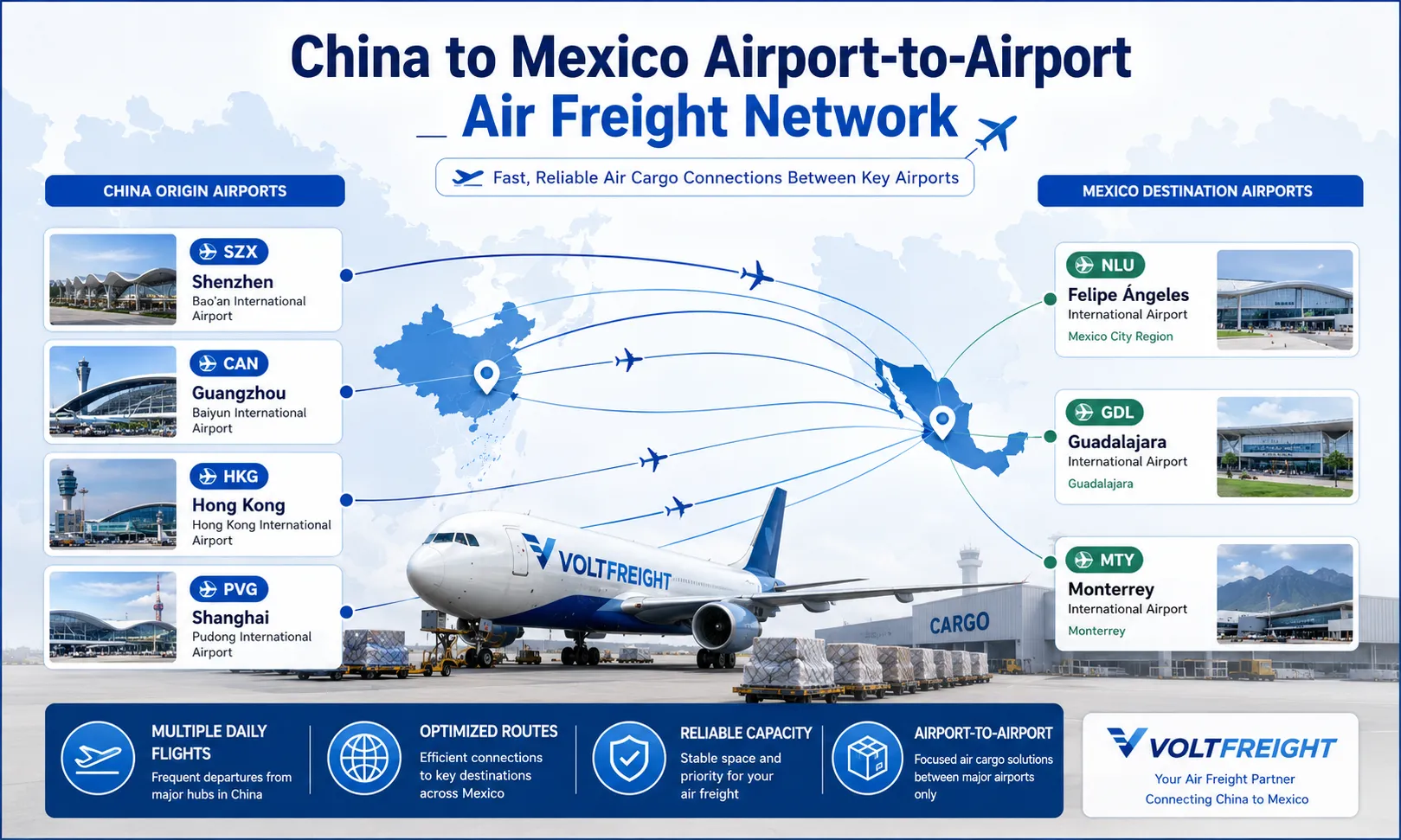
Air freight from China to Mexico connecting major Chinese cargo airports with NLU, GDL and MTY airport cargo terminals

Quick Answer: How Does Air Freight from China to Mexico Work?

Airport-to-airport air freight moves commercial cargo from an agreed origin airport in China to an agreed cargo terminal in Mexico. The freight forwarder coordinates the China-side handling and airline transportation, while the Mexican importer prepares the customs entry and airport collection.

For many shipments, the overall plan looks like this:

  • China origin: Supplier pickup or delivery to a designated warehouse
  • Origin handling: Receiving, measurement, document review and export customs
  • Departure airports: Commonly SZX, CAN, HKG, PVG, PEK or PKX
  • Mexico airports: Commonly NLU, MEX, GDL or MTY, subject to the airline route
  • General cargo planning rate: Often approximately USD 4.70–10.20 per chargeable kilogram
  • Typical airport transit: Approximately 3–9 business days after airline acceptance
  • Economy or longer connection: Approximately 7–12 business days
  • Pricing basis: Actual gross weight or volumetric weight, whichever is higher
  • Special cargo: Batteries, liquids, powders, magnets and dangerous goods need additional review
  • Mexico customs: Managed by the importer and its appointed customs professional
  • Destination expenses: Not included unless expressly shown in the quotation
  • Final delivery: Outside the standard airport-to-airport scope

Importers that need a fuller explanation of airport-only logistics can also review our airport-to-airport air freight from China guide.

Air Freight Rates and Transit Times from China to Mexico

Importers often search for the air freight cost from China to Mexico before they have final packing information. A planning table is useful for budgeting, although a live quotation must still use the actual cargo-ready date, weight, dimensions, commodity and airline capacity.

The following ranges apply to ordinary, stackable general cargo with complete documents and standard export packaging. They are not fixed offers and do not guarantee space on a particular flight.

Air Freight Route +100 kg +300 kg +500 kg +1,000 kg Estimated Airport Transit
Shanghai PVG to NLU or MEX USD 6.20–9.10/kg USD 5.70–8.20/kg USD 5.20–7.50/kg USD 4.80–6.90/kg 3–7 business days
Guangzhou CAN to NLU or MEX USD 6.10–9.00/kg USD 5.60–8.10/kg USD 5.10–7.40/kg USD 4.80–6.80/kg 3–7 business days
Shenzhen SZX to NLU or MEX USD 6.30–9.30/kg USD 5.80–8.40/kg USD 5.30–7.70/kg USD 4.90–7.00/kg 4–8 business days
Hong Kong HKG to NLU or MEX USD 6.00–8.90/kg USD 5.50–8.00/kg USD 5.00–7.30/kg USD 4.70–6.70/kg 3–7 business days
Major China airport to Guadalajara GDL USD 6.50–9.70/kg USD 5.90–8.70/kg USD 5.40–8.00/kg USD 5.00–7.30/kg 4–9 business days
Major China airport to Monterrey MTY USD 6.60–9.90/kg USD 6.00–8.90/kg USD 5.50–8.20/kg USD 5.10–7.50/kg 4–9 business days
Major China airport to QRO, TIJ or CJS USD 7.00–10.20/kg USD 6.40–9.30/kg USD 5.90–8.60/kg USD 5.40–7.90/kg 5–11 business days

Important pricing conditions: These figures are planning ranges for ordinary airport-to-airport air cargo. They do not include Mexican customs-broker fees, import duty, IVA, destination-terminal handling, bonded-warehouse storage, inspection charges, airport release, local pickup or final delivery.

Furthermore, battery cargo, dangerous goods, liquids, powders, chemical products, magnetic equipment, temperature-controlled goods, oversized pieces and non-stackable pallets require separate airline review.

What Is a Realistic Rate for Cargo Above 300 Kilograms?

For ordinary general cargo above approximately 300 kilograms, many China-to-Mexico airport quotations may fall around USD 5.50–8.90 per chargeable kilogram. The rate may be lower for dense cargo above 500 or 1,000 kilograms, particularly when the shipper can use standard connecting capacity.

Nevertheless, a lower rate per kilogram does not always mean a lower invoice. A 600-kilogram shipment may occupy enough aircraft space to create 900 kilograms of volumetric weight. In that case, the airline normally charges approximately 900 kilograms.

Why Does the Destination Airport Change the Cost?

NLU and MEX serve the Mexico City region, while GDL and MTY serve different industrial markets. Each airport has a different airline network, terminal structure and final-sector capacity. Consequently, a route to GDL or MTY may cost more than a Mexico City-region route even when it reduces domestic trucking.

Regional airports such as QRO, TIJ or CJS can be useful for selected importers. However, an additional transfer, limited frequency or smaller aircraft may increase both cost and transit time.

Why Can Two Freight Forwarders Quote Different Prices?

Quotations may differ because forwarders use different origin airports, airline contracts, connecting hubs, booking dates, weight brackets and service scopes. One offer may include factory pickup and China export customs, whereas another covers only airline line-haul between two terminals.

Therefore, compare the following items before choosing a quotation:

  • Confirmed China departure airport
  • Confirmed Mexican destination airport
  • Chargeable weight used for the calculation
  • Direct, priority, standard or deferred capacity
  • China pickup and warehouse receiving
  • Export customs and terminal delivery
  • Air Waybill and airline surcharges
  • Rate validity and cargo cut-off
  • Excluded Mexican destination charges
  • Special-cargo handling requirements

For a more detailed explanation of weight brackets and airline surcharges, read our air freight rates from China guide.

What the Airport-to-Airport Quotation Includes and Excludes

“Airport-to-airport” describes the logistics service scope. It is not an Incoterm and does not automatically tell the importer whether pickup, export handling, customs clearance or delivery is included.

For example, a supplier contract may use EXW, FCA, CPT or CIP. Separately, the freight quotation should state which China-origin services are included and where VoltFreight’s responsibility ends.

China-Origin Services That May Be Included

  • Pickup from the supplier’s factory or warehouse
  • Receiving at the designated China warehouse
  • Collection from several Chinese suppliers
  • Multi-supplier consolidation
  • Package counting and shipping-mark verification
  • Outer-carton condition checks
  • Gross-weight and dimension measurement
  • Chargeable-weight calculation
  • Commercial invoice and packing-list review
  • China export customs declaration
  • Security screening and departure-terminal handling
  • Airline space booking
  • Master or House Air Waybill preparation
  • International air freight to the agreed Mexican airport
  • Flight-status and transfer updates
  • Pre-alert documents for the Mexican importer

The exact service depends on the written quotation. For example, factory pickup may be included for one shipment but excluded when the supplier delivers directly to the airline-handling warehouse.

Mexican Importer Responsibilities

  • Maintaining valid RFC and importer information
  • Confirming Padrón de Importadores status
  • Confirming sector-specific registration when applicable
  • Appointing a Mexican customs broker or authorized customs professional
  • Confirming the TIGIE and NICO classification
  • Preparing the Pedimento de Importación
  • Completing VUCEM filings when required
  • Preparing the Manifestación de Valor and supporting valuation records
  • Confirming NOM, labeling, permit and agency requirements
  • Paying duty, IVA and other applicable charges
  • Paying destination terminal and bonded-warehouse fees
  • Completing customs or product-agency inspections
  • Obtaining customs and terminal release
  • Arranging airport pickup and domestic trucking

Expenses Normally Excluded

  • Long-term warehouse storage in China
  • Carton replacement, repacking or pallet production
  • Wooden-case treatment and certification
  • Battery testing or preparation of missing technical reports
  • Dangerous-goods documentation not included in the quote
  • Product compliance testing
  • Mexican customs-broker fees
  • Import duty, IVA and other taxes
  • Destination terminal or recinto fiscalizado charges
  • Customs examinations and cargo movement for inspection
  • Storage after arrival
  • Air Waybill amendments caused by incorrect consignee information
  • Airport pickup and final delivery

A useful quotation should clearly separate origin costs, international air freight and destination responsibilities. That separation helps the importer compare total operational cost rather than only the headline rate.

When Air Freight Is the Right Choice for Mexico

Air freight works best when speed has a measurable commercial value. In other words, the extra transportation cost should prevent a larger loss, protect an important deadline or allow the importer to sell the goods sooner.

Common Cargo Shipped by Air

  • Automotive components and urgent production parts
  • Machinery spare parts and maintenance items
  • Electronics, circuit boards and control systems
  • Industrial sensors and precision instruments
  • Medical equipment and permitted healthcare products
  • Commercial samples and pre-production materials
  • Fashion inventory and seasonal products
  • High-value tools and mould components
  • E-commerce and wholesale stock replenishment
  • Exhibition materials and project equipment
  • Critical items required to prevent factory downtime

Commercial Situations That Support Air Freight

A manufacturing company may need one replacement component to restart a production line. Likewise, an automotive supplier may need to replenish a Mexican factory before a scheduled assembly run. In both situations, the cost of delay may be far higher than the air freight charge.

Air shipping from China to Mexico can also work well for high-value products with moderate weight. Electronics, precision equipment and commercial samples often justify faster transportation because the goods spend less time in transit and reach the importer’s sales or production process sooner.

When Air Freight May Be a Poor Choice

  • Bulky, low-value cargo with no urgent deadline
  • Furniture, construction products or large-volume inventory
  • Goods with excessive volumetric weight
  • Cargo that cannot fit available aircraft doors or compartments
  • Products requiring permits that have not been obtained
  • Shipments without a prepared Mexican importer or customs broker
  • Dangerous goods without compliant packing and documents
  • Commercial transactions with unclear values or incomplete invoices

For very small shipments, express courier may provide a simpler service. Between approximately 45 and 100 kilograms, the importer should compare courier and traditional air cargo. Above 100 kilograms, commercial air freight often becomes more attractive, although package dimensions and Mexican destination charges still matter.

Main Air Freight Departure Airports in China

The supplier’s nearest airport is not automatically the best gateway. Airline space, flight frequency, cargo category, domestic trucking, transfer options and special-cargo acceptance can change the complete result.

Shenzhen Bao’an International Airport – SZX

SZX can serve suppliers in Shenzhen, Dongguan, Huizhou and nearby manufacturing areas. It is commonly considered for electronics, telecommunications products, machinery parts, accessories and ordinary commercial cargo.

However, some South China shipments use CAN or HKG when those airports offer a better route, more stable capacity or broader special-cargo acceptance.

Guangzhou Baiyun International Airport – CAN

CAN serves Guangzhou, Foshan, Zhongshan, Jiangmen and a large part of the Pearl River Delta. It can offer useful airline alternatives when SZX space is limited or when the supplier is located closer to western Guangdong.

Consequently, VoltFreight often compares SZX and CAN for South China general cargo rather than selecting an airport only by city name.

Hong Kong International Airport – HKG

HKG has an extensive international cargo network and experienced operators for approved special cargo. Therefore, it may be evaluated for selected batteries, battery-powered equipment, liquids, powders, magnets, chemicals and routes that are difficult to arrange from a mainland airport.

Nevertheless, mainland goods must first move to a Hong Kong warehouse or terminal. Cross-border trucking, Hong Kong handling and documentation can increase the total cost, so the HKG option should be compared on a complete-route basis.

Shanghai Pudong International Airport – PVG

PVG is a major gateway for Shanghai, Jiangsu, Zhejiang and the wider Yangtze River Delta. Importers commonly use it for machinery, automotive parts, electronics, industrial materials, textiles and commercial inventory.

In addition, strong consolidation volume can create several airline and connection options for larger shipments.

Beijing Capital and Beijing Daxing – PEK and PKX

PEK and PKX may serve cargo from Beijing, Tianjin, Hebei and northern China. The selected airport depends on the airline, cargo terminal, flight connection and available space.

Zhengzhou, Ezhou and Other Regional Airports

CGO, EHU, Chengdu, Chongqing, Wuhan, Hangzhou, Nanjing, Xiamen and other regional airports may be suitable for selected cargo. For example, a regional departure can reduce domestic trucking when the supplier is far from the major coastal gateways.

On the other hand, a lower China trucking cost may be offset by a higher airline rate or less stable connection. Therefore, the origin decision should use the complete transportation cost and required arrival date.

NLU, MEX, GDL or MTY: Which Mexican Airport Should You Choose?

Mexico has several important cargo gateways, and the correct destination can materially affect the importer’s customs setup, terminal charges and domestic trucking. A quotation that simply says “Mexico City” or “Mexico airport” is not specific enough for a commercial shipment.

NLU – Felipe Ángeles International Airport

Many cargo-only services for the Mexico City region currently operate through NLU. AIFA’s cargo terminal is designed for international freight operations and can receive large freighter aircraft, including aircraft requiring front-loading capability.

NLU may be suitable for:

  • Freighter cargo serving the Mexico City metropolitan region
  • Heavy, palletized or oversized commercial shipments
  • Central Mexico distribution plans
  • Importers whose customs broker and trucker operate at AIFA

Because NLU is a different airport from MEX, the importer must arrange the broker, terminal payment and truck collection at the airport shown on the Air Waybill.

MEX – Mexico City International Airport

MEX remains relevant for passenger-belly cargo when the operating airline and route use Mexico City International Airport. Therefore, cargo can still arrive at MEX even though many dedicated freighter operations use NLU.

The booking confirmation and Air Waybill should control the pickup plan. Never assume that “Mexico City” means MEX, and never send a truck to NLU when the Air Waybill shows MEX.

GDL – Guadalajara International Airport

GDL is an important passenger and air cargo airport serving Guadalajara, Jalisco and nearby industrial regions. It may be practical for electronics, automotive parts, machinery components and commercial stock intended for western or central Mexico.

Using GDL may reduce domestic trucking for importers in Jalisco, Guanajuato, Aguascalientes or parts of the Bajío region. However, the forwarder should compare the airline rate and connection against a route through NLU or MEX.

MTY – Monterrey International Airport

MTY serves Monterrey, Nuevo León and northern Mexico’s manufacturing base. Its cargo facilities include bonded warehouses, X-ray equipment, refrigeration areas, heavy-duty scales and customs-connected operating areas.

Consequently, MTY can be a strong option for automotive components, machinery, industrial parts and urgent factory cargo intended for Nuevo León or nearby northern states.

QRO, TIJ and CJS

Querétaro, Tijuana and Ciudad Juárez may support route-specific cargo for industrial or border regions. Nevertheless, international uplift from China may require an additional connection or domestic transfer.

Before using a regional airport, confirm:

  • The final airline sector
  • Whether the cargo can be interlined to that airport
  • Aircraft door and package limitations
  • Special-cargo acceptance
  • Destination terminal and customs capabilities
  • The importer’s broker and pickup setup
  • The total cost compared with trucking from NLU, MEX, GDL or MTY

Official information is available from the AIFA cargo terminal, the Guadalajara Airport website and the Monterrey cargo facilities page.

China-to-Mexico Air Route Planning

There is no single permanent air route that fits every China-to-Mexico shipment. Airlines change capacity according to demand, season, aircraft, e-commerce volume and network strategy. Therefore, a quotation should identify the expected airport pair and whether the service is direct or connecting.

Direct or Fewer-Transfer Service

A direct or fewer-transfer option can reduce handling and shorten airport transit. It may be useful for urgent production parts, fragile equipment and high-value cargo.

However, faster capacity may have a higher rate, stricter dimensions or limited availability. Moreover, a direct service does not guarantee immediate customs release after arrival.

Connecting Air Freight

Connecting services may use another Asian, North American, European or Middle Eastern cargo hub before reaching Mexico. The exact connection depends on the airline, cargo type and destination airport.

A connecting route may reduce the airline rate. Nevertheless, it introduces additional handling, transfer time and offloading risk when the onward flight is full.

Common Planning Structures

  • South China airport to NLU or MEX through an approved international hub
  • PVG or HKG to GDL through an airline’s regional network
  • PVG, CAN or HKG to MTY through an approved connecting airport
  • Mainland supplier to HKG for approved special cargo, followed by an international route to Mexico

These structures are examples, not guaranteed schedules. The final airline and transfer airport should be confirmed only after the cargo details and live space have been reviewed.

Why the Cheapest Route Can Cost More Overall

A low air rate can lose its advantage when the shipment arrives at the wrong Mexican airport, waits several days for customs preparation or requires expensive domestic transfer. Likewise, a cheap route with two connections may create unacceptable risk for production-critical cargo.

For that reason, route planning should balance:

  • Airline rate
  • China pickup and origin handling
  • Number and quality of connections
  • Cargo acceptance
  • Required arrival date
  • Importer customs readiness
  • Destination terminal costs
  • Domestic trucking after release

Realistic Transit-Time Planning

Airport-to-airport air freight from China to Mexico commonly requires approximately three to nine business days after airline acceptance. Priority services may move faster, while deferred or regional routes can require seven to twelve business days.

However, airport transit does not equal the complete factory-to-release timeline.

China Origin Handling

Before departure, the shipment may require supplier pickup, warehouse receiving, document review, export customs, security screening and terminal handover. General cargo with complete documents can move quickly, whereas late supplier delivery or an incomplete invoice can add several days.

Airline Transportation

The flight stage includes the main international sector and any transfer time. Weekend schedules, limited onward flights, weather and airline capacity can affect the expected arrival.

Mexico Customs and Cargo Release

After the aircraft lands, the importer still needs to complete customs and terminal procedures. A prepared importer may move efficiently, while missing Padrón status, a NOM requirement, a valuation document or duty payment can create a much longer delay than the flight itself.

Typical Planning Sequence

  1. Supplier pickup or delivery to the China warehouse
  2. Warehouse receiving and final measurement
  3. China export declaration and terminal delivery
  4. Airline acceptance and departure
  5. International transfer when applicable
  6. Arrival at NLU, MEX, GDL, MTY or another confirmed airport
  7. Mexican customs entry and tax payment
  8. Customs and terminal release
  9. Airport pickup by the importer’s authorized trucker

When requesting a quotation, provide both the cargo-ready date and the required airport-arrival date. These dates help the forwarder decide whether the shipment needs priority capacity or can use a lower-cost connecting route.

Chargeable Weight and Air Freight Cost Calculation

Airlines calculate freight according to chargeable weight. They compare actual gross weight with volumetric weight and normally charge whichever figure is higher.

Chargeable Weight = Higher of Actual Gross Weight and Volumetric Weight

A commonly used air freight formula is:

Length × Width × Height in centimetres ÷ 6,000

As a planning shortcut, one cubic metre equals approximately 167 kilograms of volumetric weight.

Dense Cargo Example

A shipment of machinery parts weighs 500 kilograms and occupies 2 CBM. The volumetric weight is approximately 334 kilograms. Because the actual weight is higher, the airline charges 500 kilograms.

Bulky Cargo Example

A shipment of display products weighs 250 kilograms but occupies 3 CBM. The volumetric weight is approximately 501 kilograms. Therefore, the airline charges approximately 501 kilograms rather than 250 kilograms.

Carton-Level Example

Suppose a shipment contains 24 cartons measuring 65 × 48 × 42 centimetres each.

65 × 48 × 42 ÷ 6,000 × 24 = 524.16 kg

If the actual gross weight is 460 kilograms, the airline uses approximately 525 kilograms as the chargeable weight.

Why Final Warehouse Measurements Matter

Supplier dimensions are useful for a preliminary quote. Nevertheless, the final charge should use the measurements confirmed by the warehouse or airline terminal.

A small difference on one carton may seem unimportant. However, several centimetres multiplied across many cartons can materially increase the volumetric weight and move the shipment into a different cost level.

How to Reduce Volumetric Weight

  • Remove unnecessary empty space
  • Use cartons that fit the packed products
  • Avoid excessive retail-display packaging
  • Confirm pallet height before loading
  • Separate irregular items when practical
  • Use strong but efficient export packaging
  • Provide final packed dimensions before booking

Packaging should never be weakened merely to reduce freight cost. The cargo must withstand warehouse handling, security screening, aircraft transfers and airport collection.

You can also use our CBM calculator for shipping from China when preparing the first quotation request.

Oversized Cargo, Lithium Batteries and Sensitive Goods

Total shipment weight does not guarantee airline acceptance. Each individual piece must fit the aircraft door, cargo compartment, handling equipment and final route.

Oversized and Heavy Pieces

For machinery, moulds, motors, transformers or large wooden cases, provide:

  • Length, width and height of every piece
  • Gross weight of every piece
  • Product photographs
  • Technical drawings when available
  • Centre-of-gravity information
  • Forklift or crane requirements
  • Stackable or non-stackable status
  • Whether the case can be safely tilted

Heavy cargo may require reinforced pallets, forklift pockets, lifting points and main-deck aircraft review. Therefore, airline acceptance should be checked before the supplier completes an expensive wooden case.

Batteries Contained in Equipment

Laptops, handheld devices, industrial instruments and machines may contain installed lithium batteries. Lithium-ion batteries contained in equipment are commonly reviewed under UN3481, although the exact classification depends on the product and packing arrangement.

Batteries Packed with Equipment

When batteries and equipment travel in the same shipment but the batteries are not installed, the cargo may also be reviewed under UN3481. However, the applicable packing instructions and quantity limits can differ.

Standalone Lithium-Ion Batteries

Rechargeable lithium-ion batteries shipped without equipment are commonly associated with UN3480. Standalone batteries generally face stricter airline conditions and may require approved dangerous-goods packaging, state-of-charge controls, a shipper’s declaration and cargo-aircraft arrangements.

Power Banks

Power banks are normally treated as batteries rather than batteries contained in equipment. The shipper should provide the model, chemistry, Watt-hour rating, quantity, UN38.3 test summary, MSDS and packing photographs.

Documents Commonly Requested for Battery Cargo

  • UN38.3 test summary
  • Material Safety Data Sheet
  • Battery model and specification
  • Battery chemistry
  • Watt-hour rating
  • Number of cells or batteries
  • Product photographs
  • Inner- and outer-packing photographs
  • Transport classification
  • Dangerous Goods Declaration when required

Why Some Special Cargo Uses Hong Kong

Hong Kong may offer additional dangerous-goods operators and airline options for approved cargo. VoltFreight can therefore evaluate a mainland-to-Hong-Kong route after reviewing the product and documents.

However, HKG does not guarantee acceptance. Cargo may still be rejected when the test report does not match the product, the packaging is non-compliant, the airline does not accept the configuration or the final Mexican sector has restrictions.

Other Cargo Requiring Additional Review

  • Liquids, creams, gels and aerosols
  • Powders and chemical products
  • Magnets, speakers and motors
  • Products containing oil, gas or pressure vessels
  • Cosmetics and medical products
  • Temperature-sensitive cargo
  • High-value branded goods

Airline acceptance and Mexican customs compliance are separate checks. A product may be safe for air transport but still require a Mexican permit, NOM or labeling procedure.

Official battery guidance is available from the IATA lithium battery guidance page.

Mexico Importer and Customs Readiness

Mexico customs planning should begin before the cargo leaves China. A fast flight provides little value when the importer cannot submit the entry, satisfy a product requirement or collect the goods after arrival.

RFC and Padrón de Importadores

The Mexican consignee should confirm that its RFC is active and that it meets the requirements for the Padrón de Importadores. SAT lists conditions including an active RFC, valid e.firma, satisfactory tax-compliance status, a located or validating fiscal address and a validated tax mailbox.

Certain products may also require registration in a specific importer sector. Therefore, the importer should check both the general Padrón and any sector requirement before booking.

Official information is available from the SAT Padrón de Importadores requirements page.

Appoint the Customs Broker Before Departure

The customs broker or authorized customs professional should review:

  • Importer registration
  • Consignee name and RFC
  • TIGIE and NICO classification
  • Product description and intended use
  • NOM and labeling requirements
  • Permits and automatic notices
  • Customs value and valuation documents
  • Pedimento data
  • Destination airport and terminal
  • Airport pickup instructions

Early review allows the importer to correct an invoice, obtain a permit or change the airport before the cargo reaches the airline terminal.

Pedimento de Importación

The Pedimento is a central customs document for the import operation. The broker uses the commercial, transport, classification, valuation and compliance information to prepare the customs entry.

The Pedimento data must match the actual cargo and supporting records. An incorrect airport, consignee, quantity, tariff code or commercial value can create amendments, customs questions or penalties.

Manifestación de Valor

The Manifestación de Valor supports the customs-value declaration. The importer may need to provide transaction information, supplier details, payment records, Incoterms, freight, insurance and other additions to the customs value.

Current VUCEM guidance states that the Manifestación de Valor should be transmitted before payment of the applicable contributions. Therefore, the importer and broker should not wait until the cargo is already being released.

Official guidance is available in the VUCEM Manifestación de Valor frequently asked questions.

VUCEM and Non-Tariff Requirements

VUCEM is Mexico’s electronic foreign-trade platform. It supports procedures connected with permits, notices, certificates and non-tariff regulations before customs clearance.

The exact filing depends on the product and tariff classification. For example, a regulated material may require an automatic import notice, while another product may need a permit or certificate from a different authority.

Because VUCEM procedures change over time, the importer should check the current requirement using the tariff code and confirm it with the customs broker. The official platform is available at the VUCEM website.

TIGIE and NICO Classification

The product’s Mexican tariff classification affects duty, IVA, NOMs, permits, sector registration, trade-remedy measures and customs risk.

A useful classification review should consider:

  • Main material
  • Product construction
  • Technical function
  • Industrial or consumer use
  • Whether the product is complete or only a part
  • Brand and model when relevant
  • Electrical, wireless or battery characteristics

Do not choose a code only because it appears to produce a lower duty rate. The importer’s customs professional should confirm the applicable TIGIE fraction and NICO before the shipment departs.

NOM, Labeling and Product Compliance

Airline acceptance does not confirm Mexican import compliance. Electrical goods, telecommunications equipment, textiles, footwear, toys, food, cosmetics, medical products, chemicals and automotive items may require NOM compliance, labeling or another agency procedure.

Some commercial-information NOMs can involve origin labeling or another approved compliance method. Consequently, the importer should determine whether labels must be applied before shipping, at an authorized facility or under another permitted arrangement.

SNICE provides official information about commercial-information NOM compliance methods.

Duty and IVA

The airport-to-airport rate does not include Mexican import duty, IVA or other destination taxes. The final amount depends on the tariff classification, customs value, origin, applicable trade treatment, product category and current regulations.

Therefore, the importer should obtain a landed-tax estimate from its customs broker rather than applying one general percentage to every shipment.

Documents Required for Air Freight to Mexico

Air freight documents support three separate stages: China export customs, airline cargo acceptance and Mexican import clearance. The same document may be used by several parties, but each party reviews it for a different purpose.

Commercial Invoice

The invoice should normally show:

  • Seller’s legal name and address
  • Buyer and consignee information
  • Invoice number and date
  • Detailed product description
  • Material and intended use
  • Brand and model when applicable
  • Quantity and unit price
  • Total commercial value and currency
  • Country of origin
  • HS, TIGIE or NICO information when confirmed
  • Agreed Incoterm
  • Payment terms when relevant

Avoid descriptions such as “parts,” “accessories,” “samples” or “goods.” Instead, identify the actual product, material and function.

Packing List

The packing list should include:

  • Carton, pallet or wooden-case quantity
  • Contents of each package type
  • Net and gross weight
  • Outer dimensions
  • Total volume
  • Shipping marks
  • Package or pallet numbers

The information should match the actual goods. If the warehouse finds a different weight or package size, the airline quotation may change.

Air Waybill

The Master Air Waybill or House Air Waybill identifies the shipper, consignee, airports, cargo description, package quantity and gross weight.

The destination airport code is especially important. NLU and MEX are separate airports, and the importer must prepare customs and pickup at the airport shown on the Air Waybill.

Product and Customs Information

  • Clear English and, when required, Spanish product description
  • Material and use
  • Brand and model
  • Declared commercial value
  • Country of origin
  • Supplier and importer details
  • Customs broker information
  • TIGIE and NICO classification when available
  • NOM, permit or sector-registration documents when applicable

Special-Cargo Documents

  • MSDS or safety data sheet
  • UN38.3 test summary
  • Battery specification and Watt-hour information
  • Dangerous Goods Declaration when required
  • Magnetic inspection report
  • Non-hazardous declaration for selected powders or liquids
  • Product technical sheet
  • Brand authorization or compliance certificates when required

Pre-Alert Package

Before arrival, the importer and customs broker should receive the available pre-alert documents. A useful package may contain the invoice, packing list, Air Waybill, flight itinerary, estimated arrival time, freight information, insurance certificate and special-cargo records.

Early review makes it easier to correct an airport code, consignee name or product description before the cargo lands.

Before shipping, importers may also use a China inspection service before shipping to check package quantity and visible outer condition. High-value cargo can also be reviewed for freight insurance from China.

Destination Charges, Storage and Airport Pickup

The international airline rate is not the complete cost of releasing cargo in Mexico. After arrival, the terminal, recinto fiscalizado, customs broker and other providers may issue separate charges.

Possible Destination Charges

  • Airline document or handling charges
  • Cargo-terminal receiving and handling
  • Bonded-warehouse storage
  • Customs-broker services
  • Duty, IVA and other applicable taxes
  • Customs examination or product-agency review
  • Forklift, cargo movement or special handling
  • Air Waybill amendment
  • Cargo release or administrative fees
  • Local trucking and waiting time

Storage Risk

Air cargo moves quickly, but airport storage can become expensive. Missing documents, delayed tax payment, an inspection or an unprepared truck can cause the goods to remain in the warehouse after arrival.

The free-time or minimum-storage conditions depend on the terminal and shipment. Therefore, the importer should request a destination-cost estimate and prepare funds before departure.

Arrival Notice

The destination airline or handling agent normally sends an arrival notice to the consignee or customs broker. The importer should confirm the correct email address, Air Waybill number, terminal location and payment instructions.

Airport Pickup Preparation

After customs and terminal release, the authorized trucker collects the cargo. The pickup plan may require:

  • Release documents
  • Driver identification
  • Vehicle information
  • Terminal appointment
  • Customs authorization
  • A truck suitable for the weight and dimensions
  • Forklift or loading arrangements

The standard airport-to-airport service ends when the released shipment is collected from the destination cargo facility.

Step-by-Step Air Freight Process

  1. Submit the cargo details. Provide the product name, material, use, photographs, quantity, weight, dimensions, supplier address, value and cargo-ready date.
  2. Review cargo acceptance. Confirm whether the goods are general cargo, batteries, liquids, powders, magnets, dangerous goods or oversized pieces.
  3. Calculate the estimated chargeable weight. Compare actual and volumetric weight using the supplier’s packing information.
  4. Compare China airports. Review SZX, CAN, HKG, PVG or another origin according to supplier location and airline capacity.
  5. Select the Mexican airport. Compare NLU, MEX, GDL, MTY or a regional airport according to the importer’s customs and domestic transport plan.
  6. Review Mexican import readiness. Confirm Padrón status, customs broker, tariff code, VUCEM procedures, NOMs and product permits.
  7. Issue the written quotation. Show the airport pair, chargeable weight, route, rate validity, included origin charges and excluded destination costs.
  8. Confirm airline space. Request the booking and verify the cargo cut-off.
  9. Arrange pickup or warehouse delivery. Collect from the supplier or provide the warehouse address and shipping mark.
  10. Receive and measure the cargo. Check package quantity, outer condition, gross weight and dimensions.
  11. Consolidate approved suppliers. Combine compatible cargo when the commercial and air-acceptance documents are complete.
  12. Prepare the China export documents. Review the commercial invoice, packing list and product information.
  13. Complete China export customs. Submit the export declaration and resolve origin-side document questions.
  14. Move special cargo to Hong Kong when required. Transfer eligible goods after document and packaging approval.
  15. Deliver the shipment to the airline. Complete security screening, terminal handling and final acceptance.
  16. Issue the Air Waybill. Confirm the shipper, consignee, airport pair, package count and cargo description.
  17. Send the pre-alert. Provide the available documents and itinerary to the Mexican importer and broker.
  18. Transport the cargo to Mexico. Monitor departure, transfer and arrival.
  19. Complete Mexican customs and terminal release. The importer handles the Pedimento, valuation, taxes, inspections and destination charges.
  20. Collect the released cargo. The authorized trucker picks up the shipment from the correct airport facility.

For additional information about airline cut-offs and booking confirmation, read our air freight booking from China guide.

Common Delays and Cost-Control Methods

The Airport Code Is Not Confirmed

A quotation may say “Mexico City” without clearly showing NLU or MEX. As a result, the importer may prepare the wrong broker, warehouse or truck location.

The Importer Is Not Ready

Inactive Padrón status, missing sector registration or incomplete RFC information can prevent customs clearance. Therefore, importer readiness should be checked before the airline booking is released.

The Customs Broker Receives the Documents Too Late

When the broker first sees the invoice after arrival, product-description, classification and valuation problems are harder to correct. A pre-alert before departure reduces this risk.

The Product Description Is Too Vague

Descriptions such as “parts” or “accessories” may be insufficient for airline review and Mexican classification. Instead, state the product, material, function and model.

The Declared Value Does Not Match the Transaction

Customs may question a value that conflicts with purchase orders, payment records or ordinary commercial evidence. Consequently, the invoice and Manifestación de Valor should reflect the real transaction.

NOM or Permit Requirements Were Not Checked

A product may reach Mexico before the importer discovers a labeling, permit or automatic-notice requirement. Meanwhile, destination storage continues to accumulate.

Special Cargo Was Not Disclosed

Undeclared batteries, liquids, powders or magnets can cause rejection, offloading and return-to-warehouse charges. Moreover, the original airline space may be lost.

The Supplier Misses the Cargo Cut-Off

Late warehouse delivery can move the shipment to a later flight. Therefore, the supplier should receive the warehouse address, shipping mark and cut-off instructions in advance.

The Pickup Truck Is Not Ready

Cargo can continue accumulating storage even after customs release when no authorized collector is available. The importer should prepare the vehicle and pickup documents before arrival.

How to Reduce Air Freight Cost

  • Use efficient export cartons
  • Reduce unnecessary volumetric weight
  • Consolidate cargo from several suppliers
  • Compare SZX, CAN, HKG and PVG
  • Compare NLU, MEX, GDL and MTY using total cost
  • Allow enough booking time
  • Use standard capacity when the deadline permits
  • Provide accurate final dimensions
  • Avoid unnecessary non-stackable packaging
  • Confirm oversized-case dimensions before production

How to Reduce Customs Risk

  • Confirm Padrón and importer status early
  • Appoint the Mexican customs broker before booking
  • Confirm TIGIE and NICO classification
  • Check VUCEM, NOM, labeling and permit requirements
  • Use detailed commercial descriptions
  • Support the declared transaction value
  • Match the invoice, packing list and Air Waybill
  • Disclose batteries and sensitive cargo
  • Send the pre-alert before arrival
  • Prepare destination payments and airport pickup

Planning Example: Automotive Parts from Shenzhen to Monterrey

Consider a shipment of commercial automotive components moving from a supplier in Shenzhen to a factory in Nuevo León.

  • Origin: Shenzhen, China
  • Destination airport: Monterrey MTY
  • Packages: 25 cartons
  • Actual gross weight: 420 kg
  • Total volume: 1.8 CBM
  • Volumetric weight: Approximately 301 kg
  • Chargeable weight: 420 kg

China Airport Review

SZX may provide the lowest pickup cost because the supplier is in Shenzhen. However, CAN may offer better airline space on the required date, while HKG may be considered when the cargo contains an approved battery or needs a special route.

Mexico Airport Review

MTY may reduce domestic trucking because the final factory is in Nuevo León. Nevertheless, VoltFreight should still compare MTY against NLU because a significantly lower international rate to the Mexico City region could offset part of the inland difference.

China-Side Quote Scope

The quotation could include supplier pickup, warehouse receiving, measurement, export customs, terminal handling, airline booking, Air Waybill preparation and international air freight to MTY.

Mexican Importer Scope

The importer would confirm Padrón status, appoint the customs broker, prepare the Pedimento and Manifestación de Valor, pay duty and IVA, settle terminal charges and arrange airport collection.

Because the actual weight is higher than the volumetric weight, the airline would calculate the freight using 420 kilograms. This planning example is not a live offer; a real quotation requires current capacity, final packing data and complete product information.

Why Choose VoltFreight for China-to-Mexico Air Freight?

VoltFreight helps importers plan commercial airport-to-airport air freight from Chinese suppliers to Mexican cargo airports. Instead of presenting one generic national price, we review the details that determine whether the route is genuinely workable.

Supplier Pickup and Consolidation in China

We can coordinate pickup from Shenzhen, Dongguan, Guangzhou, Foshan, Shanghai, Suzhou, Ningbo, Yiwu, Beijing and other manufacturing areas. Compatible cargo from several suppliers can also be received and consolidated.

Flexible China Airport Selection

VoltFreight can compare SZX, CAN, HKG, PVG and other gateways according to supplier location, airline capacity and cargo acceptance.

Mexican Airport Comparison

We can evaluate NLU, MEX, GDL, MTY and selected regional airports according to the importer’s location, cargo dimensions and total route cost.

Chargeable-Weight Verification

The China warehouse can check the actual gross weight and package dimensions before the final billable weight is confirmed.

Special-Cargo Review

Eligible batteries and other sensitive cargo can be reviewed for mainland or Hong Kong departure after the required technical documents are received.

China Export Customs Coordination

VoltFreight coordinates the export declaration using the commercial and product information supplied by the exporter.

Pre-Alert Preparation

Available shipment documents and itinerary information can be sent to the Mexican importer and customs broker before arrival.

Clear Cost Boundaries

The quotation separates China-origin services and international airline transportation from Mexican customs, terminal and delivery expenses.

Information Needed for an Accurate Quote

  • Product name in English
  • Detailed product description
  • Product material and intended use
  • Clear product photographs
  • HS, TIGIE or NICO code when available
  • Number of cartons, pallets or cases
  • Gross weight of every package type
  • Dimensions of every package type
  • Weight and dimensions of heavy individual pieces
  • Supplier pickup address or city
  • Confirmed cargo-ready date
  • Commercial value and currency
  • Battery, liquid, powder, magnet or chemical details
  • UN38.3 and MSDS when applicable
  • Preferred Mexican airport
  • Mexican consignee and customs-broker readiness
  • Required airport-arrival deadline

Additional answers about cargo preparation are available in our international shipping FAQ. You can also learn more about our warehouse and service approach on the About VoltFreight page.

Frequently Asked Questions

How much does air freight from China to Mexico cost per kilogram?

Ordinary airport-to-airport general cargo may cost approximately USD 4.70–10.20 per chargeable kilogram. The final rate depends on the Chinese departure airport, Mexican destination airport, chargeable weight, dimensions, airline capacity, route, cargo-ready date and product category. Batteries, dangerous goods, oversized pieces and non-stackable cargo require separate quotations.

How long does air freight from China to Mexico take?

Priority or fewer-transfer air freight may take approximately three to six business days after airline acceptance. Standard airport-to-airport transportation often requires around three to nine business days, while economy or regional routes may take seven to twelve business days. China handling, Mexican customs clearance and airport pickup require additional time.

Should cargo use NLU, MEX, GDL or MTY?

NLU is commonly used by cargo-only services serving the Mexico City region, while passenger-belly cargo may still arrive at MEX. GDL can be practical for Jalisco and parts of the Bajío, whereas MTY can suit Nuevo León and northern manufacturing areas. The correct airport depends on the airline route, importer’s customs setup, cargo dimensions and total domestic transport cost.

Can lithium batteries be shipped by air from China to Mexico?

Some lithium batteries and battery-powered products can be shipped after their UN classification, Watt-hour rating, test documents, packaging and route are reviewed. Eligible cargo may depart through mainland China or Hong Kong. Final acceptance remains subject to the dangerous-goods operator, airline, transit airports and Mexican destination sector.

Who handles customs clearance and airport pickup in Mexico?

The Mexican importer and its appointed customs broker normally handle the Padrón requirements, tariff classification, Pedimento, Manifestación de Valor, VUCEM procedures, NOM compliance, duties, IVA, destination charges and cargo release. After customs and terminal release, the importer arranges airport pickup and domestic transportation.

Conclusion: Request a China-to-Mexico Air Freight Quote

Airport-to-airport air freight gives Mexican importers a fast and structured way to move urgent commercial cargo from Chinese suppliers to NLU, MEX, GDL, MTY or another approved cargo airport.

The service is particularly useful for automotive components, electronics, machinery parts, industrial equipment, commercial samples, fashion inventory and time-sensitive replacement stock.

VoltFreight can coordinate supplier pickup, warehouse receiving, multi-supplier consolidation, chargeable-weight verification, China export customs declaration, airline booking, Air Waybill preparation, pre-alert documents and international air transportation.

Before departure, the Mexican importer should confirm its Padrón status, customs broker, tariff classification, VUCEM procedures, NOM requirements, valuation documents, destination charges and pickup plan.

Contact VoltFreight for an airport-to-airport air freight quote from China to Mexico. Send the product name, carton quantity, gross weight, dimensions, supplier city, cargo-ready date, commercial value, preferred Mexican airport and battery information when applicable.

Official Sources and Further Reading

Need Shipping Help?

Need a Clear China Freight Quote?

Send your product name, cartons, CBM/weight, pickup city in China and delivery city. We will review the best route, customs scope and final delivery plan.