

✍️ VoltFreight Editorial Team
⏱️ 13 min read
For many Amazon sellers, the biggest question is no longer only how to ship from China to Amazon FBA. Sellers also need to decide where inventory should enter the Amazon network, how to manage FBA inbound placement, whether Amazon Warehousing and Distribution is better for bulk stock, and how to avoid stockouts while controlling total inbound cost.
This guide focuses on Amazon FBA inbound placement from China. Instead of repeating a basic FBA shipping guide, it explains how sellers can compare direct-to-FBA shipping, Amazon Global Logistics, Amazon Warehousing and Distribution, traditional freight forwarders, and replenishment planning.
If you source products from China, work with Alibaba suppliers, ship seasonal inventory, or manage fast-moving Amazon SKUs, you should plan more than freight price. You should also consider inbound placement costs, inventory split decisions, FBA receiving time, reserve inventory, total landed cost, and stockout risk.
Quick Answer
- Direct to FBA can work well when inventory is fully prepared, the shipment plan is ready, and replenishment is urgent.
- Amazon Global Logistics can simplify China-to-Amazon freight for eligible sellers who want to book and track shipments within Amazon’s logistics ecosystem.
- Amazon AWD can be useful when sellers want bulk storage, automatic replenishment to FBA, and a buffer against stockouts.
- A traditional freight forwarder can be better when sellers need inspection, prep, consolidation, DDP options, non-Amazon delivery, or more flexible routing.
- The best option depends on shipment size, stockout risk, destination marketplace, delivery deadline, Amazon placement options, and total inbound cost.
Key takeaway: Do not compare China-to-Amazon shipping options by freight rate alone. Compare total inbound cost, FBA placement impact, storage strategy, replenishment lead time, customs responsibility, and stockout risk.
Why Amazon Sellers Should Think Beyond Freight Price
Many sellers ask for the cheapest shipping rate from China to Amazon FBA. That is a useful starting point, but it does not show the full cost of getting inventory ready for sale. A shipment with a low freight rate can still become expensive if it creates stockouts, slow receiving, extra placement costs, storage pressure, or unplanned final delivery charges.
For Amazon sellers, inbound planning should connect shipping decisions with inventory decisions. A shipment is not successful only because it arrives at an Amazon facility. It is successful when the right quantity arrives at the right time, the shipment meets Amazon receiving requirements, and the seller avoids both overstock and stockout risk.
Inbound Cost Factors Sellers Often Miss
| Cost or Risk | Why It Matters | What Sellers Should Check |
|---|---|---|
| FBA inbound placement | Placement options can affect cost and the number of inbound destinations. | Check the placement option and total cost before confirming the shipment plan. |
| FBA receiving time | Inventory is not sellable until Amazon receives and processes it. | Build receiving time into your replenishment calendar. |
| Stockout risk | Running out of inventory can hurt sales momentum and advertising performance. | Plan reorder points based on sales velocity and China lead time. |
| Prep or labeling errors | Amazon may delay, reject, or charge for non-compliant shipments. | Confirm carton labels, SKU prep, pallet rules, and box content details before pickup. |
| Customs and duty responsibility | Unclear importer responsibility can delay cargo and increase costs. | Confirm importer of record, HS code, duties, and tax responsibility before departure. |
What Is Amazon FBA Inbound Placement?
Amazon FBA inbound placement refers to how inventory enters and gets distributed across Amazon’s fulfillment network. Sellers may create inbound plans that send inventory to one or more Amazon locations, and Amazon’s placement options can affect cost, shipment complexity, and how quickly inventory becomes available across the network.
For sellers shipping from China, inbound placement matters because your freight decision and Amazon shipment plan are connected. If Amazon assigns multiple destinations, you may need split delivery planning. If you select a simpler inbound option, the placement cost may change. If you use AWD or Amazon Global Logistics, the inventory flow may look different again.
Seller warning: Do not finalize a China shipment before reviewing the Amazon inbound plan. A freight quote only shows transportation cost. It does not always show placement fees, storage impact, receiving delays, or stockout risk.
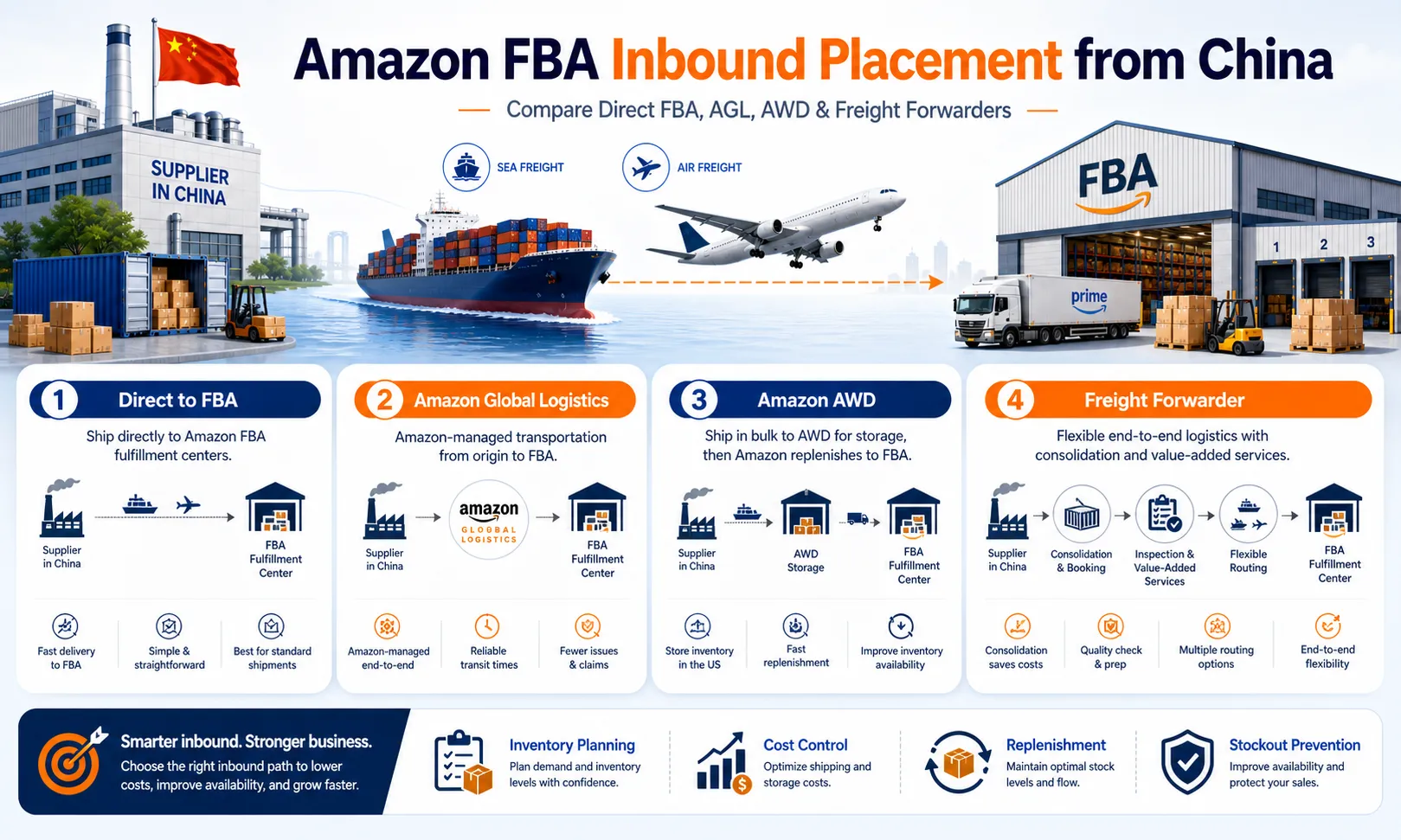
China to Amazon FBA: Direct-to-FBA vs AWD vs AGL vs Freight Forwarder
There is no single best inbound route for every Amazon seller. A small urgent replenishment shipment may need air freight directly to FBA. A large ocean shipment may be better as FCL or LCL. A seller with high sales velocity may use AWD as a buffer. A seller with multiple suppliers may need a freight forwarder or prep partner before sending inventory into Amazon.
| Inbound Option | Best For | Main Advantage | Main Risk to Check |
|---|---|---|---|
| Direct to FBA | Urgent replenishment or inventory already fully prepared for Amazon receiving. | Fewer stops and faster movement into the FBA network. | Prep errors, split shipments, receiving delays, and no reserve inventory buffer. |
| Amazon Global Logistics | Eligible FBA sellers who want Amazon-integrated ocean or air freight from China. | Seller Central booking, cross-border freight, and integrated Amazon destination flow. | Eligibility, routing flexibility, service coverage, and whether extra prep or consolidation is needed. |
| Amazon AWD | Bulk stock, reserve inventory, and automatic replenishment to FBA. | Helps sellers store larger quantities and replenish FBA when inventory runs low. | Not every SKU or seller workflow fits AWD; sellers still need to plan lead time and inventory levels. |
| Traditional freight forwarder | Multi-supplier consolidation, inspection, prep, DDP shipping, non-Amazon delivery, or custom routing. | More flexibility before inventory enters Amazon’s network. | Seller must confirm Amazon labels, appointment rules, customs responsibilities, and total landed cost. |
Amazon Global Logistics from China: When It Makes Sense
Amazon Global Logistics can make sense when a seller wants an Amazon-integrated way to move inventory from China into the Amazon fulfillment network. Amazon describes AGL as an ocean and air freight solution for eligible FBA sellers, with services that can include origin pickup, export declaration, cross-border freight, destination customs clearance, and delivery to Amazon fulfillment or warehousing facilities.
AGL may be attractive when the shipment is already Amazon-ready, the seller wants to manage booking and tracking in Seller Central, and the shipment fits Amazon’s service coverage and requirements. It may not be the best fit when the seller needs factory inspection, supplier consolidation, special handling, flexible 3PL routing, non-Amazon delivery, or a customized DDP solution.
AGL May Be a Good Fit When
- You are an eligible FBA seller shipping from China into Amazon’s covered fulfillment network.
- Your shipment is ready to move directly into an Amazon inbound workflow.
- You want Seller Central booking and tracking instead of managing multiple providers separately.
- You do not need complex supplier consolidation or special prep before Amazon delivery.
- Your timeline and shipment size fit AGL’s available ocean or air options.
Amazon AWD from China: When Bulk Storage Is Better Than Direct FBA
Amazon Warehousing and Distribution, or AWD, is different from sending every carton directly to FBA. AWD can act as a bulk storage layer that helps sellers hold more inventory and replenish FBA when needed. This can be useful when production lead times are long, sales velocity is unpredictable, or sellers want a buffer before peak season.
For China sourcing, AWD can be useful when sellers want to ship larger ocean quantities without pushing all units directly into FBA at once. Instead of sending all inventory immediately into FBA storage, sellers may use AWD as a reserve inventory layer and allow replenishment to flow into FBA.
AWD may be worth considering when:
- You ship larger quantities from China by ocean freight.
- You want backup inventory for fast-moving SKUs.
- You want to reduce the chance of FBA stockouts.
- You sell on Amazon and also need inventory for non-Amazon channels.
- You want a more structured replenishment system rather than sending every shipment directly to FBA.
Traditional Freight Forwarder vs Amazon Global Logistics
Amazon Global Logistics can simplify many China-to-Amazon shipments, but a traditional freight forwarder can still be useful when sellers need flexibility before inventory enters Amazon’s network. Many sellers do not ship from one factory directly to one Amazon plan. They may need inspection, prep, labeling, palletization, consolidation, DDP service, multi-channel delivery, or a warehouse stop before FBA.
| Seller Need | AGL May Work | Freight Forwarder May Be Better |
|---|---|---|
| Direct Amazon-ready inventory | Yes, if the shipment fits AGL requirements. | Yes, especially if you want rate comparison or custom routing. |
| Multiple Chinese suppliers | May be limited if consolidation is complex. | Often better for consolidation before export. |
| Product inspection before shipping | Not usually the main purpose. | Better if you need inspection coordination or warehouse handling. |
| FBA prep or relabeling | Possible only if services fit the program scope. | Often better for customized prep, label correction, and carton checks. |
| DDP or non-Amazon delivery | May not fit every route or buyer requirement. | Often better for commercial warehouses, 3PLs, trade shows, or multi-channel delivery. |
FBA Replenishment Lead Time from China
Amazon sellers should not calculate replenishment time using only vessel transit time or air transit time. The real replenishment lead time starts before pickup and ends after Amazon receives inventory. If you reorder too late, even a fast freight service may not prevent a stockout.
China-to-FBA Replenishment Timeline
- Production or supplier readiness time
- Inspection, product check, or sample approval if needed
- FBA prep, carton labeling, palletization, or box content confirmation
- China pickup and export handling
- Ocean freight, air freight, rail, truck, or multimodal transit
- Destination customs clearance and duty payment if applicable
- Final delivery appointment or Amazon inbound delivery
- Amazon receiving and inventory availability
Planning tip: Reorder before your sales velocity becomes urgent. If your daily sales are increasing, your reorder point should account for production time, freight time, customs time, Amazon receiving time, and a safety buffer.
How to Estimate Total Inbound Cost
A seller should not compare China-to-Amazon options using only the freight charge. Direct FBA, AGL, AWD, and freight-forwarder routes may include different services. Some quotes include pickup, customs, delivery, or placement-related services; others exclude them.
Amazon seller inbound cost formula:
Total inbound cost = product cost + China pickup + inspection or prep + export handling + freight + customs clearance + duty and taxes + Amazon placement or destination cost + storage + final delivery + stockout risk.
Questions to Ask Before Comparing Quotes
- Does the quote include pickup from the supplier in China?
- Does the shipment need inspection, relabeling, palletization, or FBA prep?
- Who handles import customs clearance and duty payment?
- Does the Amazon inbound plan create multiple destinations or placement costs?
- Will the inventory go directly to FBA, to AWD, to a 3PL, or to another warehouse first?
- What is the cost of running out of stock if the shipment arrives late?
When Direct to FBA Is Not the Best Option
Shipping directly from China to FBA sounds efficient, but it is not always the best option. Direct-to-FBA shipping works best when products are ready, packaging is correct, labels are accurate, and the Amazon inbound plan is stable. If anything needs correction before delivery, a direct shipment may create more risk.
| Situation | Why Direct FBA May Be Risky | Alternative to Consider |
|---|---|---|
| First production order | Packaging, labeling, or quantity errors may not be discovered until too late. | Inspection or prep before Amazon delivery. |
| Multiple suppliers | Separate suppliers may create inconsistent cartons, labels, or documents. | China consolidation warehouse or freight forwarder handling. |
| Seasonal or peak inventory | Late arrival can create stockout risk during the highest sales period. | Earlier ocean shipment plus AWD or reserve inventory planning. |
| Multi-channel selling | All inventory inside FBA may reduce flexibility for other channels. | AWD, 3PL, or split inventory strategy. |
Decision Checklist Before Shipping from China
Before shipping inventory from China into Amazon’s network, use this checklist to compare direct FBA, AGL, AWD, and freight-forwarder options.
- Confirm whether the inventory should go directly to FBA, AWD, a 3PL, or another warehouse first.
- Review Amazon inbound placement options before confirming the shipping plan.
- Check whether your shipment needs one destination, split destinations, AWD replenishment, or bulk reserve storage.
- Calculate replenishment lead time from production to Amazon receiving, not just freight transit time.
- Confirm FNSKU labels, carton labels, box content data, pallet requirements, and appointment rules if applicable.
- Check importer of record, HS code, customs documents, and duty responsibility before export.
- Compare AGL, AWD, DDP shipping, and freight forwarder options using total inbound cost.
- Keep enough buffer inventory to protect against production delays, port delays, customs holds, and Amazon receiving delays.
How VoltFreight Helps Amazon Sellers Plan China-to-Amazon Inventory
VoltFreight helps Amazon sellers review China-to-Amazon shipping options before inventory moves. We can help compare air freight, sea freight, DDP shipping, supplier pickup, FBA delivery, AWD strategy, customs documents, and final delivery planning.
- China supplier pickup and export coordination
- Air freight, sea freight, LCL, FCL, and door-to-door options
- DDP shipping options for sellers who want duty-paid delivery
- Amazon FBA delivery planning and appointment-based delivery support
- Multi-supplier consolidation and pre-shipment document review
- Total inbound cost comparison for FBA, AWD, 3PL, and non-Amazon delivery routes
Need help comparing FBA, AWD, AGL and freight forwarder options?
Send VoltFreight your supplier city, destination marketplace, product details, carton quantity, carton size, gross weight, sales velocity, and preferred delivery timeline. We can help you compare China-to-Amazon inbound options before you ship.
FAQ: Amazon FBA Inbound Placement from China
What is Amazon FBA inbound placement?
Amazon FBA inbound placement refers to how inventory enters and gets distributed across Amazon’s fulfillment network. Placement options can affect how many destinations a seller ships to and how much the inbound plan costs.
Should I ship from China directly to FBA or AWD?
Direct FBA may be better for urgent replenishment and Amazon-ready inventory. AWD may be better for bulk storage, reserve inventory, and automatic replenishment to FBA. The best option depends on sales velocity, stockout risk, shipment size, and total inbound cost.
Is Amazon Global Logistics better than a freight forwarder?
Amazon Global Logistics can be useful for eligible sellers who want Amazon-integrated freight from China. A freight forwarder may be better when sellers need inspection, prep, consolidation, flexible routing, DDP shipping, or delivery to non-Amazon warehouses.
How do I reduce FBA inbound placement costs?
Review Amazon’s inbound placement options before confirming the shipping plan. Sellers should compare the cost of fewer destinations, split shipments, AWD, AGL, and freight-forwarder delivery. The cheapest freight quote is not always the lowest total inbound cost.
How early should I replenish Amazon inventory from China?
Sellers should calculate replenishment lead time from production through Amazon receiving, not just freight transit time. Include production, inspection, prep, pickup, export, international freight, customs, final delivery, and Amazon receiving time.
When should I use air freight instead of ocean freight for FBA?
Air freight may be useful for urgent replenishment, high-value products, small-volume shipments, or stockout prevention. Ocean freight is usually better for larger shipments where cost control matters more than speed.
Can I use a freight forwarder and Amazon AWD together?
In some seller workflows, a freight forwarder can help coordinate supplier pickup, export, customs documents, and China-side handling, while AWD can serve as a bulk storage and replenishment layer. Sellers should confirm routing, eligibility, and receiving requirements before booking.
What information should I send for a China-to-Amazon quote?
Send supplier city, destination marketplace, Amazon shipment plan details, product name, HS code if available, carton quantity, carton size, gross weight, total CBM, delivery deadline, and whether the shipment should go to FBA, AWD, a 3PL, or another warehouse.
Can VoltFreight help compare AGL, AWD and freight forwarder options?
Yes. VoltFreight can help Amazon sellers compare China-to-Amazon shipping options, including air freight, sea freight, DDP shipping, supplier pickup, customs support, FBA delivery, AWD planning, and total inbound cost.
Final Thoughts
Shipping from China to Amazon FBA is no longer just a question of sea freight, air freight, or express delivery. Sellers also need to think about inbound placement, AWD reserve inventory, Amazon Global Logistics, total inbound cost, and replenishment timing.
Direct-to-FBA shipping can work well when inventory is ready and time is urgent. AWD can help sellers build a bulk storage and replenishment buffer. AGL can simplify China-to-Amazon freight for eligible sellers. A freight forwarder can add flexibility when inspection, prep, DDP, consolidation, or non-Amazon delivery is needed.
Need help planning your China-to-Amazon inbound route? Contact VoltFreight to compare FBA, AWD, AGL, DDP, air freight, sea freight, and freight-forwarder delivery options.
Sources & References
- Amazon — Amazon Global Logistics, ocean and air freight from China to the Amazon fulfillment network. sell.amazon.com
- Amazon — Amazon Warehousing and Distribution, bulk storage, FBA inbound placement coverage and auto-replenishment. sell.amazon.com
- Amazon Seller Central — FBA inbound placement service fee information. sellercentral.amazon.com
- Amazon — Fulfillment by Amazon and AWD information for sellers. sell.amazon.com
- VoltFreight — Contact VoltFreight for China-to-Amazon shipping, DDP, air freight, sea freight and delivery planning. voltfreight.com
Tags
Shipping from China to Amazon
Amazon Global Logistics
Amazon AWD
FBA Replenishment
China to FBA Inventory Planning