Shipping clothing and shoes from China to Greece requires more than choosing the cheapest sea or air freight rate. Fashion cargo often contains many SKUs, colours, sizes, materials and packaging formats, while EU rules can require accurate fibre-composition labels, footwear material labels, product traceability and customs-ready commercial documents.
A shipment described only as “clothes,” “shoes,” “samples” or “mixed goods” can create classification, valuation and inspection questions. Importers should prepare product descriptions, material composition, SKU lists, commercial invoices, packing lists, HS/TARIC classifications, EORI details and label information before the cargo leaves China.
This guide explains how to ship garments, footwear and fashion accessories from China to Greece by express courier, air freight, LCL or FCL sea freight. It also covers EU textile and footwear labels, GPSR product traceability, CE-marking boundaries, Piraeus customs risks, DDP considerations and the information needed for an accurate freight quotation.
Last reviewed: July 31, 2026. Labelling, customs, VAT and product-safety requirements can change. Confirm the final requirements with the Greek importer, customs broker and compliance specialist before production and shipment.
Need a clothing or footwear shipping quote? Send product photos, material composition, SKU list, carton quantity, dimensions, gross weight, total CBM, invoice value, supplier city and final Greek postcode. Contact VoltFreight to compare express, air, LCL, FCL and reviewed door-to-door options.
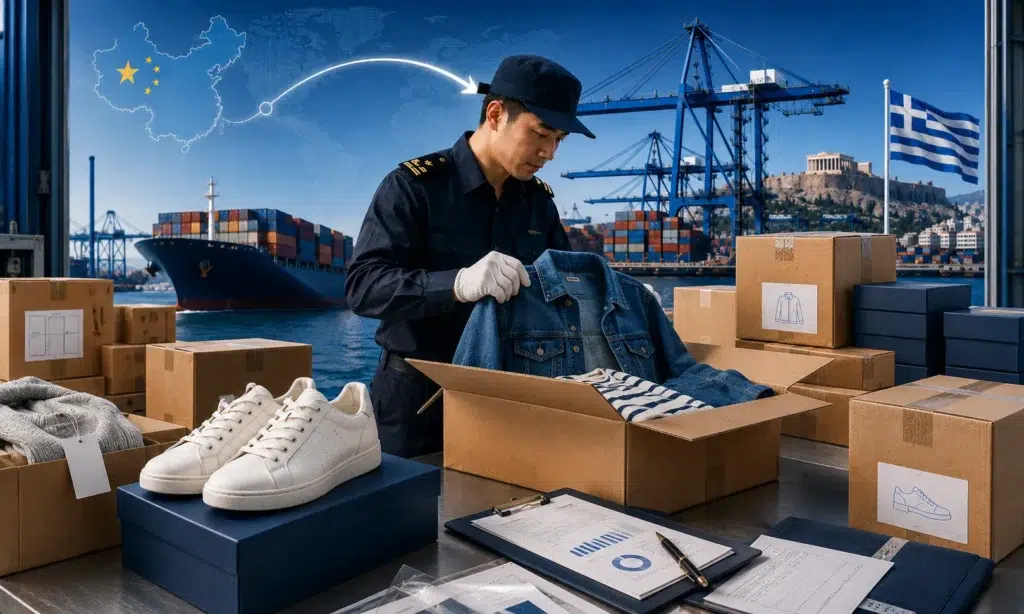
Quick Answer: How Should You Ship Clothing and Shoes from China to Greece?
Express courier or air freight is usually suitable for samples, size sets, urgent replenishment and small commercial orders. LCL sea freight can work for moderate wholesale shipments, while FCL is generally more efficient for large seasonal orders, palletised inventory and high carton volumes.
The shipping method is only one part of the plan. Before dispatch, the Greek importer should confirm:
- The exact product name and intended use
- Textile fibre or footwear material composition
- HS or TARIC classification
- Commercial invoice value and Incoterm
- Carton, SKU, size and colour breakdown
- EU textile or footwear label format
- Manufacturer, importer and EU economic-operator information
- Trademark or brand authorisation where applicable
- Greek customs broker and EORI readiness
- Final delivery address and unloading conditions
The table below provides an initial method comparison. Final selection should consider chargeable weight, CBM, cargo-ready date, customs preparation and the customer’s stock deadline.
| Fashion Shipment | Method to Compare | Typical Use | Product-Specific Checks |
|---|---|---|---|
| Samples and size sets | Express courier | Product approval, photography, showroom samples and urgent replacements | Realistic declared value, precise product description and label status |
| Urgent commercial cartons | Air freight | Seasonal replenishment, launch inventory and time-sensitive wholesale orders | Chargeable weight, customs documents, SKU list and importer readiness |
| Small or medium wholesale order | Air freight or LCL sea freight | Mixed cartons, several suppliers and moderate inventory volumes | Consolidation plan, carton marks, destination charges and SKU separation |
| Large seasonal order | FCL sea freight | High carton volume, pallets, retail launches and repeat import programmes | Container loading plan, documentation, customs value and delivery appointment |
| E-commerce replenishment | Air, LCL or reviewed door-to-door service | Regular inventory sent to a Greek warehouse or fulfilment location | EU importer, VAT treatment, GPSR information and final delivery scope |
For the wider route, cost and freight-method comparison, review our main shipping from China to Greece page.
Why Fashion Cargo Needs Product-Specific Planning
Clothing and footwear may appear simple compared with machinery or electronics, but fashion shipments can be operationally complex.
A single purchase order can include:
- Men’s, women’s and children’s products
- Different fibre or material combinations
- Dozens or hundreds of SKUs
- Multiple sizes and colours
- Individual retail packaging
- Mixed cartons from several suppliers
- Branded and unbranded products
- Seasonal delivery deadlines
These variations affect customs descriptions, classification, labels, carton control and warehouse receiving. For example, a cotton knitted T-shirt, woven polyester jacket, leather-upper shoe and textile-upper sneaker should not share one vague invoice line such as “fashion products.”
Use Product-Level Descriptions
A useful commercial invoice description should identify the product and material clearly. Examples include:
- Women’s knitted cotton T-shirts
- Men’s woven polyester jackets
- Children’s cotton trousers
- Textile-upper sports shoes with rubber outer soles
- Leather-upper casual shoes with rubber soles
- Polyester backpacks with metal fittings
The wording should match the physical goods, purchase order, packing list, label information and tariff classification.
Do Not Combine Incompatible Products Under One Line
Clothing, footwear, bags and accessories can fall under different customs chapters and product rules. Combining them into one invoice line can make customs classification and valuation harder to support.
When one shipment contains multiple product types, use separate lines for materially different goods. Include quantity, unit price, total value, material and SKU or model reference where practical.
Brand Status Must Be Clear
For licensed or branded fashion goods, keep purchase records and authorisation documents available. Customs or the carrier may request proof that the goods are genuine and legally exported.
VoltFreight does not recommend shipping counterfeit, unauthorised or falsely labelled branded goods.
Best Shipping Methods for Clothing and Footwear
The best method depends on urgency, cargo volume, product value, carton dimensions and the importer’s customs arrangement.
Express Courier for Samples and Small Parcels
DHL, UPS, FedEx and similar courier networks can work well for:
- Pre-production samples
- Size sets
- Colour approvals
- Catalogue photography items
- Replacement pieces
- Small urgent orders
Courier shipments still require a clear commercial invoice. Descriptions such as “free sample” do not remove customs responsibility. Even when the supplier provides samples without charge, the invoice should use a reasonable customs value and explain the product accurately.
Air Freight for Urgent Commercial Stock
Air freight is suitable when a commercial order is too large for economical express pricing but must arrive faster than sea freight.
Fashion importers should pay particular attention to volumetric weight. Jackets, footwear cartons and individually boxed retail products can occupy considerable space even when the actual weight is low.
Before booking, confirm:
- Actual and volumetric weight
- Airport-to-airport or door-to-door scope
- Greek customs broker arrangement
- Product labels and commercial documents
- Final delivery deadline
LCL Sea Freight for Moderate Wholesale Orders
LCL allows several shippers to share one container. It can be suitable for clothing and shoe orders that are too large for air freight but do not fill a container.
However, LCL involves additional warehouse handling and destination charges. Mixed SKUs should be packed and marked carefully so the Greek importer can reconcile the shipment after deconsolidation.
Ask the forwarder to clarify:
- China warehouse receiving charges
- Ocean freight charging basis
- Destination deconsolidation charges
- Customs-clearance responsibility
- Final delivery cost
- Storage and free-time conditions
FCL Sea Freight for Large Orders
FCL is usually the strongest option for large clothing and footwear programmes, particularly when the importer has many cartons, repeat shipments or a fixed retail deadline.
Container loading should account for:
- Carton dimensions and crush resistance
- Moisture protection
- SKU and colour separation
- Container utilisation
- Loading sequence
- Destination unloading method
For sea-route and port planning, review our sea freight from China to Piraeus guide.
EU Textile Fibre Label Requirements
Textile products marketed to consumers in the EU generally need labels or markings that state their fibre composition. The textile label should be durable, legible, visible and accessible, and it should be firmly attached to the product where required.
The EU textile-labelling framework applies to products made up of at least 80% textile fibres by weight. It can therefore cover clothing and other textile goods such as certain bags, coverings and accessories.
Use Recognised Fibre Names
The fibre composition should use recognised textile-fibre names rather than marketing descriptions.
For example, do not replace a fibre name with vague wording such as:
- Premium fabric
- Soft-touch material
- Eco textile
- Luxury blend
- High-quality fibre
Marketing claims may appear separately, but they should not replace the legally relevant fibre-composition information.
Multi-Component Products May Need Separate Information
If a product contains two or more textile components with different fibre compositions, each relevant component may need its own composition information.
For example, a jacket may contain:
- Outer shell
- Lining
- Padding
- Ribbed cuffs
The importer should confirm which components require separate disclosure instead of placing one percentage on the label for the entire product.
Plan Greek-Language Labels Before Production Ends
Textile fibre information should be provided in the official language or languages of the EU country where the product is sold. Products placed on the Greek consumer market should therefore be prepared with Greek-language fibre information unless the importer’s legal adviser confirms another permitted arrangement.
Do not wait until the goods arrive in Greece to discover that the retail labels need replacement. Relabelling after arrival can create labour, storage and delivery costs.
Separate Legal and Commercial Label Requirements
Fibre composition is an EU regulatory requirement. Other information can be required by the buyer, retailer, marketplace or commercial agreement, including:
- Size
- Care instructions
- SKU or barcode
- Country of origin
- Brand information
- Retail price tag
These commercial elements should be checked separately rather than being presented as if every item were part of the same EU textile-fibre rule.
EU Footwear Material Label Requirements
Footwear labels follow a different system from textile fibre labels. The label identifies the materials used in three main parts of the footwear:
- The upper
- The lining and sock
- The outer sole
The material categories include leather, coated leather, textiles and other materials.
The 80% Rule
For the upper and for the lining and sock, the label generally identifies a material when it covers at least 80% of the relevant surface area.
For the outer sole, the rule applies to a material representing at least 80% of the sole’s volume.
If no single material reaches 80%, the label should identify the two main materials used in that component.
Examples
A product description and label could distinguish:
- Leather upper with textile lining and rubber outer sole
- Textile upper with textile lining and synthetic outer sole
- Coated-leather upper with other-material lining and rubber sole
The supplier should not guess the main material from the product’s appearance. Confirm the construction and material breakdown with the factory.
How the Label Can Be Attached
Footwear material information can generally be provided using pictograms or written indications. The label may be printed, stuck, embossed or attached to at least one item in each pair, depending on the chosen compliant method.
The information must remain visible, securely attached and understandable to the consumer.
GPSR, EU Importer and Product Traceability
The EU General Product Safety Regulation applies to consumer products that are not fully covered by a more specific safety regime, including many ordinary clothing, footwear and fashion-accessory products.
Before products are placed on the EU market, the importer should confirm that the supply chain can identify the responsible economic operator established in the EU.
Depending on the commercial arrangement, that operator may be:
- An EU-based manufacturer
- The EU importer
- An authorised representative
- A fulfilment service provider where the regulatory conditions apply
Product Identification
The product should carry information that allows it to be identified, such as:
- Model
- Type
- Batch
- SKU
- Serial or production reference where appropriate
This information should connect the physical product with the supplier records, test documents and purchase order.
Manufacturer and Importer Information
The product, packaging or accompanying document may need to show the manufacturer’s name and contact details. Where the manufacturer is outside the EU, the EU importer or other responsible economic operator information also needs to be considered.
Online sellers should make sure that required product-identification, manufacturer and responsible-person information is available in the online offer where the applicable rules require it.
Safety Information
Warnings and safety instructions should be provided in language that consumers in the destination market can understand.
Ordinary adult clothing may need limited safety warnings, while products such as children’s clothing, products with cords, accessories with small parts and specialist footwear may require additional review.
Does Clothing or Footwear Need CE Marking?
Ordinary fashion clothing and ordinary footwear do not automatically require CE marking. CE marking applies only when a product falls under specific EU legislation that requires the mark.
Do not add a CE logo simply because the goods will be sold in Europe. Using CE marking on a product that is not covered by applicable CE legislation can be misleading.
Products That May Fall Under PPE Rules
Protective products can fall under the EU Personal Protective Equipment Regulation and may require conformity assessment, technical documentation, an EU declaration of conformity and CE marking.
Examples can include:
- Safety footwear
- High-visibility protective clothing
- Protective gloves
- Chemical-resistant garments
- Heat-resistant clothing
- Cut-resistant protective products
The product’s intended protective function matters. A fashion boot is not automatically PPE, while footwear marketed as protection against workplace hazards may be.
Ask the manufacturer to provide the applicable test reports, standards, declaration of conformity and CE documentation before shipping protective products.
Customs Descriptions, HS/TARIC Codes and Greece VAT
Clothing and footwear do not use one universal customs code.
Customs classification can depend on:
- Knitted or crocheted construction
- Woven construction
- Fibre composition
- Men’s, women’s or children’s category
- Type of garment
- Footwear upper material
- Outer sole material
- Sports, protective or ordinary use
For example, knitted clothing is generally classified separately from non-knitted clothing, while footwear classification depends heavily on the upper and sole materials.
Commercial Invoice Details
Each invoice line should include:
- Clear product name
- Material composition
- Quantity and unit
- Unit price
- Total value
- Currency
- Country of origin
- HS code where confirmed
- Incoterm
The value should reflect the genuine transaction. Do not use an artificially low value to reduce duty or VAT.
Packing List Details
The packing list should show:
- Carton number
- Product or SKU
- Colour
- Size range
- Pieces or pairs
- Net weight
- Gross weight
- Carton dimensions
The invoice, packing list, labels, purchase order and actual goods should tell the same commercial story.
EORI, Duty and VAT
An EORI number is required for EU customs operations involving economic operators. The Greek importer and customs broker should confirm the importer-of-record arrangement before shipment.
Greece’s standard VAT rate is currently 24%. Import VAT and customs duty depend on the applicable classification, customs value and transaction structure.
For a complete explanation of EORI, customs documents, VAT and importer responsibilities, use our main China to Greece customs clearance guide.
Piraeus Inspection Risk and Document Integrity
Piraeus is a major gateway for cargo entering Greece and the wider European market. Fashion cargo does not automatically face inspection, but clothing and footwear can attract questions when customs detects possible undervaluation, vague product descriptions, false invoices, incorrect classification or trademark risk.
Operation Calypso, led by the European Public Prosecutor’s Office, involved suspected organised customs and VAT fraud connected with Chinese imports. The investigation included 2,435 containers seized at Piraeus, primarily containing e-bikes, textiles and footwear.
This case does not mean that ordinary legitimate clothing or shoe shipments will be detained. It does show why customs values and documents must be supportable.
Keep Evidence Ready
A legitimate importer should be able to provide:
- Supplier purchase order
- Commercial invoice
- Payment records
- Packing list
- Product photos
- Material composition
- SKU list
- Labels
- Brand authorisation where applicable
- Sales or distribution information where requested
Common Risk Signals
Customs questions are more likely when:
- The declared value appears substantially below market or purchase value
- The invoice uses vague descriptions
- Carton quantities do not match the packing list
- Materials do not match the declared HS code
- Branded goods lack supporting records
- The importer or consignee arrangement is unclear
- The customs procedure does not match the real destination of the goods
Prepare corrections before loading whenever possible. Amending documents after the container reaches Piraeus can cause storage, inspection and delivery delays.
SKU, Carton and Packaging Control
Fashion logistics can fail after customs clearance when the SKU and carton plan is weak.
Carton Marks
Each carton should show or connect to:
- Carton number
- Purchase order
- SKU
- Colour
- Size or size range
- Quantity
- Destination or warehouse code where needed
A master carton list should allow the importer to locate any SKU without opening every box.
Moisture and Compression Protection
Clothing and footwear can be damaged by moisture, carton crushing and long storage periods.
Depending on the cargo and season, consider:
- Strong export cartons
- Inner polybags
- Desiccants where suitable
- Moisture barriers
- Palletisation
- Corner protection
- Strapping or wrapping
Avoid packing damp textiles. Moisture trapped before loading can create mould or odour during sea transport.
Multiple Suppliers
When collecting goods from several Chinese suppliers, use one consolidation plan. Ask each supplier to provide carton data before delivery to the VoltFreight warehouse.
After receiving the cargo, the warehouse can compare cartons, dimensions and marks against the expected list before international shipment.
Delivery in Greece
Delivery to Athens and Piraeus is generally easier to plan than delivery to Thessaloniki, Crete or remote destinations.
For Crete, confirm ferry or parcel-network conditions and allow additional time. Other Greek islands require case-by-case service review and should not be assumed to fall within a standard DDP or truck-delivery scope.
For timing by shipping method and destination, review our China to Greece shipping time guide.
DDP vs Standard Import for Fashion Goods
DDP can simplify delivery when the service provider has a lawful and transparent customs arrangement. However, DDP does not remove product-labelling, valuation, importer or product-safety requirements.
Questions to Ask Before Accepting DDP
- Who acts as importer of record?
- Where will customs clearance take place?
- What product description and value will be declared?
- How are duty and VAT handled?
- Does the service include all destination charges?
- Will the customer receive customs or tax documentation?
- Which final delivery network will be used?
- Are clothing, footwear and branded goods accepted?
- Are mainland Greece and Crete covered?
A provider offering “tax-free clothing shipping” without requesting product photos, materials, value, brand status or delivery postcode may not have enough information to assess the shipment responsibly.
When Standard Import May Be Better
A standard freight arrangement can be more transparent when the Greek buyer has:
- An active EORI number
- A Greek customs broker
- A VAT and accounting setup
- Experience importing commercial fashion goods
Under this structure, VoltFreight can manage China pickup and international freight, while the Greek importer handles local declaration, duty and VAT through its appointed broker.
Quote Checklist for Clothing and Shoes
Send the following information together to reduce quotation changes and customs risk:
- Supplier city and pickup address in China
- Product type and intended use
- Product photos
- Material or fibre composition
- Footwear upper, lining, sock and outer-sole materials
- SKU, size and colour list
- Carton quantity
- Carton dimensions
- Gross weight
- Total CBM
- Pallet details where applicable
- Commercial invoice value and currency
- Incoterm
- HS or TARIC code where available
- Brand status and authorisation documents
- Textile or footwear label artwork
- Greek importer and EORI status
- Preferred method and required delivery date
- Final Greek address and postcode
- Customs-clearance and delivery requirements
How VoltFreight Supports Greece Fashion Importers
VoltFreight helps fashion importers, wholesalers, retailers and e-commerce sellers arrange shipping from Chinese suppliers to Greece.
Depending on the shipment, our support can include:
- Supplier pickup in China
- Multiple-supplier consolidation
- Warehouse receiving and carton measurement
- Basic carton and packing checks
- Express, air, LCL and FCL comparison
- Product-description review
- Invoice and packing-list preparation support
- SKU and carton-list coordination
- FCL loading planning
- DDP feasibility review
- Coordination with the importer’s customs arrangement
- Delivery planning to Athens, Piraeus, Thessaloniki, mainland Greece and Crete
VoltFreight is a freight forwarder rather than a legal or product-certification authority. The Greek importer remains responsible for confirming final tariff classification, product compliance, labels, VAT treatment and market-access obligations with qualified advisers.
Request a clothing or footwear freight quote with your product, carton, customs and delivery details.
FAQ About Shipping Clothing and Shoes from China to Greece
What is the best way to ship clothing from China to Greece?
Express or air freight is suitable for samples and urgent commercial cartons. LCL can work for moderate wholesale orders, while FCL is generally more efficient for large seasonal or repeat inventory shipments.
The best option depends on chargeable weight, CBM, cargo-ready date, customs readiness and the required delivery deadline.
What textile labels are needed for clothing sold in Greece?
Textile products marketed in the EU generally need durable and visible fibre-composition information using recognised fibre names. The information should be provided in the official language of the country where the product is sold, so Greek-language preparation should be considered for the Greek market.
What materials must appear on a footwear label?
Footwear labels cover the upper, lining and sock, and outer sole. When one material accounts for at least 80% of the relevant surface area or sole volume, that material is shown. If no material reaches 80%, the two main materials should be identified.
Do ordinary clothes and shoes need CE marking?
Ordinary fashion clothing and footwear do not automatically require CE marking. Protective clothing and safety footwear that fall under the EU PPE Regulation may require conformity assessment, documentation and CE marking.
Is DDP safe for clothing and shoes shipped to Greece?
DDP can work when the importer, customs value, classification, VAT treatment, product compliance and delivery scope are clear. Avoid vague “tax-free” offers that do not request product, material, value and brand information.
Final Advice
Shipping clothing and shoes from China to Greece should start with product preparation rather than freight booking.
Before the cargo leaves China, confirm:
- Product descriptions
- Fibre or footwear materials
- EU labels
- SKU and carton records
- HS or TARIC classification
- Commercial value
- Importer and EORI details
- GPSR traceability
- Brand authorisation
- Customs and delivery arrangements
A low freight rate cannot compensate for unclear documents, unsuitable labels or an unsupported customs value. Accurate product data and a clear importer arrangement reduce the risk of inspection, storage and delivery delays.
For help comparing express, air freight, LCL, FCL or reviewed door-to-door shipping, contact VoltFreight with your fashion cargo details.
Official Information Sources
- Your Europe — Textile Label Requirements
- Your Europe — Footwear Label Requirements
- EUR-Lex — General Product Safety Regulation
- European Commission — Personal Protective Equipment
- Access2Markets — Finding EU Import Duty
- European Commission — EORI
- Gov.gr — Greece VAT Rates
- EPPO — Operation Calypso and Piraeus Container Seizures
Important: This guide supports freight and import planning but does not replace legal, customs, tax or product-compliance advice. Confirm the final requirements with the Greek importer, customs broker and qualified compliance adviser before production or shipment.