Your supplier in Shenzhen says 24 cartons are ready. A flight can move them to São Paulo within days—but your customs broker has not reviewed the invoice, and nobody has confirmed GRU or VCP. That is how a fast shipment can spend longer waiting at the airport than it spent in the air.
Air freight from China to Brazil works best when speed protects something more valuable than the freight charge: a production line, a customer deadline, a product launch or stock that is about to run out. Typical cargo includes machinery parts, electronics, automotive components, medical equipment and precision instruments.
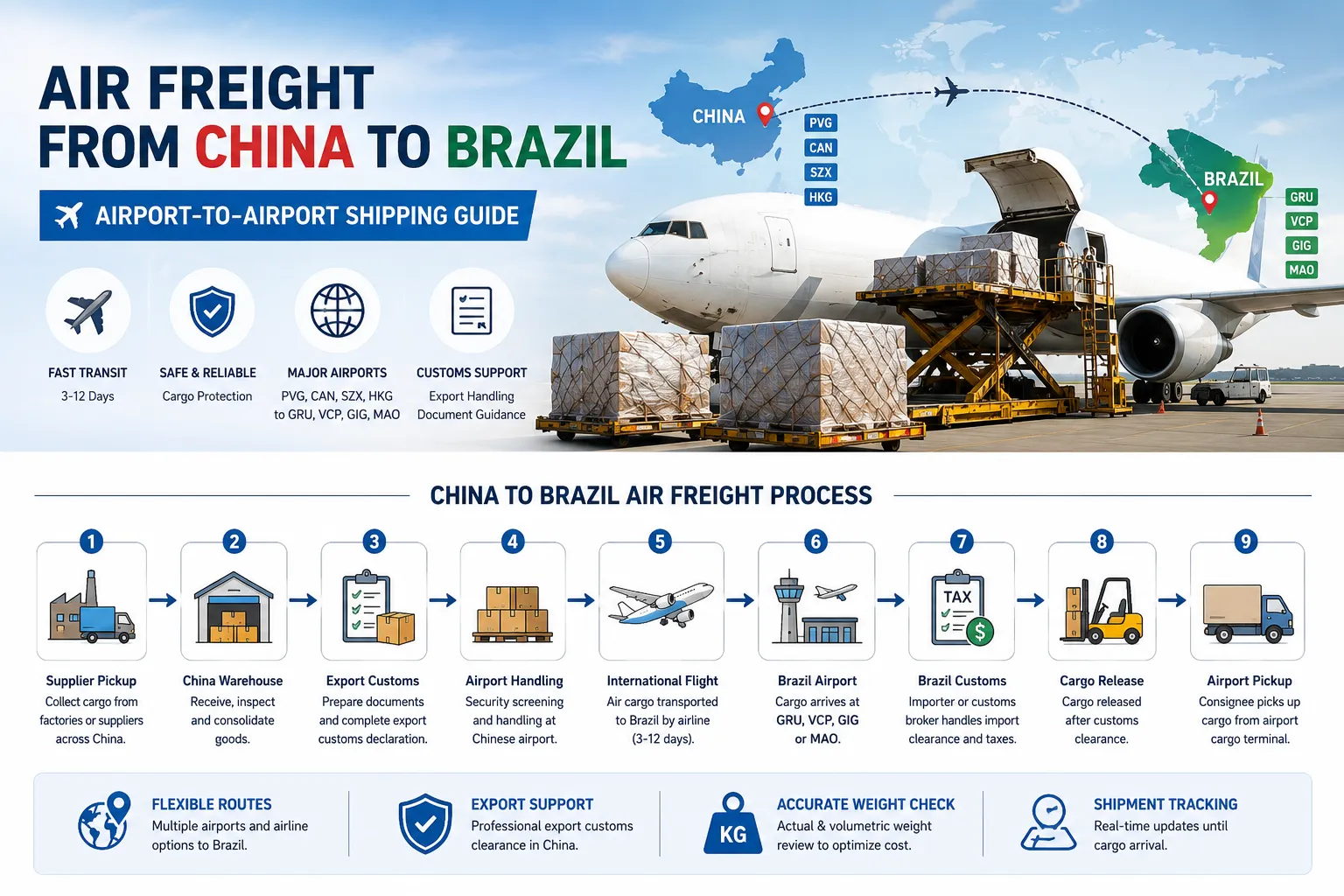
This guide covers formal commercial air cargo from China to Brazil, not ordinary express parcels. Brazilian importers may describe this service as frete aéreo da China para o Brasil or importação aérea formal. The China-side plan can cover supplier pickup, consolidation, export customs, airline booking, the Air Waybill and international transport to the agreed Brazilian airport.
The Brazilian importer and its customs broker (despachante aduaneiro) handle NCM, licences, the import declaration, taxes, terminal charges, release and airport collection. Agree on that division before departure—not after landing.
For an overview of our international airline network, see our air freight services from China.
Quick Answer: Cost, Transit Time and Service Scope
For ordinary, stackable general cargo, airport-to-airport air freight from China to Brazil commonly takes about 3–8 business days after airline acceptance. A priority route with fewer transfers may take around 3–5 business days. An economy routing or a longer connection may take 7–12 business days.
That is airport transit, not factory-to-release time. China pickup, export handling, airline cut-off, Brazilian customs and airport collection need additional time.
| Planning Item | Practical Reference | What the Importer Should Know |
|---|---|---|
| Airport-to-airport transit | Usually 3–8 business days after airline acceptance | Pickup, export handling, Brazil customs and airport collection require additional time |
| Planning freight range | About USD 5–12+ per chargeable kg for 100 kg+ general cargo | September 2026 public-market planning range only; it is not a final VoltFreight quotation |
| Chargeable weight | The higher of actual gross weight or volumetric weight | One cubic meter equals approximately 167 kg under the common 6,000 divisor |
| Suitable cargo | Urgent commercial cargo that has outgrown a simple courier shipment | Common examples include machinery parts, electronics, automotive parts and time-sensitive inventory |
| Brazil destination costs | Not included | The importer arranges customs, taxes, terminal handling, storage, examination, pickup and domestic trucking |
The range is broad because prices move with capacity, route, cargo-ready date, dimensions and commodity. A live quotation requires final packing details and cannot be replaced by a website rate.
Is Airport-to-Airport Air Freight Right for Your Shipment?
Air freight looks expensive by the kilogram, but it can be economical when a missing part stops production, stockouts cost daily sales or a launch has a fixed date.
It is often a good fit for:
- Production-critical machinery and replacement parts
- Electronics, automotive components and precision parts
- Approved medical devices and laboratory instruments
- Samples, prototypes and pre-production units
- High-value or deadline-sensitive retail inventory
Airport-to-airport service assumes the Brazilian company is ready at destination. A finished order is not ready to fly if the importer, broker or airport-pickup plan is missing.
When an express courier may be simpler: For documents, samples and a few light cartons, an express courier may be easier. At roughly 45–100 kg of chargeable weight, compare courier and formal air cargo. Check the import method, restrictions, customs responsibility and arrival charges—not only the rate per kilogram.
When air freight is the wrong financial choice: Bulky, low-value or non-urgent cargo may not support the air bill, especially when pieces are non-stackable, oversized or require specialist handling. If arriving sooner does not protect revenue, production or a firm deadline, air freight is probably the wrong choice.
How Much Does Air Freight from China to Brazil Cost?
Any useful China to Brazil air freight cost estimate must begin with the real cargo details. Two shipments with the same gross weight can price differently because one occupies more space, contains a battery or needs a costlier connection.
A live China-to-Brazil air freight quotation is normally affected by:
- The China departure and Brazil destination airports
- Actual weight, package dimensions and calculated volumetric weight
- The airline’s +45, +100, +300, +500 or +1,000 kg weight break
- Stackability, individual piece size and special-cargo acceptance
- Priority, standard or economy routing and its connections
- Cargo-ready date, available capacity and rate validity
- Pickup, consolidation, screening and export handling in China
A quote showing only “USD X per kilogram” is incomplete. It should identify chargeable weight, airport pair, routing, validity, China-side inclusions and Brazil-side exclusions. Our air freight rates guide explains weight breaks and capacity.
How Chargeable Weight Changes the Price
Airlines normally charge the higher of actual gross weight and volumetric weight. A commonly used commercial-air formula is:
Length × Width × Height in centimeters ÷ 6,000
Suppose 20 cartons each measure 60 × 50 × 40 cm:
60 × 50 × 40 ÷ 6,000 × 20 = 400 kg
If their actual total is 320 kg, the estimated chargeable weight is 400 kg. Removing empty space may lower the bill, but packaging must still survive screening, handling and transfers. A collapsed carton is not a saving.
You can use our CBM and chargeable-weight calculator before requesting a rate. Final billing still depends on the measurements verified at the warehouse or airline terminal.
Which China Departure Airport Should You Use?
The nearest airport is not automatically the best one. The real comparison includes factory pickup, airline schedules, available space, special-cargo acceptance and the number of transfers.
South China: SZX can reduce pickup distance for suppliers in Shenzhen and Dongguan. CAN often provides useful capacity for Guangzhou, Foshan, Zhongshan and the wider Pearl River Delta. HKG may offer additional international routings or specialist acceptance, but mainland cargo also needs cross-border transportation and Hong Kong handling.
East China: PVG is normally the first gateway considered for suppliers in Shanghai, Suzhou, Kunshan, Hangzhou, Ningbo and parts of Zhejiang and Jiangsu. A regional airport may be closer to the factory, but a domestic transfer to PVG can still produce a better international schedule.
North and Central China: PEK, PKX and CGO can support selected cargo from northern and central manufacturing areas. The decision depends on the precise supplier location and the service available on the cargo-ready date.
The comparison must cover the complete China-origin plan. Moving cargo to a larger gateway can look inefficient on a map yet reduce cost or connection risk when the nearest airport has limited long-haul capacity.
GRU or VCP: Which Airport Gives You the Better Total Cost?
Brazil is too large to choose the arrival airport from the international rate alone. Compare:
International air freight + terminal charges + storage exposure + customs-broker operation + airport pickup and inland trucking
When GRU Is Usually the First Option
When comparing air freight to GRU, importers usually find the widest range of options for São Paulo and southeast Brazil. Its broad international network is useful when cargo is urgent or capacity is tight.
GRU may be a practical choice when:
- The consignee is in São Paulo or the Guarulhos area
- More carrier or connection choices matter
- The broker already operates at the relevant GRU cargo terminal
- The airline offers a clearly better rate or schedule
Also identify the airline’s cargo terminal, the arrival-notice contact and the collecting trucker. GRU publishes current airport and cargo-related charges on its official tariff page.
When VCP May Produce the Better Arrival Plan
Air freight to VCP deserves a direct comparison when the final facility is in Campinas, Jundiaí, Sorocaba or another São Paulo State industrial area. A higher air rate may still win if it reduces trucking or fits the importer’s customs operation.
VCP may be attractive when:
- The importer or facility is closer to Campinas
- The broker and trucker already work efficiently at VCP
- The flight better balances rate, capacity and connection time
- Required handling has been confirmed there
VCP is not automatically cheaper. Compare the carrier, terminal, storage calculation and collection cost. The official Viracopos Cargo portal provides current operational information.
When GIG or MAO Makes More Sense
GIG can reduce inland transport for Rio de Janeiro. MAO can suit manufacturers in Manaus and northern Brazil, but it should be compared with arrival in southeast Brazil followed by domestic transport. For either airport, check the real cargo, route, connections, local customs readiness and collection plan.
What an Airport-to-Airport Quote Includes—and What It Does Not
For importers comparing airport-to-airport shipping from China to Brazil, the most important detail is the service boundary. It is not an all-inclusive factory-to-importer price. The quotation shows where VoltFreight’s work ends and the consignee’s local arrangements begin.
China-Side and International Services
The confirmed China-side and international plan can include:
- Pickup from one or more Chinese suppliers
- Warehouse receiving, carton checks and multi-supplier consolidation
- Measurement and chargeable-weight verification
- Commercial invoice and packing-list review for transport consistency
- China export customs declaration
- Security screening and origin-terminal handling
- Airline booking, cargo acceptance and MAWB or HAWB preparation
- Flight information and document pre-alert
- International transportation to the agreed Brazilian airport
Brazil-Side Responsibilities
For the service covered by this page, the Brazilian importer and its appointed local providers arrange:
- Siscomex habilitation, authorized representation and import declaration
- NCM, LPCO, product registration and agency approvals
- Duties, federal taxes, ICMS and related payments
- Airline, handling-agent, terminal, examination and storage charges
- Customs release, airport collection and domestic transport
Storage is where a fast shipment can become expensive. Late documents, missing approval or unavailable funds can leave cargo in the terminal while charges grow. Ask the broker for a current destination estimate before booking.
Our airport-to-airport air freight guide explains the service boundary in more detail.
What the Brazilian Importer Must Have Ready Before Departure
Do not wait for the arrival notice. A missing approval or uncertain classification can catch up with air cargo quickly.
Before the goods are sent to the airline, the Brazilian importer should be able to answer these questions:
- Is the company’s CNPJ habilitated to operate in Siscomex, with an authorized broker appointed?
- Has the broker reviewed the real product and confirmed its NCM?
- Will the operation use DI or DUIMP under the current transition rules?
- Is an LPCO or approval from Anvisa, Anatel, Inmetro, MAPA, Ibama or another authority required?
- Are Product Catalog and foreign-operator details ready if DUIMP applies?
- Are funds and arrangements ready for taxes, terminal payments, storage and collection?
Siscomex habilitation, DI and DUIMP: Many importers still say “RADAR”; the official term is habilitation to operate in Siscomex. Before departure, check the current status, representatives and applicable limits through Receita Federal’s Siscomex habilitation services.
The DI-to-DUIMP transition varies by operation, product, state, customs regime and participating agency. Check the current DI disconnection schedule and official simulator, then let the broker confirm the actual procedure.
NCM, LPCO and product information: NCM affects taxes, administrative treatment and licensing. Give the broker specifications, photographs, composition, function, model and intended use; do not choose a code simply because its tax rate is lower.
LPCO is not universal; it depends on NCM, product attributes, purpose, origin and authority. Use the live Siscomex import manuals for DUIMP, Product Catalog and LPCO instructions.
Documents Your Chinese Supplier Must Get Right
Brazilian customs preparation starts with supplier information. A forwarder can organize transport documents but cannot repair an unclear transaction after arrival.
Commercial Invoice and Packing List
The invoice should show the true seller, buyer, consignee arrangement, product, quantity, unit and total value, currency, origin and Incoterm. The broker must be able to tell what the product actually is.
“Parts,” “sample” and “equipment” are weak descriptions. “Stainless-steel replacement shaft for industrial packaging machine, model X200” provides material, function and use. Do not undervalue or falsely describe goods.
Packing list: List cartons, pallets or cases; net and gross weight; dimensions; volume; contents; and marks. Show different package sizes separately so the airline can check large pieces and calculate chargeable weight.
Air Waybill and Pre-Alert
The AWB must match the shipper, consignee, airport pair, packages, gross weight and cargo description. For DUIMP air cargo, AWB or HAWB freight data enters CCT Import and affects customs-value processing; see the official air-cargo DUIMP notice.
We send the available transport documents and flight information in the pre-alert. The broker should have reviewed the invoice before then.
For the China export side, see our China export customs clearance guide.
Batteries, Regulated Products and Oversized Cargo
A supplier calling a product “ordinary cargo” does not make it airline-ready. Disclose special characteristics before pickup because routing, packaging, documents and price may change.
Batteries and Products Requiring Special Review
For lithium batteries or powered products, provide battery type, model, watt-hours, quantity, net battery weight, photographs, packing method, SDS and UN38.3 test summary where applicable. The airline may request state of charge, a Dangerous Goods Declaration or other evidence.
Liquids, chemicals and powders may require composition, SDS or transport-classification evidence. Motors, speakers and magnetic assemblies may need testing or shielding. Acceptance is product-, route- and airline-specific.
Products controlled in Brazil: Airline acceptance and Brazilian approval are separate. A product can be safe to fly yet require LPCO, registration or authorization. Medical goods, cosmetics, food, agricultural items, wireless devices and selected electrical products may involve Anvisa, MAPA, Anatel, Inmetro or another authority.
The importer and broker confirm current administrative treatment before shipment. The result must be available early enough to align transport documents and avoid an undeclarable arrival.
Oversized, Heavy and High-Value Pieces
For a mold, motor, transformer or large case, send each piece’s dimensions and weight, plus photographs, lifting points, center of gravity, stackability and whether it may be tilted.
The airline checks aircraft doors, pallets, floor limits and ground equipment. Ten 100 kg cartons are not the same as one 1,000 kg case. Review valuable or production-critical cargo for suitable freight insurance from China.
How the Shipment Moves—and Where Time Is Usually Lost
- Send the cargo details. Provide the product, photographs, value, package count, dimensions, weight, supplier location and cargo-ready date.
- Check transport acceptance and import readiness. We review the China-side transport requirements while the Brazilian importer and broker confirm NCM, declaration and licensing readiness.
- Compare airport and route options. We review China pickup, departure airport, airline capacity, connections and GRU, VCP, GIG or MAO as appropriate.
- Confirm the quotation in writing. The quote identifies chargeable weight, airport pair, estimated transit, rate validity, included origin services and excluded Brazil costs.
- Receive and prepare the cargo in China. Goods are collected or delivered to the warehouse, measured, checked and processed for export and airline acceptance.
- Book, hand over and send the pre-alert. After space is confirmed, the cargo meets the cut-off, receives its AWB details and departs under the agreed itinerary.
- Complete the Brazil-side process. The importer and broker arrange the applicable declaration, approvals, tax and terminal payments, customs release and airport collection.
Booking is only firm when the airline confirms the requested capacity and the cargo meets acceptance conditions. Our air freight booking guide explains cargo-ready dates, cut-offs and flight confirmation.
Where a Fast Shipment Usually Loses Time
The aircraft is rarely the only reason an urgent shipment runs late. Many delays begin while the goods are still at the supplier.
- The broker is appointed after departure. Nobody reviews the invoice, NCM or declaration path while corrections are still easy.
- The product description is too vague. “Electronic parts” does not explain material, function, model or intended use.
- An approval is discovered at the last minute. The importer checks LPCO or agency treatment only after the booking is made.
- The packed dimensions are larger than quoted. The airline recalculates the chargeable weight after warehouse measurement.
- A battery or liquid was not disclosed. Cargo booked as general freight fails screening or airline acceptance.
- The airport was selected from the air rate alone. The broker, cargo terminal or final truck plan does not fit the chosen gateway.
- Destination payments are not ready. The shipment waits while taxes, terminal fees or collection arrangements are completed.
The practical solution is simple: let the broker review the shipment before the airline receives it. One day spent correcting information in China can prevent several expensive days at a Brazilian cargo terminal.
A Shenzhen-to-Campinas Planning Example
Consider industrial replacement parts moving from Shenzhen to a factory near Campinas:
- Packages: 24 cartons
- Actual gross weight: 420 kg
- Volumetric weight: 510 kg
- Estimated chargeable weight: 510 kg
- Brazil airport options: GRU or VCP
SZX may shorten pickup, while CAN may offer better capacity. HKG is worthwhile only when its routing or acceptance advantage offsets cross-border handling.
GRU may offer more flights; VCP is closer to Campinas. The importer compares both complete arrival plans.
Imagine, only for illustrating the decision, that the international rate to GRU is USD 0.30 per chargeable kilogram lower than VCP. For 510 kg, the difference is:
510 kg × USD 0.30 = USD 153
If VCP saves more than USD 153 in collection, trucking or handling, its higher air rate still produces a lower total. If GRU is much faster, avoided production downtime may outweigh either freight difference.
The example compares airports; it is not a quote. Before departure, the broker must still confirm Siscomex status, DI or DUIMP, NCM, any LPCO, taxes, terminal procedures and collection. Airport selection cannot replace import preparation.
Get a China-to-Brazil Air Freight Quote
For commercial air shipping from China to Brazil, a clear inquiry receives a faster and more reliable answer. Send:
- Product name, material, function and intended use
- Product photographs and a supplier link where available
- HS code or confirmed NCM, if already reviewed
- Commercial value and currency
- Number of cartons, pallets or wooden cases
- Gross weight and dimensions of every package type
- Individual dimensions and weight for heavy or oversized pieces
- Supplier pickup city and full address
- Cargo-ready date and required airport-arrival date
- Preferred Brazilian airport and final Brazilian city
- Battery, liquid, powder, magnet, chemical or temperature requirements
- SDS, UN38.3 and technical documents when applicable
- Brazilian importer and customs-broker contact details for the pre-alert
If several suppliers are involved, identify which cartons belong to each supplier and whether one consolidated AWB plan is required. VoltFreight can receive the shipments at our China warehouse, check the package information and prepare one coordinated origin plan.
Frequently Asked Questions
How long does air freight from China to Brazil take?
Standard airport transit is commonly 3–8 business days after airline acceptance. Priority routes may take 3–5 days and economy routings 7–12 days. Pickup, export handling, Brazil customs and collection add time.
How much does China-to-Brazil air freight cost per kilogram?
A broad September 2026 planning range for 100 kg+ stackable general cargo is USD 5–12+ per chargeable kilogram—not a fixed quotation. Live pricing depends on dimensions, airports, date, capacity, routing and commodity; Brazil-side charges are excluded.
Should I use GRU or VCP?
GRU often offers more routes for São Paulo; VCP may suit Campinas and nearby industrial areas. Compare air rate, terminal, broker operation, storage and trucking.
Does the Brazilian importer need a customs broker?
Yes. The importer should appoint an authorized broker before departure to confirm Siscomex access, NCM, DI or DUIMP, licensing, taxes, release and collection.
What does VoltFreight’s service include, and which Brazil costs are excluded?
The quotation can include China pickup, receiving, consolidation, measurement, export customs, screening, airline booking, AWB, pre-alert and flight to the agreed Brazilian airport. The Brazilian importer separately arranges and pays import clearance, duties and taxes, terminal handling, storage, examinations, release, airport pickup and domestic transportation.
Can batteries and special cargo move by air to Brazil?
Some can move after document, packaging and airline review. Acceptance depends on product, route and carrier. The importer and broker separately confirm Brazilian product approval.
Plan the shipment before the cargo reaches the airport. A good air-freight plan does more than find a low rate. It connects the supplier’s real cargo details, the correct China gateway, an airline that will accept the shipment, a Brazilian airport that suits the importer and a broker who is ready before arrival.
VoltFreight coordinates the China-side and international airport-to-airport movement. We can collect from one or multiple suppliers, receive and measure the cargo, review transport documents, arrange China export customs, compare airline routes, issue the available AWB information and send the pre-alert for the selected Brazilian airport.
Request an air freight quote from China to Brazil. Send the product name, photographs, carton count, gross weight, dimensions, supplier city, cargo-ready date, commercial value and preferred Brazilian airport. If you are unsure whether GRU or VCP is the better option, include the final city in Brazil and we will compare the available international routes while your Brazilian broker reviews the destination costs and import requirements.