Country Freight Route
Professional Freight Forwarder from China to Australia
Get a tailored freight route from China based on your cargo details, destination, timeline and budget. VoltFreight supports pickup, consolidation, customs guidance and final delivery planning.
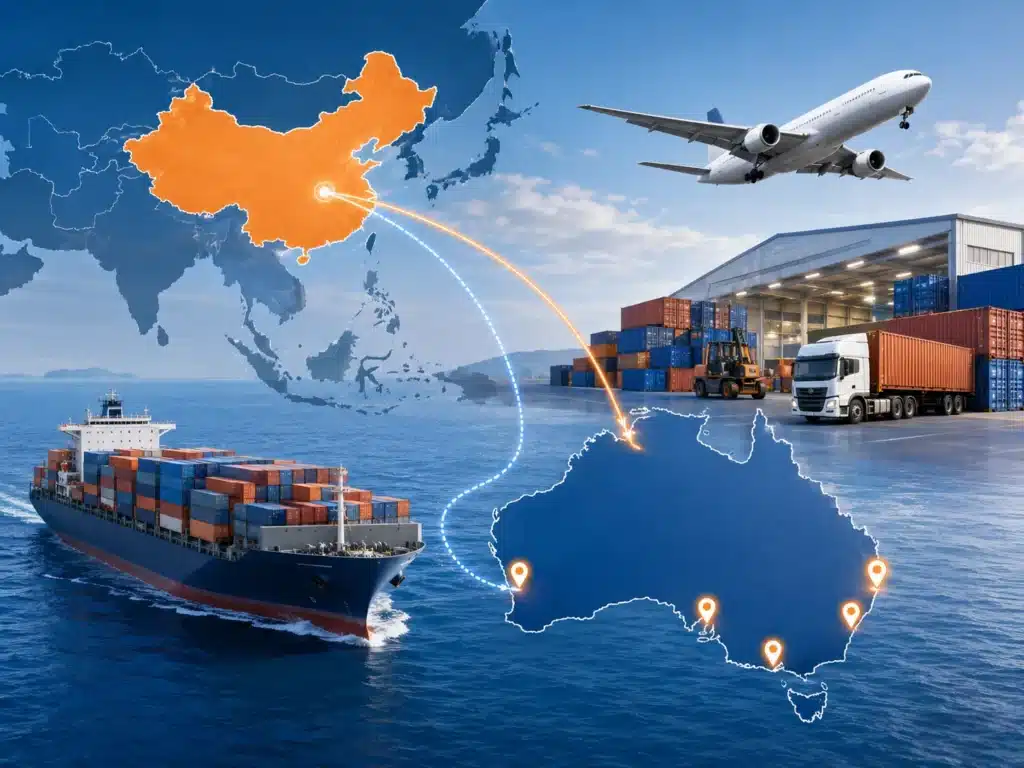
Freight Route Planning Built Around Your Cargo
Shipping from China to Australia by sea freight, air freight, express courier, air small parcel, DDP, DDU and door-to-door delivery. VoltFreight helps importers, e-commerce sellers, Amazon sellers, wholesalers and B2B companies ship cargo from China to Sydney, Melbourne, Brisbane, Perth, Adelaide and other Australian destinations.
Send your cargo name, weight, carton dimensions, supplier city and Australia delivery postcode. Our team will help compare shipping methods, transit time, GST and duty scope, biosecurity requirements, customs documents and final delivery options before booking.
- Supplier pickup and warehouse receiving in China
- Cargo consolidation from multiple suppliers
- Customs document review and final delivery planning
Shipping Details & Route Options
Review available freight options, route details, customs notes and planning information for this destination.
Shipping from China to Australia: Sea Freight, Air Freight, Express, Small Parcel and DDP Delivery
Shipping from China to Australia can be arranged by sea freight, air freight, express courier, air small parcel, DDP, DDU, DAP and door-to-door delivery. The best route depends on cargo weight, CBM, product type, declared value, delivery city, customs scope, GST responsibility, biosecurity requirements and final delivery address in Australia.
VoltFreight helps importers, e-commerce sellers, Amazon sellers, wholesalers, manufacturers and B2B companies compare China-to-Australia shipping options based on real cargo details. Before recommending a route, our team reviews carton dimensions, gross weight, product photos, HS code, supplier city in China, destination city in Australia, delivery address type and required service scope.
Australia is different from many other destinations because customs clearance is only one part of the import process. In addition, importers may need to consider GST, duty, import declarations, biosecurity inspection, quarantine review, wood packaging rules, possible treatment requirements and final delivery conditions. Therefore, a reliable freight quote should not only compare freight rates. It should also explain the customs, compliance and delivery responsibility clearly.
Get a China-to-Australia Freight Quote Before Booking
Not sure whether sea freight, air freight, express courier, air small parcel, DDP or DDU is better for your shipment? Send your cargo name, weight, carton dimensions, supplier city and Australia delivery postcode through our contact page. After reviewing the details, VoltFreight can compare route options, transit time, customs scope, GST responsibility and final delivery method before booking.
You can also explore our related service pages for ocean freight from China, air freight from China, express freight and door-to-door shipping from China.
Route Finder: Which China-to-Australia Shipping Method Should You Choose?
Many importers first ask for the lowest shipping cost. However, the better question is which route matches the cargo size, delivery deadline, customs responsibility and Australia delivery address. For example, sea freight usually works better for large or heavy shipments. Meanwhile, air freight suits urgent commercial cargo, and express courier works better for documents, samples and small urgent parcels.
China-to-Australia Route Comparison
| Shipping Method | Best For | Common Route | Planning Notes |
|---|---|---|---|
| Sea Freight LCL | Small and medium commercial cargo where cost control matters | China port to Sydney, Melbourne, Brisbane, Fremantle or Adelaide, then delivery if required | Useful when cargo does not fill a full container. CBM, warehouse handling and destination charges should be checked. |
| Sea Freight FCL | Large orders, furniture, machinery, building materials and full containers | 20ft, 40ft or 40HQ container from China to an Australian port | Often gives better unit cost and cargo control for larger shipments. |
| Air Freight | Urgent commercial cargo, electronics, spare parts and high-value goods | China airport to Sydney, Melbourne, Brisbane, Perth or another Australian airport | Good for speed, but chargeable weight and airline space must be checked. |
| Express Courier | Documents, samples, spare parts and urgent small parcels | DHL, UPS, FedEx or TNT from China to Australia | Fast and simple for suitable small shipments, but expensive for heavy cartons. |
| Air Small Parcel | E-commerce parcels, lightweight cartons and small B2B packages | China consolidation, air movement to Australia and local parcel delivery | Useful when express courier costs too much but sea freight takes too long. |
| Air DDP | Urgent cartons, e-commerce replenishment and small commercial shipments | China pickup, air transport, Australia customs process under agreed scope and final delivery | Needs product, declared value, GST/duty scope and delivery address review before confirmation. |
| Sea DDP | Cost-controlled cartons, commercial stock and larger door delivery shipments | China pickup, sea freight, Australia customs process under agreed scope and final delivery | Suitable for non-urgent cargo when both sides confirm taxes, duties, biosecurity and delivery responsibility. |
| DDU / DAP | Importers who handle Australian duty, GST or customs charges themselves | China pickup to Australia arrival or final address under agreed delivery term | Freight and delivery may be arranged, but import taxes and local charges usually remain with the importer. |
Sea Freight from China to Australia: LCL, FCL and Container Shipping
Sea freight from China to Australia is usually the most cost-effective option for large, heavy or less urgent cargo. Importers often use sea freight for furniture, machinery, home goods, building materials, packaging materials, fitness equipment, commercial stock, wholesale orders, construction products and full container shipments.
Because Australia has several major coastal gateways, the best destination port depends on the final delivery city, container type, vessel schedule, customs plan, biosecurity risk and inland delivery cost. Therefore, a reliable quote should compare the full route instead of only the ocean freight rate.
LCL Shipping from China to Australia
LCL shipping from China to Australia means Less than Container Load. It suits cargo that does not fill a full container. As a result, several shipments share container space, and freight usually follows CBM. This option can help smaller importers, e-commerce sellers and buyers who consolidate goods from multiple suppliers in China.
However, LCL also involves warehouse receiving, consolidation, container loading, destination deconsolidation, customs clearance, possible biosecurity inspection and final delivery planning. For this reason, importers should provide accurate carton dimensions, product descriptions and delivery details before booking.
FCL and Container Shipping from China to Australia
FCL shipping from China to Australia means Full Container Load. This route usually works better when the cargo volume can use a dedicated 20ft, 40ft or 40HQ container. Since one container moves for one shipment, FCL often gives better cargo control, simpler handling and stronger unit cost for larger orders.
Container shipping can suit furniture, machinery, home improvement products, building materials, retail stock, industrial goods and larger wholesale cargo. However, the final plan still depends on container loading, origin trucking, sailing schedule, Australian port, customs clearance, quarantine review and inland delivery address.
Main China Export Ports
- Shenzhen / Yantian
- Guangzhou / Nansha
- Shanghai
- Ningbo-Zhoushan
- Qingdao
- Xiamen
- Tianjin
- Hong Kong
Main Australian Destination Ports
- Sydney
- Melbourne
- Brisbane
- Fremantle / Perth
- Adelaide
Sea DDP from China to Australia
Sea DDP from China to Australia can help importers manage landed delivery for larger cartons, commercial stock and cost-sensitive shipments. Under an agreed DDP scope, the service may include China pickup, export handling, sea freight, Australia customs clearance support, duty/GST handling if included in the quote and final delivery to the Australian address.
However, DDP does not mean every local charge disappears automatically. Biosecurity inspection, quarantine treatment, special permits, remote delivery, storage, demurrage, detention or address access problems may still affect the final cost if they fall outside the agreed service scope. Therefore, VoltFreight reviews cargo details and service terms before confirming Sea DDP.
Air Freight from China to Australia
Air freight from China to Australia works well for urgent, high-value or time-sensitive cargo. Importers often use air freight for electronics, spare parts, samples, fashion goods, medical-related equipment, replacement goods, seasonal stock, urgent B2B orders and e-commerce replenishment.
Standard Air Freight to Sydney, Melbourne and Brisbane
Standard air freight usually moves from major China airports to Australian airports such as Sydney, Melbourne, Brisbane, Perth or Adelaide. Common China departure airports include Hong Kong, Shenzhen, Guangzhou, Shanghai, Beijing, Zhengzhou, Xiamen and other export air cargo hubs.
This route works best when the Australian importer has its own customs broker, GST arrangement and final delivery plan. In that case, VoltFreight can arrange airport-to-airport air freight or air freight plus local delivery under a clearly defined service scope.
Air DDP from China to Australia
Air DDP from China to Australia can support urgent cartons, e-commerce replenishment, small B2B shipments and higher-value goods when customers need faster landed delivery. Compared with standard airport-to-airport air freight, Air DDP may include more service steps, such as China pickup, export handling, air transport, Australia customs process under the agreed scope and final delivery.
Before confirming Air DDP, VoltFreight reviews HS code, declared value, product category, GST/duty responsibility, biosecurity risk, carton size, delivery postcode and address type. As a result, customers can understand whether Air DDP, standard air freight, express courier or air small parcel fits the shipment better.
Chargeable Weight for Air Freight
Air freight pricing usually depends on chargeable weight. Freight forwarders compare actual gross weight with volumetric weight and use the higher value for pricing. Therefore, accurate carton dimensions matter as much as gross weight when preparing an air freight quote.
When Air Freight Is Better Than Sea Freight
- The cargo is urgent and cannot wait for sea freight.
- The shipment has higher value and can support faster freight cost.
- The goods are too heavy for express courier but still time-sensitive.
- The importer needs fast replenishment for stock, spare parts or production needs.
- The cargo can meet airline, customs and compliance requirements before booking.
Express Courier from China to Australia: DHL, UPS, FedEx and TNT
Express shipping from China to Australia suits documents, samples, spare parts, testing products, replacement items and urgent lightweight parcels. VoltFreight can help review DHL, UPS, FedEx and TNT courier options based on cargo size, declared value, product type, pickup city and delivery address in Australia.
When Express Courier Works Best
Express courier works best when the shipment is small, urgent and suitable for international parcel delivery. It can provide direct courier movement, online tracking and simpler handling compared with standard freight. Therefore, many importers use express courier for samples, urgent parts, documents and small commercial parcels.
- Documents, samples and spare parts often fit courier service.
- Urgent lightweight cartons can move faster by express courier.
- Small parcels with clear product descriptions usually move more smoothly.
- Courier service can help when the consignee wants direct delivery to an Australian address.
- DHL, UPS, FedEx or TNT may be reviewed based on cargo type and route availability.
When Express Courier May Not Be the Best Choice
However, express courier can become expensive for heavy cartons, many-box shipments or bulky low-value cargo. In that case, air freight, air small parcel, Air DDP, Sea DDP or LCL sea freight may provide better cost control.
- Many cartons can become costly by courier.
- Bulky cartons may create high volumetric weight.
- Restricted products may need extra review before booking.
- Commercial shipments may require a more structured freight plan.
- Some goods may trigger customs or biosecurity questions in Australia.
Air Small Parcel Service from China to Australia
Air small parcel service from China to Australia can support e-commerce parcels, lightweight cartons, small commercial packages and regular parcel batches that need a balance between courier speed and freight cost.
How Air Small Parcel Works
Unlike DHL, UPS, FedEx or TNT express courier, air small parcel service usually follows a consolidated route. Cargo may be collected from suppliers in China, consolidated at a China warehouse, moved by air to Australia, processed through an agreed customs route and then handed over to a local parcel delivery network for final delivery.
This service can help when express courier costs too much but sea freight takes too long. However, parcel size, weight, declared value, product type, HS code, GST scope, biosecurity risk and final delivery address still need review before booking.
Air Small Parcel Is Suitable For
- E-commerce parcels and small commercial packages
- Lightweight cartons that cost too much by express courier
- Multiple small parcels going to Australian customers or warehouses
- Small B2B replenishment shipments
- Products that can move through parcel delivery after route review
Air Small Parcel Needs Review When
- The product contains batteries, liquids, powders, magnets or cosmetics.
- Goods include branded, high-value, food-related or restricted products.
- The declared value, product name or HS code is unclear.
- Parcel size or weight exceeds delivery network limits.
- The delivery address is remote, commercial, warehouse or appointment-based.
DDP, DDU and Door-to-Door Shipping from China to Australia
Door-to-door shipping from China to Australia can mean different service scopes. It may be DDP, DDU, DAP, express courier, air small parcel or freight plus final delivery. Therefore, importers should confirm who handles customs clearance, GST, duty, biosecurity charges and final delivery before shipment.
DDP Shipping from China to Australia
DDP shipping from China to Australia can help importers receive cargo with one coordinated landed delivery plan. Under an agreed DDP scope, the quote may include China pickup, export handling, international freight, Australia customs clearance support, duty/GST handling if included and final delivery to the Australian address.
However, DDP does not mean every possible local charge is automatically included. Biosecurity inspection, quarantine treatment, special documents, storage, remote-area delivery, failed delivery, demurrage, detention or special handling may still need separate review if they fall outside the agreed quote scope.
DDU and DAP Shipping from China to Australia
DDU or DAP shipping from China to Australia can suit importers who want VoltFreight to arrange international transport and delivery coordination while the importer handles Australian import tax, GST, customs clearance charges or local import responsibility. This option can work well when the importer already has an Australian customs broker, ABN, GST setup or internal import process.
DDP vs DDU vs Door-to-Door
| Service Term | Typical Responsibility | Best For |
|---|---|---|
| DDP | Freight, customs and tax scope may be included under the agreed quote | Importers who want one coordinated landed delivery plan. |
| DDU / DAP | Freight and delivery may be arranged, while duty, GST and import charges usually remain with the importer | Importers with their own broker or Australian import setup. |
| Door-to-door | Can mean DDP, DDU, DAP, courier or freight plus delivery | Customers who need delivery to a final address but must confirm tax and customs responsibility. |
Air DDP and Sea DDP to Australia
| DDP Method | Best For | Planning Notes |
|---|---|---|
| Air DDP | Urgent cartons, e-commerce replenishment and lightweight commercial cargo | Faster than sea DDP, but product type, declared value and biosecurity risk must be reviewed. |
| Sea DDP | Cost-controlled cartons, wholesale goods and larger commercial shipments | Better for non-urgent cargo, but port handling, customs, GST and biosecurity scope must be clear. |
| DDP to warehouse or business address | B2B cargo, e-commerce stock and retail inventory | Delivery appointment, unloading access, pallet rules and address type should be checked. |
| DDP to Amazon FBA Australia | Amazon inventory and marketplace sellers | FBA labels, carton limits, pallet requirements and appointment rules must be prepared before delivery. |
Australia Customs Clearance: GST, Import Declaration and Required Documents
Australia customs clearance is an important part of shipping from China to Australia. The Australian Border Force explains that goods with a value over AUD 1000 generally require an import declaration, while customs duty, GST and import processing charges may apply depending on the shipment. You can review official guidance on the Australian Border Force importing charges page.
GST and Import Duty
Australia generally applies 10% GST to taxable importations. Import duty depends on product classification, country of origin, customs value and any applicable trade agreement or duty concession. Therefore, importers should confirm HS code, product description, declared value and origin documents before shipping.
For eligible China-origin goods, a China-Australia Free Trade Agreement Certificate of Origin may help reduce or eliminate customs duty for some products. However, the final result depends on product classification, origin rules and customs assessment.
AUD 1000 Import Declaration Threshold
For many shipments valued above AUD 1000, the importer or broker needs to lodge an import declaration. In addition, the importer may need an ABN, customs broker support, correct supplier details, invoice value, freight cost, insurance cost and product classification information.
Low-value goods may follow different rules, especially for online sales and consumer parcels. Therefore, commercial importers should confirm GST, duty and declaration requirements with their broker or adviser before shipment.
Common Documents for Australia Import Clearance
- Commercial invoice
- Packing list
- Bill of Lading, Sea Waybill or Air Waybill
- HS code and accurate product description
- Importer details, ABN or broker details when required
- Certificate of Origin if applicable
- Product compliance documents if required
- Biosecurity documents, treatment certificates or permits when required
- Delivery address and contact details
Australia Biosecurity, Quarantine and BICON Requirements
Australia has strict biosecurity and quarantine requirements. For many shipments, customs clearance is not the only concern. Importers may also need to check whether the product triggers biosecurity inspection, quarantine review, treatment, fumigation, cleaning, documentation or permit requirements.
The Australian Department of Agriculture, Fisheries and Forestry provides the Biosecurity Import Conditions system, known as BICON. Importers can use BICON to check whether a commodity intended for import into Australia meets biosecurity import conditions and whether an import permit may be required. You can review official information on the DAFF BICON page or search directly through the BICON system.
Products That May Need Biosecurity Review
- Wood packaging, wooden furniture, timber, plywood and flooring
- Bamboo, rattan, straw, plant materials and natural fiber products
- Food products, food-contact goods and kitchen-related products
- Used machinery, used equipment and outdoor products
- Products that may contain soil, seeds, insects or biological contamination
- Animal-origin, plant-origin, mineral or biological products
- Goods requiring treatment, fumigation, cleaning or special documents
BMSB and Seasonal Biosecurity Risk
Some Australia-bound cargo may need additional seasonal biosecurity review, including Brown Marmorated Stink Bug risk measures. However, requirements depend on product type, origin, routing, shipment period and current Australian rules. Therefore, importers should check the latest DAFF guidance before shipment rather than assuming every China-to-Australia sea shipment needs the same treatment.
Why Biosecurity Planning Matters
Biosecurity inspection can affect cost, release time and delivery schedule. If the cargo needs inspection, cleaning, treatment or document review, the shipment may face extra charges or delays. As a result, importers should provide product photos, material details, packaging details and intended use before booking when cargo may trigger biosecurity concern.
Shipping Cost from China to Australia
The shipping cost from China to Australia depends on cargo weight, volume, shipping method, pickup city, Australian destination city, customs scope, GST responsibility, biosecurity risk and final delivery address. Because sea freight, air freight, express courier, air small parcel and DDP rates change with market conditions, a reliable quote should use real cargo details instead of fixed online prices.
Main Cost Factors
| Cost Factor | Why It Matters |
|---|---|
| Shipping method | Sea freight, air freight, express, air small parcel and DDP follow different pricing logic. |
| Cargo weight and dimensions | Air and express use chargeable weight, while sea freight depends heavily on CBM or container type. |
| LCL or FCL | LCL charges by CBM and handling, while FCL charges by container type and route. |
| China pickup city | Supplier location affects domestic trucking, warehouse receiving and consolidation cost. |
| Australia destination city | Sydney, Melbourne, Brisbane, Perth, Adelaide and regional addresses may have different delivery costs. |
| DDP, DDU, DAP or standard import | Customs, GST, duty and final delivery responsibility change the total landed cost. |
| GST and duty scope | Tax responsibility should be confirmed before booking, especially for DDP and DDU shipments. |
| Biosecurity inspection or treatment | Quarantine inspection, treatment, fumigation or cleaning can add cost and time. |
| Delivery address type | Warehouse, business, residential, remote and appointment delivery addresses follow different delivery rules. |
| Season and capacity | Airline space, vessel schedule, peak season and port conditions can affect rates. |
Shipping Time from China to Australia
Shipping time from China to Australia depends on pickup time, warehouse handling, export process, flight or vessel schedule, customs clearance, biosecurity inspection, terminal handling and final delivery. Therefore, importers should treat transit time as a planning range rather than a fixed guarantee.
Estimated Transit Time by Shipping Method
| Shipping Method | Estimated Transit Time | Best Use Case |
|---|---|---|
| Express courier | About 3-7 business days depending on carrier, product type and customs processing | Documents, samples, urgent small parcels and spare parts. |
| Air freight | About 3-8 days airport-to-airport depending on route and airline space | Urgent commercial cargo and high-value goods. |
| Air DDP | About 8-15+ days depending on flight space, customs scope and final delivery | Urgent cartons, e-commerce replenishment and small commercial shipments. |
| Air small parcel | About 7-15+ days depending on air capacity, processing and parcel delivery | E-commerce parcels, lightweight cartons and small B2B packages. |
| Sea freight FCL | About 18-35+ days port-to-port depending on port pair and vessel schedule | Full containers and larger commercial shipments. |
| Sea freight LCL | About 25-45+ days including consolidation and destination handling | Small and medium commercial cargo where cost control matters. |
| Sea DDP | About 30-50+ days depending on sailing, customs, biosecurity review and final delivery | Cost-controlled door delivery for commercial stock and larger shipments. |
Delivery Areas in Australia: Sydney, Melbourne, Brisbane, Perth and Adelaide
Australia delivery planning should match the final postcode, address type and cargo size. Delivery to a warehouse in Sydney may differ from delivery to Melbourne, Brisbane, Perth, Adelaide or a regional address. In addition, residential delivery, tail-lift service, appointment delivery, pallet unloading and remote-area delivery may affect the final route and cost.
Main Australian Delivery Zones
| Delivery Area | Common Use | Planning Notes |
|---|---|---|
| Sydney / New South Wales | Sea freight, air freight, e-commerce, warehouse and B2B delivery | Often a major destination for both air and sea shipments. |
| Melbourne / Victoria | Retail stock, warehouse delivery, FBA and commercial cargo | Important for container, air freight and inland distribution planning. |
| Brisbane / Queensland | Commercial stock, e-commerce and regional distribution | Delivery cost can vary by postcode and address type. |
| Perth / Fremantle / Western Australia | Sea freight, commercial cargo and warehouse delivery | Transit and delivery planning may differ from eastern Australia routes. |
| Adelaide / South Australia | B2B cargo, industrial goods and regional delivery | Final delivery should be reviewed by cargo size and postcode. |
| Regional Australia | Business addresses, farms, project cargo and remote sites | May require extra delivery time, surcharge or special delivery arrangement. |
Amazon FBA, E-commerce and B2B Warehouse Delivery in Australia
Australia is an important destination for e-commerce stock, Amazon FBA inventory, marketplace sellers, B2B warehouse delivery, retail replenishment and commercial distribution. For these shipments, route planning should consider supplier pickup, consolidation, carton labels, pallet requirements, customs documents, GST responsibility, appointment delivery and final warehouse rules.
Amazon FBA Australia Delivery
VoltFreight can help review Amazon FBA Australia delivery requirements, including China pickup, consolidation, carton labels, pallet planning, route selection and delivery appointment coordination. If the shipment goes to Amazon, sellers should prepare FNSKU labels, shipment labels, carton details and pallet requirements before booking.
E-commerce and Air Small Parcel Planning
For e-commerce sellers, air small parcel can be useful when shipments include many lightweight parcels or small cartons. Meanwhile, express courier may work better for urgent samples or small replacement items. For larger stock replenishment, Air DDP, Sea DDP, LCL or FCL may provide better cost control.
B2B Warehouse Delivery
B2B warehouse delivery often needs more planning than simple parcel delivery. Importers should confirm delivery appointment rules, receiving hours, pallet requirements, unloading access, tail-lift needs and contact information before shipment. As a result, the final delivery plan can avoid failed delivery, extra waiting time or storage charges.
Common Products Shipped from China to Australia
| Product Type | Common Shipping Option | Planning Notes |
|---|---|---|
| E-commerce goods | Air small parcel, air freight, sea freight or DDP | Useful for online sales, marketplace inventory and warehouse replenishment. |
| Furniture and home goods | Sea freight LCL/FCL or Sea DDP | Wood, bamboo, rattan or natural materials may need biosecurity review. |
| Electronics and accessories | Air freight, sea freight, express or DDP after review | Battery, compliance and declared value details should be checked. |
| Machinery and spare parts | Sea freight, air freight or truck delivery after arrival | Used machinery may need cleaning, inspection or biosecurity review. |
| Building materials | Sea freight FCL, LCL or project delivery | Weight, dimensions, packaging and unloading requirements should be reviewed. |
| Textiles and footwear | Air freight, sea freight or DDP after customs review | Labeling, customs value and product description should be accurate. |
| Samples and small parcels | DHL, UPS, FedEx, TNT or air small parcel | Best route depends on urgency, parcel size, product type and declared value. |
| Food-contact and natural products | Route review required before shipping | These products may trigger biosecurity, food safety or document requirements. |
What VoltFreight Can Help With
- Compare sea freight, air freight, express courier, air small parcel, DDP, DDU and door-to-door shipping options
- Arrange supplier pickup in Shenzhen, Guangzhou, Yiwu, Ningbo, Shanghai and other China cities
- Receive goods from multiple suppliers at our China warehouse
- Measure cartons and calculate CBM or chargeable weight
- Consolidate cargo before export
- Plan LCL, FCL, Air DDP, Sea DDP, express courier or air small parcel routes to Australia
- Review DDP, DDU, DAP and standard import service scope before booking
- Help prepare commercial invoice, packing list and basic customs information
- Review potential GST, duty, import declaration and biosecurity issues
- Plan final delivery to Sydney, Melbourne, Brisbane, Perth, Adelaide and regional Australia
- Support Amazon FBA, e-commerce and B2B warehouse delivery planning
- Provide a clear quote based on real cargo details
What We Need for a China-to-Australia Freight Quote
To prepare a reliable quote for freight from China to Australia, please send the following details:
- Cargo name and product photos if available
- HS code if available
- Total number of cartons or pallets
- Gross weight and carton dimensions
- Supplier city and pickup address in China
- Australia destination city, postcode and delivery address
- Preferred method: sea freight, air freight, express, air small parcel, DDP, DDU, LCL or FCL
- Cargo ready date
- Declared value and invoice information
- Importer details, ABN or broker details if available
- Special cargo details, such as batteries, liquids, powders, magnets, wood, bamboo, natural materials, food-related goods or used machinery
- Required service scope, such as customs support, GST/duty handling, DDP, DDU, FBA delivery or warehouse delivery
You can contact our team through the VoltFreight contact page. We will help review your cargo details and suggest a suitable China-to-Australia freight route.
Related Freight Routes and Services
If you import goods into more than one market, you may also need similar route planning for nearby or related destinations:
- Shipping from China to New Zealand
- Shipping from China to USA
- Shipping from China to Canada
- Ocean Freight from China
- Air Freight from China
- Door-to-Door Shipping from China
FAQ: Shipping from China to Australia
What is the best way to ship from China to Australia?
The best method depends on cargo size, urgency, budget, product type and customs requirements. Sea freight works better for large or heavy cargo, air freight suits urgent commercial shipments, express courier fits samples and small parcels, and DDP can help importers who want a more coordinated landed delivery plan.
How long does shipping from China to Australia take?
Express courier may take about 3-7 business days, while air freight may take about 3-8 days airport-to-airport. In addition, Air DDP may take about 8-15+ days, air small parcel about 7-15+ days, sea freight FCL about 18-35+ days, LCL about 25-45+ days and Sea DDP about 30-50+ days depending on route, customs, biosecurity and final delivery.
How much does shipping from China to Australia cost?
The cost depends on shipping method, cargo weight, carton dimensions, CBM, pickup city, destination city, customs scope, GST responsibility, biosecurity risk and delivery address type. Because rates change frequently, VoltFreight prepares quotes based on real cargo details instead of fixed online prices.
What is the cheapest way to ship from China to Australia?
Sea freight is usually the cheapest option for large or heavy shipments. LCL can suit smaller commercial cargo, while FCL often gives better unit cost for larger orders. However, air freight or express courier may be better when delivery speed matters more than the lowest cost.
Do you offer DDP shipping from China to Australia?
Yes. VoltFreight can review Air DDP and Sea DDP to Australia for suitable cargo. Before confirming DDP, we check product type, HS code, declared value, GST/duty scope, biosecurity risk, delivery postcode and address type.
What is the difference between DDP, DDU and DAP to Australia?
DDP usually means freight, customs and tax responsibility may be handled under the agreed quote scope. DDU or DAP usually means the importer handles duty, GST, customs charges or local import responsibility. Door-to-door does not always mean DDP, so customers should confirm customs and tax responsibility before shipping.
Do I need to pay GST when importing from China to Australia?
In many cases, taxable importations into Australia attract 10% GST. Customs duty may also apply depending on HS code, origin and customs value. Importers should confirm GST, duty and declaration requirements with their broker or adviser before shipping.
What documents are needed for Australia customs clearance?
Common documents include commercial invoice, packing list, Bill of Lading or Air Waybill, HS code, product description, importer details, declared value and Certificate of Origin if applicable. Some cargo may also need biosecurity documents, treatment certificates, permits or product compliance documents.
Does Australia require biosecurity inspection?
Some goods may require biosecurity inspection, quarantine review, treatment, fumigation, cleaning or document review. Wood, bamboo, rattan, plant materials, food-related products, used machinery, outdoor goods and products with contamination risk need extra attention. Importers should check BICON before shipment.
Can you ship to Amazon FBA Australia?
Yes. VoltFreight can help review Amazon FBA Australia delivery requirements, including supplier pickup, consolidation, carton labels, pallet planning, route selection and final delivery coordination. Sellers should prepare FBA labels, shipment details and warehouse requirements before booking.
Can you ship small parcels from China to Australia?
Yes. VoltFreight can review express courier and air small parcel options for documents, samples, spare parts, e-commerce parcels and lightweight cartons. DHL, UPS, FedEx and TNT may work for urgent small parcels, while air small parcel may fit cost-sensitive e-commerce shipments.
Can you ship furniture, machinery, electronics or batteries to Australia?
Yes, but these products need route and compliance review before booking. Furniture and wooden products may need biosecurity checks, used machinery may need cleaning or inspection, electronics may need product compliance review, and batteries may require special airline or carrier approval.
Does Taobao ship to Australia?
Taobao does not always provide direct international shipping for every product or seller. However, customers can send goods to a China warehouse and use a freight forwarder to consolidate, repack and ship to Australia by courier, air small parcel, air freight or sea freight depending on cargo size and product type.
How can I get an accurate shipping quote from China to Australia?
Please provide the cargo name, product photos, HS code if available, number of cartons, gross weight, carton dimensions, supplier city, Australia delivery address, cargo ready date and preferred shipping method. With these details, VoltFreight can compare routes and prepare a clearer freight quote.
Get a clear freight quote for your cargo.
Send us your cargo details, supplier location and destination address. We will help review the suitable route and prepare a clearer quote.
Popular Freight Routes from China
Explore related China-to-destination shipping services for air freight, sea freight, customs support and door-to-door delivery.