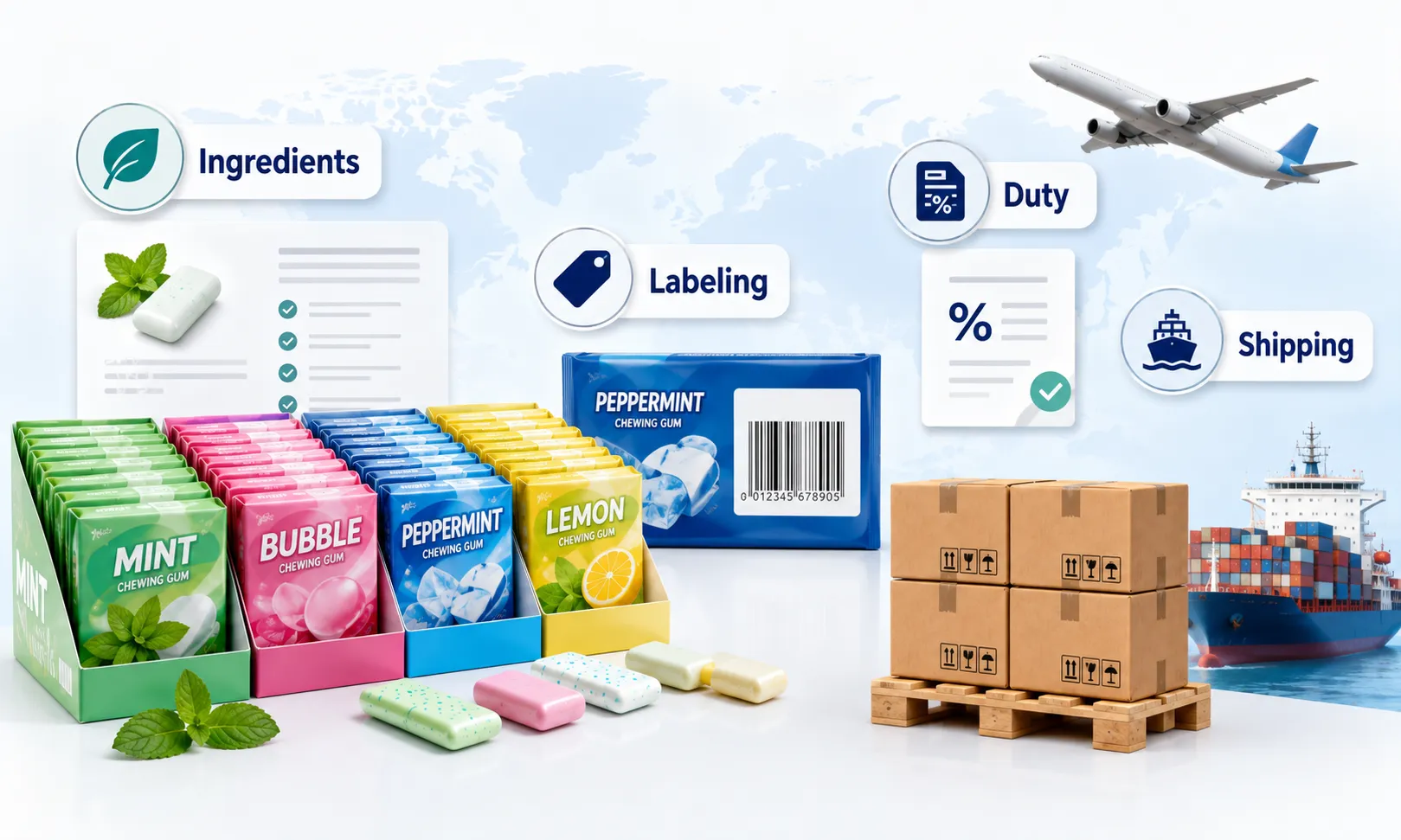
Importing chewing gum from China to the USA requires more than finding an air or sea freight rate. A commercial shipment may involve FDA food-import requirements, ingredient and label checks, packaging decisions, temperature exposure, remaining shelf life, U.S. importer responsibilities and final delivery planning.
For ordinary retail chewing gum, the logistics are often manageable when the formula, manufacturer, packaging and importer information are clear before departure. However, sugar-free gum, functional gum, gummies, chocolate-coated candy and other confectionery can create different shipping or regulatory risks.
The practical question is therefore not simply:
“Can chewing gum ship from China to the USA?”
The better questions are:
- What type of gum or candy are you importing?
- Is it a conventional food or a special functional product?
- Are the FDA and importer details ready?
- Can the retail packaging tolerate heat, humidity and international handling?
- Should the shipment move by express, air freight, LCL or FCL?
- How much shelf life will remain after transportation and customs processing?
For broader information covering tea, snacks, noodles, sauces, beverages and other food products, read our main Shipping Food from China to USA guide.
Need a chewing gum or candy shipping review? Send VoltFreight your product photos, ingredient list, English label, manufacturer information, shelf life, carton dimensions, gross weight, total CBM, cargo value, supplier city and U.S. destination. We can compare the transportation options and identify the logistics information that should be prepared before booking.
Can You Import and Ship Chewing Gum from China to the USA?
Yes. Many conventional chewing gum products can be imported and shipped from China to the United States when the manufacturer, product information, label, FDA-related data and import arrangements meet the applicable requirements.
This includes products such as:
- Regular chewing gum
- Sugar-coated chewing gum
- Sugar-free chewing gum
- Bubble gum
- Filled chewing gum
- Pellet gum
- Stick gum
- Individually wrapped retail gum
The route is commercially established rather than theoretical. According to 2024 WITS / UN Comtrade data, the United States imported approximately 2.22 million kg of HS 170410 chewing gum from China, with a reported import value of approximately USD 8.65 million.
Nevertheless, successful importation depends on the actual product.
A standard mint chewing gum is very different from nicotine gum, a caffeine-containing functional gum or a candy marketed with therapeutic claims. Likewise, an ordinary ambient-stable gum shipment may need a different freight plan from chocolate-coated confectionery that can melt during summer transportation.
For this reason, identify the product category before asking a forwarder to confirm the final shipping method.
Chewing Gum and Other Candy Products We Can Review for Shipping
Chewing gum remains the main focus of this guide. However, importers often source several confectionery products from China at the same time.
Many of these products can share the same warehouse, consolidation or international freight plan, although their ingredient, labeling and temperature requirements may differ.
Regular and Bubble Gum
Conventional gum is often relatively compact and dense. That can make it suitable for express, air freight, LCL or FCL depending on the commercial quantity.
The main logistics checks include:
- Retail packaging strength
- Carton compression resistance
- Recommended storage temperature
- Humidity protection
- Remaining shelf life
- Odor contamination risk
Sugar-Free Gum
Sugar-free gum needs closer ingredient and label review because it may use sugar alcohols or high-intensity sweeteners such as:
- Sorbitol
- Xylitol
- Mannitol
- Maltitol
- Aspartame
- Acesulfame potassium
- Sucralose
These ingredients do not automatically make a product difficult to ship. However, the importer should know exactly what is in the finished formula before the U.S. label and import documents are finalized.
Hard Candy, Mints and Lollipops
Hard candy and mints can often tolerate normal international transportation better than highly heat-sensitive chocolate products.
Even so, moisture can affect coatings and texture, while weak cartons can damage retail boxes. Lollipops also need enough internal protection to prevent sticks and individual pieces from damaging surrounding packages.
Gummies and Jelly Candy
Gummies deserve more attention during warm-weather transportation.
Depending on the formula, heat can cause:
- Softening
- Pieces sticking together
- Shape deformation
- Coating deterioration
- Retail-package appearance problems
Therefore, the manufacturer’s storage specification should be reviewed before choosing a long summer sea-freight route.
Chocolate and Chocolate-Coated Candy
Chocolate is much more temperature-sensitive than most conventional chewing gum.
A freight plan that works for ordinary gum should not automatically be used for chocolate-coated candy.
For these products, the shipper may need to consider:
- Manufacturer-specified temperature range
- Insulated packaging
- Gel packs or another cooling method for suitable small shipments
- Faster transport
- Temperature-controlled freight for suitable commercial loads
- Season and origin/destination weather
Functional, Medicated or Nicotine Products
Do not treat every product sold in a gum or candy format as ordinary confectionery.
Products containing nicotine, drug ingredients, strong stimulant formulations, CBD/THC or therapeutic claims require separate regulatory review.
In particular, nicotine replacement gum is not an ordinary food product. It belongs to a different FDA regulatory pathway and should not be booked under a normal chewing gum or candy shipping process.
Basic FDA Requirements Before Shipping Chewing Gum
Chewing gum is treated as food for the FDA food-import framework. Therefore, ordinary commercial chewing gum should not be shipped to the United States as if it were unrestricted general cargo.
The purpose of this section is not to turn the importer into an FDA specialist. Instead, it identifies the core information that should be ready before the shipment leaves China.
FDA Prior Notice
FDA generally requires Prior Notice before food is offered for import into the United States unless a specific exemption applies.
Prior Notice gives FDA advance information about the imported food shipment.
For a commercial chewing gum shipment, the importer and filing party should therefore make sure that the product, manufacturer and shipment information are available early enough for the applicable filing.
Prior Notice is not FDA approval of the product, factory, importer or label.
Food Facility Registration
Foreign facilities that manufacture, process, pack or hold food for U.S. consumption may need FDA food facility registration unless an exemption applies.
Before booking, confirm the actual manufacturer rather than assuming the trading company is the production facility.
Useful manufacturer information includes:
- Legal manufacturer name
- Production address
- Applicable FDA facility information
- Ingredient specification
- Product and lot information
- Shelf life
- Recommended storage conditions
Also remember:
FDA registration does not mean “FDA Approved.”
A supplier should not use a facility registration number as evidence that FDA has approved the individual chewing gum product.
FSVP Importer
Many commercial food imports are subject to the Foreign Supplier Verification Program unless an exemption or modified requirement applies.
For FSVP purposes, the importer is generally the U.S. owner or consignee of the food at the time of entry. If there is no U.S. owner or consignee, an eligible U.S. agent or representative of the foreign owner or consignee may serve in that role under the applicable requirements.
Importantly, the FSVP importer is not automatically:
- The China freight forwarder
- The U.S. warehouse
- The delivery trucker
- The customs broker
The responsible party should therefore be identified before departure.
Ingredients and U.S. Retail Label
The importer should collect the complete formula and English label before mass production whenever possible.
Important label and product information may include:
- Product identity
- Net quantity
- Ingredient list
- Allergen information
- Nutrition Facts when required
- Manufacturer, packer or distributor information
- Country-of-origin information
- Sweetener statements where applicable
- Claims used on the retail package
Do not rely on a supplier document that only says:
“sweetener,” “flavor” or “food color.”
The actual ingredients matter.
For a complete overview of U.S. food import requirements, use our Shipping Food from China to USA guide.
Ingredients, Sweeteners and Special Gum to Check
Chewing gum often contains more components than importers expect.
A typical formula can include gum base, sweeteners, flavor systems, colors, emulsifiers, glazing agents, humectants and coating ingredients.
Therefore, collect the finished formula rather than only the ingredients in the gum center.
Aspartame and Phenylalanine
Aspartame contains phenylalanine.
FDA requires foods containing aspartame to carry a statement informing people with phenylketonuria that the product contains phenylalanine.
Consequently, the importer should identify aspartame before printing the final U.S. retail packaging.
Sugar-Free Claims
Do not automatically copy a “sugar free” claim from Chinese domestic packaging onto the U.S. version.
The final formulation, Nutrition Facts information and claim should be reviewed for the intended U.S. market.
Allergens
Gum formulas may contain or involve ingredients derived from:
- Soy
- Milk
- Wheat
- Peanuts
- Tree nuts
- Sesame
- Other allergen sources
For private-label orders, the importer should confirm that the supplier’s allergen statement matches the actual manufacturing formula.
Health or Therapeutic Claims
Claims such as:
- Smoking cessation
- Disease treatment
- Weight loss
- Strong stimulant or energy claims
- Medicinal delivery
can change how the product should be reviewed.
If the product is not clearly conventional chewing gum or candy, confirm its regulatory category before booking freight.
How to Pack Chewing Gum and Candy for International Shipping
Good export packaging protects both the food and the retail presentation.
Chewing gum is compact, but commercial cartons can become heavy. At the same time, display boxes, blister packs and individually wrapped products may be damaged by compression or repeated handling.
Use Strong Master Cartons
The outer carton should be suitable for international transportation rather than only domestic delivery from the Chinese factory.
Check:
- Carton strength
- Gross weight per carton
- Internal empty space
- Retail-box protection
- Stacking height
- Moisture resistance
A carton that looks fine when leaving the factory may fail after warehouse handling, pallet stacking and long international transport.
Reduce Movement Inside the Carton
Retail boxes should not move freely inside the master carton.
Use suitable dividers, inner cartons, cushioning or another food-compatible packing method when necessary.
However, avoid unnecessary packaging that traps moisture or damages the retail boxes.
Protect Against Moisture and Odor
Chewing gum and confectionery should be kept away from cargo that can release strong odors.
Avoid consolidating food next to:
- Chemicals
- Perfumes
- Fragrances
- Essential oils
- Industrial liquids
- Other strongly scented products
Sealed inner packaging and clean export cartons can reduce exposure, but the consolidation environment still matters.
Palletize When It Improves Handling
Palletization can reduce repeated carton handling for larger shipments.
It can be useful when:
- Retail packaging is easy to crush
- Many cartons share the same SKU
- The importer wants cleaner warehouse handling
- The final 3PL or distributor prefers palletized cargo
However, pallet dimensions and total pallet height should be planned before freight pricing because they can affect air-freight chargeable weight, LCL volume and U.S. delivery.
Heat, Humidity and Shelf-Life Risks
Temperature risk is one of the biggest differences between shipping confectionery and shipping ordinary dry general cargo.
The correct decision should come from the product specification, not from the simple label “candy.”
Heat Exposure
Ocean containers, trucks, terminals and warehouses may experience high temperatures during summer.
Depending on the formula, heat can:
- Soften chewing gum
- Damage sugar coatings
- Make gummies stick together
- Deform retail packs
- Melt chocolate or chocolate coatings
Air freight generally reduces total transit exposure compared with sea freight, but normal air freight is not automatically temperature-controlled.
Therefore, do not assume that choosing air freight alone solves every heat-related problem.
Humidity
Humidity can affect coatings, wrappers, master cartons and some candy textures.
For longer sea shipments, confirm:
- Inner packaging seal
- Carton moisture resistance
- Pallet wrapping
- Container cleanliness
- Whether desiccant use is appropriate for the shipment
Remaining Shelf Life
Do not calculate shelf life only from the expected vessel transit.
The usable inventory period should consider:
Production date → China pickup → warehouse handling → export cutoff → international transit → FDA/customs processing → U.S. delivery → warehouse receiving → retail sale.
For example, a product with only a few months of remaining shelf life may not be suitable for a slow ocean route even when sea freight is much cheaper.
Before booking, ask the supplier for:
- Production date
- Expiration or best-before date
- Total shelf life
- Recommended storage temperature
- Recommended humidity or storage conditions where applicable
Express vs Air vs Sea Freight for Chewing Gum and Candy
The best shipping method depends on cargo size, urgency, shelf life, product sensitivity and final delivery requirements.
A low freight rate is not automatically the best option if the product spends too long in a hot or humid environment.
| Shipping Method | Best For | Main Advantages | Main Points to Check |
|---|---|---|---|
| Express Courier | Samples, label-review quantities and small urgent orders | Fast pickup and door delivery | Food acceptance, FDA filing requirements, high cost per kg |
| Air Freight | Urgent commercial orders and replenishment | Shorter transit and less long-term heat exposure | Chargeable weight, airport handling, customs and final delivery |
| Sea LCL | Smaller wholesale shipments | Lower freight cost for suitable commercial volumes | More handling, consolidation environment, humidity, odor and longer transit |
| Sea FCL | Large private-label or distributor orders | Dedicated container and better cargo separation | Container heat, loading plan, shelf life and destination delivery |
| Door-to-Door / Reviewed DDP | Importers needing coordinated freight and final delivery | Simplifies transportation coordination when scope is clear | Importer, FSVP, FDA, duty and product responsibilities must still be confirmed |
Express Courier
Courier service can work well when the importer only needs a few sample cartons or urgently needs product for evaluation.
However, low quantity does not automatically remove FDA food-import requirements.
Before pickup, confirm that the courier accepts the product and that the required import information is available.
Air Freight
Air freight can be useful for:
- New product launches
- Urgent replenishment
- Higher-value confectionery
- Products with limited remaining shelf life
- Warm-season shipments where shorter exposure is valuable
Chewing gum is often dense compared with many lightweight consumer products, so actual weight can be commercially important. Nevertheless, carton dimensions are still required for an accurate air-freight quote.
For U.S.-specific air routes, review our Air Freight from China to USA guide.
Sea Freight
Sea freight usually becomes more attractive for wholesale and distributor quantities.
The importer can choose between LCL and FCL depending on total CBM, carton quantity and cargo risk.
However, summer temperatures, long transit, destination delays and remaining shelf life should be evaluated before choosing the cheapest ocean option.
For route, port and transit planning, see Sea Freight from China to USA.
LCL, FCL and Multi-Supplier Candy Consolidation
Commercial confectionery importers often purchase from more than one Chinese supplier.
For example, one order may contain:
- Chewing gum from one manufacturer
- Mints from another supplier
- Gummies from a third factory
- Lollipops or hard candy from another location
These goods can sometimes be collected in one China warehouse before international shipping.
LCL for Smaller Wholesale Orders
LCL can work when the total cargo does not justify a complete container.
Nevertheless, confectionery requires more attention than ordinary general cargo because the goods share the logistics environment with other shipments.
Before consolidation, consider:
- Odor-producing neighboring cargo
- Warehouse cleanliness
- Pallet or carton condition
- Handling frequency
- Summer temperature exposure
For the wider LCL process, see our LCL Sea Freight from China guide.
FCL for Larger Candy Orders
FCL gives the importer more control over how the container is loaded.
That can be useful for:
- Large chewing gum orders
- Private-label candy
- Several compatible confectionery SKUs
- Products where repeated CFS handling is undesirable
However, a dedicated dry container is still exposed to seasonal temperature conditions unless a temperature-controlled solution is selected.
Consolidating Several Suppliers in China
VoltFreight can coordinate China warehouse consolidation when several suppliers are involved.
Possible warehouse steps include:
- Receiving cartons from multiple suppliers
- Counting packages
- Checking external carton condition
- Taking warehouse photos
- Measuring cartons and gross weight
- Checking shipping marks
- Repacking damaged outer cartons where suitable
- Palletizing commercial cargo
- Combining compatible shipments for international transport
Physical consolidation does not mean that manufacturer, SKU or FDA information should be mixed together.
The importer should still keep product and manufacturer records clear for each SKU.
For more information about consolidation before export, review our China Warehouse Service for U.S. Importers.
Customs, Duty and DDP Checks
Chewing gum also needs normal U.S. customs planning, but this page does not need to duplicate a complete customs and tariff guide.
Conventional chewing gum is commonly associated with U.S. HTS heading 1704.10, but the importer or customs broker should confirm the final classification for the actual product.
Do not assume that every confectionery item uses the same code.
For example:
- Chewing gum
- Other sugar confectionery
- Chocolate-containing confectionery
- Medicated products
can fall under different tariff treatment.
In addition, China-origin merchandise may be affected by current additional tariff measures or other entry requirements depending on the actual classification and entry date.
For detailed tariff planning, read our Import Tax from China to USA guide.
For IOR, customs bond, entry documents and cargo release, see USA Customs Clearance from China.
Can Chewing Gum Use DDP Shipping?
A reviewed DDP or customs-inclusive door-to-door route may be available for suitable conventional chewing gum and candy shipments.
However:
DDP does not remove FDA, FSVP, labeling or product-compliance responsibilities.
Before confirming DDP, the provider should know:
- Exact product type
- Complete ingredients
- Manufacturer
- Retail label
- Cargo value
- Importer structure
- FSVP information where applicable
- Final delivery address
A freight quote based only on “candy, 500 kg” is not enough to evaluate a U.S. food shipment properly.
For the wider duty-paid delivery structure, read DDP Shipping from China to USA.
Common Chewing Gum and Candy Shipping Mistakes
Many problems begin before the goods leave China.
Common mistakes include:
1. Booking the Cargo as Ordinary General Goods
The forwarder should know that the cargo is chewing gum or confectionery before quoting and booking.
Do not hide the food category behind vague descriptions such as:
“goods,” “samples,” “accessories” or “general cargo.”
2. Supplier Cannot Provide Complete Ingredients
An incomplete formula creates problems for FDA review, labeling and product classification.
Ask for the actual finished-product formula before shipping.
3. No FSVP Importer Is Confirmed
Do not wait until the shipment arrives to determine who is responsible on the U.S. side.
4. Using an Unfinished U.S. Label
Correcting retail labels after the shipment arrives can create extra labor, storage and delay.
Review the final U.S. packaging before mass production whenever possible.
5. Ignoring Heat Risk
A route that works in February may expose the cargo to very different temperatures in July or August.
Review the season before choosing a slow ocean service.
6. Weak Cartons
Dense chewing gum cartons can damage lower cartons when stacked too high.
Confirm master-carton strength and pallet configuration before export.
7. Mixing Food with Strong-Odor Cargo
Food should not be consolidated carelessly with fragrances, oils or chemicals.
8. Ignoring Remaining Shelf Life
A cheap sea-freight route is not useful if the product reaches the U.S. warehouse with insufficient commercial shelf life.
9. Treating Chocolate Like Ordinary Gum
Chocolate-coated confectionery can require a substantially different temperature plan.
10. Treating Functional Gum Like Normal Candy
Nicotine, medicinal, CBD/THC or other unusual functional formulations should be reviewed separately before freight is booked.
What Information Should You Send for a Shipping Quote?
To quote chewing gum or candy accurately, send the product and logistics information together rather than only the total weight.
Useful information includes:
- Product name
- Product photos
- Type of gum or candy
- Complete ingredient list
- Sweetener details for sugar-free products
- English retail label or artwork
- Brand information
- Manufacturer name and address
- FDA facility information if available
- U.S. importer and FSVP information if available
- Production date
- Expiration or best-before date
- Recommended storage temperature
- Units per carton
- Carton quantity
- Carton dimensions
- Gross weight per carton
- Total gross weight
- Total CBM
- Cargo value
- Supplier pickup city in China
- U.S. ZIP code and delivery address
- Commercial warehouse, 3PL, Amazon, distributor or other destination type
- Preferred delivery deadline
With this information, VoltFreight can compare express, air freight, LCL, FCL and suitable door-to-door options.
Send your chewing gum or candy shipment details for a China-to-USA freight quote.
Why Choose VoltFreight for Chewing Gum and Candy Shipping?
VoltFreight is a freight forwarder, so our role is different from an FDA consultant or customs-law specialist.
Our focus is turning the product information into a practical transportation plan.
For chewing gum and confectionery, our support can include:
- Supplier pickup in China
- Multi-supplier warehouse consolidation
- Carton receiving and condition checks
- Weight and dimension verification
- Outer-carton repacking where suitable
- Palletization
- Shipping-mark coordination
- Express, air and sea freight comparison
- LCL and FCL planning
- Commercial invoice and packing list coordination
- FDA-related shipment-information coordination with the importer or filing party
- U.S. customs and delivery coordination
- Delivery to business addresses, warehouses and 3PL facilities
- Shipment tracking and communication
We do not replace FDA, an FSVP specialist, legal counsel or the U.S. customs broker.
Instead, our goal is to identify the logistics information that should be prepared early and select a shipping method that fits the cargo size, temperature risk, shelf life and final delivery plan.
FAQ About Importing and Shipping Chewing Gum from China
Can ordinary chewing gum be shipped from China to the USA?
Yes. Many conventional chewing gum products can be imported when the manufacturer, ingredients, label, FDA-related information, importer setup and shipping documents meet the applicable requirements.
Does chewing gum need FDA Prior Notice?
Chewing gum is treated as food for FDA Prior Notice purposes. Prior Notice is generally required for imported food unless a specific exemption applies.
Does chewing gum need FDA approval before shipping?
FDA does not generally pre-approve an individual conventional food product or shipment before importation.
However, the imported food must meet applicable U.S. requirements, and the relevant facility registration, Prior Notice, FSVP, labeling and import information should be reviewed where applicable.
Can I ship sugar-free chewing gum?
Yes, but provide the complete sweetener system and label information.
For example, if the gum contains aspartame, the U.S. label must include the required phenylalanine statement.
Can nicotine gum ship as ordinary chewing gum?
No.
Nicotine replacement gum is regulated differently from ordinary confectionery and should not use a normal food-shipping process.
Is air freight or sea freight better for chewing gum?
Air freight is useful for urgent or smaller commercial orders and reduces total transit time.
Sea freight usually works better for larger wholesale quantities when the product has enough shelf life and can tolerate the expected route and seasonal conditions.
Can gummies and hard candy ship with chewing gum?
They can sometimes share a consolidated shipment when the products and logistics conditions are compatible.
However, gummies may be more heat-sensitive, while different manufacturers and SKUs should retain clear product and FDA information.
Does chewing gum need refrigerated shipping?
Not every conventional chewing gum shipment requires refrigerated transport.
The decision should follow the manufacturer’s storage specification, formula, season, route and packaging.
Heat-sensitive gummies, chocolate-coated candy and similar products may need a more protective or temperature-controlled solution.
Can different candy suppliers be consolidated in China?
Yes, compatible products from several Chinese suppliers can often be received at one warehouse and combined for international shipping.
However, product, manufacturer, lot and SKU information should remain clearly separated even when the physical cargo is consolidated.
Can chewing gum use DDP shipping?
A reviewed DDP route may be possible for suitable products.
Nevertheless, DDP does not eliminate FDA, FSVP, labeling or importer responsibilities, so the product and importer structure should be reviewed before the route is confirmed.
Conclusion
Importing chewing gum from China to the USA is not only a customs or FDA question. It is also a packaging, temperature, shelf-life and freight-planning problem.
The best process starts before the supplier ships the cargo.
First, identify exactly what type of gum or candy you are buying. Next, collect the complete ingredients, manufacturer information and U.S. label. Then confirm the basic FDA and importer requirements.
After that, review the logistics.
For regular chewing gum and hard candy, the main issues may be carton strength, humidity, odor and transit time. Sugar-free products require closer ingredient and label checks. Gummies may need additional heat protection, while chocolate or chocolate-coated confectionery can require a much more temperature-sensitive shipping plan.
Finally, compare express, air freight, LCL and FCL based on:
- Total shipment size
- Cargo value
- Product sensitivity
- Season
- Remaining shelf life
- U.S. delivery deadline
If several Chinese suppliers are involved, VoltFreight can also help receive and consolidate compatible chewing gum and candy shipments before international transportation.
Contact VoltFreight for a chewing gum or candy shipping review from China to the USA.
Official Sources and Further Reading
- U.S. FDA — Importing Human Foods
- U.S. FDA — Prior Notice of Imported Food Shipments
- U.S. FDA — FSVP Key Requirements
- U.S. FDA — Aspartame and Other Sweeteners in Food
- U.S. FDA — Nicotine Replacement Therapy Products
- U.S. International Trade Commission — Harmonized Tariff Schedule
- World Integrated Trade Solution / UN Comtrade — U.S. Chewing Gum Imports 2024
Important: This article provides general logistics and import-planning information. FDA, FSVP, facility registration, Prior Notice, labeling, product classification, tariffs and transportation requirements depend on the actual product, ingredients, claims, manufacturer, importer, shipment date and route. Confirm product-specific compliance with the responsible U.S. importer, qualified compliance specialist and customs broker before shipping.