Shipping News · Green Freight · China-Europe Trade
📅 Published: April 6, 2026 | ✍️ VoltFreight Editorial Team | ⏱️ 8 min read | 🔖 EU ETS · Carbon Surcharge · Ocean Freight
EU ETS Shipping Surcharge 2026: Quick Overview for Exporters
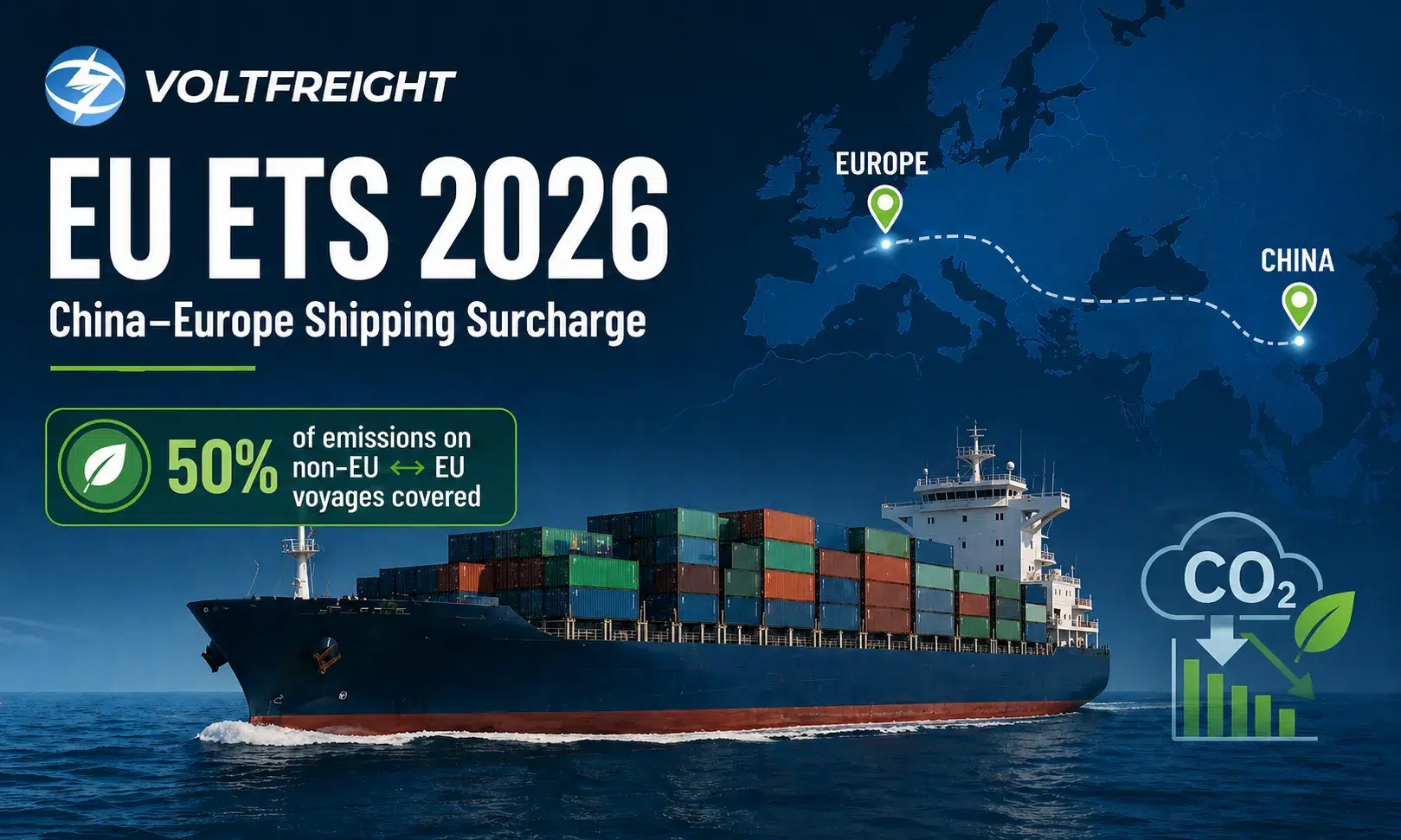
EU ETS shipping surcharge 2026 has become a real cost item for importers and exporters moving cargo between China and Europe. China-Europe voyages are generally subject to 50% EU ETS coverage for emissions on the international leg, while emissions within EU ports and voyages between EU ports are covered at 100%. As a result, carriers pass part of the compliance cost through as carbon surcharges on FCL and LCL shipments.
In practical terms, 2026 ETS-related charges can add a noticeable amount to each 40ft container shipped from China to North Europe. For example, Hapag-Lloyd’s Q2 2026 ETS notice lists USD 89 per TEU for dry containers from East Asia to North Europe, which is roughly USD 178 per 40ft container when calculated on a two-TEU basis. However, each carrier publishes its own surcharge by trade lane, direction, equipment type, and period.
Important: EU ETS surcharge amounts are not fixed freight rates. They vary by carrier, route, equipment type, contract type, booking date, vessel emissions profile, and EU Allowance (EUA) price. Always request an itemised quote before comparing China-Europe ocean freight options.
TL;DR — Key Takeaways
- The EU ETS maritime system applies to cargo and passenger ships of 5,000 gross tonnage and above calling at EU/EEA ports.
- For China-Europe ocean freight, 50% of emissions on voyages between non-EU and EU ports are generally covered by EU ETS.
- For voyages between two EU/EEA ports and emissions while ships are within EU/EEA ports, 100% of emissions are covered.
- From the 2026 emissions year, the maritime ETS phase-in reaches 100%, and methane (CH₄) plus nitrous oxide (N₂O) are included.
- Exporters should compare carrier ETS surcharges, update landed cost models, and consider China-Europe rail freight for suitable cargo.
In This Guide
What Changed in EU ETS Shipping Rules in 2026?
The EU extended the Emissions Trading System (EU ETS) to maritime transport in 2024. The system requires shipping companies to monitor emissions and surrender EU Allowances for covered emissions. Although the legal obligation sits with the shipping company, carriers commonly recover part of the cost through an EU ETS surcharge, emissions surcharge, or similar environmental charge.
For cargo owners, 2026 matters for two reasons. First, the 2026 emissions year is the first year at the full 100% maritime ETS phase-in level. Second, methane (CH₄) and nitrous oxide (N₂O) are added to the maritime ETS scope from 2026, in addition to CO₂.
The phase-in timeline by emissions year is:
| Emissions Year | Phase-in Level | Greenhouse Gases Included | Practical Meaning |
|---|---|---|---|
| 2024 | 40% | CO₂ | First maritime ETS year; lower compliance exposure |
| 2025 | 70% | CO₂ | Higher surcharge pressure compared with 2024 |
| 2026 onward | 100% | CO₂ + CH₄ + N₂O | Full phase-in; wider GHG scope for maritime emissions |
Sources: European Commission Climate Action FAQ; European Commission shipping sector emissions page; Maersk Emissions Surcharge update.
EU ETS Shipping Surcharge 2026: How Much More Can China-Europe Freight Cost?
For Chinese exporters shipping to Germany, the Netherlands, France, Spain, Italy, Poland, and other European markets, EU ETS shipping surcharge 2026 can now appear as a visible line item in freight quotes. The exact amount is carrier-specific. Therefore, the safest way to use published figures is to treat them as examples and market references, not as universal prices.
Published Carrier Example — East Asia to North Europe
East Asia → North Europe, dry container
based on two TEU
by carrier and period
Source: Hapag-Lloyd Emission Allowance Surcharge (ETS), Q2 2026 notice. Actual charges vary by carrier, direction, route, container type, and EUA price.
This is why a China-Europe quote that looks cheaper at the ocean freight level may not be cheaper after ETS, bunker, destination, documentation, and local charges are included. When comparing ocean freight from China, ask for a landed cost view instead of only a base freight rate.
For example, if you ship one 40ft container per week to North Europe, even a surcharge around USD 178 per FEU can become a meaningful annual cost. However, the real impact depends on shipment frequency, product margin, Incoterms, and whether the surcharge is paid directly by the exporter, importer, or buyer.
How EU ETS Applies to China-Europe Ocean Freight
The EU ETS does not treat every voyage in the same way. For China-Europe container shipping, the key rule is that voyages between an EU/EEA port and a non-EU port are generally covered at 50% of emissions. In contrast, voyages between EU/EEA ports and emissions within EU/EEA ports are covered at 100%.
| Voyage / Emission Type | EU ETS Coverage | Meaning for China-Europe Cargo |
|---|---|---|
| Voyage between a non-EU port and an EU/EEA port | 50% | Main rule for China to Europe ocean freight |
| Voyage between two EU/EEA ports | 100% | May affect feeder or intra-European legs |
| Emissions while a ship is within an EU/EEA port | 100% | Relevant for port time in Hamburg, Rotterdam, Antwerp, and other EU/EEA ports |
| Certain neighbouring container transhipment ports | Anti-avoidance rule | Stops at listed neighbouring container transhipment ports do not automatically reset the ETS voyage calculation |
Sources: European Commission Climate Action; EMSA EU ETS maritime FAQ.
The neighbouring container transhipment rule is designed to reduce avoidance risk. In simple terms, certain nearby non-EU container transhipment ports cannot be used to make a voyage appear outside the ETS scope. Therefore, exporters should not assume that indirect routing will remove carbon-related charges.
Why Carrier Surcharges Differ
A common misunderstanding is that EU ETS creates one identical surcharge for all carriers. In reality, carriers publish and update their own ETS or emissions surcharge based on their trade lanes, equipment types, contracts, and assumptions about allowance prices and compliance costs.
Maersk, for example, uses Emissions Surcharge terms to cover costs associated with EU ETS and FuelEU Maritime compliance. Hapag-Lloyd publishes Emission Allowance Surcharge (ETS) values that are direction-specific and subject to regular review. As a result, shippers should compare all-in quotations rather than only one surcharge line.
What Exporters Should Do: 5 Practical Steps
EU ETS is now part of the cost structure for China-Europe logistics. Therefore, exporters, Amazon sellers, e-commerce brands, manufacturers, and importers should respond in five practical ways.
Ask for itemised freight quotes
Do not compare only the all-in number. Ask your freight forwarder to separate base ocean freight, bunker surcharge, EU ETS surcharge, destination charges, customs-related fees, and door delivery costs.
Compare carriers, not just routes
Two carriers on similar China-Europe routes may show different ETS-related charges. Equipment type, sailing direction, contract type, and review period can all affect the final surcharge.
Update landed cost models for EU markets
If you sell into Germany, France, the Netherlands, Spain, Italy, or Poland, include ETS-related charges in your landed cost model. This is especially important for low-margin products and recurring FCL programs.
Consider rail freight for suitable cargo
China-Europe railway freight is land-based, so maritime EU ETS does not charge it. It is not the right option for every shipment, but it can be useful for electronics, auto parts, consumer goods, and time-sensitive cargo where rail routing is available.
Use a forwarder that compares total landed cost
A good China freight forwarder should compare sea freight, rail, air, door-to-door shipping, and customs clearance together. This gives you a more realistic view of final delivered cost.
Context: EU ETS Is One Part of Green Shipping Cost
EU ETS is not the only regulation affecting freight costs. FuelEU Maritime also affects carriers operating in EU-related trades, and some carriers combine these compliance costs into broader emissions surcharges.
For exporters, the direction is clear: carbon-related logistics costs are becoming structural. Transparent quote comparison is now part of freight procurement.
Shipping from China to Europe? Compare Your Real Landed Cost
VoltFreight helps importers compare China-Europe sea freight, rail freight, air freight, door-to-door shipping, customs clearance, and ETS-related surcharges with transparent, itemised quotes.
FAQ: EU ETS Shipping Surcharge 2026
Sources & References
- European Commission Climate Action — FAQ: Maritime Transport in EU Emissions Trading System (ETS). climate.ec.europa.eu
- European Commission Climate Action — Reducing emissions from the shipping sector. climate.ec.europa.eu
- EMSA — FAQ: Extension of ETS to maritime transport. emsa.europa.eu
- Maersk — Emissions Surcharge (EMS/ESS), explaining EU ETS and FuelEU Maritime compliance cost recovery. maersk.com
- Hapag-Lloyd — Emission Allowance Surcharge (ETS), Q2 2026 notice, East Asia to North Europe ETS charge example. hapag-lloyd.com
- VoltFreight service pages — ocean freight, railway freight, door-to-door shipping, and customs clearance.
Topics
China Europe Shipping Cost
EU Carbon Tax Shipping
ETS Surcharge Container
Ocean Freight China Europe
Green Shipping Surcharge