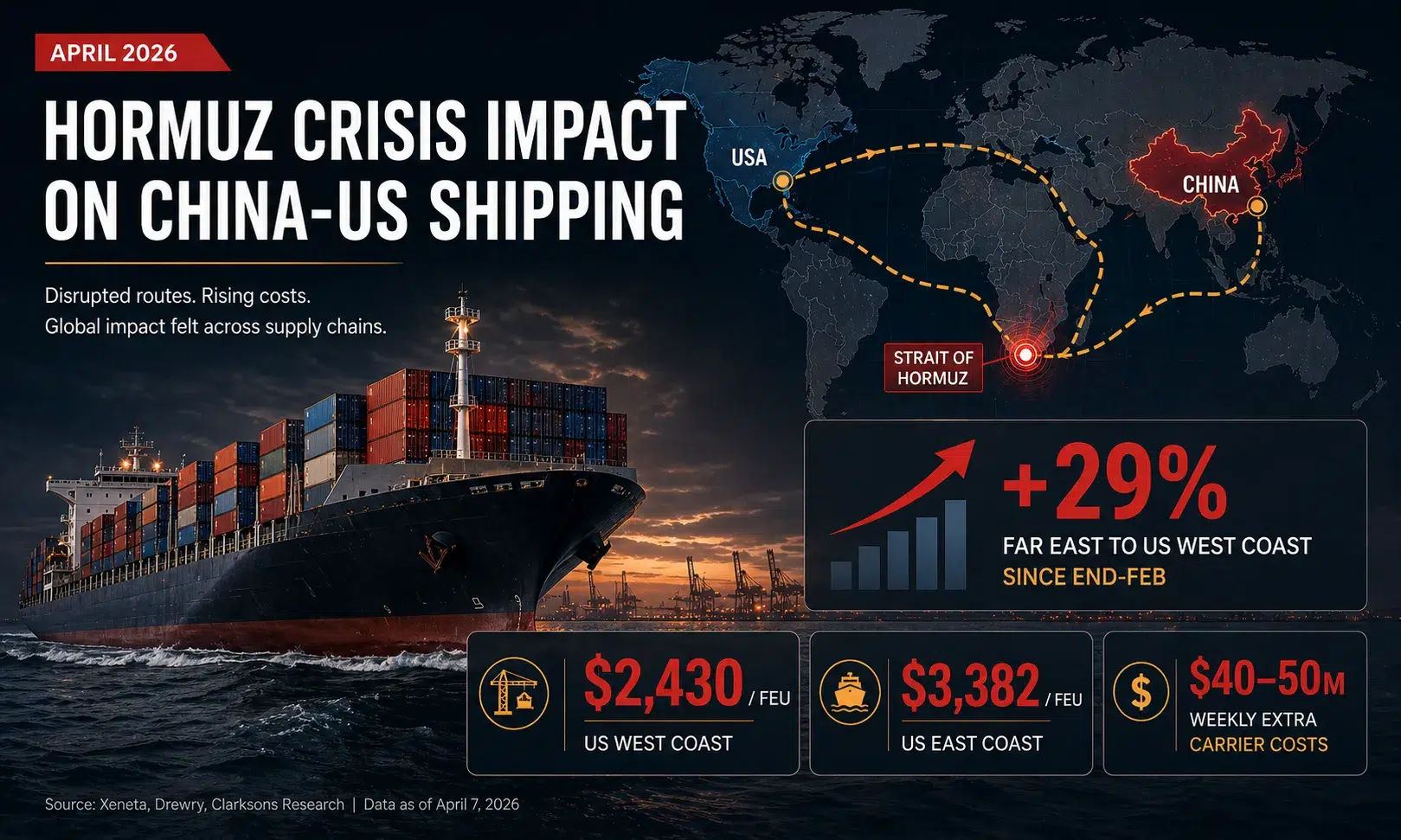
China-US shipping rates are facing renewed pressure in 2026 as the Hormuz crisis spreads risk across global freight networks. Although most ocean freight from China to the USA does not sail directly through the Strait of Hormuz, the impact can still reach US importers through higher fuel costs, insurance premiums, emergency surcharges, transshipment congestion and carrier schedule changes.
For importers shipping from China to the United States, the key issue is not only whether rates are rising today. The bigger question is whether the quoted price includes surcharge exposure, whether space is protected, whether the sailing schedule is reliable and whether customs documents are ready before cargo departure.
This article explains how the Hormuz crisis can affect China-US ocean freight, air freight, DDP shipping, customs planning and door-to-door delivery. It also gives practical steps for importers who need to control cost and reduce delay risk during a volatile shipping market.
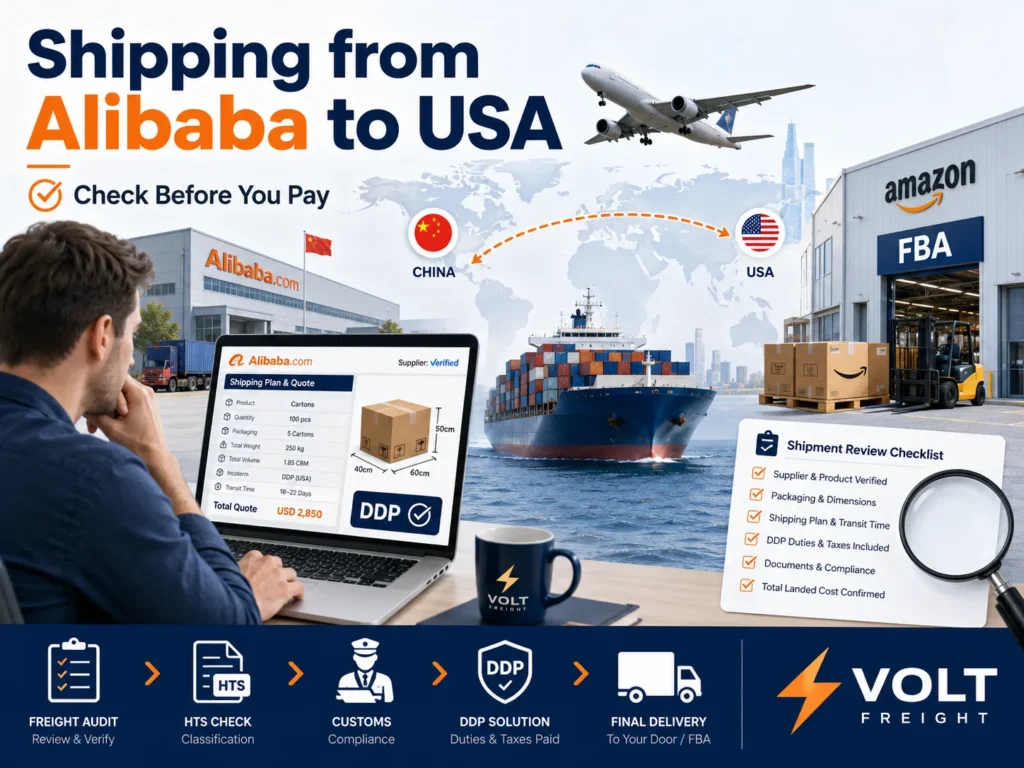
Need a China-US freight quote? Send your pickup city in China, delivery address in the USA, product name, carton quantity, gross weight, dimensions, CBM and required delivery timeline. Contact VoltFreight to compare ocean freight, air freight, DDP shipping and door-to-door delivery options.
Key Takeaways for US Importers
- China-US ocean freight is exposed to global risk: Even when the cargo moves across the Pacific, fuel prices, insurance costs and carrier network adjustments can affect the final freight rate.
- Spot rates can change quickly: Importers should confirm whether the quoted rate is valid until cargo receipt, vessel departure or only for a short booking window.
- FCL and LCL need earlier planning: When carrier schedules become less predictable, booking earlier helps reduce rolled cargo and warehouse cutoff problems.
- Air freight may become more expensive: When ocean freight becomes uncertain, urgent cargo often shifts to air freight, increasing demand for limited capacity.
- Landed cost matters more than port-to-port price: Importers should compare ocean freight, customs clearance, duties, destination charges, warehouse handling and final delivery together.
Why China-US Shipping Rates Are Under Pressure
The Hormuz crisis affects shipping costs because container shipping is a global network. Carriers manage vessels, containers, fuel supply, insurance exposure, port rotations and transshipment connections across many trade lanes. When one critical region becomes unstable, the cost pressure can move beyond the original affected area.
For China-US importers, this means a Pacific route can still become more expensive even if the vessel does not pass through the Strait of Hormuz. Higher bunker fuel costs, war-risk insurance, emergency operating costs, port congestion and vessel schedule changes can all influence ocean freight pricing.
In a stable market, importers may compare quotes mainly by price. In a volatile market, they should also compare rate validity, space protection, surcharge terms, sailing reliability and destination cost transparency. A low quote may not be the best choice if it excludes emergency charges or has weak booking protection.
If you are planning a shipment from China to the USA, you can also review our guide on container shipping cost from China to the USA.
How the Hormuz Crisis Can Affect China-US Ocean Freight
Most China to USA ocean freight moves across the Pacific to ports such as Los Angeles, Long Beach, Oakland, Seattle, New York, Savannah, Norfolk, Charleston, Miami and Houston. However, carriers do not price trade lanes in isolation. Global fuel markets, vessel deployment decisions and insurance costs can influence rates across multiple routes.
Asian transshipment hubs can also feel the pressure when carrier networks are adjusted. If ports such as Singapore, Port Klang or Tanjung Pelepas face congestion or schedule disruption, cargo connections may become less predictable. This can affect LCL consolidation, feeder connections, vessel space and cargo cutoff planning.
For US importers, the practical risk is simple: a quote that looks acceptable today may change if bunker adjustments, emergency surcharges or carrier capacity rules are updated before the cargo is received. This is why importers should confirm the rate validity period and surcharge responsibility in writing.
Ocean Freight: FCL, LCL and Door-to-Door Cost Risk
Ocean freight from China to the USA is usually arranged as FCL, LCL or door-to-door shipping. Each option reacts differently when market conditions become unstable.
| Shipping Option | Best For | Main Risk During Volatile Markets | Importer Action |
|---|---|---|---|
| FCL Ocean Freight | Full container shipments, large orders and planned inventory | Rate changes, rolled bookings, port congestion and surcharge exposure | Book earlier and confirm space protection, rate validity and destination charges |
| LCL Ocean Freight | Smaller cargo that does not fill a full container | Warehouse cutoff changes, consolidation delays and destination handling fees | Confirm sailing schedule, warehouse cutoff, CBM chargeable volume and destination cost |
| Door-to-Door Shipping | Importers who need pickup, ocean freight, customs and final delivery in one plan | Unclear inclusions, customs delays, final-mile cost and surcharge adjustments | Compare landed cost instead of only port-to-port freight |
| DDP Shipping | Importers who want duties, customs and delivery included under agreed terms | Unclear duty/VAT responsibility, exam fees and remote delivery charges | Ask exactly what is included and what is excluded before booking |
In uncertain markets, US importers should avoid comparing only the ocean freight price. The better method is to compare the total landed cost, including China pickup, export handling, ocean freight, destination handling, customs clearance, duties, exams, storage, truck delivery and warehouse receiving requirements.
For importers who need final delivery instead of port-only shipping, read more about door-to-door shipping from China.
Air Freight Spillover: When Ocean Shipping Becomes Less Predictable
When ocean freight becomes less predictable, some shippers move urgent cargo into air freight. This can happen when importers need to avoid stockouts, protect product launches, supply Amazon FBA inventory, support urgent repairs or move high-value goods faster than ocean freight can deliver.
However, air freight from China to the USA is also exposed to fuel surcharges and capacity pressure. A sudden increase in urgent shipments can push air rates higher, especially for popular routes, dense cargo, oversized goods, batteries, electronics and time-sensitive inventory.
Air freight is not always the answer. It is best used for cargo where faster delivery protects revenue, prevents penalties or supports urgent sales demand. For lower-value or non-urgent goods, ocean freight may still be more cost-effective if the importer can plan earlier and accept a longer transit time.
| Use Air Freight When | Use Ocean Freight When |
|---|---|
| Goods are urgent, high-value or needed to prevent stockouts | Goods are planned inventory with flexible delivery timing |
| Product launch or replacement parts cannot wait | Cargo volume is large and cost control is more important |
| Amazon FBA replenishment is time-sensitive | Shipment can be booked earlier with stable documentation |
| Small cargo has strong profit margin | Large-volume cargo would be too expensive by air |
If you need to compare ocean and air options, send your cargo details to VoltFreight before booking. Our team can help review urgency, cost, customs requirements and delivery timeline.
What Importers Should Confirm Before Booking
During a volatile freight market, importers should treat every quote as a set of conditions, not just a number. The same China-US shipping quote can mean very different things depending on rate validity, included charges and service scope.
- Rate validity: Confirm how long the rate is valid and whether it is protected until cargo receipt or vessel departure.
- Surcharge terms: Ask whether bunker adjustment, emergency fuel surcharge, port congestion fees and destination charges are included.
- Space protection: Confirm whether the booking is protected against cargo roll-over or subject to carrier space availability.
- Cutoff date: Check the warehouse cutoff, port cutoff and document cutoff before supplier pickup.
- Transit time: Ask for a practical planning range rather than a guaranteed promise if the market is unstable.
- Customs documents: Prepare commercial invoice, packing list, HS code, declared value and importer details before departure.
- Final delivery: Confirm whether the quote includes port delivery, warehouse delivery, Amazon FBA delivery or residential/commercial final-mile delivery.
Customs documents should not be treated as a last-minute task. A shipment can lose time and money if the invoice, packing list, HS code, declared value or importer information is incorrect. For more details, you can read about our customs clearance support.
Practical Booking Strategy for China-US Shipments
US importers do not need to panic, but they do need to plan with more discipline. When freight markets are unstable, the best strategy is to prepare earlier, compare total landed cost and separate urgent cargo from flexible cargo.
- Book FCL earlier: For full container shipping, check space several weeks before the cargo ready date and confirm whether the rate is still valid.
- Control LCL cutoff risk: For smaller shipments, confirm consolidation warehouse cutoff, sailing date, destination charges and final delivery plan.
- Use air freight selectively: Move only urgent SKUs, samples, spare parts or stockout-prevention cargo by air.
- Prepare customs documents before cargo leaves China: Review product description, HS code, invoice value and importer details early.
- Compare West Coast and East Coast routing: The cheapest port-to-port rate may not create the lowest total landed cost after inland trucking and warehouse delivery.
- Ask for DDP details clearly: If using DDP shipping, confirm duties, taxes, customs brokerage, exam fees, storage and final delivery responsibility.
For importers shipping to Amazon, warehouse networks or commercial addresses, the final-mile plan is just as important as the ocean freight rate. A cheaper ocean route can become expensive if the destination port, rail leg, truck delivery or warehouse appointment creates delays.
How VoltFreight Helps US Importers Manage Freight Risk
VoltFreight helps importers arrange shipping from China to the USA by ocean freight, air freight, DDP shipping, customs clearance and door-to-door delivery. During volatile market conditions, our role is not only to provide a freight quote, but also to help clients understand which route is safer for their cargo, budget and delivery deadline.
- Supplier pickup in China: Coordinate collection from factories, trading companies and warehouses.
- Warehouse consolidation: Combine cargo from multiple suppliers before ocean or air shipment.
- FCL and LCL comparison: Help importers compare full container, LCL and door-to-door freight options.
- Air freight review: Check whether urgent cargo should move by air or wait for ocean freight.
- Customs document review: Help review product description, invoice, packing list, HS code and importer details before shipment.
- DDP and door-to-door planning: Clarify service scope, included charges, final delivery address and possible extra costs.
- Route and cost comparison: Compare West Coast, East Coast, inland delivery and warehouse delivery options before booking.
If you need help comparing China-US ocean freight, air freight, DDP shipping or door-to-door delivery, contact VoltFreight with your cargo details. We will help you review the route, cost, customs scope and delivery plan before shipping.
FAQ About the Hormuz Crisis and China-US Shipping Rates
Does the Hormuz crisis directly affect China-US shipping?
Most China-US ocean freight does not sail through the Strait of Hormuz. However, the crisis can still affect China-US shipping rates through fuel costs, insurance risk, carrier network changes, transshipment congestion and emergency surcharges.
Why can China-US ocean freight rates rise even when the route is across the Pacific?
Container shipping works as a global network. When fuel prices, insurance costs, vessel deployment or port congestion change in one region, carriers may adjust pricing and capacity across multiple trade lanes, including China to the USA.
Should US importers wait for rates to fall?
Waiting may work if the market stabilizes quickly, but it also creates risk if space tightens, surcharges increase or peak-season demand arrives earlier than expected. Importers with firm deadlines should prioritize route reliability and space protection.
Is air freight from China to the USA a better option during the crisis?
Air freight can be better for urgent, high-value or time-sensitive cargo, but it is usually more expensive and may also face fuel surcharge pressure. Importers should use air freight selectively for cargo where faster delivery protects revenue or prevents stockouts.
What should I ask before booking China-US ocean freight?
Ask whether the quote includes bunker adjustment, emergency surcharge, port fees, destination handling, customs clearance, final delivery and how long the rate is valid. Also confirm cargo cutoff, sailing schedule and whether the booking is subject to roll-over.
Can VoltFreight help with DDP shipping from China to the USA?
Yes. VoltFreight can help review DDP shipping options for suitable cargo, including China pickup, export handling, ocean or air freight, customs clearance, duties, taxes and final delivery under agreed terms. The exact scope should be confirmed before booking.
Final Thoughts
The Hormuz crisis is a reminder that China-US shipping rates are affected by more than the direct route between China and America. Fuel prices, insurance risk, carrier surcharges, transshipment congestion, air freight demand and customs preparation can all change the real cost of importing goods from China.
For US importers, the safest approach is to book earlier, confirm surcharge terms, prepare customs documents, compare total landed cost and choose the right mix of ocean freight, air freight, DDP shipping and door-to-door delivery. If you need a practical freight plan, send VoltFreight your cargo details and our team will help you choose the most suitable China-US shipping option.
Information Sources
- Xeneta: Weekly Ocean Container Shipping Market Update, April 1, 2026
- Reuters: Hormuz shipping traffic remains at a trickle as US-Iran deadlock deepens
- Reuters: Hapag-Lloyd faces $40-50 million costs weekly due to Iran war
- Reuters: Air freight rates soar as Middle East conflict blocks trade routes
- Dimerco: Asia Pac Freight Report, April 2026
- Federal Maritime Commission: Statement Regarding Strait of Hormuz Surcharges